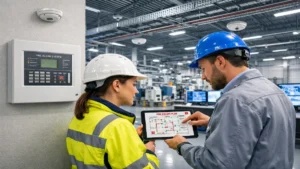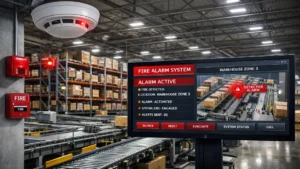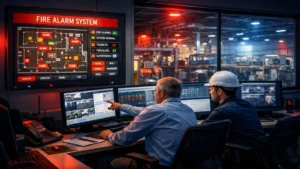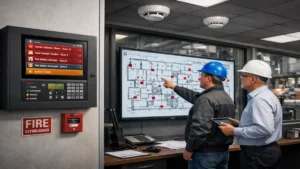
Selecting the right fire alarm panel is one of the most critical engineering decisions in any building project. Whether it is an industrial plant, commercial tower, hospital, hotel or data centre, the fire panel functions as the brain of the entire fire detection ecosystem. A wrong choice can lead to high false alarms, maintenance challenges, integration issues and non-compliance with local safety codes.
Modern buildings, especially smart infrastructures, require panels that deliver accuracy, scalability, interoperability and long-term reliability. Because of this, engineers cannot rely on assumptions or vendor claims. They must evaluate a fire alarm panel purely based on technical specifications, system architecture and performance parameters.
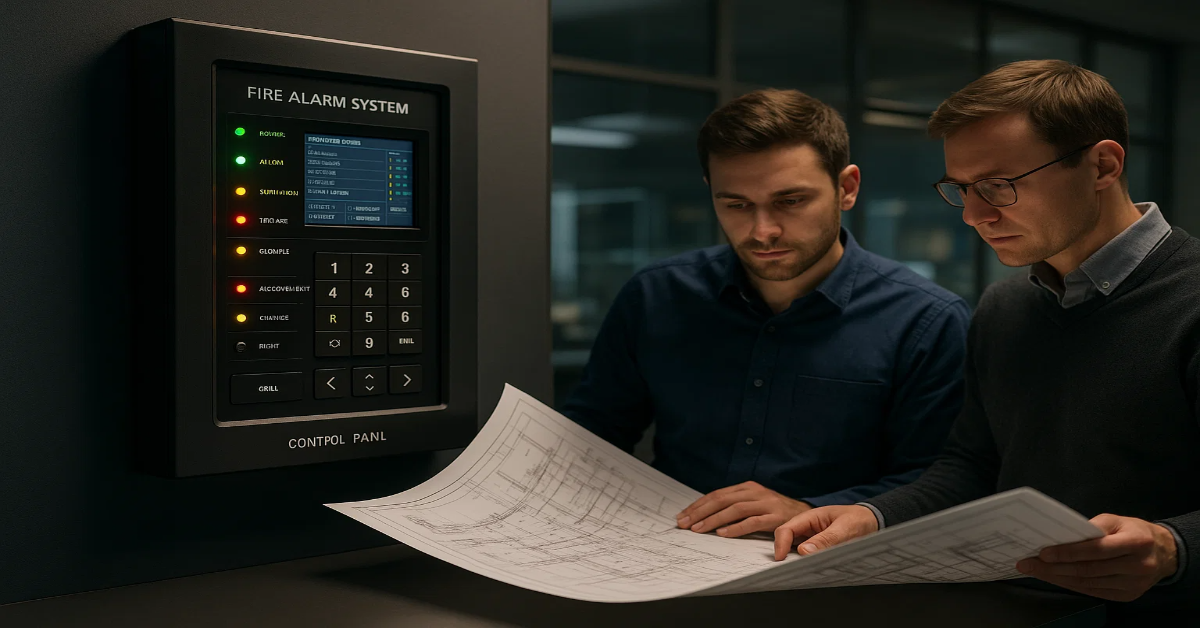
This article explains 12 essential technical specifications engineers must verify before selecting a fire alarm panel. Each specification is suitable for engineering, EPC and facility management teams.
Importance Of Technical Evaluation In Fire Alarm Engineering
Fire alarm selection is no longer just about choosing between “conventional” or “addressable.” Today, stakeholders expect:
- Lower false alarm rates
- Better integration with BMS/BAS
- Accurate device-level identification
- Faster response times
- Reduced cabling cost
- Future-ready expandability
- Compliance with global and local safety standards
Engineers therefore require a structured technical evaluation checklist. The following 12 parameters form the backbone of that checklist.
1. System Architecture: Addressable Vs. Conventional Capability
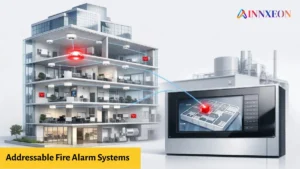
The first technical specification engineers must evaluate is the system architecture itself. Addressable systems provide:
- Pinpoint identification of each device
- Reduced troubleshooting time
- Minimal false alarm impact
- Easier integration with modern platforms
Conventional systems, although cheaper initially, become more expensive when scaling, rewiring, or troubleshooting. Most modern industrial and commercial projects now prefer addressable panels because they support programmable logic, mapping, device isolation and large system expansions.
Tip For Engineers:
Check whether the panel supports true digital addressable communication rather than pseudo-addressable loops.
2. Loop Capacity And Total Number Of Addresses Supported
Loop capacity determines how many devices the panel can manage. Engineers should examine:
- Number of loops
- Devices per loop
- Maximum address count
- Loop current capacity
- Loop length support
- Short-circuit isolation features
Large facilities such as airports, malls or manufacturing plants require higher loop density and better power distribution. A panel with sufficient loop capacity reduces the need for multiple interconnected systems.
3. Communication Protocol And Device Compatibility
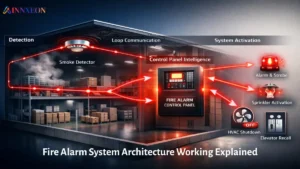
Every fire alarm panel communicates with detectors, modules and call points using a specific protocol. Engineers must verify:
- Protocol stability
- Backward compatibility
- Cross-device support
- Availability of third-party device compatibility
A stable and open communication protocol ensures long-term reliability. Proprietary or restricted protocols may limit device choices or increase future maintenance and purchasing costs.
4. Networkability And Panel-to-Panel Communication
For medium and large projects, the ability to network multiple panels is essential. Engineers should confirm:
- Maximum number of panels supported in a network
- Network topology (ring, star, bus, mesh)
- Event synchronization capability
- Network isolation and redundancy
A robust networking capability ensures the entire facility operates as one unified system, even if panels are installed in different sections of the building.
5. Response Time And Event Processing Speed
Fire detection requires fast action. Engineers must evaluate:
- Polling speed
- Event response time
- Processor capability
- Ability to handle multiple events simultaneously
Modern panels use intelligent algorithms to differentiate smoke, heat and pre-alarm conditions. Faster processing improves occupant safety and reduces emergency response delays.
6. Display Interface And Human-Machine Interaction
A clear and intuitive display improves operational efficiency. Engineers should assess:
- Display size (LCD or TFT)
- Touch or keypad operation
- Event clarity and categorization
- Ability to view device-level details
- Real-time loop status indicators
Advanced user interfaces help reduce training requirements for facility management teams.
7. Integration Capability With BMS, CCTV and Automation Systems
Modern smart buildings depend on interconnected systems. Engineers must verify whether the fire panel can integrate with:
- Building Management Systems (BMS)
- HVAC systems
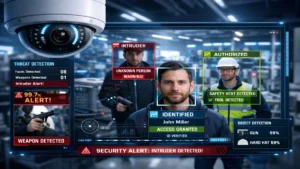
- CCTV monitoring
- Access control
- Public Address/Voice Alarm (PA/VA) systems
- Emergency lighting
Integration typically uses protocols such as:
- Modbus
- BACnet
- Ethernet/IP
- RS-485
Panels that support standard communication protocols offer seamless interoperability across platforms.
8. Power Supply Capacity and Battery Backup Specifications
Fire alarm panels require stable power and reliable backup. Engineers must evaluate:
- Main power supply rating
- Battery capacity and type
- Backup duration (usually 24 hours standby + 30 minutes alarm mode)
- Charger performance
- Real-time battery health monitoring
Insufficient power supply can lead to unexpected shutdowns and premature battery failure.
9. Detector and Module Compatibility Range
A panel’s capabilities depend significantly on the range of compatible devices. Engineers should check compatibility with:
- Photoelectric smoke detectors
- Multi-sensor detectors
- Carbon monoxide detectors
- Rate-of-rise and fixed-temperature heat detectors
- Beam detectors
- Flame detectors
- Manual call points
- Input and output modules
- Sounder bases and AV devices
A wider device ecosystem offers greater flexibility during design and commissioning.
10. Event Logging, History Storage and Reporting Features
A professional-grade panel must maintain detailed logs of all critical activities, including:
- Alarms
- Faults
- Supervisories
- Isolations
- User actions
- Scheduled tests
Engineers should review:
- Total event storage capacity
- Data export options (USB, Ethernet, software)
- Real-time monitoring tools
Strong reporting functions help with audits, insurance reviews and compliance inspections.
11. Compliance with Global and Local Standards
A fire alarm panel must comply with widely accepted testing and certification standards. Engineers should check for approvals such as:
- EN 54
- UL Listed
- CE Marking
- BIS Indian Standards
- Local fire authority certifications
Compliance ensures safety reliability and smooth approval from local fire departments.
12. Scalability and Long-Term Upgrade Potential
Fire alarm systems typically have a lifecycle of 10 to 20 years. Engineers must ensure the selected panel can grow and upgrade over time. Key factors include:
- Ability to add extra loops
- Firmware upgrade support
- Compatibility with upcoming device technologies
- Support for multi-building networking
- Expansion without rewiring
A future-ready panel lowers long-term costs and prevents premature system replacement.
How Engineers Can Use These 12 Specs To Build A Selection Framework
Engineers can convert these specifications into a technical comparison sheet. This may include:
- Loop capacity
- Display type
- Event memory
- Integration options
- Device ecosystem
- Certification standards
This matrix enables fast and unbiased comparison across different brands and models.
Why Technical Specifications Matter More Than Initial Price
Procurement teams often focus on pricing, but engineers must highlight that:
- Incorrect panel selection increases lifetime operational cost
- Re-cabling and redesigning are expensive
- False alarms lead to downtime and losses
- Compatibility issues escalate future expenses
A technically superior panel reduces long-term system failures and maintenance costs.
Practical Tips For Engineers Before Final Selection
To ensure a smooth implementation, engineers should:
- Review detailed BOQ and system drawings
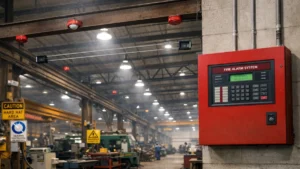
- Physically inspect a panel sample
- Validate loop loading calculations
- Verify product authenticity
- Request a live demonstration if possible
- Check service and spare parts availability
These steps help prevent risks during commissioning and ensure system reliability.
Note: Choosing a fire alarm panel is not just a procurement task; it is a vital engineering responsibility. It directly influences life safety, regulatory approvals and operational continuity. By evaluating these 12 technical specifications, engineers can confidently select a fire alarm panel that delivers stability, accuracy, integration capability and long-term performance.
A systematic technical approach ensures the chosen panel meets both current and future building requirements while maintaining the highest level of fire safety assurance.
Read Also: Why Hotel Chains Are Switching to Addressable Fire Alarm Panels