
How Does Fire Alarm System Architecture Work?
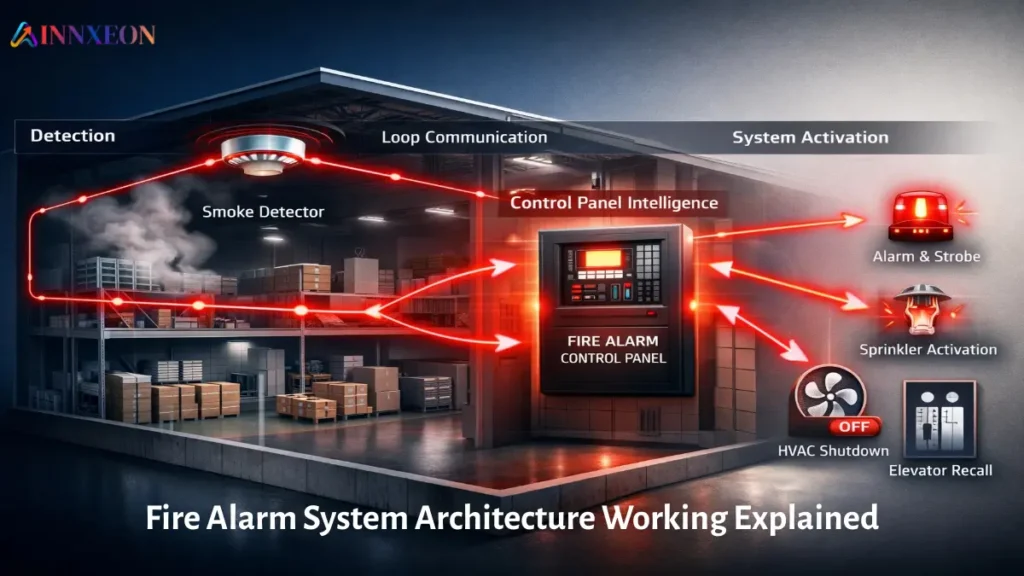
Fire alarm architecture is the foundation of any reliable life safety system. In industrial plants, commercial complexes, data centres and warehouses, the architecture determines how effectively the system performs under real emergency conditions. When we design a fire alarm system, we are not simply placing detectors and panels. We are building a structured communication network that must: Architecture directly impacts the system: For example, in large industrial campuses, we typically prefer a GST Addressable Fire Alarm System because it provides device-level intelligence and network expansion capability. In smaller buildings with defined zones, a GST Conventional Fire Alarm System may be sufficient and cost-effective. Understanding architecture allows us to design systems that are not only compliant but operationally resilient. What Is Fire Alarm System Architecture? Fire alarm system architecture refers to the logical and physical arrangement of system components and their communication pathways. It defines how: We can think of it as a layered structure: Layer 1: Detection Layer (Sensing Intelligence at the Edge) The Detection Layer is the first line of defence. This is where physical fire phenomena are converted into electrical signals. At this layer, devices continuously monitor environmental conditions such as: 1. Types of Detection Technologies Optical Smoke DetectorsUse light scattering principles to detect airborne particulates. Heat Detectors Multi-Sensor DetectorsCombine smoke and heat for higher accuracy and false alarm reduction. Beam DetectorsUsed in warehouses and high-ceiling environments. In advanced systems like a GST Addressable Fire Alarm System, detectors transmit analogue values (not just alarm/no alarm). The panel evaluates smoke density trends and compensates for drift. In contrast, GST Conventional Fire Alarm Detectors operate on fixed threshold activation within a defined zone. 2. Intelligent Features in Modern Detection Modern detection architecture includes: This layer is critical because early detection defines overall response time. If the detection layer fails or generates frequent nuisance alarms, the entire architecture loses credibility. 3. Design Considerations for Detection Layer When we design this layer, we consider: Proper detector spacing, mounting height and technology selection ensure accurate performance. Layer 2: Communication Layer (Structured Signal Transmission) The Communication Layer ensures that signals from detection devices reach the control panel reliably and without delay. This layer includes: 1. Loop-Based Communication (Addressable Architecture) In intelligent systems using GST Addressable Fire Alarm Detectors, devices connect in a ring topology. Key characteristics: If a wire break occurs, communication continues from the opposite direction. This significantly increases system survivability. 2. Zone-Based Communication (Conventional Architecture) In a GST Conventional Fire Alarm System, detectors connect in radial circuits. The panel identifies the affected zone but not the exact device. This architecture is simpler but offers: 3. Communication Layer Design Priorities We design this layer to ensure: In large facilities, we may divide loops per building or floor to improve fault containment. This layer acts as the nervous system of the fire alarm architecture. Layer 3: Processing Layer (Decision Intelligence) The Processing Layer is where raw data becomes actionable intelligence. This layer primarily consists of the Fire Alarm Control Panel (FACP). In a GST Addressable Fire Alarm System, the panel continuously polls devices, sometimes every few seconds. 1. Signal Evaluation The panel performs: For example: If a detector shows a slight increase in smoke but not sustained, the panel may enter pre-alarm instead of full evacuation. 2. Cause-and-Effect Programming This is where architectural intelligence truly emerges. The panel can be programmed to: This structured logic reduces panic and ensures a controlled response. 3. Fault Monitoring & Supervision The panel continuously supervises: If a fault occurs, the system generates a trouble signal immediately. This ensures the architecture remains operational at all times. Layer 4: Response Layer (Execution & Control) The Response Layer converts panel decisions into physical action. It includes: This layer ensures that detection leads to real-world protective action. 1. Notification Logic Outputs can be programmed based on: For example: 2. Integration with Fire Protection Systems The fire alarm panel may interface with: Integration follows best practices discussed in professional platforms such as Fire Engineering. This ensures coordinated emergency response. 3. Integration with Building Systems Advanced architecture also triggers: This coordinated response minimises chaos and speeds evacuation. How These Layers Work Together The four layers operate sequentially but also continuously supervise each other. Detection Layer → Senses fireCommunication Layer → Transmits signalProcessing Layer → Validates & decidesResponse Layer → Activates protection If any layer is poorly designed, the entire architecture becomes weak. When we design projects properly, whether using a GST Addressable Fire Alarm System for complex industrial sites or a GST Conventional Fire Alarm System for defined zones, we ensure these four layers function as a unified safety intelligence network. Addressable vs Conventional Architecture (Conceptual Comparison) Parameter Addressable Conventional Device Identification Individual Zone-based Wiring Loop topology Radial zones Fault Isolation High Limited Scalability Very high Moderate Diagnostics Advanced Basic In a GST Addressable fire alarm system, every detector has a unique address. The panel communicates digitally, allowing pinpoint identification and preventive diagnostics. In a GST Conventional fire alarm system, detectors are grouped by zone. The panel identifies the affected zone but not the specific device. For industrial facilities, architectural flexibility becomes critical when future expansion is expected. Core Building Blocks of Fire Alarm System Architecture A robust architecture relies on well-defined building blocks. Each layer must function independently and collectively. a. Fire Alarm Control Panel (FACP) The FACP is the command centre of the system. It performs: In intelligent systems such as a GST Addressable fire alarm system, the panel evaluates analogue signals from detectors. Instead of waiting for fixed thresholds, it analyses signal patterns and environmental variations. Advanced panels support: For large-scale projects, panel networking allows multiple buildings to operate under centralised supervision. b. Detection & Notification Loops In addressable systems, loops are wired in a ring topology. This architecture offers built-in redundancy. If a short circuit occurs: With intelligent devices like GST Addressable fire alarm detectors, the loop supports: Loop capacity may range from 125 to 250 devices, depending on design. Proper loop planning ensures: For industrial facilities with long