
How to Choose the Right Power Backup System For Fire Safety?
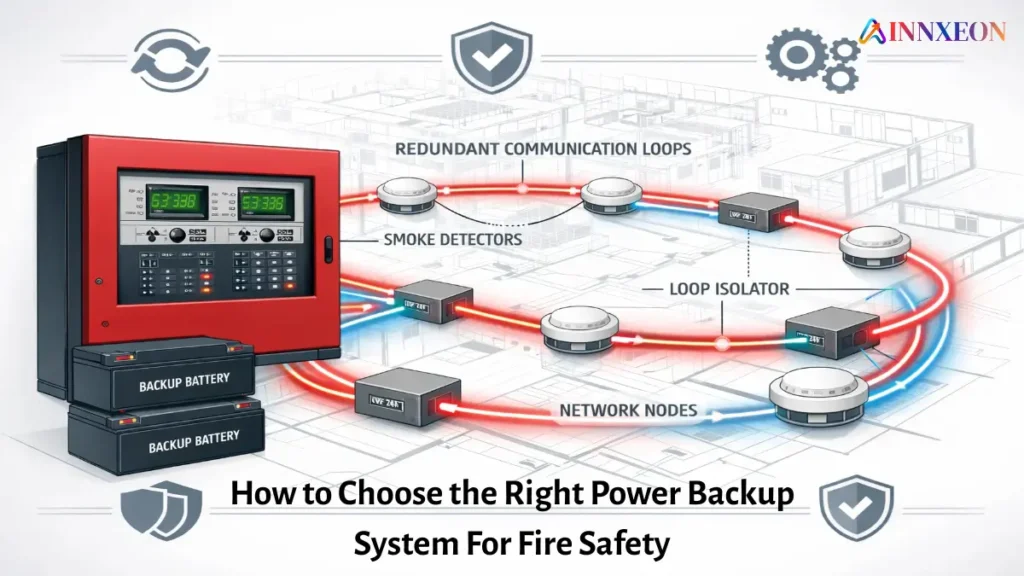
When we design fire safety systems, we often focus heavily on detection technology, panel architecture, suppression logic and network communication. But in real-world incidents, the most common root cause of total system failure is not detection technology; it is loss of power. Every fire safety system is electrically dependent. If power fails: In a real emergency, even a few seconds of power interruption can reset a fire alarm control panel, corrupt event logs or delay suppression activation. We have seen this in: When we design systems like the GST Addressable Fire Alarm System under the broader fire detection system category, we are not merely meeting specifications; we are designing life safety infrastructure. Power backup is not a checkbox item. It is a reliability engineering decision. Consequences of Power Loss During Fire Let us analyse the technical impact: Failure Type Technical Impact Consequence Detection failure Loop communication stops No fire identification Suppression failure Release panel shuts down Gas discharge blocked Alarm silence NAC circuits de-energised Occupants not alerted Pump failure Motor control panel offline Water supply compromised Code violation System non-compliant Legal & insurance exposure In environments like: Power backup must be engineered with the same rigour as detection logic. Backup power design is not just about compliance. It is life safety engineering. 2. What Is a Power Backup System in Fire Safety? Before choosing a solution, we must clearly define terms. Primary Power Primary power is the normal utility supply, typically 230V/415V AC from the grid. Secondary Power Secondary power is the standby source that activates when the primary supply fails. Standby Power Standby power maintains system readiness under normal (non-alarm) conditions. Alarm Power Alarm power supports the system during active fire conditions when the current draw significantly increases. Backup vs Redundancy vs Emergency Supply These terms are often misused: Term Meaning Duplicate systems to eliminate single-point failure Alternate power source during outage Redundancy Duplicate systems to eliminate single-point failure Emergency supply Dedicated supply for life safety circuits Core Components A properly designed backup system integrates: All integrate with systems like: 3. Fire Safety Systems That Depend on Power Backup Let us examine system-level dependencies. Fire Alarm Control Panels Panels like the GST Addressable Fire Alarm System rely on: If power drops, loop devices disconnect instantly. Detection Loops Devices such as Addressable fire alarm detectors draw continuous standby current. Power instability can: Notification Devices Sounders, strobes and voice evacuation systems increase current 3–5x during alarm. If batteries are undersized, NAC voltage collapses. Fire Pumps Under NFPA 20, fire pumps require a reliable emergency supply. Failure example:A warehouse pump failed during a fire because the generator ATS did not transfer the load properly. Smoke Exhaust Systems Fans require a generator-backed supply. Without smoke extraction, evacuation time increases. 4. Regulatory and Code Requirements for Power Backup Compliance is mandatory. Key standards include: 24-Hour Standby + Alarm Duration Typical requirement: Battery replacement cycles typically occur every 3–5 years. Testing frequency: 5. Types of Power Backup Systems Used in Fire Safety 5.1 Battery-Based Backup Systems Most fire alarm panels include internal sealed lead-acid batteries. Types: Failure Modes: Battery sizing is critical. 5.2 UPS Systems Used in: Online UPS provides zero transfer delay. Limitation:UPS supports short duration unless connected to extended battery banks. 5.3 Generator-Based Backup Diesel generators support: Key components: Failure cases: 6. Key Factors to Consider When Choosing a Power Backup System 6.1 Load Calculation and System Capacity We must calculate: Example: Standby current = 2.5AAlarm current = 8AStandby duration = 24hAlarm duration = 0.5h Battery AH =(2.5 × 24 + 8 × 0.5) × 1.25 safety factor= (60 + 4) × 1.25= 80 AH approx. Refer to systems under the fire detection system category for accurate load sheets. 6.2 Required Standby and Alarm Duration Industrial facilities often require greater autonomy due to delayed emergency response times. High-risk occupancy: Require enhanced autonomy beyond minimum code. 6.3 Redundancy and Reliability We must consider: Reliability engineering eliminates single points of failure. 6.4 Environmental and Installation Conditions Temperature affects battery life drastically. For every 10°C increase above 25°C:Battery life reduces by ~50%. We must consider: 6.5 Battery Sizing and Capacity Calculation Formula: Battery AH =(Standby current × standby hours + Alarm current × alarm hours) × Safety Factor Include ageing factor 1.25–1.3Temperature derating as required. Integrated into systems like Addressable fire alarm control panel installations. 7. Common Power Backup Selection Mistakes Consultants Should Avoid From field audits, we repeatedly see: Consequences Backup power must be engineered, documented and tested. Note: Choosing the right power backup system is not about installing batteries or connecting a generator. It requires: When we design systems like a GST addressable fire alarm system, integrate addressable fire alarm detectors and deploy panels from the fire alarm control panel category, we must treat backup power as a core life safety subsystem. In fire safety engineering, power reliability equals life reliability. Read Also: Fire Alarm Components That Make or Break System Performance Read Also: Why should you use Addressable Fire Alarm Systems for Large-Scale Projects?