Let’s imagine we are responsible for monitoring a large manufacturing facility. Production lines run continuously, forklifts move between storage zones, and restricted areas must remain secure at all times. We already have guards, procedures and safety protocols, but when something unexpected happens, visibility becomes our biggest challenge.
Maybe an equipment failure occurs in a remote section of the plant. Maybe a safety incident happens in a warehouse corner that isn’t actively supervised. Or maybe we simply need reliable records to review operational decisions later.
This is where we start thinking beyond basic surveillance and begin designing a centralised monitoring system that gives us operational awareness, not just video footage.
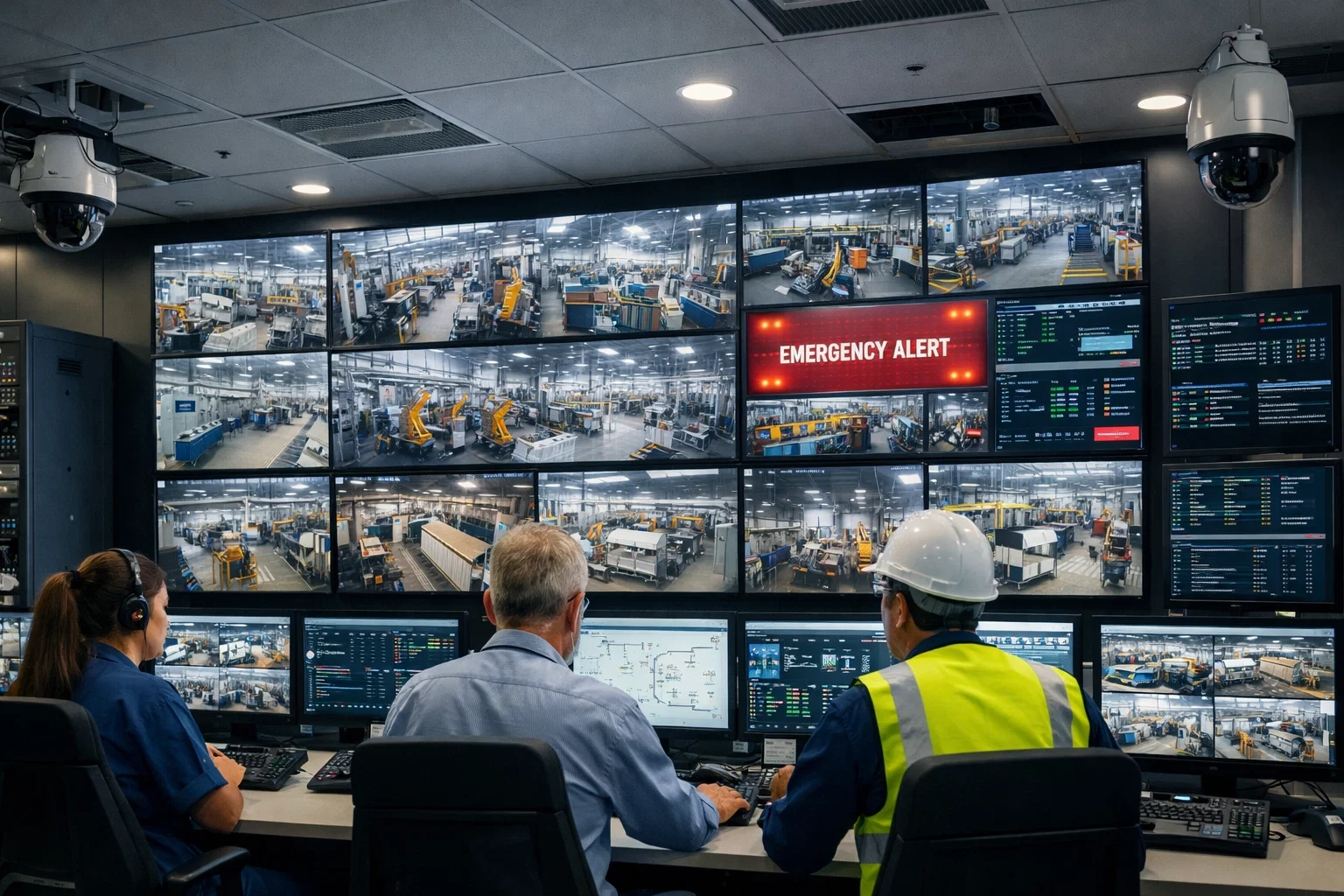
In this article, we’ll walk through how we would design a centralised emergency monitoring ecosystem together step by step, using practical industrial surveillance thinking and real-world engineering logic.
Understanding the Role of Centralised Monitoring in Industrial Safety
A centralised monitoring ecosystem connects cameras, recording infrastructure and monitoring software into a single operational visibility platform. Instead of isolated surveillance points, we gain real-time situational awareness across facilities, enabling faster response, better incident documentation and clearer operational decision-making.
When we centralise monitoring, we stop thinking of surveillance as “security cameras” and start treating it as an operational intelligence system.
In industrial environments, visibility directly affects safety, productivity and compliance. When monitoring systems are fragmented, response times increase and critical events can be missed.
A centralised architecture ensures that multiple facilities, zones, or processes can be observed from one coordinated monitoring environment.
Key benefits of centralised monitoring:
- Unified operational visibility
- Faster emergency response
- Consistent monitoring workflows
- Reliable incident recording
- Simplified system management
How Modern Surveillance Improves Operational Visibility
When we design surveillance for industrial environments, the goal isn’t just recording, it’s awareness.
Operational visibility means we can immediately understand what’s happening across multiple locations without physically being present.
Real-Time Awareness Across Facilities
Industrial operations often span large physical areas. By deploying industrial surveillance cameras across production floors, loading bays, access points and safety-critical zones, we create a continuous visual layer of awareness.
This visibility reduces uncertainty during incidents.
Instead of relying on reports or assumptions, we can see the situation directly.
Supporting Faster Emergency Response
When incidents occur, response time matters. A centralised monitoring setup allows supervisors or control-room operators to immediately assess events and coordinate action.
This reduces confusion and improves decision-making under pressure.
Creating Operational Transparency
Video records help us review processes, understand incidents and improve workflows. Over time, surveillance becomes part of operational learning, not just security.
Core Components of a Centralised Emergency Monitoring Ecosystem
A centralised monitoring ecosystem typically includes industrial cameras, recording systems, monitoring software, storage infrastructure and a reliable network backbone. Together, these components form an integrated surveillance environment capable of continuous monitoring, incident recording and coordinated response management.
Let’s break down the system the way we would during an actual project discussion.
Industrial Camera Layer
The foundation of the ecosystem is the camera network.
Modern industrial surveillance cameras are designed for:
- Dust and heat resistance
- Low-light environments
- Wide-area coverage
- Continuous operation
Camera selection depends on environment, risk level and monitoring objectives.
We typically consider:
- Fixed cameras for production zones
- PTZ cameras for large yards
- Bullet cameras for perimeter monitoring
- Dome cameras for indoor environments
Recording Infrastructure
Video must be reliably stored for review and compliance.
This is where the network video recorder becomes critical. It ensures continuous recording, indexing and playback of surveillance footage.
Recording systems must be designed for:
- Storage redundancy
- Long retention periods
- High-resolution recording
- System reliability
Recording failures can compromise incident investigations, so reliability planning is essential.
Monitoring and Control Software
A video management system connects cameras and recording devices into a single monitoring interface.
Instead of switching between multiple systems, operators can monitor all facilities from one dashboard.
This software allows us to:
- View multiple camera feeds
- Search recorded video
- Manage user access
- Configure alerts
- Monitor system health
This is where centralised monitoring becomes operationally effective.
Network Infrastructure
An IP CCTV system depends heavily on network reliability.
Industrial environments require:
- Dedicated surveillance VLANs
- Redundant switching
- Stable bandwidth planning
- Secure remote access
Network design determines whether the monitoring system performs reliably during critical moments.
Storage Planning
Storage capacity must match operational needs.
We typically plan storage based on:
- Number of cameras
- Resolution
- Recording duration
- Retention policies
Proper storage planning ensures compliance and prevents data loss.
Component summary:
- Cameras capture events
- Recorders store footage
- Software enables monitoring
- Networks connect systems
- Storage preserves history
Together, these form a centralised monitoring system.
Real-World Industrial Monitoring Scenarios
Centralised surveillance becomes easier to understand when we imagine how it works in real environments.
Let’s walk through a few scenarios together.
Manufacturing Facilities
In a manufacturing plant, monitoring helps track safety compliance, machine zones and material movement.
If an emergency occurs near production equipment, centralised monitoring allows supervisors to assess conditions instantly.
Instead of relying on radio communication alone, visual confirmation improves response coordination.
Warehouses and Logistics Hubs
Warehouses involve continuous movement, forklifts, loading operations and inventory handling.
Centralised monitoring allows us to:
- Track loading bays
- Monitor storage zones
- Review incidents
- Improve operational discipline
Over time, surveillance footage becomes a valuable operational reference.
Infrastructure and Utilities
Infrastructure facilities often operate with minimal on-site staff.
A centralised system allows remote monitoring teams to supervise multiple locations simultaneously.
This reduces staffing pressure while improving oversight.
Large Industrial Campuses
When facilities expand, surveillance must scale.
Centralised monitoring allows new buildings, gates, and production zones to be integrated into the same system without redesigning the entire infrastructure.
This scalability is essential for growing operations.
Engineering Best Practices for Centralised Monitoring Design
Designing centralised surveillance requires careful planning of camera placement, recording redundancy, monitoring workflows, maintenance strategy and system scalability. When these elements are considered early, the monitoring ecosystem becomes reliable, easier to manage and capable of supporting long-term operational growth.
Let’s walk through the engineering decisions we typically make.
Camera Placement Strategy
Camera placement should follow operational risk, not just building layout.
We typically prioritise:
- Entry and exit points
- Safety-critical zones
- Equipment areas
- Material handling zones
- Perimeter boundaries
Coverage planning ensures monitoring effectiveness without unnecessary camera deployment.
Recording Redundancy
Recording systems should never be single-point failures.
We often plan:
- RAID storage
- Backup recorders
- Network redundancy
- Power backup
Reliability planning protects critical surveillance data.
Monitoring Workflow Design
A centralised monitoring system must align with how teams actually work.
We define:
- Who monitors feeds
- Escalation procedures
- Incident review processes
- Access permissions
Technology works best when workflows are clear.
Maintenance Planning
Surveillance systems require routine checks.
Maintenance typically includes:
- Camera cleaning
- Firmware updates
- Storage health checks
- Network testing
Preventive maintenance keeps monitoring reliable.
Scalability Considerations
Industrial facilities evolve.
A well-designed IP CCTV system should allow new cameras and locations to be added without replacing the core infrastructure.
Scalable architecture protects long-term investment.
Building Long-Term Monitoring Reliability
Centralised surveillance is not just about installation, it’s about continuity.
Reliability comes from:
- Consistent hardware performance
- Stable software platforms
- Strong supply support
- Planned system expansion
This is where working with experienced industrial surveillance suppliers like Innxeon becomes valuable. Access to dependable industrial surveillance cameras, recording infrastructure and monitoring platforms ensures that centralised monitoring systems remain stable over time.
When supply consistency and technical compatibility are maintained, monitoring ecosystems remain reliable across facility expansions and operational changes.
Designing Monitoring for Awareness, Not Just Surveillance
When we design a centralised emergency monitoring ecosystem, we are not just installing cameras; we are building operational visibility.
A well-planned surveillance environment improves:
- Emergency awareness
- Incident response
- Operational transparency
- Decision-making clarity
- Facility security
Industrial surveillance works best when it is designed as an ecosystem of cameras, recording systems, monitoring software and infrastructure working together.
With reliable supply partners like Innxeon providing industrial surveillance solutions, organisations can build monitoring systems that remain dependable, scalable and aligned with real industrial needs.
And ultimately, that’s what centralised monitoring is about: helping us see clearly, respond faster and operate more safely.
Read Also: Why Safety Infrastructure Should Include Both Detection & Monitoring
Read Also: Avoiding Fire Safety Delays: Why Vendor Capability Matters