In industrial leadership meetings, we often discuss production targets, cost control, compliance audits and market expansion. But rarely do we sit together and ask a more strategic question:
Is our fire safety infrastructure protecting our brand, or is it just meeting compliance requirements?
In today’s industrial ecosystem, a single fire incident is no longer just an operational event. It becomes a headline, a social media discussion, an insurance case study and sometimes a legal investigation. The damage spreads beyond equipment and inventory. It impacts reputation, investor confidence, customer trust and long-term valuation.
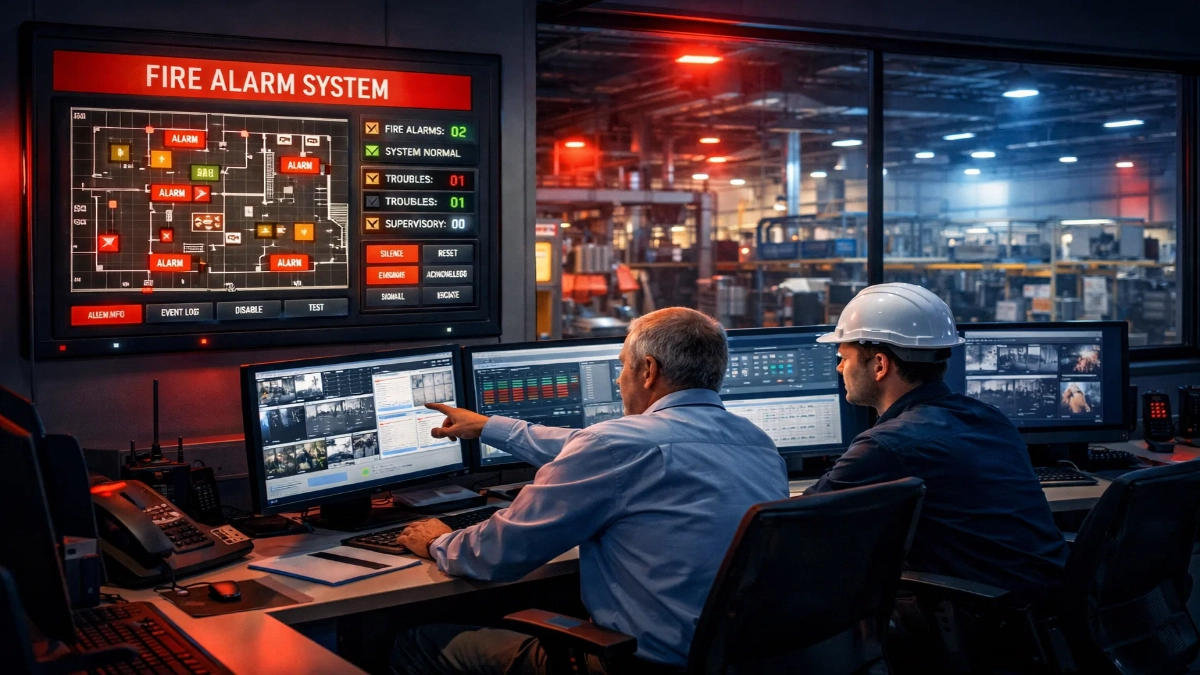
When we treat fire safety as infrastructure, not expense, we shift from regulatory thinking to brand strategy.
Let’s walk through this together from an engineering and business perspective.
What Is Fire Safety Infrastructure?
Fire safety infrastructure is the integrated system of detection, alarm, monitoring, suppression and emergency response technologies designed to detect, control and communicate fire risks within a facility. It includes fire alarm panels, detectors, evacuation systems and monitoring integration to protect people, assets and operations.
When we design a plant or commercial facility, fire safety infrastructure is not just a panel on the wall. It is a network of intelligence distributed across the building. It includes:
- Detection devices (smoke, heat, multi-sensor)
- Alarm control panels
- Notification systems
- Integration with CCTV and BMS
- Emergency evacuation logic
If designed correctly, it becomes the first line of brand defence.
Why Brand Protection Depends on Fire Safety Planning
Fire incidents damage more than property. They disrupt operations, trigger insurance scrutiny, increase regulatory attention and erode customer trust. A strong fire safety infrastructure reduces downtime, legal exposure and reputational risk.
Let’s consider what truly happens during a major fire event.
Operational Downtime Becomes Market Risk
When production halts for weeks, customers shift to competitors. Restarting a facility is not instant. Equipment recalibration, compliance inspections and workforce stabilisation take time.
Brand perception changes from “reliable supplier” to “risk-prone operator.”
Regulatory and Legal Exposure Expands
After a fire, investigators examine detection systems first.
Was the alarm system functioning?
Were the detectors properly spaced?
Was maintenance documented?
Inadequate infrastructure transforms a fire into a negligence case.
Insurance and Investor Confidence Decline
Insurers reassess risk profiles. Premiums increase. Claims face scrutiny. Investors question governance and operational discipline.
A well-engineered fire detection system demonstrates risk maturity, which protects valuation.
Key Takeaway Summary:
- Fire safety directly affects brand trust
- Detection time determines damage scale
- Compliance alone does not equal protection
- Infrastructure maturity reflects leadership quality
Core Concept: From Reactive Safety to Proactive Protection
Reactive safety responds after flames are visible. Proactive protection detects anomalies at the earliest stage, often before ignition escalates. The difference lies in system design, detector intelligence, and response integration.
Let’s compare.
Reactive Approach
- Basic alarm installation
- Limited zone identification
- Manual inspection dependence
- Delayed emergency coordination
This approach minimises initial capital cost but increases long-term brand risk.
Proactive Infrastructure Strategy
- Intelligent zoning
- Real-time location identification
- Integrated monitoring
- Maintenance diagnostics
- Scalable architecture
Here, detection becomes predictive. The system identifies abnormal conditions before a full-scale emergency develops.
This is where selecting between an addressable fire alarm panel and a conventional fire alarm panel becomes strategic, not technical.
Technical Breakdown: Infrastructure That Protects Reputation
Addressable vs Conventional Architecture
An addressable system identifies the exact device location during an alarm event, while a conventional system identifies only a general zone. Addressable systems enable faster response and reduced downtime.
Addressable Fire Alarm Panel
An addressable fire alarm panel assigns a unique ID to every detector. When triggered, it tells us exactly which device activated the room, rack, or corridor.
This precision reduces:
- Investigation time
- Operational disruption
- False alarm downtime
It also strengthens incident documentation, critical during legal reviews.
Conventional Fire Alarm Panel
A conventional fire alarm panel divides a building into zones. If an alarm activates, we only know the zone, not the exact device.
For small facilities, this may be adequate. For industrial plants or data centres, it increases response delay.
Detection Layer: Intelligence at the Edge
Detection devices determine how early we respond.
Addressable Detectors
Addressable detectors communicate continuously with the control panel. They send status updates, contamination levels and fault signals.
This enables:
- Predictive maintenance
- Reduced nuisance alarms
- Faster incident validation
Conventional Detectors
Conventional detectors operate within a circuit zone and trigger when thresholds are exceeded. They are simpler but offer limited diagnostic capability.
In a large infrastructure, this limitation can delay investigation.
Why GST Architecture Supports Brand Resilience
The GST fire alarm system is engineered for scalable, intelligent detection environments. Its modular architecture allows:
- Large loop capacity
- Network integration
- Advanced event logging
- Industrial-grade reliability
From a brand protection standpoint, system reliability equals reputational stability.
Real-World Scenario: When Infrastructure Determines Headlines
Let’s walk through two hypothetical industrial scenarios.
Scenario 1: Limited Detection Design
A manufacturing unit uses a basic zonal system. A cable tray overheats at midnight. Smoke triggers a general zone alarm. Security takes 10 minutes to identify the source.
Fire spreads to the adjacent insulation.
Production stops for 18 days.
Media coverage highlights “delayed response.”
Scenario 2: Intelligent Addressable Design
Same overheating event.
An addressable detector pinpoints “Cable Tray Section B – Line 4.”
Security isolates power within minutes.
Damage remains localised.
Operations resume the next morning.
The difference?
Detection precision and system integration.
Brand Impact Comparison:
- Delayed detection → Media scrutiny
- Precise detection → Controlled incident narrative
- Long downtime → Customer migration
- Fast containment → Operational credibility
Engineering Best Practices for Brand-Focused Fire Infrastructure
Brand-protective fire infrastructure requires risk-based design, intelligent panel selection, scalable detection, integration planning and lifecycle maintenance protocols.
Let’s outline this clearly.
Step 1: Risk Mapping Before System Selection
Map high-risk zones:
- Electrical rooms
- Server rooms
- Chemical storage
- Production lines
Match detector type to risk category.
Step 2: Choose Architecture Based on Scale
Use addressable systems when:
- Facility exceeds multiple floors
- Production is continuous
- Downtime cost is high
- Documentation transparency is critical
Use conventional systems for:
- Small standalone buildings
- Budget-limited temporary structures
Step 3: Integrate With Monitoring Systems
Integrate fire alarm outputs with:
- CCTV systems
- Building management systems
- Remote monitoring centres
Integration reduces verification time.
Step 4: Design for Scalability
Industrial facilities expand.
Your fire system must expand without replacement.
Select panels and loops with future capacity.
Step 5: Implement Lifecycle Maintenance Strategy
- Quarterly detector testing
- Annual panel audit
- Event log review
- Firmware updates
Maintenance records protect against liability claims.
Fire Safety as a Governance Signal
When investors evaluate companies, they assess governance maturity.
Strong fire infrastructure demonstrates:
- Risk awareness
- Compliance discipline
- Operational continuity planning
- Leadership accountability
It communicates seriousness, internally and externally.
In many industrial audits, documentation from the fire alarm panel becomes evidence of preparedness.
Fire Safety Is Brand Insurance
When we look at fire safety only through a compliance lens, we underestimate its strategic value.
But when we view it as brand protection infrastructure, our design decisions change.
We choose:
- Precision over approximation
- Intelligence over basic signalling
- Scalability over short-term savings
- Documentation over assumption
A robust fire detection ecosystem, built around intelligent panels, reliable detectors and integrated monitoring, protects more than property.
It protects continuity.
It protects trust.
It protects reputation.
In industrial leadership, brand strength is built through risk discipline. Fire safety infrastructure is one of the clearest signals of that discipline.
And when designed thoughtfully, it becomes silent insurance working every minute to protect everything you have built.
Read Also: Legal Liability & Fire Safety: What Business Leaders Must Know
Read Also: How Security Cameras Support Fire Evacuation Management