When we walk into a large industrial project during its early design stage, one thing becomes immediately clear: the most resilient enterprises don’t treat fire safety as a last-minute compliance expense. They plan for it from day one.
If we’ve worked on factories, data centres, oil & gas terminals, logistics parks or large commercial campuses, we know that fire safety decisions made early influence everything, layout planning, electrical load distribution, network architecture, insurance approvals and even brand credibility.
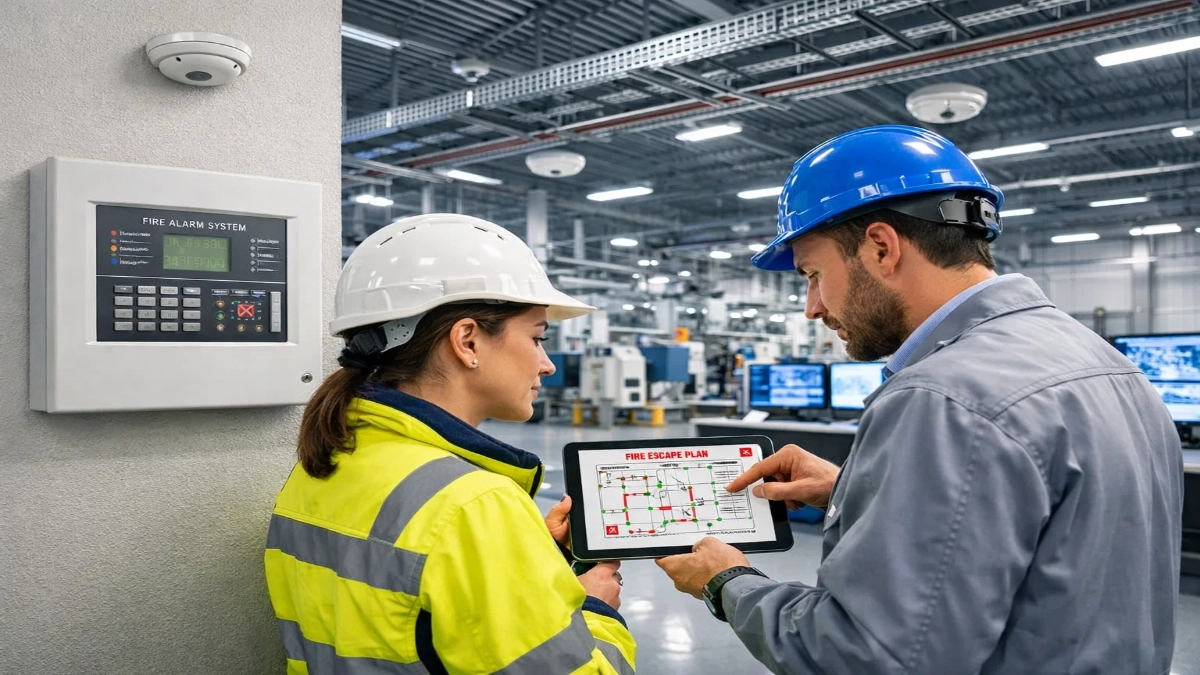
Large enterprises allocate budget early for fire safety not because they “have extra funds,” but because they understand risk, lifecycle cost and operational continuity at a strategic level.
Let’s break this down step by step, practically, technically and from a real-world engineering perspective.
The Core Concept: Fire Safety as a Strategic Infrastructure Investment
Large enterprises allocate fire safety budgets early because early integration reduces risk, lowers lifecycle cost, ensures regulatory compliance, improves insurability and prevents operational disruption. Fire protection systems influence building design, electrical planning and emergency protocols, making early investment more efficient and cost-effective than retrofitting later.
Early budgeting allows fire detection systems to be integrated into architectural and electrical design rather than added as an afterthought. This improves system performance, scalability and compliance while avoiding costly redesigns.
When we delay fire safety planning, we introduce structural constraints, cable routing challenges, panel placement limitations and integration issues. Early allocation solves these before they become expensive problems.
Why Early Planning Changes the Entire Design Approach
When fire detection is part of the initial design discussion:
- Cable trays are sized correctly.
- Redundant power supplies are planned.
- Control rooms accommodate panels.
- Detector placement follows airflow studies.
- Integration with BMS and security systems is seamless.
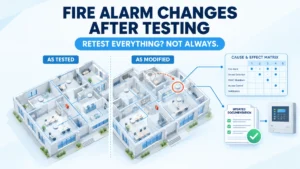
Compare this to retrofitting a system after civil work is completed. Suddenly, ceilings need modification, conduits must be exposed and detection coverage becomes compromised.
Engineering Reality:
Retrofitting can increase total system cost by 20–40% due to rework and labour disruption.
Technical Breakdown: How Early Budgeting Improves System Architecture
Early fire safety budgeting enables the correct selection of system type, panel architecture, detector technology, loop configuration and redundancy strategy. It ensures the project uses scalable, addressable technology where required and avoids under-specification that may compromise safety and compliance.
Let’s go deeper into the technical side.
1. Choosing Between Addressable vs Conventional Systems
In early planning stages, engineers assess:
- Site size
- Risk classification
- Occupancy load
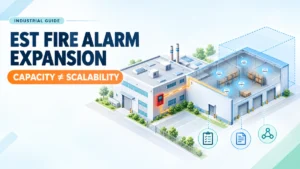
- Expansion plans
- Critical asset zones
This determines whether the project requires an addressable fire alarm panel or a conventional fire alarm panel.
Addressable Systems
An addressable fire alarm panel identifies the exact detector or device that triggered an alarm. This is ideal for:
- Large factories
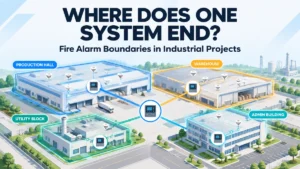
- Multi-building campuses
- Data centers
- Oil & gas facilities
Addressable systems use addressable detectors that communicate digitally with the panel.
Benefits:
- Precise fault identification
- Faster troubleshooting
- Reduced downtime
- Scalability
Conventional Systems
A conventional fire alarm panel divides a building into zones. It identifies the affected zone but not the exact detector. These systems use conventional detectors and are suitable for smaller facilities with limited risk complexity.
If budgeting is delayed, projects often default to lower-spec systems due to remaining financial constraints.
Early allocation allows the right decision, not the cheapest decision.
2. Loop Design and Network Architecture
Addressable systems rely on loop architecture. Early design ensures:
- Proper loop segmentation
- Redundancy for high-risk areas
- Future expansion capacity
- Fault isolation modules
If we install without planning, loop lengths exceed recommended parameters, voltage drops increase and reliability decreases.
When enterprises allocate early budget, engineers can design optimal loop topology, ring configurations, isolator modules and segmented networks.
3. Integration with Other Safety Systems
Modern industrial projects require integration between:
- Fire detection
- CCTV surveillance
- Access control
- PA/VA systems
- BMS platforms
The GST fire alarm system, distributed by Innxeon, supports seamless integration with industrial monitoring ecosystems. But integration only works effectively when considered during the design phase.
If fire safety is added later, integration becomes complex and costly.
Real-World Scenario: Factory Expansion vs Fire Incident
Let’s imagine two manufacturing plants.
Plant A: Early Fire Safety Budgeting
- Fire detection planned during the civil stage
- Addressable panel selected
- Detector layout based on airflow simulation
- Insurance audit cleared without modification
- Integrated with central monitoring
Result:
- Minimal false alarms
- Fast incident localisation
- Reduced downtime
- Lower insurance premium
Plant B: Delayed Fire Safety Investment
- System selected after civil completion
- Cable routing compromises
- Limited panel capacity
- Poor integration
- Multiple compliance corrections
Result:
- Frequent nuisance alarms
- Costly rework
- Insurance penalty
- Higher operational risk
This is why large enterprises treat fire safety as infrastructure, not optional equipment.
Financial Perspective: Early Budgeting Reduces Lifecycle Cost
Allocating fire safety budgets early reduces lifecycle cost by avoiding retrofit expenses, design rework, system under-sizing, compliance penalties and downtime losses. It ensures a scalable architecture that supports expansion and reduces long-term maintenance costs.
Let’s quantify this practically.
Cost Components Affected by Late Budgeting
- Civil rework
- Additional cable routing
- Panel relocation
- Compliance redesign
- System replacement within 5–7 years
- Downtime during retrofits
Early allocation eliminates most of these variables.
Insurance & Risk Management Impact
Insurance providers assess:
- Detection coverage
- Response time
- System reliability
- Monitoring integration
A robust system like the GST fire alarm system strengthens compliance documentation and risk scoring.
Over time, this can influence insurance premiums and claim approvals.
Engineering Best Practices Large Enterprises Follow
Leading enterprises follow structured fire safety planning: early risk assessment, technology selection based on hazard profile, integration design, lifecycle cost analysis and compliance validation before construction begins.
Let’s break down best practices step by step.
Step 1: Conduct Hazard & Risk Assessment
Identify:
- High heat zones
- Flammable storage
- Electrical load clusters
- Server rooms
- Occupancy density
This guides detector type and placement.
Step 2: Select Detector Technology Based on Environment
Industrial environments may require:
- Multi-criteria detectors
- Heat detectors
- Beam detectors
- Flame detectors
Using addressable detectors improves precision in complex facilities.
Step 3: Design for Scalability
Large enterprises rarely remain static.
Early budgeting allows:
- Spare loop capacity
- Additional panel ports
- Network expansion compatibility
Without this, future upgrades require full system replacement.
Step 4: Choose a Reliable Technology Platform
Selecting a proven solution like the GST fire alarm system ensures:
- Industrial-grade reliability
- Scalable addressable architecture
- Strong integration capability
- Compliance with global standards
When distributed and supported by experienced suppliers like Innxeon, enterprises also gain engineering consultation—not just equipment.
Comparison: Early Allocation vs Delayed Allocation
| Factor | Early Budgeting | Delayed Budgeting |
|---|---|---|
| System Design | Integrated with architecture | Added after construction |
| Cost Efficiency | Optimized lifecycle cost | Higher retrofit cost |
| Compliance | Seamless approval | Risk of rework |
| Scalability | Designed for expansion | Limited flexibility |
| Downtime Risk | Reduced | Higher |
Summary Insight:
Early budgeting improves safety, cost control and operational stability simultaneously.
Why Early Allocation Reflects Strategic Leadership
When we evaluate how mature enterprises operate, one pattern becomes clear: they invest in risk mitigation before risk materialises.
Fire safety is not a decorative compliance checklist. It is operational insurance, brand protection, legal protection and engineering integrity combined.
Early budgeting enables:
- Proper system architecture
- Scalable infrastructure
- Regulatory compliance
- Lower lifecycle cost
- Reduced downtime risk
For industrial and commercial facilities that demand reliability, choosing robust solutions such as the GST fire alarm system supported by experienced partners like Innxeon ensures the system is not just installed, but engineered correctly from the beginning.
In large enterprises, safety planning is not reactive. It is strategic.
And strategic organisations always plan early.
Read Also: How Fire Detection Systems Protect Supply Chains
Read Also: How Security Cameras Support Fire Evacuation Management