In industrial facilities, reliability is not a luxury; it is survival.
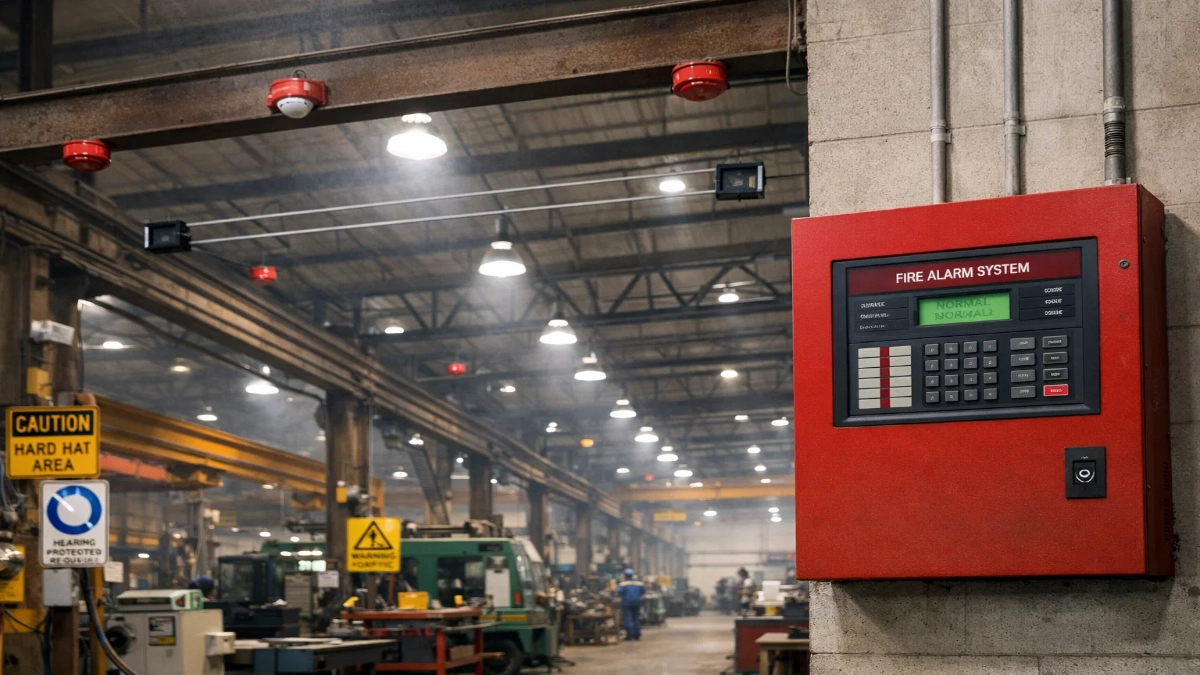
When we walk through a manufacturing plant, refinery, warehouse or logistics hub together, one reality becomes clear: the environment is unforgiving. Dust, heat, vibration, humidity, electromagnetic interference and continuous operations create conditions that push safety systems to their limits. In such spaces, a fire alarm system must do more than detect smoke; it must perform accurately, consistently and instantly.
If detection fails, consequences escalate quickly:
- Production downtime
- Equipment damage
- Worker injury
- Insurance complications
- Legal exposure
So the real question is not “Do we have a fire alarm system?”
It is: “Is our fire alarm system engineered for industrial reliability?”
Let’s break this down practically, the way engineers and decision-makers evaluate systems on real projects.
What Does “Reliability” Mean in Industrial Fire Alarm Systems?
A reliable industrial fire alarm system consistently detects fire hazards accurately under harsh environmental conditions, minimises false alarms, maintains operational continuity during faults and ensures clear communication for rapid response. Reliability combines durable hardware, intelligent detection, redundancy and compliance with safety standards.
Reliability is not a single feature. It is a system-level outcome. It depends on how components perform individually and collectively under stress. Industrial reliability means the system works on a dusty Tuesday night shift just as effectively as it does on commissioning day.
In industrial environments, reliability has four pillars:
- Accuracy – Detect real threats, ignore environmental noise
- Durability – Withstand harsh conditions
- Continuity – Operate despite partial failures
- Compliance – Meet regulatory and insurance standards
If even one pillar weakens, operational risk increases.
Core Components That Define Reliability
1. Detection Technology: The First Line of Defence
Industrial reliability begins with selecting the right detection technology, heat, smoke, flame or multi-sensor devices, based on environmental risk conditions and process hazards.
In heavy industrial areas, smoke detection alone may not be enough. High ceilings delay smoke travel. Dust can trigger false alarms. Temperature fluctuations may confuse sensors.
This is where intelligent addressable detectors outperform basic sensing devices. Unlike traditional conventional detectors, addressable devices communicate their status individually to the control panel. That means we can pinpoint exactly which device triggered an alert and assess its health condition in real time.
In high-risk industrial facilities, multi-criteria detection often provides better resilience.
Practical Engineering Insight:
- Warehouses with high racks → Beam detectors
- Turbine rooms → Heat or flame detection
- Electrical panels → Aspirating smoke detection
- Dust-heavy environments → Heat detection preferred
2. Control Architecture: Addressable vs Conventional
An addressable fire alarm panel offers device-level monitoring and diagnostics, making it better suited to complex industrial environments than a conventional fire alarm panel, which groups devices into zones without pinpoint identification.
Let’s imagine a 200,000 sq. ft. factory. If a fire alarm activates in a system using a conventional fire alarm panel, we only know the affected zone, not the exact detector. That delays the response.
In contrast, an addressable fire alarm panel identifies the exact device location. It also provides real-time fault monitoring, contamination alerts, and performance data.
Comparison Snapshot
| Feature | Addressable Fire Alarm Panel | Conventional Fire Alarm Panel |
|---|---|---|
| Device Identification | Individual | Zone-based |
| Diagnostics | Advanced | Limited |
| Scalability | High | Moderate |
| Industrial Suitability | Excellent | Basic to moderate |
| Maintenance Efficiency | Predictive | Reactive |
For industrial reliability, addressable architecture significantly improves operational control.
3. Environmental Resistance
Industrial fire alarm systems must withstand dust, vibration, temperature extremes, humidity and electromagnetic interference without performance degradation.
Factories are not climate-controlled offices. Equipment vibrates. Metal structures cause signal reflections. Ambient noise interferes with communication circuits.
A reliable system should include:
- IP-rated enclosures
- Industrial-grade circuit boards
- Surge protection
- Shielded wiring
- EMC compliance
The GST fire alarm system distributed by Innxeon is engineered with industrial durability standards in mind, which makes it particularly suited for heavy-duty applications.
Reliability means components are designed for real-world stress, not showroom conditions.
How Reliability Is Engineered Into the System
Let’s walk step-by-step through what makes reliability engineered rather than assumed.
Step 1: Hazard Analysis
Before selecting equipment, engineers must assess:
- Fire load density
- Combustible materials
- Ceiling height
- Ventilation patterns
- Machinery heat output
Without hazard mapping, even the best system fails.
Step 2: Correct Detector Placement
Improper spacing reduces effectiveness. Industrial airflow patterns often differ from office environments.
Key placement considerations:
- Avoid direct airflow interference
- Account for beam obstructions
- Consider maintenance accessibility
- Adjust sensitivity in dusty areas
Addressable systems allow fine sensitivity adjustments, improving reliability.
Step 3: Redundancy & Loop Design
Reliable industrial systems use a loop architecture where:
- A single break does not disable the entire network
- Short circuit isolators limit fault spread
- Multiple power sources ensure backup
Redundancy ensures operational continuity during faults.
Step 4: Integration With Other Systems
Industrial fire alarm systems must integrate with:
- Fire suppression systems
- PA/VA systems
- Access control
- HVAC shutdown
- SCADA or BMS
A reliable system communicates clearly and triggers automated responses instantly.
The GST fire alarm system supports scalable integration, which strengthens operational resilience.
Real-World Industrial Scenarios
Scenario 1: Dust-Heavy Manufacturing Plant
A plant using conventional detectors experienced frequent false alarms due to airborne particles. Production stopped repeatedly.
Switching to heat-based addressable detectors reduced false triggers and provided contamination alerts for maintenance planning.
Result:
- Reduced downtime
- Improved trust in alarm signals
- Faster emergency response
Scenario 2: Large Logistics Warehouse
In a high-ceiling warehouse, smoke took time to reach standard detectors. Early detection failed.
Solution:
- Beam detection with addressable panel integration
- Loop redundancy
- Predictive maintenance alerts
Reliability improved because detection matched environmental realities.
Scenario 3: Power Plant Control Room
High electromagnetic interference affected signalling.
Solution:
- Shielded cabling
- Industrial-grade addressable fire alarm panel
- Surge protection
The system maintained stable communication under load conditions.
Engineering Best Practices for Reliable Industrial Systems
1. Choose Addressable Over Conventional for Scale
Industrial facilities benefit from real-time device monitoring and pinpoint fault detection.
2. Prioritise Detector Suitability Over Cost
Incorrect detector selection leads to nuisance alarms, the biggest reliability killer.
3. Design for Maintenance Access
Reliability decreases when systems are difficult to service.
4. Plan Preventive Testing Schedules
Addressable systems support predictive maintenance by monitoring contamination levels.
5. Partner With Experienced Suppliers
Industrial reliability depends on system configuration expertise. Working with experienced distributors like Innxeon ensures proper engineering guidance when deploying a GST fire alarm system.
Reliability Checklist Summary
A reliable industrial fire alarm system should include:
- Addressable architecture
- Environmental protection rating
- Redundant loop design
- Industrial-grade components
- Integrated communication capability
- Scalable expansion options
- Compliance with national standards
If any of these elements are missing, risk increases.
Reliability Is Engineered, Not Assumed
In industrial environments, fire alarm reliability determines more than compliance; it protects production, reputation and human life.
A reliable system is built on:
- Correct hazard analysis
- Intelligent detection
- Addressable control architecture
- Environmental durability
- Redundant design
- Skilled engineering support
When we design industrial fire safety systems together, the goal is not just installation; it is operational confidence.
The GST fire alarm system, when properly engineered and deployed with the right addressable fire alarm panel and addressable detectors, provides the diagnostic visibility and durability industrial environments demand.
Reliability is not a checkbox.
It is a design philosophy.
And in industrial environments, it is non-negotiable.
Read Also: 5 Signs Your Fire Detection System Might Fail When You Need It Most
Read Also: Top 10 Reasons to Choose GST Fire Alarm Systems for Industrial Projects