Fire alarm architecture is the foundation of any reliable life safety system. In industrial plants, commercial complexes, data centres and warehouses, the architecture determines how effectively the system performs under real emergency conditions.
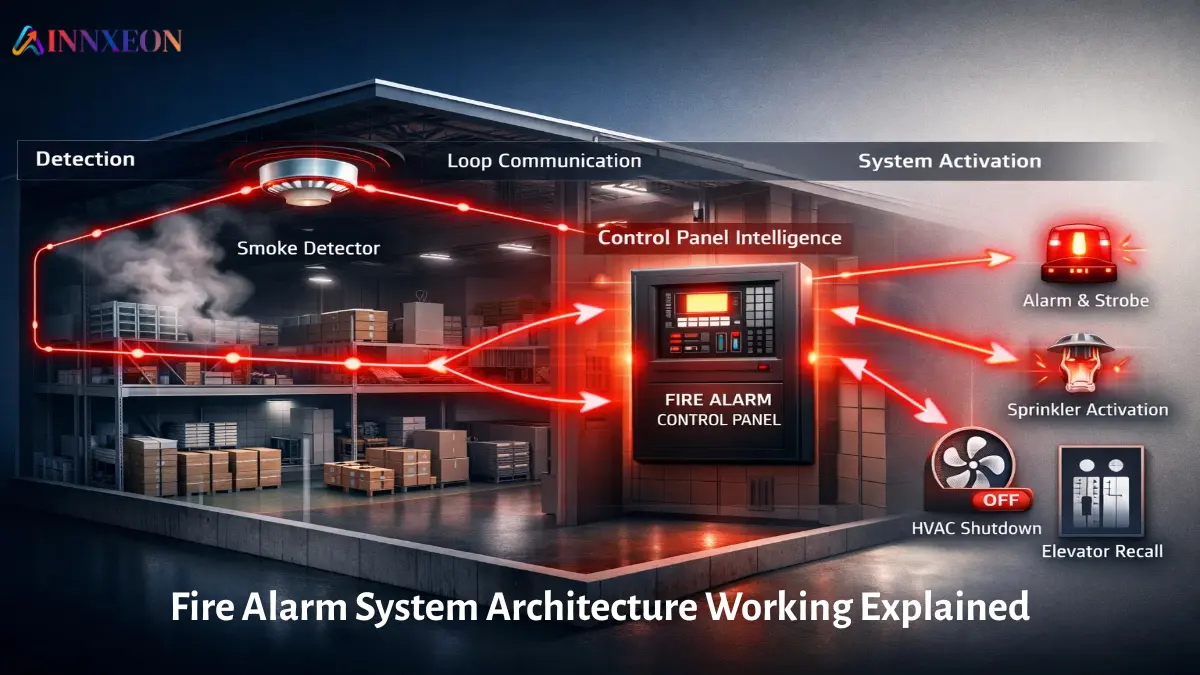
When we design a fire alarm system, we are not simply placing detectors and panels. We are building a structured communication network that must:
- Detect fire at the earliest stage
- Transmit signals without delay
- Identify exact locations
- Trigger evacuation procedures
- Activate suppression systems
- Maintain operation even during faults
Architecture directly impacts the system:
- Reliability
- Response speed
- Fault tolerance
- Future scalability
- Integration capability
For example, in large industrial campuses, we typically prefer a GST Addressable Fire Alarm System because it provides device-level intelligence and network expansion capability. In smaller buildings with defined zones, a GST Conventional Fire Alarm System may be sufficient and cost-effective.
Understanding architecture allows us to design systems that are not only compliant but operationally resilient.
What Is Fire Alarm System Architecture?
Fire alarm system architecture refers to the logical and physical arrangement of system components and their communication pathways.
It defines how:
- Devices are interconnected
- Signals are transmitted
- Decisions are processed
- Outputs are activated
- External systems are integrated
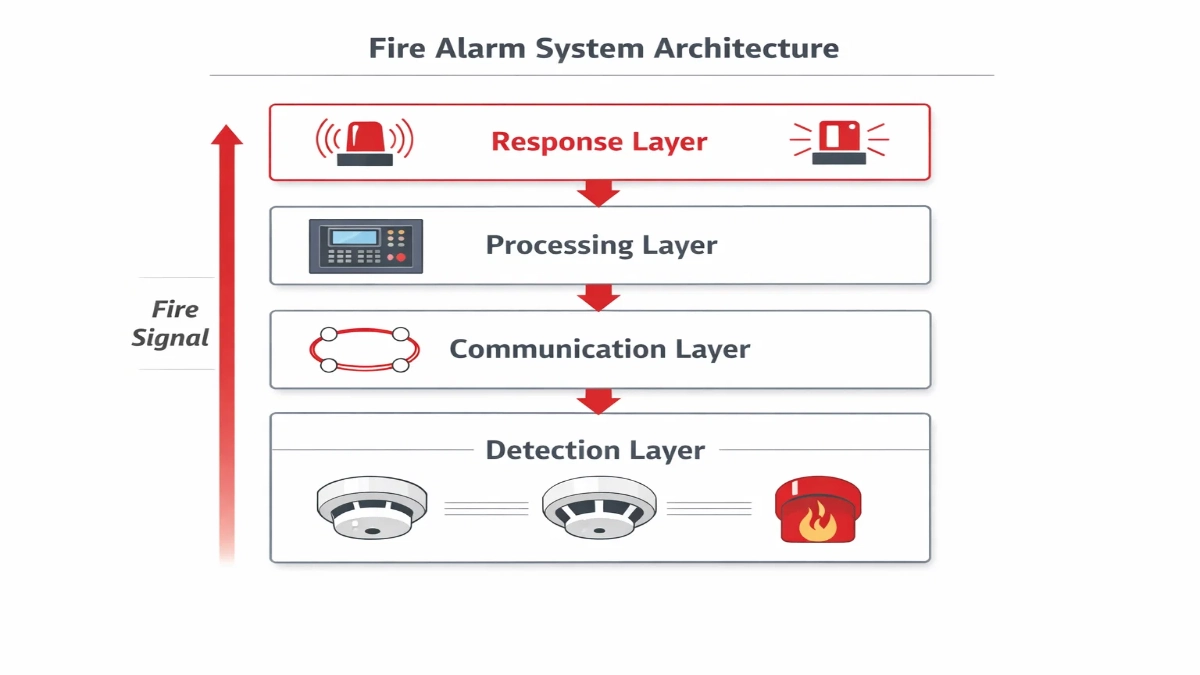
We can think of it as a layered structure:
Layer 1: Detection Layer (Sensing Intelligence at the Edge)
The Detection Layer is the first line of defence. This is where physical fire phenomena are converted into electrical signals.
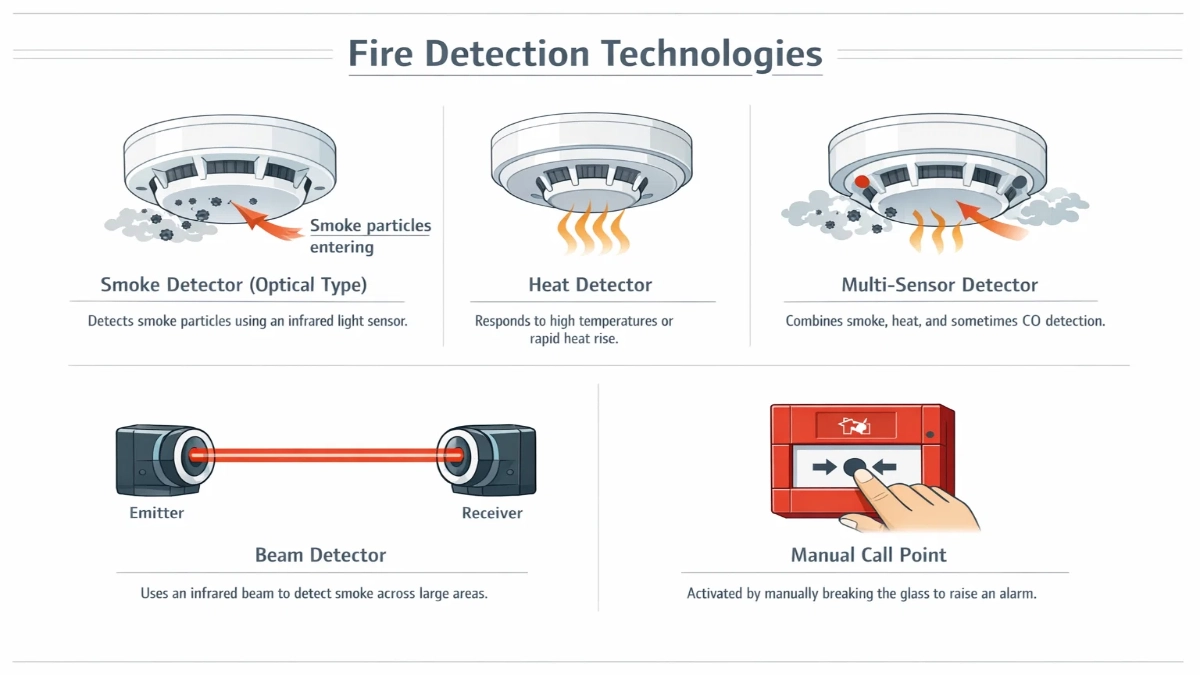
At this layer, devices continuously monitor environmental conditions such as:
- Smoke particles
- Temperature rise
- Flame radiation
- Gas concentration (in specialised applications)
- Manual human activation (MCPs)
1. Types of Detection Technologies
Optical Smoke Detectors
Use light scattering principles to detect airborne particulates.
Heat Detectors
- Fixed temperature
- Rate-of-rise
Multi-Sensor Detectors
Combine smoke and heat for higher accuracy and false alarm reduction.
Beam Detectors
Used in warehouses and high-ceiling environments.
In advanced systems like a GST Addressable Fire Alarm System, detectors transmit analogue values (not just alarm/no alarm). The panel evaluates smoke density trends and compensates for drift.
In contrast, GST Conventional Fire Alarm Detectors operate on fixed threshold activation within a defined zone.
2. Intelligent Features in Modern Detection
Modern detection architecture includes:
- Drift compensation
- Contamination monitoring
- Sensitivity adjustment
- Environmental calibration
- Device health reporting
This layer is critical because early detection defines overall response time.
If the detection layer fails or generates frequent nuisance alarms, the entire architecture loses credibility.
3. Design Considerations for Detection Layer
When we design this layer, we consider:
- Ceiling height
- Airflow patterns
- Dust levels
- Hazard classification
- Regulatory codes (e.g., NFPA guidelines from the National Fire Protection Association)
Proper detector spacing, mounting height and technology selection ensure accurate performance.
Layer 2: Communication Layer (Structured Signal Transmission)
The Communication Layer ensures that signals from detection devices reach the control panel reliably and without delay.
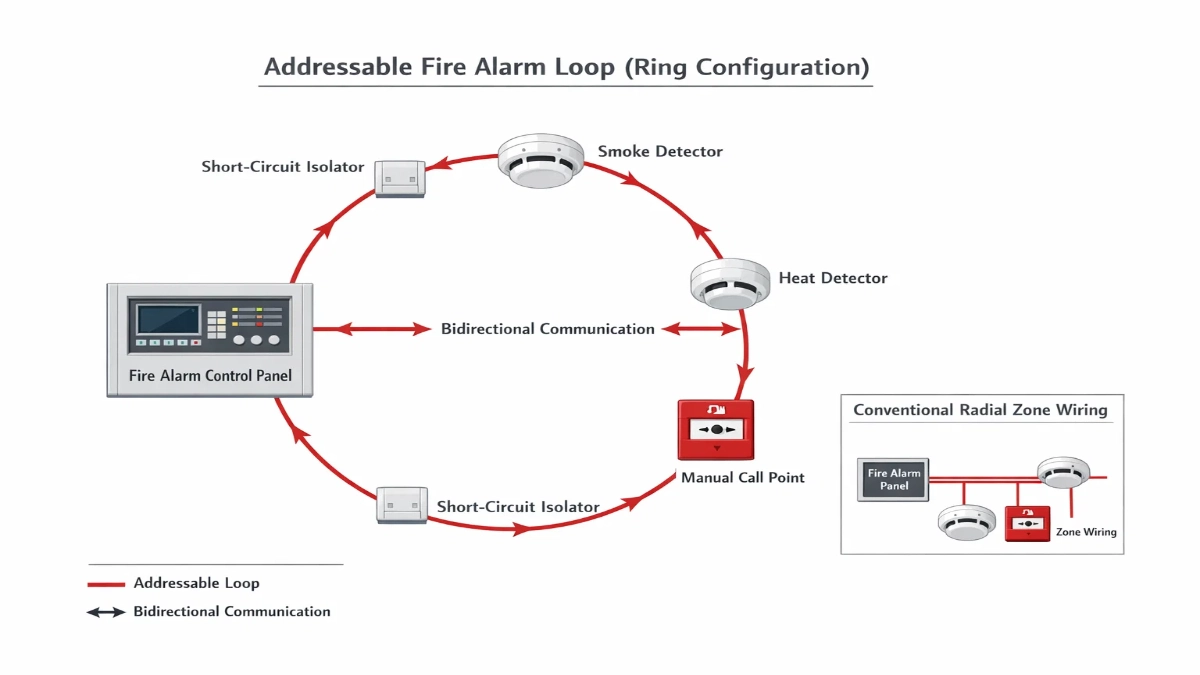
This layer includes:
- Addressable loops
- Conventional zones
- Signal line circuits
- Isolator modules
- Wiring topology
1. Loop-Based Communication (Addressable Architecture)
In intelligent systems using GST Addressable Fire Alarm Detectors, devices connect in a ring topology.
Key characteristics:
- Bi-directional communication
- Continuous polling
- Short-circuit isolation
- Device-level addressing
If a wire break occurs, communication continues from the opposite direction. This significantly increases system survivability.
2. Zone-Based Communication (Conventional Architecture)
In a GST Conventional Fire Alarm System, detectors connect in radial circuits.
The panel identifies the affected zone but not the exact device.
This architecture is simpler but offers:
- Limited fault isolation
- Basic supervision
- Moderate scalability
3. Communication Layer Design Priorities
We design this layer to ensure:
- Voltage drop within limits
- EMI resistance in industrial plants
- Segregation from power cables
- Proper loop loading
- Surge protection
In large facilities, we may divide loops per building or floor to improve fault containment.
This layer acts as the nervous system of the fire alarm architecture.
Layer 3: Processing Layer (Decision Intelligence)
The Processing Layer is where raw data becomes actionable intelligence.
This layer primarily consists of the Fire Alarm Control Panel (FACP).
In a GST Addressable Fire Alarm System, the panel continuously polls devices, sometimes every few seconds.
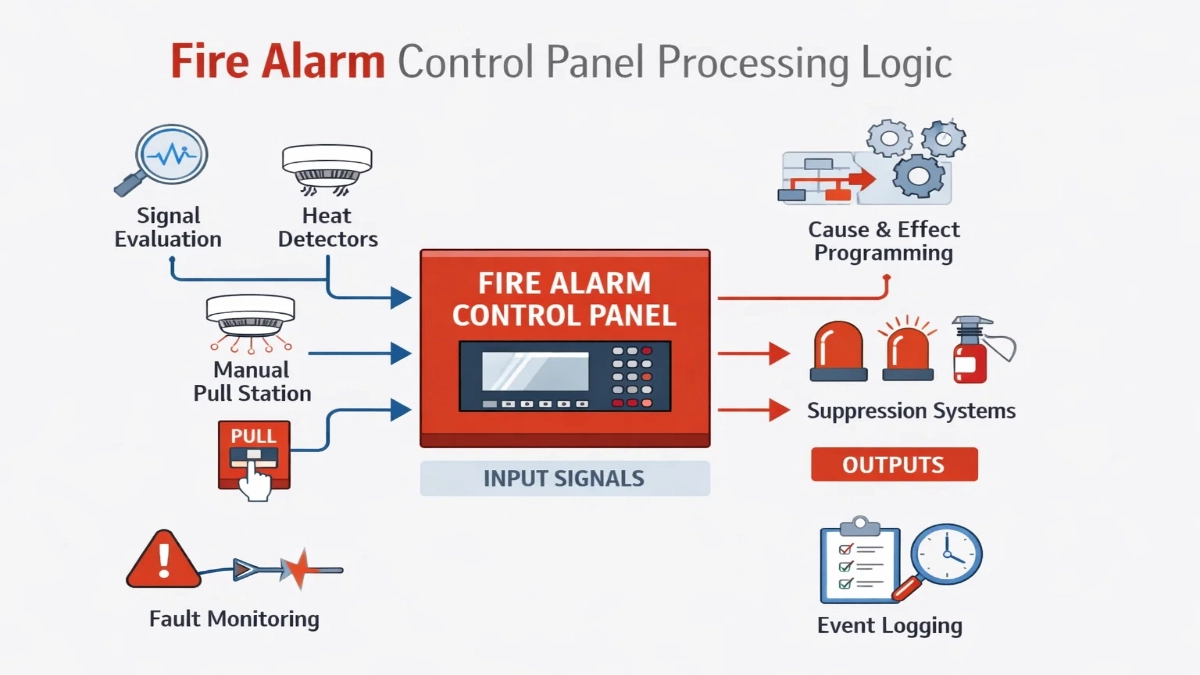
1. Signal Evaluation
The panel performs:
- Analogue value comparison
- Threshold validation
- Time delay filtering
- Multi-device confirmation logic
- False alarm suppression
For example:
If a detector shows a slight increase in smoke but not sustained, the panel may enter pre-alarm instead of full evacuation.
2. Cause-and-Effect Programming
This is where architectural intelligence truly emerges.
The panel can be programmed to:
- Activate specific outputs for specific zones
- Delay suppression activation
- Trigger staged evacuation
- Send signals to BMS
- Log and timestamp events
This structured logic reduces panic and ensures a controlled response.
3. Fault Monitoring & Supervision
The panel continuously supervises:
- Loop integrity
- Power supply status
- Battery backup
- Device communication
- Short circuits
- Open circuits
If a fault occurs, the system generates a trouble signal immediately.
This ensures the architecture remains operational at all times.
Layer 4: Response Layer (Execution & Control)
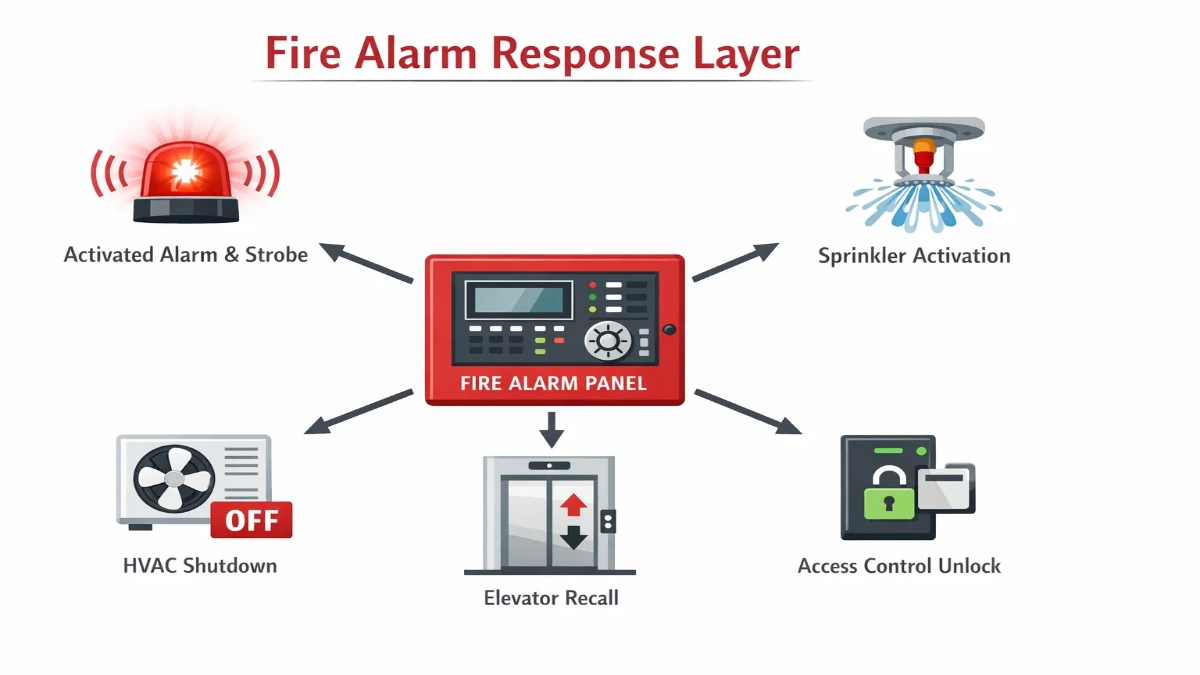
The Response Layer converts panel decisions into physical action.
It includes:
- Sounders
- Horns
- Strobes
- Voice evacuation systems
- Relays
- Suppression interfaces
- HVAC shutdown controls
- Lift recall modules
This layer ensures that detection leads to real-world protective action.
1. Notification Logic
Outputs can be programmed based on:
- Alarm type
- Time-of-day logic
- Confirmation from multiple detectors
- Hazard classification
For example:
- Pre-alarm → Local warning only
- Confirmed alarm → Full evacuation
- Suppression zone alarm → Gas release activation
2. Integration with Fire Protection Systems
The fire alarm panel may interface with:
- Sprinkler systems
- Deluge systems
- Fire pumps
- Gas suppression systems
Integration follows best practices discussed in professional platforms such as Fire Engineering.
This ensures coordinated emergency response.
3. Integration with Building Systems
Advanced architecture also triggers:
- HVAC shutdown to prevent smoke spread
- Elevator recall to safe floor
- Access control unlocking
- BMS alerts
This coordinated response minimises chaos and speeds evacuation.
How These Layers Work Together
The four layers operate sequentially but also continuously supervise each other.
Detection Layer → Senses fire
Communication Layer → Transmits signal
Processing Layer → Validates & decides
Response Layer → Activates protection
If any layer is poorly designed, the entire architecture becomes weak.
When we design projects properly, whether using a GST Addressable Fire Alarm System for complex industrial sites or a GST Conventional Fire Alarm System for defined zones, we ensure these four layers function as a unified safety intelligence network.
Addressable vs Conventional Architecture (Conceptual Comparison)
| Parameter | Addressable | Conventional |
|---|---|---|
| Device Identification | Individual | Zone-based |
| Wiring | Loop topology | Radial zones |
| Fault Isolation | High | Limited |
| Scalability | Very high | Moderate |
| Diagnostics | Advanced | Basic |
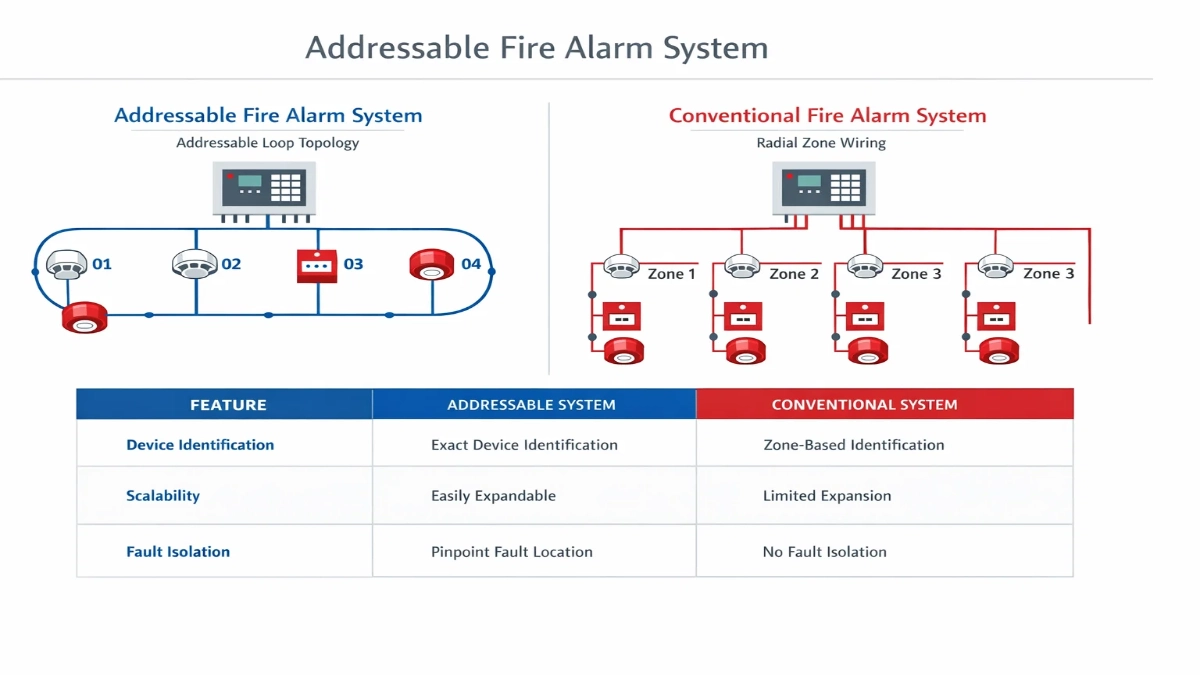
In a GST Addressable fire alarm system, every detector has a unique address. The panel communicates digitally, allowing pinpoint identification and preventive diagnostics.
In a GST Conventional fire alarm system, detectors are grouped by zone. The panel identifies the affected zone but not the specific device.
For industrial facilities, architectural flexibility becomes critical when future expansion is expected.
Core Building Blocks of Fire Alarm System Architecture
A robust architecture relies on well-defined building blocks. Each layer must function independently and collectively.
a. Fire Alarm Control Panel (FACP)
The FACP is the command centre of the system.
It performs:
- Continuous loop polling
- Alarm verification
- Fault detection
- Event logging
- Signal prioritization
- Output activation
- Network communication
In intelligent systems such as a GST Addressable fire alarm system, the panel evaluates analogue signals from detectors. Instead of waiting for fixed thresholds, it analyses signal patterns and environmental variations.
Advanced panels support:
- Multi-panel networking
- Redundant processors
- Battery backup
- Communication via Modbus or BACnet
- Graphical LCD or touchscreen interfaces
For large-scale projects, panel networking allows multiple buildings to operate under centralised supervision.
b. Detection & Notification Loops
In addressable systems, loops are wired in a ring topology. This architecture offers built-in redundancy.
If a short circuit occurs:
- The system isolates the faulty section.
- Communication continues from the opposite direction.
With intelligent devices like GST Addressable fire alarm detectors, the loop supports:
- Bi-directional communication
- Device health monitoring
- Sensitivity adjustments
- Remote configuration
Loop capacity may range from 125 to 250 devices, depending on design.
Proper loop planning ensures:
- Voltage drop control
- EMI resistance
- Balanced device distribution
- Segmentation for large areas
For industrial facilities with long cable runs, loop isolation modules enhance survivability.
c. Field Devices (Input Layer)
Field devices detect physical changes in the environment.
They include:
- Optical smoke detectors
- Heat detectors (fixed & rate-of-rise)
- Multi-criteria detectors
- Beam detectors
- Manual call points
- Input/output modules
In GST Addressable fire alarm detectors, sensors transmit analogue values. The panel determines alarm conditions based on programmed logic.
In GST Conventional fire alarm detectors, activation occurs when a fixed threshold is crossed.
Advanced detection logic allows:
- Drift compensation
- False alarm reduction
- Sensitivity auto-adjustment
- Environmental calibration
For industrial plants, multi-sensor detectors reduce nuisance alarms caused by dust or humidity.
d. Notification Appliances (Output Layer)
Outputs convert system intelligence into human action.
They include:
- Audible alarms (hooters, horns)
- Visual strobes
- Voice evacuation systems
- PA integration
- Relay outputs for suppression
The panel activates outputs based on pre-programmed cause-and-effect logic.
For example:
- Alarm in Zone 1 → Evacuate Zone 1
- Pre-alarm → Local sounder only
- Confirmed fire → Full building evacuation
Industrial facilities may use phased evacuation to avoid production disruption.
Proper architecture ensures selective activation rather than full-site panic.
How Data Flows Inside a Fire Alarm System
Fire alarm architecture operates through a structured signal flow.
Step-by-Step Signal Flow
- Detector senses an abnormal condition
- Detector sends digital/analogue data
- Loop transmits data to the panel
- Panel verifies signal
- Panel checks programmed logic
- Alarm condition confirmed
- Output devices activated
- Interface systems triggered
Real-Time Communication
In intelligent systems like a GST fire alarm system, the panel polls each device every few seconds.
This ensures:
- Immediate detection
- Fault reporting
- Continuous supervision
Example: Warehouse Smoke Incident
Smoke rises in the storage area. The detector senses increasing density. The panel verifies a sustained signal beyond the threshold. It confirms the alarm and:
- Activates local sounders
- Sends a signal to fire the pump
- Shuts down HVAC
- Logs event in BMS
All within seconds.
System Interfaces and Integration Architecture
Modern fire alarm systems act as central safety controllers.
a. Interface with Fire Protection Systems
The fire alarm panel integrates with:
- Sprinkler flow switches
- Gas suppression systems
- Deluge valves
- Fire pumps
Integration ensures a coordinated response aligned with guidelines from the National Fire Protection Association.
When detection occurs:
- Suppression activates
- Pumps start
- Valve status feedback is monitored
This structured integration improves reliability and compliance.
b. Interface with Building Systems
Integration extends to:
- HVAC shutdown
- Lift recall
- Access control
- Building Management Systems
Industry knowledge platforms like Fire Engineering highlight the importance of integrated safety architecture in large facilities.
Integration enables:
- Smoke containment
- Controlled evacuation
- Real-time event monitoring
- Reduced response delay
For large enterprises, architecture must support seamless coordination across systems.
Note: Fire alarm system architecture works because it follows structured communication logic.
It connects:
Detection → Communication → Processing → Notification → Integration
When we design architecture correctly, we ensure:
- Faster detection
- Precise location tracking
- Fault tolerance
- Compliance
- Scalability
- Long-term operational safety
Understanding this structure allows us to design systems that are not only code-compliant but operationally intelligent.
Read Also: What Makes a Fire Alarm System Reliable in Industrial Environments?
Read Also: 5 Signs Your Fire Detection System Might Fail When You Need It Most