Large-scale projects introduce a level of fire-detection complexity far beyond that of standard buildings. When we design fire detection systems for industrial plants and high-rise buildings, we are not just installing detectors; we are building an intelligent safety infrastructure that must operate reliably across vast areas and thousands of devices.
These environments present several critical challenges:
- Extensive coverage areas: Facilities may span multiple floors, production zones or entire campuses.
- High device density: Thousands of detectors, modules and notification devices must operate seamlessly together.
- Fast fault identification requirements: Any device failure or wiring issue must be detected immediately to avoid blind spots.
- Reliable and rapid emergency response: Emergency teams need precise information to act quickly and safely.
In such environments, conventional fire alarm systems quickly reach their limitations. They cannot provide precise device-level identification or intelligent system diagnostics at scale.
This is where modern intelligent systems, such as the GST addressable fire alarm system and advanced addressable fire alarm control panel architectures, become essential. Addressable fire alarm systems use digital communication and device-level monitoring to provide precise detection, faster response and scalable protection across large facilities.
Instead of simply detecting that “something is wrong in Zone 4,” these systems identify the exact device, location and condition, transforming fire detection into a fully intelligent safety network.
What is an Addressable Fire Alarm System
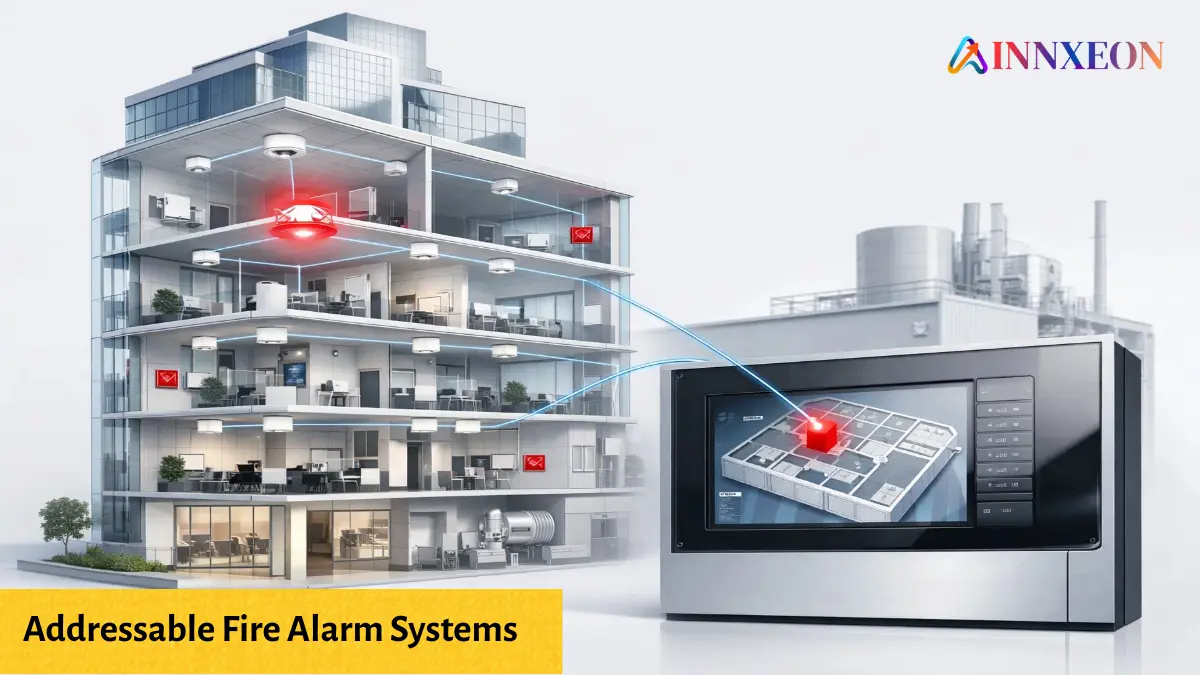
An addressable fire alarm system is an intelligent fire detection system where every connected device has a unique digital address. The control panel communicates individually with each detector, module and notification device to monitor status in real time.
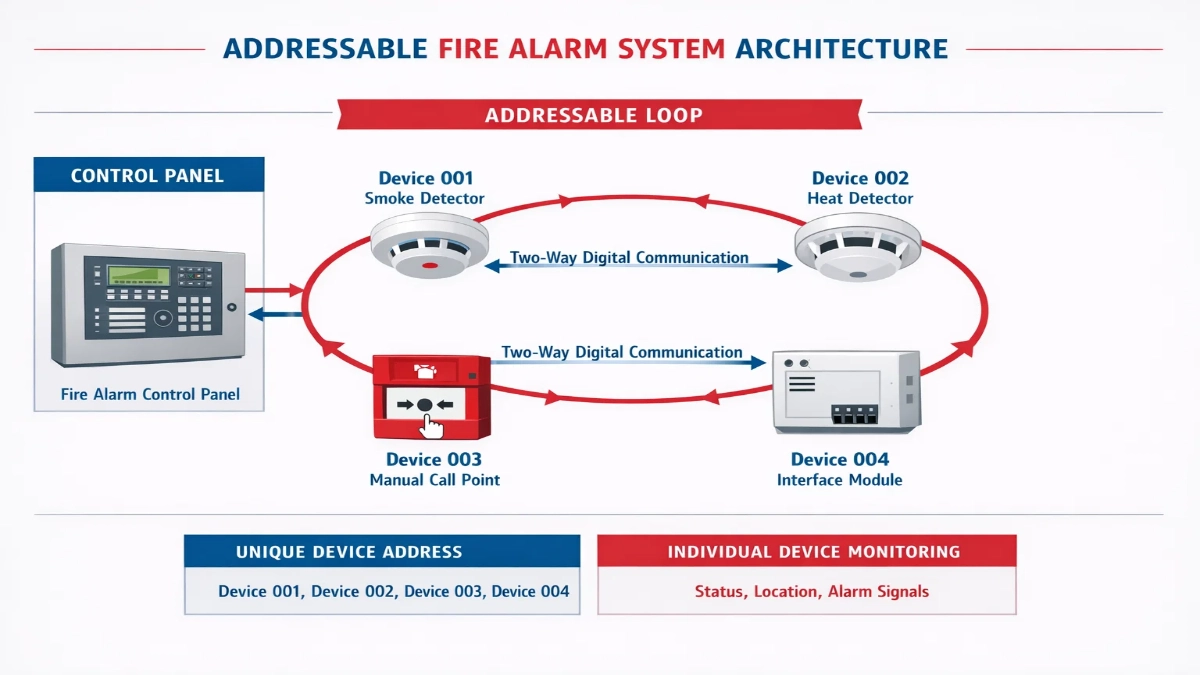
Unlike conventional systems that monitor zones, addressable systems monitor individual devices.
This architecture allows the control panel to identify:
- Exact detector location
- Device health status
- Wiring faults
- Alarm conditions
- Environmental changes
Modern platforms such as the GST addressable fire alarm system use loop-based communication networks that connect hundreds of devices on a single circuit while maintaining individual identification.
Device-Level Communication and Monitoring
In addressable systems, the addressable fire alarm control panel continuously communicates with every device connected to the loop.
Each device responds with:
- Normal status
- Alarm status
- Fault condition
- Maintenance alerts
This continuous communication ensures full system visibility.
According to the National Fire Protection Association, intelligent systems improve response efficiency by providing precise alarm location information and real-time monitoring. You can explore their educational resources here:
https://www.nfpa.org/news-and-research/resources
Difference Between Addressable and Conventional Systems
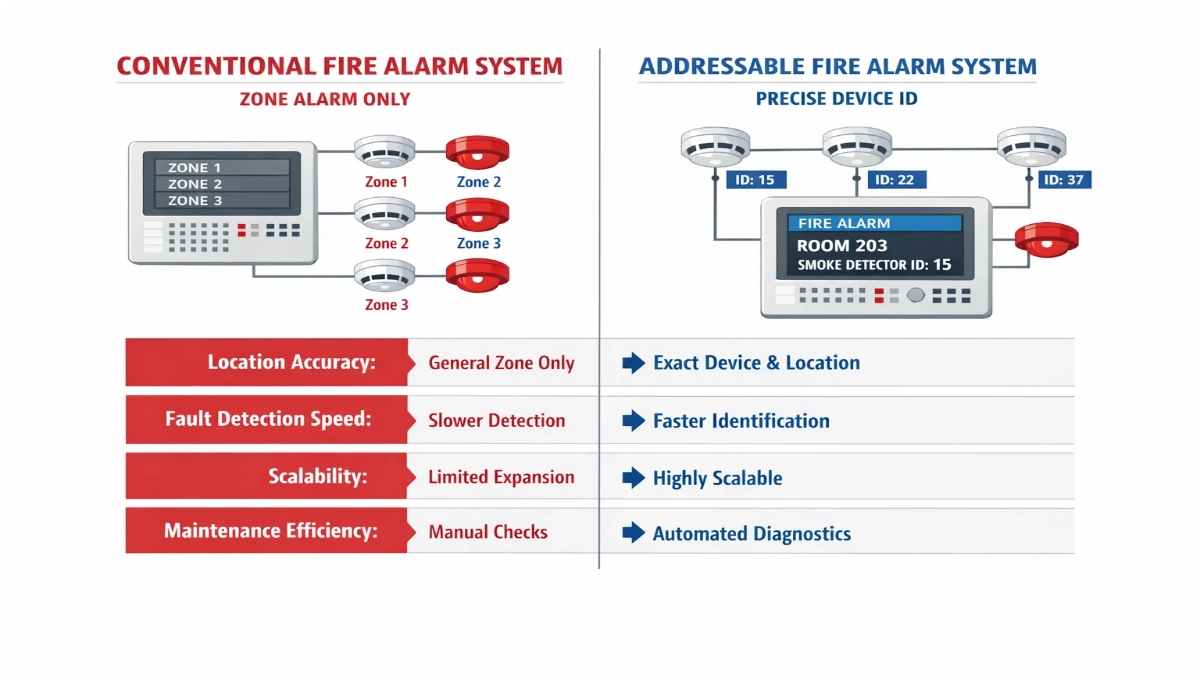
The key difference lies in identification and intelligence.
Conventional system:
- Monitors zones
- Cannot identify individual device location
- Limited diagnostics
Addressable system:
- Monitors individual devices
- Provides precise location information
- Supports intelligent diagnostics
- Enables predictive maintenance
This difference becomes critical in large facilities.
Core Components of Addressable System Architecture
Addressable fire alarm systems include several key components:
1. Control Panel
The addressable fire alarm control panel acts as the system brain. It processes device data, manages communication and activates alarms.
2. Detection Loops
Loops are communication circuits connecting addressable devices to the panel.
3. Addressable Detectors
Modern addressable fire alarm detectors include:
- Smoke detectors
- Heat detectors
- Multi-criteria detectors
Each detector has a unique digital identity.
4. Interface Modules
Modules connect external systems such as:
- Suppression systems
- HVAC controls
- Elevators
- Building management systems
These modules enable system integration and automation.
Benefits of Using Addressable Fire Alarm Systems
Addressable systems offer several critical advantages that directly improve safety, reliability and operational efficiency in large-scale projects.
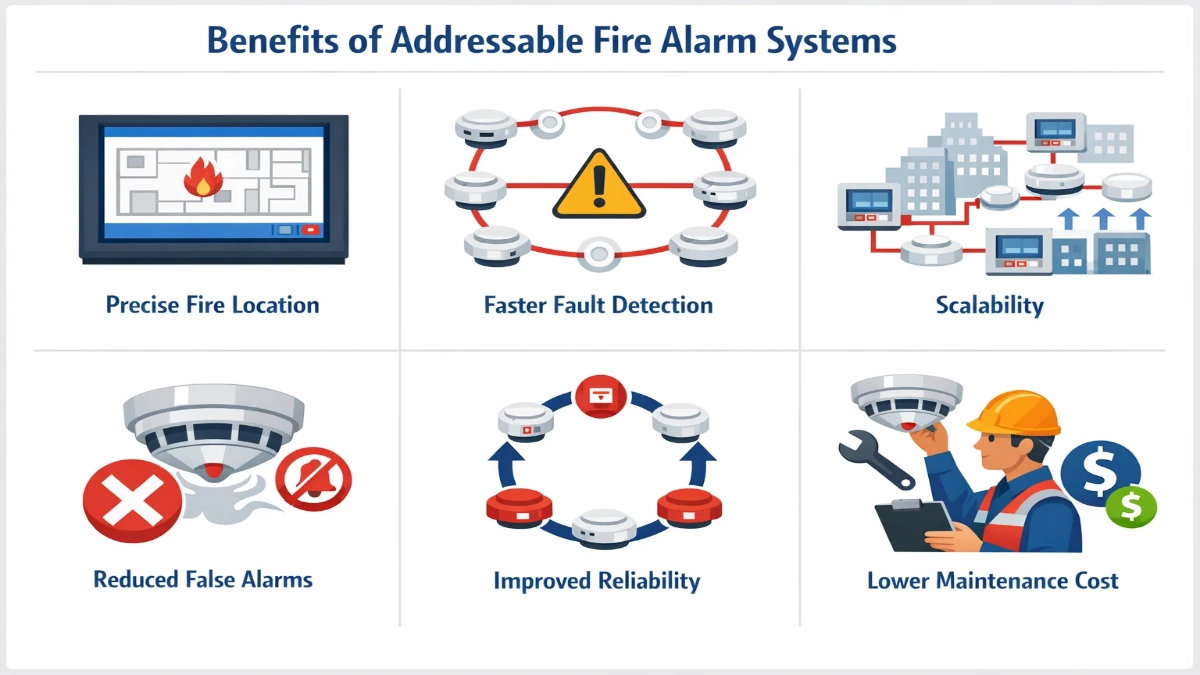
Precise Fire Location Identification
This is one of the most important advantages.
When an alarm occurs, the control panel displays the exact device location.
For example:
Instead of showing:
“Zone 3 alarm”
It shows:
“Smoke detector – Level 5 – Electrical Room 2”
This precise information allows emergency teams to respond immediately without wasting time searching.
According to IFSEC Global’s fire detection guidance:
https://www.ifsecglobal.com/fire-news/fire-alarm-systems-guide/
Precise alarm identification significantly improves emergency response efficiency in large facilities.
Faster Fault Detection and Maintenance
Addressable systems continuously monitor system health.
They detect:
- Wiring faults
- Device failures
- Communication loss
- Detector contamination
The addressable fire alarm control panel immediately displays faults.
Maintenance teams can locate and fix issues quickly without manual inspection of entire zones.
This reduces downtime and improves system availability.
Scalability for Large Projects
- Large projects often expand over time.
- Addressable systems allow easy expansion.
- We can add new devices to loops without redesigning the entire system.
- Modern systems, such as the gst addressable fire alarm system, support hundreds of devices per loop and multiple loops per panel.
This makes them ideal for:
- Industrial plants
- Commercial campuses
- Airports
- Hospitals
Reduced False Alarms
- False alarms disrupt operations and reduce system credibility.
- Addressable detectors use intelligent sensing and signal processing.
- They can distinguish between real fire conditions and environmental changes.
- Intelligent fire detection technologies significantly reduce unwanted alarms.
- This improves operational efficiency and safety.
Improved System Reliability
Addressable systems improve reliability through advanced communication and fault isolation.
Features include:
- Loop integrity monitoring
- Fault isolation modules
- Continuous communication testing
If a wiring fault occurs, only a small portion of the loop is affected, not the entire system.
This ensures continuous protection.
Lower Long-Term Maintenance Cost
Addressable systems reduce maintenance costs by enabling targeted servicing.
Instead of testing entire zones, technicians can identify specific devices requiring maintenance.
This reduces:
- Inspection time
- Maintenance labor cost
- System downtime
The addressable fire alarm detectors also provide contamination alerts, allowing predictive maintenance.
Why Addressable Systems Are the Best Choice for Large-Scale Projects
Large-scale facilities require intelligent fire detection systems capable of managing thousands of devices reliably.
Handling Large Device Counts Efficiently
- Large projects may include thousands of devices.
- Addressable systems manage large device counts using a loop architecture.
- A single loop can support hundreds of devices.
- Multiple loops can be connected to one panel.
- This architecture reduces wiring complexity and improves scalability.
Addressable systems provide efficient device management and improved monitoring capabilities.
Faster Emergency Response in Critical Environments
- In critical environments such as data centres or industrial plants, response speed is crucial.
- Precise device identification allows emergency teams to respond immediately.
- This reduces fire spread and damage risk.
- NFPA guidance emphasises rapid identification as a critical factor in fire safety effectiveness.
Better System Monitoring and Control
Addressable systems provide real-time system visibility.
The fire alarm control panel displays:
- Device status
- Fault conditions
- Alarm events
- System health
Facility teams can monitor the entire system from one interface.
This improves safety management.
Integration with Other Safety and Building Systems
Modern addressable systems integrate with:
- Fire suppression systems
- Building Management Systems (BMS)
- HVAC systems
- Access control systems
- Emergency evacuation systems
This integration enables an automated response.
For example:
If a detector activates:
- HVAC shuts down
- Fire doors close
- Suppression systems activate
- Emergency alerts trigger
The integrated fire detection system provides a coordinated safety response.
Real-World Example: Industrial Manufacturing Plant; Why Addressable Systems Make a Critical Difference
To understand the true impact of addressable fire alarm systems, let us consider a realistic, large-scale industrial manufacturing facility.
This facility includes:
- 4 production buildings handling machining, assembly and processing
- 1 large central warehouse storing raw materials and finished goods
- 1 control centre managing plant operations and automation systems
- 1 utility building housing electrical panels, compressors and backup power systems
The total covered area exceeds 85,000 square meters, with high ceilings, multiple hazard zones and different fire risk profiles.
The fire detection system includes approximately:
- 1,800 addressable smoke detectors
- 350 heat detectors
- 120 manual call points
- 180 interface modules
- 75 sounders and notification devices
Total connected devices: 2,500+
This is a typical device scale in modern industrial environments.
Scenario 1: If This Facility Used a Conventional Fire Alarm System
In a conventional architecture, detectors are grouped into zones.
To cover this facility properly, the system would require:
- 250 to 400 zones
- Extensive wiring from each zone to the control panel
- Complex cable routing across multiple buildings
Now consider a real incident scenario.
At 2:15 AM, a smoke detector activates inside the warehouse’s electrical maintenance room.
The control panel displays:
“Zone 117 Alarm – Warehouse Section B”
This creates several operational challenges:
1. No Precise Location Visibility
The maintenance team only knows the alarm originated somewhere in Zone 117.
This zone could include:
- Electrical maintenance room
- Storage racks
- Conveyor areas
- Power distribution panels
The response team must physically search the entire zone.
This wastes critical response time.
2. Slower Emergency Response
Even a delay of 3–5 minutes in locating the fire source can significantly increase fire spread risk.
In industrial environments, fire growth can accelerate due to:
- Electrical equipment
- Combustible materials
- Cable insulation
- Packaging materials
Delayed identification increases potential damage and safety risk.
3. Difficult Fault Identification
Now consider a wiring fault in the same zone.
The panel displays:
“Zone 117 Fault”
Technicians must manually inspect:
- Hundreds of meters of cable
- Dozens of detectors
- Multiple junction points
This process may take hours or even days.
During this period, the affected zone may remain partially unprotected.
4. Higher Maintenance Effort and Cost
Routine maintenance becomes inefficient.
Technicians must inspect entire zones rather than individual devices.
This results in:
- Higher labor cost
- Longer maintenance time
- Increased operational disruption
Scenario 2: Using an Addressable Fire Alarm System in the Same Facility
Now, let us examine the same facility using an addressable system.
Each device has a unique digital identity and location label.
Example device label:
“Device ID 1452 – Smoke Detector – Warehouse – Electrical Maintenance Room – Panel WM-01 Loop 3”
At 2:15 AM, when the same detector activates, the control panel displays:
“Alarm – Smoke Detector – Electrical Maintenance Room – Warehouse – Loop 3 – Device 1452”
This provides immediate clarity.
Immediate and Precise Emergency Response
The response team instantly knows:
- Exact building
- Exact room
- Exact detector location
No search is required.
Security and emergency personnel can proceed directly to the source.
This improves response time dramatically.
In many real industrial environments, this precision reduces response time by 60–80%.
This can prevent:
- Fire escalation
- Equipment damage
- Production shutdown
Instant Fault Identification and Faster Repair
Now consider a wiring fault on Loop 3.
The control panel displays:
“Fault – Loop 3 – Section between Device 1470 and Device 1475”
- This narrows the fault location to a small physical area.
- Maintenance technicians can quickly inspect the exact cable section.
- Repair time reduces from hours to minutes.
- The rest of the system continues operating normally.
- This ensures continuous protection.
Improved Maintenance Efficiency Through Intelligent Diagnostics
Addressable systems continuously monitor device health.
For example, if a detector becomes contaminated due to dust accumulation, the system displays:
“Maintenance Alert – Detector Contamination – Device 1452 – Warehouse Electrical Room”
Maintenance teams can service the specific detector before it causes false alarms or detection failure.
This enables predictive maintenance.
Benefits include:
- Reduced unexpected faults
- Improved system reliability
- Lower maintenance cost
Efficient System Expansion as Facility Grows
Industrial facilities often expand over time.
For example, this plant adds:
- New assembly line
- New storage section
- Additional electrical panels
With an addressable system, expansion is simple.
We can:
- Add new detectors to existing loops
- Add new loops to the control panel
- Integrate new buildings into the network
No major redesign is required.
This protects the original system investment.
Improved System Visibility for Facility and Safety Teams
The addressable control panel provides full system visibility.
Operators can view:
- Real-time device status
- Alarm history
- Fault history
- Maintenance alerts
- Loop communication status
This enables proactive system management.
Facility teams always know the system condition.
There are no hidden failures.
Reduced Operational Risk and Downtime
In industrial environments, fire system failures can result in:
- Production downtime
- Safety risk
- Compliance violations
- Financial loss
Addressable systems reduce these risks through:
- Continuous monitoring
- Fast fault detection
- Precise alarm identification
This improves operational continuity.
Improved Compliance with Fire Safety Standards and Best Practices
Many international fire safety standards and engineering best practices recommend intelligent fire detection for large and complex facilities.
Addressable systems provide the required capabilities for:
- Device-level monitoring
- System supervision
- Reliable alarm communication
This helps meet compliance requirements and inspection standards.
Long-Term Operational and Financial Benefits
Although addressable systems may have slightly higher initial investment compared to conventional systems, they provide significant long-term savings through:
- Reduced maintenance labor
- Faster troubleshooting
- Lower downtime risk
- Improved reliability
- Easier expansion
Over the system lifecycle, addressable systems provide better return on investment.
Note: Addressable fire alarm systems have become the preferred choice for large-scale projects because they provide intelligence, scalability and reliability that conventional systems cannot match.
They solve critical challenges in large facilities by enabling:
- Precise fire location identification
- Faster fault detection and maintenance
- Scalable system expansion
- Reduced false alarms
- Improved reliability
- Lower maintenance cost
- Integration with building safety systems
For fire consultants, system integrators, EPC contractors and facility managers, addressable systems provide the technical foundation required for modern fire safety infrastructure.
As facilities grow larger and more complex, intelligent fire detection systems such as the gst addressable fire alarm system and advanced addressable fire alarm control panel architectures are no longer optional; they are essential for ensuring safety, operational continuity and regulatory compliance.
Read Also: How Does Fire Alarm System Architecture Work?
Read Also: What Makes a Fire Alarm System Reliable in Industrial Environments?