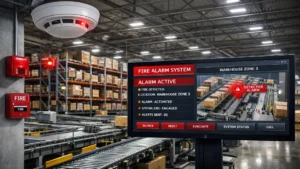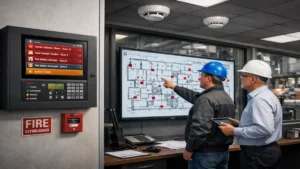
Fire alarm systems are no longer evaluated only on how fast they detect fire. In modern buildings, system reliability during faults is equally critical. A single cable short, device failure or power fluctuation should never compromise life safety. This is where fault isolation and redundancy play a vital role.
GST Fire Alarm Panels (Gulf Security Technology) are engineered with advanced fault isolation and redundancy mechanisms that ensure uninterrupted operation, even when part of the system fails. These features make GST panels a preferred choice for high-rise buildings, hospitals, data centres, airports, industrial plants and government projects.
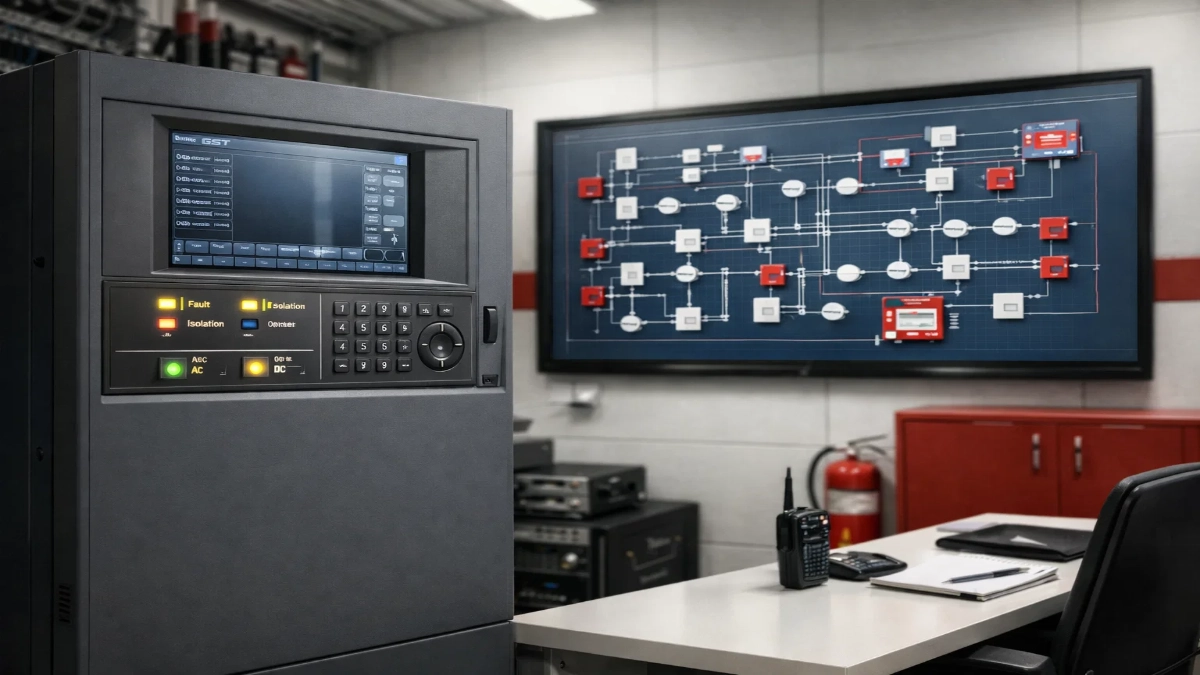
This article explains how fault isolation and redundancy work in GST fire alarm systems, why they matter and how GST performs better than many conventional alternatives, all in simple and easy-to-understand language.
What Is Fault Isolation in Fire Alarm Systems?
Fault isolation refers to a system’s ability to identify, contain and isolate faults without affecting the rest of the fire alarm network.
Common Faults in Fire Alarm Systems
- Short circuits in loop wiring
- Open circuits or cable breaks
- Device communication failure
- Power supply faults
- Ground leakage issues
In poorly designed systems, one fault can disable an entire loop or zone. GST eliminates this risk through intelligent isolation technology.
What Is Redundancy in Fire Alarm Panels?
Redundancy refers to having backup paths, components or power sources so that the system continues to operate even if one part fails.
Why Redundancy Is Critical
- Fire emergencies are unpredictable
- Faults often occur during maintenance or expansion
- System downtime can lead to catastrophic consequences
GST fire alarm panels are built with layered redundancy, ensuring the system remains operational at all times.
Why Fault Isolation & Redundancy Matter More Today
Modern buildings are:
- Larger and more complex
- Equipped with thousands of devices
- Expected to run 24/7 without failure
A single fault should never disable emergency detection or evacuation alerts. Regulatory authorities and consultants now demand high fault tolerance, especially in mission-critical infrastructure.
How GST Fire Alarm Panels Handle Fault Isolation
1. Intelligent Loop-Level Isolation
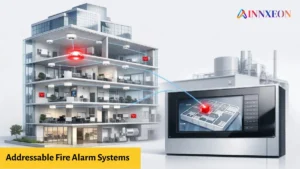
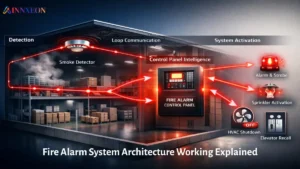
GST addressable fire alarm panel technology uses smart loop architecture with built-in isolation logic.
- Each loop is continuously monitored
- Short circuits are instantly detected
- Faulty sections are automatically isolated
- Healthy devices continue operating
This ensures that partial system faults do not escalate into system-wide failures.
2. Isolator Modules for Enhanced Protection
GST supports addressable isolator modules placed strategically along the loop.
Benefits:
- Limits fault impact to a small segment
- Allows the rest of the loop to function normally
- Simplifies fault troubleshooting
This is especially useful in:
- Large commercial complexes
- Industrial environments
- Campus-wide installations
3. Device-Level Fault Identification
GST panels do not just show “fault present.” They clearly identify:
- Exact device address
- Type of fault
- Location on the loop
This level of visibility significantly reduces downtime and maintenance effort.
4. Automatic System Recovery
Once the fault is resolved:
- The panel automatically restores the loop
- No manual reset is required
- System integrity is reverified
This self-healing capability is a major advantage of the GST fire alarm system.
Redundancy Features in GST Fire Alarm Panels
1. Dual Power Supply Architecture
GST panels support:
- Primary mains power
- Automatic battery backup
If mains power fails:
- The system instantly switches to battery mode
- No loss of detection or alarm signalling occurs
This redundancy ensures continuous protection during power outages.
2. Redundant Communication Paths
GST addressable systems use robust communication protocols that:
- Retry failed communications
- Maintain device polling even under high load
- Prevent data loss during transient faults
This is critical in systems using thousands of addressable detectors.
3. CPU and Memory Protection
GST panels are designed with:
- Watchdog timers
- Memory integrity checks
- Fail-safe firmware logic
If any processing anomaly occurs, the system recovers automatically without affecting field devices.
4. Network Redundancy for Large Systems
In multi-panel or networked systems:
- Panels communicate via redundant paths
- Failure of one panel does not collapse the network
- Fire signals continue to propagate across the system
This makes GST ideal for airports, metros, data centres and smart cities.
Comparison: GST Addressable vs Conventional Systems
Fault Handling Capability
| Feature | GST Addressable | Conventional Fire Alarm Panel |
|---|---|---|
| Fault Isolation | Automatic & intelligent | Limited or none |
| Fault Location | Exact device address | Zone-level only |
| System Recovery | Automatic | Manual reset |
| Scalability | Very high | Limited |
| Downtime Risk | Minimal | High |
While a conventional fire alarm panel may be suitable for small buildings, it lacks the advanced fault tolerance required for modern infrastructure.
Fault Isolation in Addressable vs Conventional Detectors
Addressable Detectors (GST)
- Each detector has a unique address
- Faults are instantly identified
- Only affected devices are isolated
- System remains operational
Conventional Detectors
- Devices are grouped by zones
- One fault can disable the entire zone
- Fault tracing is time-consuming
This is why GST strongly recommends addressable detectors for medium to large installations.
How GST Minimises False Alarms During Fault Conditions
Faults often cause nuisance alarms in poorly designed systems. GST prevents this through:
- Advanced signal validation
- Continuous device health monitoring
- Intelligent alarm confirmation logic
This ensures alarms are triggered only by real fire events, even during fault scenarios.
Maintenance Advantages of GST Fault Isolation
Faster Troubleshooting
- Clear fault messages
- Exact location identification
Reduced System Downtime
- No need to shut down entire loops
- Maintenance can be done section by section
Lower Long-Term Costs
- Fewer service visits
- Less manual testing
This makes GST systems cost-effective over their entire lifecycle.
Compliance with Global Safety Standards
GST fire alarm panels are designed to meet:
- International fire safety norms
- Tender and consultant specifications
- Government and PSU project requirements
Fault isolation and redundancy features are now mandatory in many global codes and GST systems are fully aligned with these expectations.
Real-World Applications Where GST Excels
GST fault-tolerant design is widely used in:
- Hospitals and healthcare facilities
- Data centres and IT parks
- Airports and metro stations
- Industrial plants
- High-rise residential towers
In these environments, system failure is not an option.
Why Consultants and System Integrators Prefer GST
- Predictable system behaviour during faults
- Easy compliance with tender specifications
- Scalable architecture
- Proven reliability
These factors consistently position GST as a trusted brand in fire safety technology.
Future-Ready Design of GST Fire Alarm Panels
GST continuously evolves its systems to:
- Support higher device densities
- Improve fault diagnostics
- Enhance network redundancy
This ensures long-term compatibility with smart buildings and advanced safety ecosystems.
Conclusion
Fault isolation and redundancy are no longer optional features; they are essential requirements for modern fire alarm systems. GST Fire Alarm Panels stand out by offering intelligent fault handling, automatic recovery and multi-layer redundancy that protect lives and assets even during unexpected failures.
Whether you are upgrading from a conventional fire alarm panel or designing a large-scale system with addressable detectors, GST delivers unmatched reliability, safety and peace of mind.
GST (Gulf Security Technology) continues to set benchmarks in fire detection by ensuring that even when something goes wrong, safety never stops.
Read Also: When Is the Right Time to Upgrade to a GST Addressable Fire Alarm System?
Read Also: Why GST Panels Remain Stable During Partial System Failures