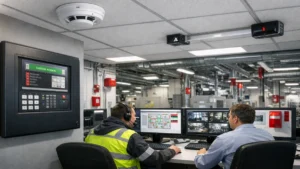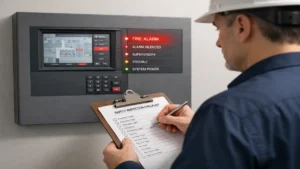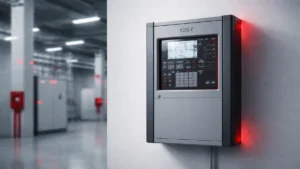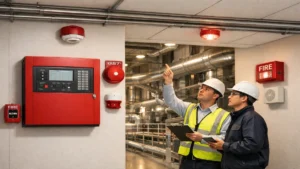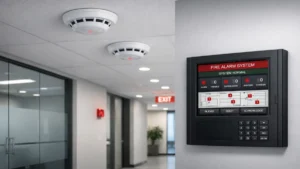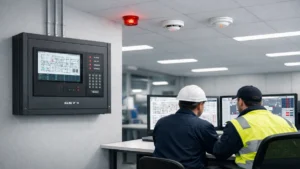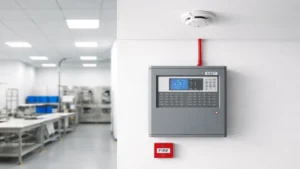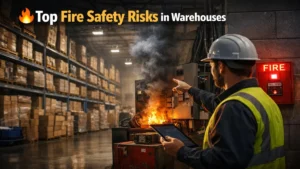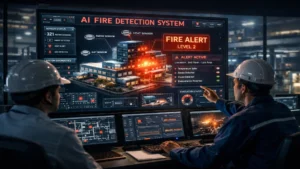
In every engineered fire protection system, performance is never determined by software alone. It depends on the correct selection, configuration and integration of physical components. A fire detection system operates as a coordinated network of sensors, control electronics, communication loops and notification devices. Each component contributes directly to detection reliability, signal transmission and emergency response effectiveness.
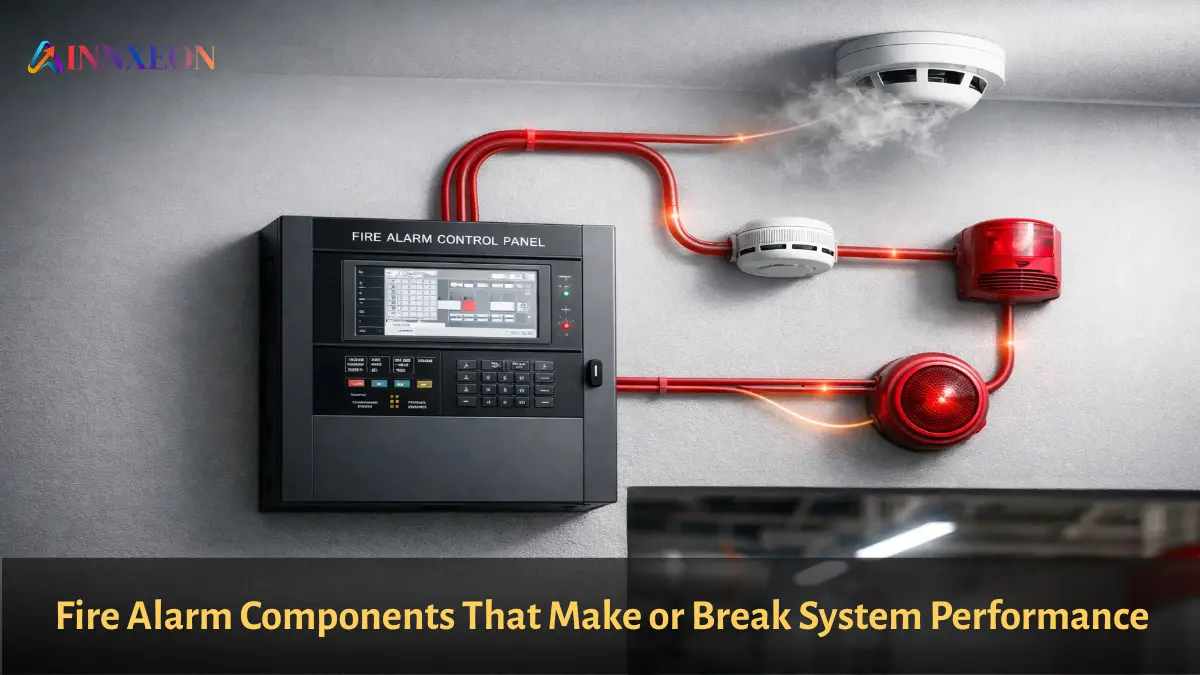
When even one component is poorly selected, incorrectly sized or improperly installed, the entire system becomes vulnerable. We see this frequently in industrial plants where detection delays occur because inappropriate detectors were used for the environment. In commercial buildings, undersized panels cause communication bottlenecks. In warehouses, improper wiring leads to loop failures. These are not theoretical issues; they are real engineering failures with serious consequences.
Why Component Selection Determines System Performance
Fire alarm systems are not just compliance requirements; they are real-time life safety systems designed to detect fire early and trigger immediate response. In these systems, performance is defined not by the presence of a control panel or detectors alone, but by the engineering quality, compatibility and reliability of every individual component.
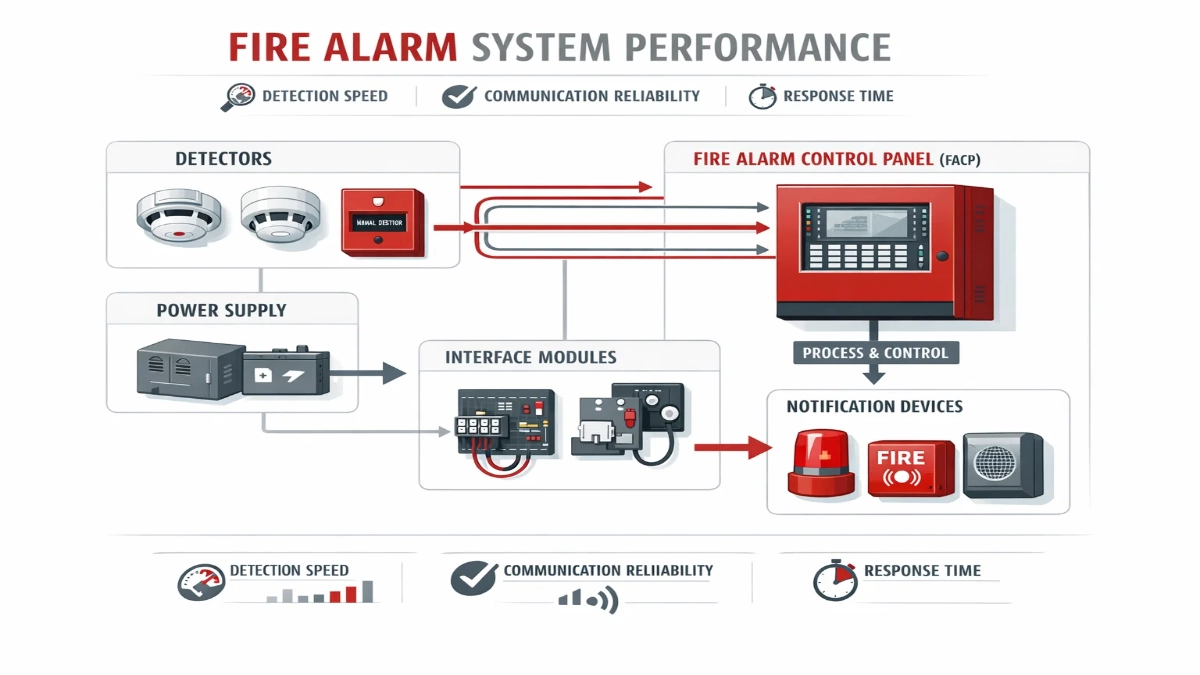
Each component plays a specific role in detection, signal transmission, processing and emergency response. If any component underperforms, the effectiveness of the entire system is reduced.
To understand this clearly, we must look at how component selection directly influences detection speed, communication reliability, system stability, compliance and long-term operational performance.
1. Fire Alarm Systems Operate in Real Time – There Is No Margin for Delay
A fire alarm system functions continuously, monitoring the protected environment every second. The moment fire conditions begin to develop, whether in the form of smoke, heat or combustion particles, the system must detect, process and respond immediately.
This process involves three critical stages:
Detection:
Detectors must identify fire conditions at the earliest possible stage. The sensitivity, sensing technology and environmental suitability of the detector determine how quickly detection occurs. If the detector is not appropriate for the environment, detection may be delayed or inaccurate.
Signal Transmission:
Once detection occurs, the signal must travel through communication loops or circuits to the control panel. This communication must be fast, stable and immune to electrical noise, voltage drops, or wiring faults.
Signal Processing and Response:
The fire alarm control panel must process the signal instantly and activate outputs such as sounders, strobes, annunciators and system integrations like HVAC shutdown or fire suppression activation.
If any component slows down or interrupts this chain, the system response is delayed. Even small delays can allow fire growth, increasing risk to occupants and assets.
2. Each Component Directly Influences Detection Reliability
Detection reliability depends heavily on the type, quality and suitability of the detector used. Different environments require different detection technologies.
For example:
- Smoke detectors are effective in clean environments such as offices and commercial buildings.
- Heat detectors are more suitable for dusty industrial environments where smoke detectors may generate false alarms.
- Multi-criteria detectors provide higher accuracy in critical environments like data centres.
If an incorrect detector type is selected, the system may either detect fire too late or generate frequent false alarms.
Delayed detection allows fire to grow before alarm activation, increasing damage and risk. False alarms, on the other hand, reduce system credibility. When false alarms occur frequently, occupants and facility staff may begin ignoring alarms, which is extremely dangerous during an actual emergency.
The correct detector selection ensures both fast detection and operational reliability.
3. Communication Components Determine Signal Integrity and System Stability
Once a detector senses fire, the alarm signal must reach the control panel without interruption. This depends on the integrity of communication loops, wiring, interface modules and panel communication capacity.
Poor component selection in this area can cause:
- Signal delays
- Communication errors
- Loss of device connectivity
- Inability to identify alarm locations
For example, if the wiring is not properly designed or if the panel capacity is exceeded, the system may experience slow communication polling. This means the control panel takes longer to receive and process alarm signals.
In addressable systems, each device has a unique address. This allows precise identification of the alarm location. However, this advantage is only effective if the communication infrastructure and panel capacity are properly engineered.
Poor communication design can result in intermittent faults that are difficult to diagnose and dangerous during emergencies.
4. Control Panel Capacity and Processing Capability Are Critical
The fire alarm control panel is responsible for managing all system communication and responses. Its processing capacity, loop capacity and system architecture determine how efficiently it can handle alarm signals.
If the control panel is undersized, several problems can occur:
- Slow response to alarm signals
- Limited ability to support system expansion
- Increased risk of system overload
- Difficulty in troubleshooting and maintenance
For example, in a large facility with hundreds of devices, an undersized panel may struggle to communicate with all devices efficiently. This results in delayed signal processing and slower alarm activation.
Proper panel selection ensures fast signal processing, stable communication, and long-term scalability.
5. Power Supply and Backup Components Ensure Continuous Operation
A fire alarm system must remain operational even during power failures. This is achieved through backup batteries and power supply systems.
If backup power components are not properly sized or selected, the system may shut down during electrical outages. This creates a dangerous situation where the facility is left without fire protection.
Common power-related failures include:
- Insufficient battery capacity
- Poor battery quality
- Improper charging systems
- Lack of maintenance monitoring
Proper power supply design ensures the system remains operational under all conditions, including extended power outages.
6. Poor Component Selection Leads to Real Operational Problems
In real projects, component selection mistakes often lead to serious operational issues.
Some common consequences include:
Detection delays:
Incorrect detector types or low-quality detectors may respond slowly to fire conditions.
False alarms:
Unsuitable detectors or poor-quality components can generate nuisance alarms, disrupting operations.
Communication failures:
Improper wiring or insufficient panel capacity can prevent alarm signals from reaching the control panel.
System shutdown during power failure:
Undersized or poor-quality batteries may fail to support the system during outages.
Compliance failures:
Using non-compliant or uncertified components can result in regulatory violations.
Increased maintenance costs:
Poor-quality components fail more frequently, increasing maintenance effort and cost.
These problems not only affect safety but also increase operational and financial risks.
7. Real-World Example: Impact of Incorrect Component Selection
Consider a large manufacturing facility using conventional fire alarm detectors instead of addressable detectors.
In conventional systems, detectors are grouped into zones rather than individually identified. When a fault or alarm occurs, the system only indicates the zone, not the exact device.
As a result:
- Maintenance teams must physically inspect multiple detectors to locate the issue
- Troubleshooting takes longer
- System downtime increases
- Fault resolution is delayed
In contrast, addressable systems identify the exact device and location, allowing faster response and repair.
This example demonstrates how proper component selection improves system efficiency, reliability and safety.
8. Component Selection Directly Affects Long-Term System Reliability
Fire alarm systems are expected to operate reliably for many years. Component quality plays a major role in long-term performance.
High-quality components provide:
- Stable communication
- Accurate detection
- Lower failure rates
- Easier maintenance
- Longer service life
Poor-quality components increase system instability, maintenance frequency and failure risk.
Over time, the operational cost of maintaining poor-quality components can exceed the initial savings from selecting cheaper equipment.
9. Component Selection Is an Engineering Responsibility, Not a Procurement Decision
Fire alarm component selection must be based on engineering requirements, not just cost considerations. Each component must be evaluated based on:
- Environmental suitability
- System compatibility
- Capacity requirements
- Compliance with standards
- Reliability and durability
Engineering-driven component selection ensures system performance, safety and compliance.
Procurement-driven selection based only on cost often results in poor system reliability and higher long-term costs.
High-Risk Environments Where Component Quality Is Critical
Fire alarm system component quality becomes significantly more important in high-risk and complex environments. In such facilities, fire incidents can escalate rapidly due to high fire loads, complex building layouts, sensitive equipment, or high occupant density.
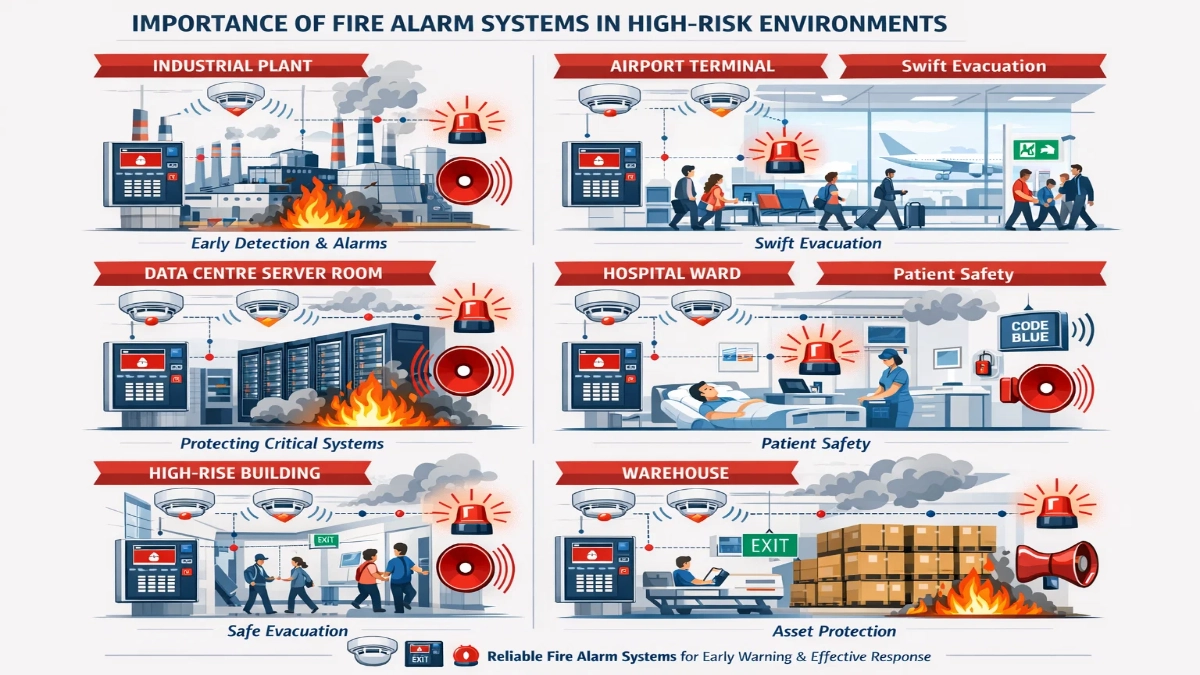
Unlike small buildings, these environments cannot tolerate delayed detection, communication failures, or unreliable system response. Every component, from detectors and control panels to power supplies and communication loops, must perform consistently under demanding conditions.
In these environments, fire alarm systems are not only responsible for detecting fire but also for coordinating evacuation, activating suppression systems, and protecting critical infrastructure. Even a minor component failure can result in major operational disruption, financial loss or risk to human life.
Below, we examine why component reliability is essential in each type of high-risk facility and how engineering-focused component selection directly affects system performance.
1. Industrial Plants with Combustible Materials
Industrial facilities present some of the most challenging fire detection environments. These facilities often contain combustible raw materials, flammable liquids, dust, chemicals and high-temperature processes. Fire growth in such environments can be rapid and severe.
Component reliability is critical because environmental conditions can affect detector performance. Dust, steam, vibration and temperature fluctuations can interfere with standard smoke detectors if they are not properly selected.
For example, in manufacturing plants such as textile mills, woodworking facilities and chemical processing units, airborne particles can cause false alarms if inappropriate detectors are used. Frequent false alarms may lead operators to disable or ignore alarms, which creates serious safety risks.
Control panels and communication modules must also operate reliably in electrically noisy industrial environments. Heavy machinery can generate electromagnetic interference, which may disrupt communication if components are not properly designed and shielded.
Power supply reliability is equally important. Industrial power systems often experience voltage fluctuations. Proper power supply units and backup batteries ensure continuous system operation even during electrical disturbances.
Failure of any component in such environments can allow fire to grow undetected, increasing damage and risk.
2. Airports with Large Passenger Occupancy
Airports represent large, complex infrastructures with high occupant density and continuous public movement. Fire alarm systems in airports must provide fast detection and clear notification across terminals, baggage areas, retail zones and operational spaces.
Component reliability is essential because evacuation coordination depends on accurate and timely alarm signals. Notification devices must provide clear and audible alerts across large open spaces with high ambient noise levels.
Detection components must also perform reliably in challenging environments such as:
- High ceilings
- Airflow from HVAC systems
- Dust and exhaust from ground operations
If detectors fail to detect fire quickly or if communication loops fail, evacuation delays can occur. In large public spaces, evacuation delays increase the risk significantly.
Control panels and annunciators must provide precise alarm location information so emergency teams can respond quickly.
System integration components must also function correctly to control HVAC shutdown, smoke extraction systems and access control.
3. Data Centres with Mission-Critical Equipment
Data centres require highly reliable fire detection because they protect mission-critical digital infrastructure. Even small fire incidents can cause significant operational and financial impact.
Early detection is essential to prevent damage to servers and communication equipment. Multi-criteria detectors and high-sensitivity detection systems are commonly used in these environments.
Component reliability is critical because:
- Equipment operates continuously
- Downtime is costly
- Fire suppression systems depend on reliable alarm activation
Interface modules must activate clean agent suppression systems without delay. If interface modules fail, suppression may not activate, allowing fire to spread.
Power supply reliability is also essential because data centres require continuous protection even during power outages.
Communication reliability is equally critical. Addressable systems must precisely identify alarm location so response teams can act immediately.
Poor component selection in data centres increases the risk of undetected fires and costly downtime.
4. Hospitals Where Evacuation Is Complex
Hospitals present unique fire safety challenges. Unlike commercial buildings, evacuation in hospitals is slow and complex due to patients with limited mobility, critical medical equipment and continuous care requirements.
Fire alarm system components must provide:
- Early and reliable detection
- Accurate alarm location identification
- Reliable communication and annunciation
Component failures in hospitals can delay emergency response, putting vulnerable patients at risk.
Notification devices must also be carefully selected. Alarm signals must alert staff without causing unnecessary panic among patients.
System integration components must control fire doors, elevators and HVAC systems to prevent smoke spread.
Power supply reliability is especially critical because hospitals must maintain fire protection even during extended power outages.
Failure of any fire alarm component in a hospital environment can compromise patient safety and emergency response.
5. High-Rise Buildings with Vertical Evacuation Challenges
High-rise buildings present significant fire safety challenges due to vertical evacuation requirements and large building size.
Fire alarm systems must provide reliable detection across multiple floors and ensure communication integrity throughout the building.
Component reliability is critical because:
- Alarm signals must travel long distances
- Communication loops must remain operational despite wiring faults
- Annunciators must provide clear alarm location information
Short circuit isolators and properly designed loop architecture improve system survivability in case of wiring faults.
Notification devices must provide clear alarms across all floors, including stairwells and evacuation routes.
Control panels must manage large numbers of devices without communication delays.
Component failures in high-rise buildings can delay evacuation and emergency response.
6. Warehouses with High Fire Load
Warehouses often contain large quantities of combustible materials such as packaging, plastics, textiles and stored goods. Fire growth in warehouses can be rapid due to high fuel load.
Detection components must provide reliable detection in large open spaces with high ceilings. Improper detector selection can delay fire detection.
Heat detectors, beam detectors, or aspirating detection systems are often used in warehouse environments, depending on ceiling height and storage layout.
Communication components must also remain reliable across large coverage areas.
Power supply and backup systems must support notification devices that cover large areas.
Failure of fire alarm components in warehouses can result in large-scale fire damage and operational loss.
7. Commercial Complexes with Mixed Occupancy
Commercial complexes combine multiple occupancy types such as offices, retail stores, restaurants and entertainment areas. Each area presents different fire risks and detection requirements.
Component selection must consider environmental differences across building areas.
For example:
- Kitchens require heat detectors
- Offices require smoke detectors
- Parking areas require specialised detection
Notification systems must also provide clear alarms across different occupancy zones.
Control panels must manage multiple zones and integrated building systems.
Component reliability ensures consistent system performance across the entire facility.
8. Impact on Life Safety, Asset Protection and Business Continuity
In high-risk environments, fire alarm system performance directly affects:
Life safety:
Reliable detection and notification enable safe evacuation and emergency response.
Asset protection:
Early detection reduces fire damage to equipment and infrastructure.
Business continuity:
Reliable fire alarm systems prevent extended operational downtime.
Component failures in these environments can result in:
- Increased fire damage
- Operational disruption
- Regulatory non-compliance
- Financial loss
- Safety risks
9. Engineering Approach to Component Selection in High-Risk Facilities
To ensure reliable performance, component selection must consider:
- Environmental conditions
- System capacity requirements
- Communication reliability
- Power backup requirements
- Integration requirements
- Compliance with standards
Engineering evaluation ensures components perform reliably under real operating conditions.
System Components Work as an Integrated Engineering Network
A modern fire alarm system is not a collection of independent devices. It functions as an integrated engineering network controlled by an addressable fire alarm control panel.
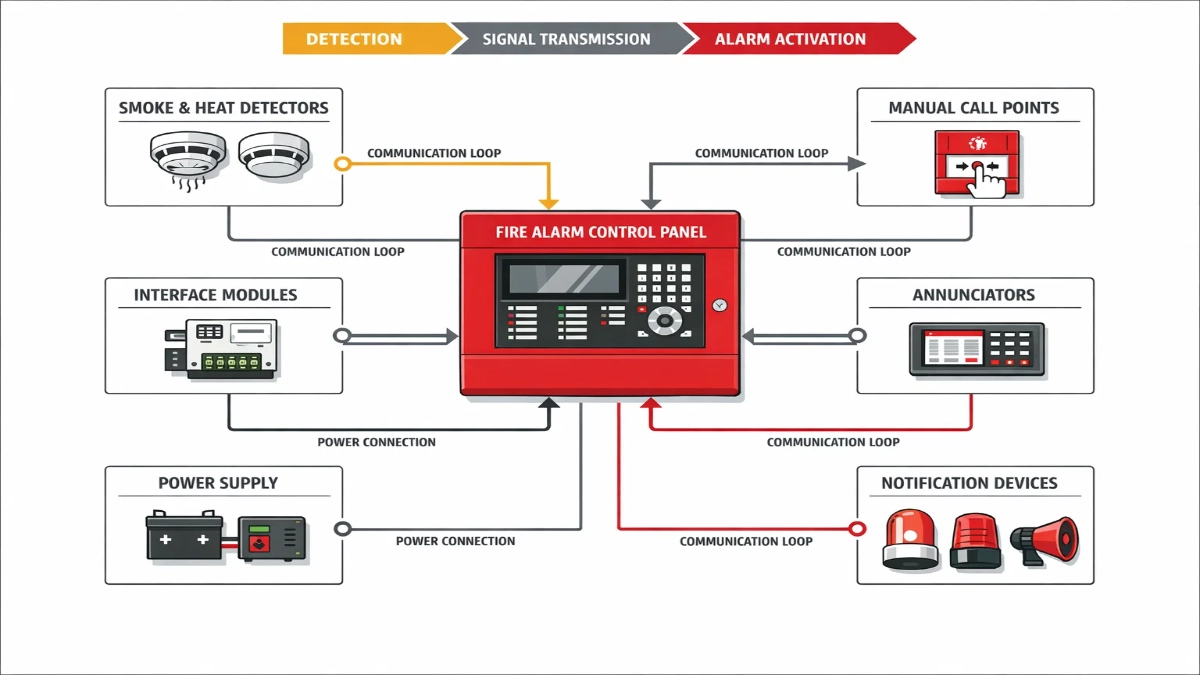
Core components include:
- Fire alarm control panel (FACP)
- Detection devices
- Manual call points
- Notification appliances
- Power supply and batteries
- Interface modules
- Communication loops
- Annunciators
- Integration interfaces
- Cabling and enclosures
Each component contributes to:
- Detection accuracy
- Signal integrity
- System reliability
- Emergency response speed
For example, selecting a high-quality GST addressable fire alarm system with proper loop isolation improves system survivability during wiring faults.
Industry guidance from organisations such as the National Fire Protection Association explains that system performance depends heavily on correct equipment selection and installation.
We will now examine each component in engineering detail and explain how it affects system performance.
2. Fire Alarm Control Panel (FACP)
The fire alarm control panel is the brain of the system. It manages communication with field devices, processes alarm signals, monitors faults and controls output activation.
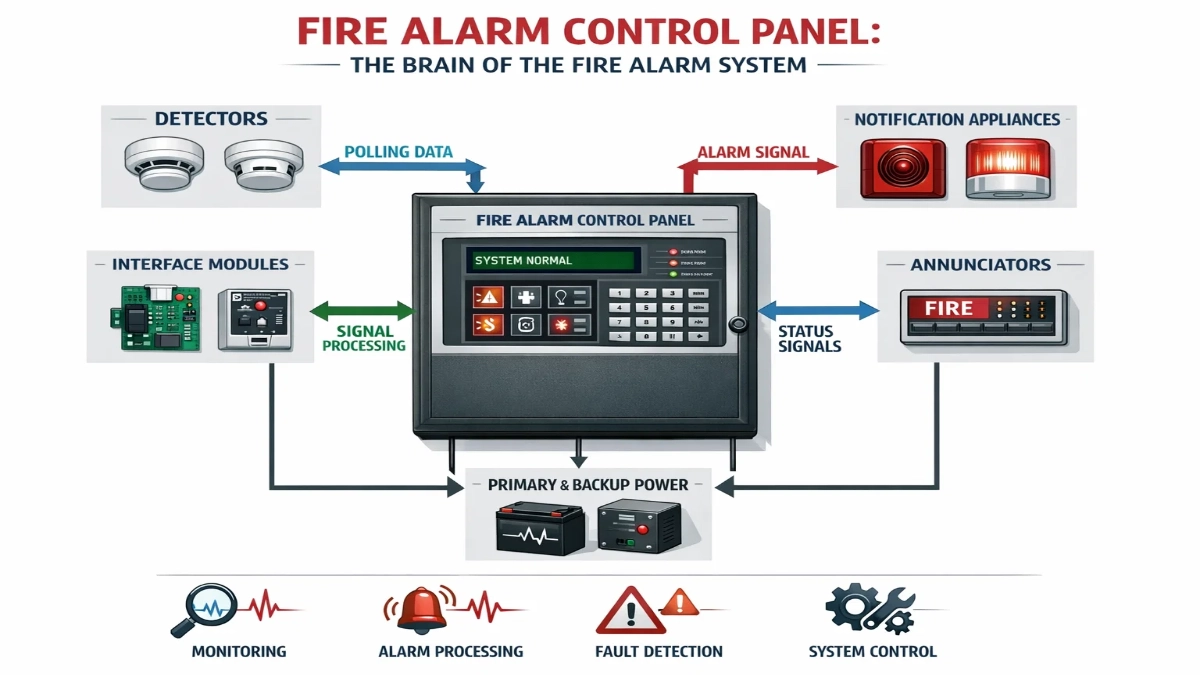
Every detector, module and notification appliance communicates through the panel. If the panel fails, the system becomes non-functional regardless of detector quality.
Core Functions of the Control Panel
The fire alarm control panel is the central decision-making unit of the entire fire alarm system. Every field device, detector, manual call points, modules, and notification appliances communicate with the control panel. The panel continuously monitors system conditions, processes incoming signals and activates appropriate responses. Its ability to perform these functions reliably determines how quickly and accurately the system responds during a fire or fault condition.
To understand its importance from an engineering perspective, we must examine its core operational functions.
1. Polling Addressable Devices
In an addressable fire alarm system, each field device has a unique digital address. The control panel continuously communicates with these devices through a process called polling. During polling, the panel sends communication signals to each device and waits for a status response.
This process confirms whether each device is:
- Operating normally
- Detecting fire conditions
- Experiencing faults
- Disconnected or missing
Polling happens continuously and very quickly, typically completing a full loop scan within a few seconds. This allows the system to detect fire conditions or faults almost immediately.
If polling is slow due to panel limitations or excessive device load, alarm detection and fault identification may be delayed. This is why control panel processing capacity and loop design are critical engineering considerations.
2. Processing Alarm Signals
When a detector senses smoke, heat or fire, it sends an alarm signal to the control panel. The panel must immediately process this signal and determine the appropriate response.
The panel performs several actions during alarm processing:
- Identifies the exact device in the alarm
- Displays the alarm location on the screen
- Activates alarm outputs such as sounders and strobes
- Sends signals to integrated systems
Fast and accurate alarm processing ensures rapid occupant notification and emergency response.
If the control panel is overloaded, undersized or poorly designed, alarm processing delays can occur. Even small delays can increase risk in fast-developing fire situations.
3. Monitoring Faults and Trouble Conditions
In addition to detecting fire, the control panel continuously monitors system health. It identifies faults that may affect system performance.
Common faults include:
- Device communication failure
- Open circuit wiring faults
- Short circuit conditions
- Power supply problems
- Battery faults
The control panel immediately reports these issues, allowing maintenance teams to take corrective action.
This fault monitoring capability ensures the system remains operational and reliable at all times.
Without proper fault monitoring, system failures may go unnoticed until an emergency occurs.
4. Activating Notification Appliances
Once the control panel confirms an alarm condition, it activates notification appliances to alert occupants.
These include:
- Sounders
- Horns
- Strobes
- Speakers
The panel sends output signals to these devices through output circuits or addressable modules.
Proper activation ensures occupants receive clear and immediate warning, allowing safe evacuation.
If the control panel fails to activate notification devices correctly, occupants may not be alerted in time.
5. Controlling Integration Outputs
Modern fire alarm systems integrate with other building systems. The control panel manages these integration functions through control modules and output circuits.
Typical integration functions include:
- Shutting down HVAC systems
- Activating fire suppression systems
- Releasing magnetic door holders
- Controlling smoke extraction systems
- Recalling elevators
These actions help prevent fire and smoke spread and improve evacuation safety.
Reliable control panel operation ensures these integration actions occur immediately when required.
6. Logging System Events
The control panel maintains a detailed event log of system activity. This includes:
- Alarm events
- Fault conditions
- System resets
- Device status changes
Event logs help engineers and maintenance teams analyse system performance and troubleshoot issues.
This information is also important for compliance reporting and system audits.
Accurate event logging improves long-term system management and reliability.
Addressable panels assign unique addresses to devices, allowing precise identification of alarm locations.
Modern panels, such as those in the fire alarm control panel category, use distributed intelligence and microprocessor-based communication.
Importance of Processing Capacity and Loop Capacity
Panel selection must consider:
- Maximum number of supported devices
- Number of communication loops
- Polling speed
- Processing power
In large industrial facilities, using undersized panels causes communication delays and limits expansion capability.
For example, if a panel supports only 250 devices but the system requires 600 devices, engineers must install additional panels, increasing complexity and cost.
Guidance from the Fire Protection Association emphasises proper panel sizing for system reliability.
Failure Risks from Poor Panel Selection
Poor panel selection leads to:
- Communication overload
- System’s slow response
- Limited expansion capability
- Increased failure risk
- Difficult troubleshooting
In a real project, an undersized panel caused polling delays of 10 seconds, delaying alarm activation.
Proper engineering selection ensures reliable system performance.
3. Power Supply and Backup Systems
Power supply reliability directly determines whether the system remains operational during emergencies.
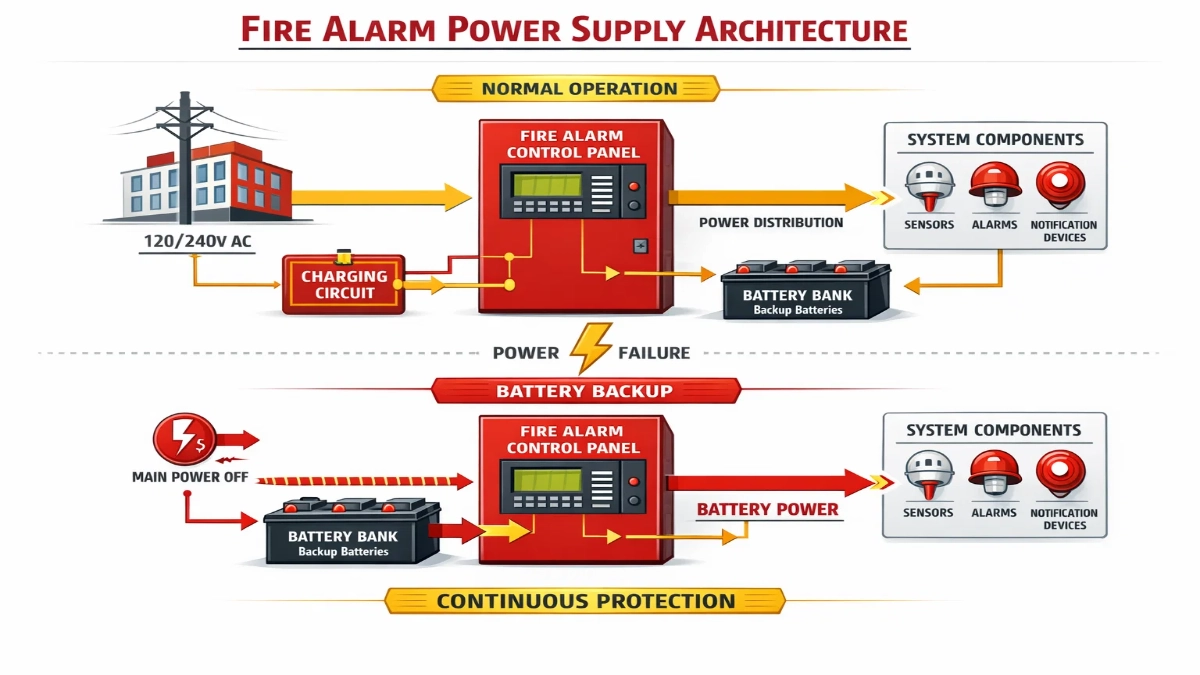
Fire alarm systems use:
- Primary AC power supply
- Backup battery supply
Backup power ensures operation during mains failure.
Importance of Battery Backup Capacity
Battery sizing must consider:
- System current consumption
- Standby duration requirements
- Alarm load duration
Standards from the National Fire Protection Association require standby operation, typically for 24 hours plus alarm operation duration.
Undersized batteries cause system shutdown during a power failure.
Real-World Failure Scenario
In one facility, batteries supported only 4 hours of operation instead of the required 24 hours. During a power outage, the system failed before the fire occurred.
Proper battery selection prevents such failures.
4. Fire Detection Devices
Detectors are the first line of defence. Their performance directly determines detection speed and accuracy.
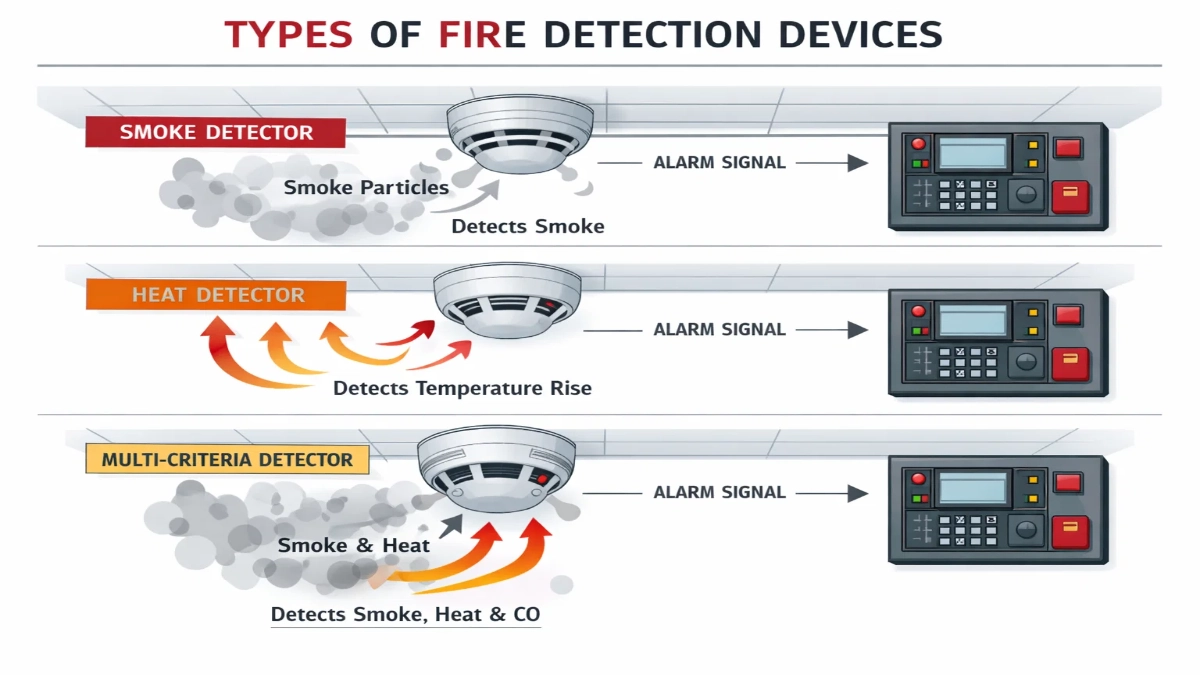
Modern systems use addressable fire alarm detectors for precise detection.
Detector types include:
- Smoke detectors
- Heat detectors
- Multi-criteria detectors
Guidance from IFSEC Global explains detector selection importance.
Incorrect detector selection leads to false alarms or delayed detection.
5. Manual Alarm Initiation Devices
Manual call points allow occupants to initiate alarms.
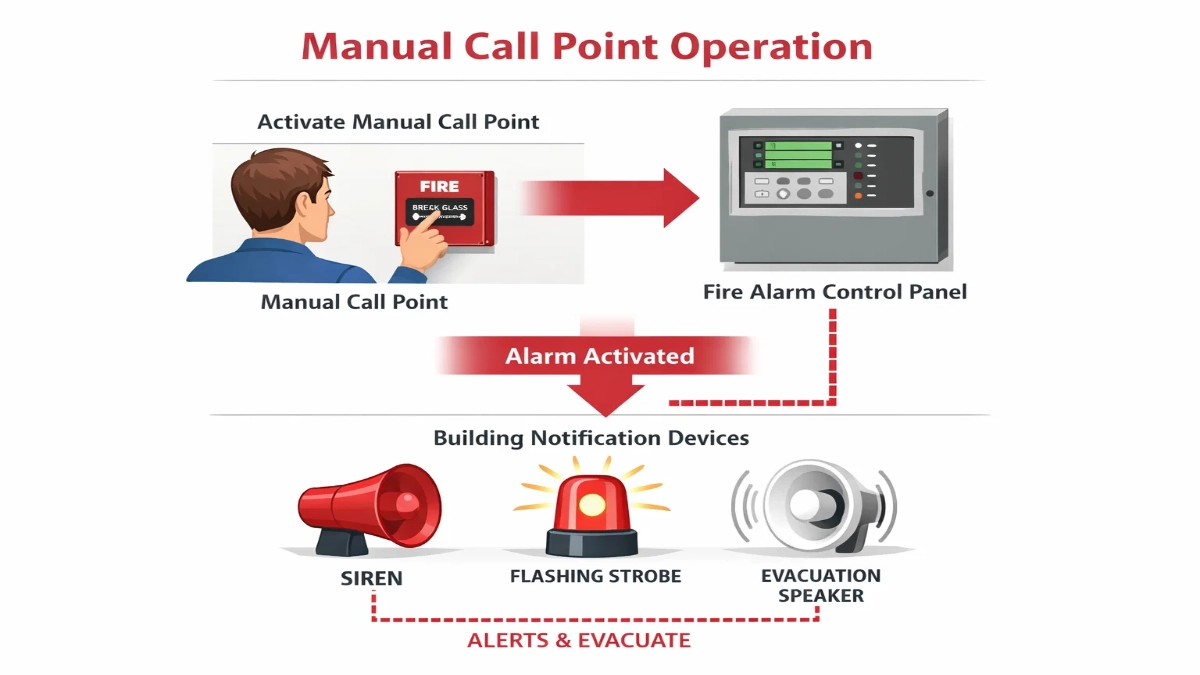
They are critical when fire is detected visually before automatic detection.
Placement must ensure accessibility and visibility.
6. Alarm Notification Devices
Notification devices alert occupants.
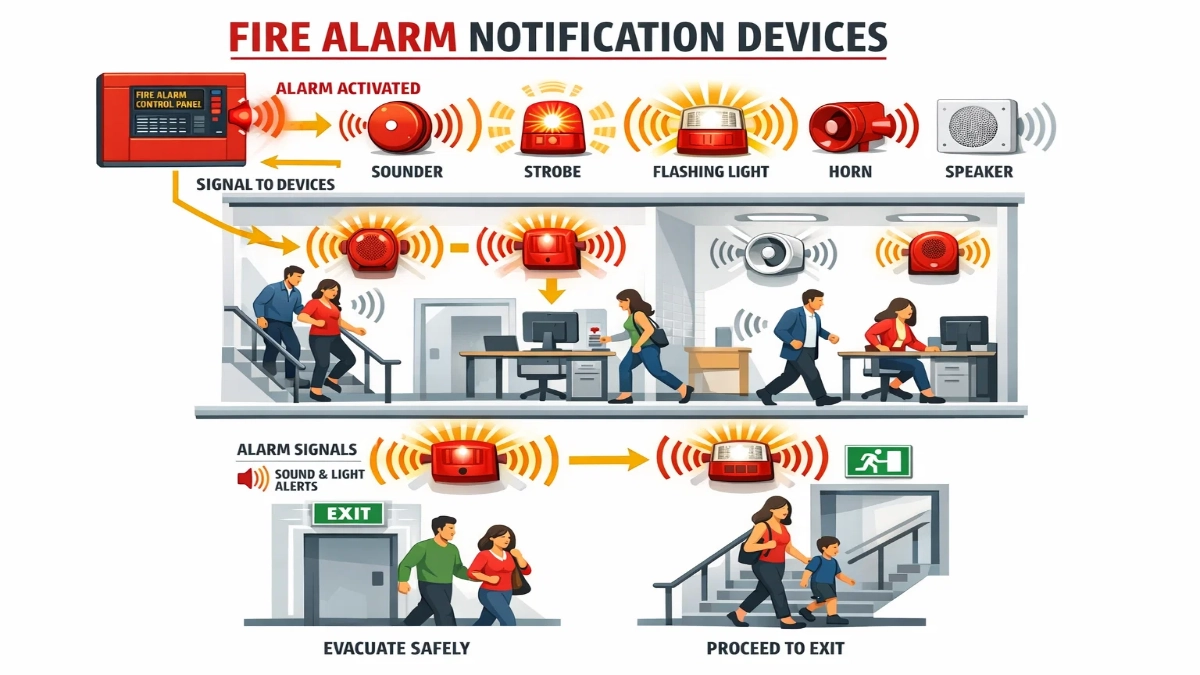
Devices include:
- Sounders
- Strobes
- Speakers
Poor audibility prevents evacuation.
7. Control and Monitoring Modules
Modules connect external systems.
They monitor inputs and control outputs.
Modules enable integration with suppression systems.
8. Communication Loops and Circuit Architecture
Loop architecture determines communication reliability.
Short circuit isolators improve survivability.
Proper wiring prevents communication failure.
Engineering discussions on platforms like Fire Engineering emphasise loop design.
9. System Integration Components
Fire alarm systems integrate with:
- HVAC shutdown
- Fire suppression
- Building management systems
Integration improves emergency response.
10. Annunciation and User Interface Devices
Annunciators provide alarm information.
They improve response speed.
11. Enclosures, Cabling and Passive Components
Cable quality affects signal integrity.
Fire-rated cables ensure operation during a fire.
12. Codes, Standards and Compliance Impact on Component Selection
Component selection must comply with standards such as:
- NFPA 72
- EN 54
- IS standards
These resources provide engineering guidance.
13. Common Component Selection Mistakes Consultants Should Avoid
Common mistakes include:
- Undersized control panels
- Incorrect detector selection
- Poor wiring design
- Insufficient battery capacity
- Lack of loop isolation
These mistakes cause system failure.
Final Engineering Perspective: Why Every Component Decision Matters
A fire alarm system is only as reliable as the components that make up its detection, communication and control network. Every element, from detectors and control panels to power supplies and wiring, must be correctly selected and engineered to ensure fast detection, uninterrupted signal transmission, and immediate alarm activation.
If even one component is undersized, unsuitable for the environment or unreliable, it can delay detection, disrupt communication or prevent proper system response. This risk becomes even more critical in high-risk environments such as industrial plants, hospitals and high-rise buildings, where system failure can directly impact life safety and operations. Proper engineering-based component selection ensures consistent performance, long-term reliability and effective fire protection when the system is needed most.
Read Also: Why should you use Addressable Fire Alarm Systems for Large-Scale Projects?