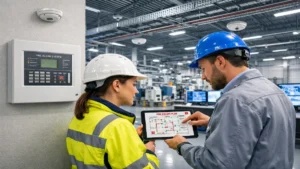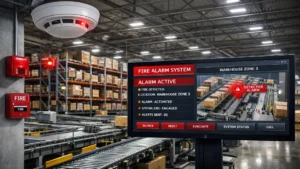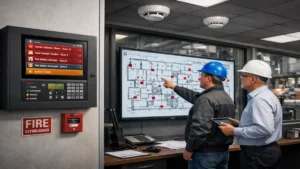
Fire alarm systems are rarely designed to fail. They fail quietly during expansion.
In Phase-1 of most projects, the fire alarm system works perfectly. All detectors respond, panels communicate and compliance certificates are issued. Everyone moves on.
Then Phase-2 happens.
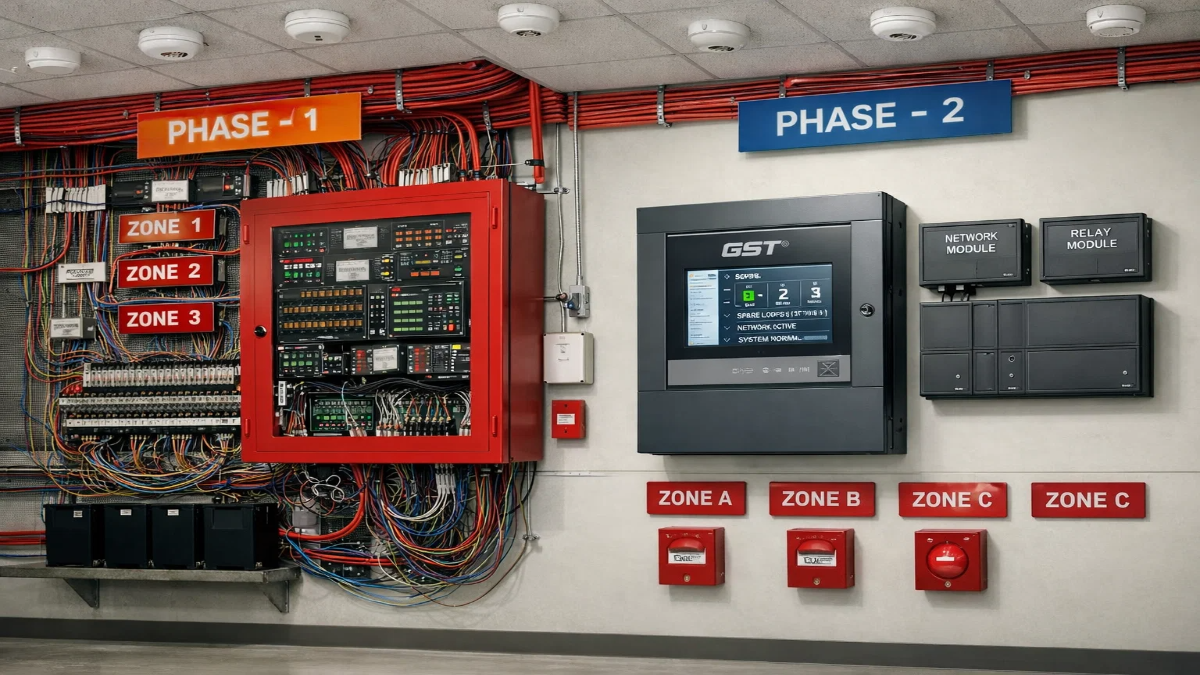
A new block is added. Another floor is constructed. A warehouse expands. Suddenly, engineers discover that the original fire alarm system cannot scale without major changes. Loops are full. Panel capacity is exhausted. Cable pathways are overloaded. Integration becomes complex and expensive.
This is a fire alarm system scalability problem; a problem no one notices until it is too late.
In this article, we will explain:
- What scalability really means in fire alarm systems
- Why most systems fail during expansion
- Common mistakes engineers make in Phase-1
- How modern systems like GST fire alarm systems solve scalability challenges
- Practical planning strategies engineers should adopt from Day-1
What Is Fire Alarm System Scalability?
Fire alarm system scalability is the ability of a system to expand without redesigning, replacing or disrupting the existing installation.
A scalable system allows:
- Addition of more detectors
- Extension of loops or zones
- Integration of new buildings or floors
- Networked communication between panels
All while maintaining:
- Compliance with fire codes
- System reliability
- Clear fault monitoring
- Cost efficiency
Unfortunately, many systems are only designed for the current scope, not future growth.
Why Scalability Is Ignored in Phase-1 Projects
1. Budget Pressure at Early Stages
During initial construction, cost control is the priority. Project owners often say:
“Let’s install what we need now. We’ll upgrade later.”
This leads to:
- Selection of undersized panels
- Minimum loop capacity
- No spare I/O or network provision
A conventional fire alarm panel is often chosen because it is cheaper upfront, without considering future expansion.
2. Expansion Plans Are “Not Confirmed Yet”
Many developers know expansion will happen, but avoid planning for it because:
- Future layouts are unclear
- Phase-2 funding is not approved
- Consultants are instructed to “design only Phase-1”
The result is a system with zero scalability margin.
3. Misunderstanding Panel Capacity vs Real-World Load
On paper, a panel may support 250 devices.
In reality:
- Long cable runs reduce capacity
- Sounders and modules consume addresses
- Future cause-and-effect logic increases load
By Phase-2, the system is already at its limit.
How Expansion Breaks Original Fire Alarm Designs
1. Address Exhaustion in Addressable Systems
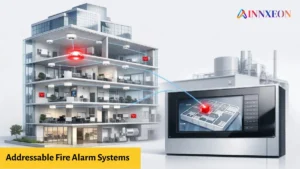
An addressable fire alarm panel assigns a unique address to each device.
The problem?
- Engineers often design loops at 80–90% capacity
- No spare addresses are left
When Phase-2 begins:
- New addressable detectors cannot be added
- Entire loops must be split or replaced
- Panel upgrades become unavoidable
2. Zone Limitations in Conventional Systems
A conventional fire alarm panel divides the building into zones instead of addresses.
During expansion:
- Zones are already fully utilised
- New areas require new panels
- Fire alarm zoning becomes confusing and non-compliant
Adding more conventional detectors often results in:
- Reduced fault isolation
- Difficult maintenance
- Higher false alarm risk
3. Cable Infrastructure Becomes a Bottleneck
Original designs often:
- Use minimum cable sizes
- Avoid spare conduits
- Do not plan loop extension routes
During Phase-2:
- New cabling disturbs occupied areas
- Fire stopping must be redone
- Downtime increases
This is one of the most expensive scalability failures.
4. Cause-and-Effect Logic Becomes Overloaded
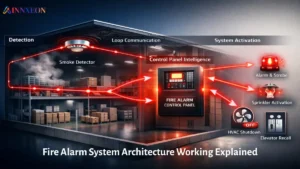
Modern fire alarm systems are logic-driven:
- Detector → Panel → Output action
As buildings expand:
- More scenarios are added
- Logic tables grow complex
- Older panels struggle with processing load
This affects response time and system stability.
Why Fire Alarm Scalability Is a Safety Issue, Not Just a Cost Issue
Scalability failures do not just increase cost; they increase risk.
Poorly expanded systems often lead to:
- Delayed alarm response
- Incorrect output activation
- Disabled zones during modifications
- Confusing event displays for operators
In emergencies, clarity and speed matter. Scalability directly impacts life safety.
How Engineers Should Plan for Scalability from Day-1
1. Select a Panel Designed for Growth
Engineers should always choose a system that supports:
- Multiple loops
- Networkable panels
- Software-based expansion
A modern GST fire alarm system is designed with scalability in mind:
- High device capacity per loop
- Network-ready architecture
- Modular expansion without replacing panels
2. Design Loops at 60–70% Capacity Maximum
Best practice:
- Never exceed 70% of the loop capacity in Phase-1
- Reserve addresses for future expansion
This applies to:
- Addressable detectors
- Sounders
- Interface modules
Spare capacity is not waste; it is planning.
3. Always Plan for Panel Networking
Even if Phase-1 uses a single panel:
- Ensure the panel supports networking
- Leave space for communication cards
- Allocate IP or fibre pathways
Networked addressable fire alarm panels allow:
- Multi-building integration
- Centralized monitoring
- Seamless Phase-2 addition
4. Choose Systems with Software-Based Configuration
Scalable systems rely on:
- PC-based programming
- Flexible cause-and-effect logic
- Easy database expansion
GST fire alarm systems allow engineers to:
- Add new devices without reprogramming the entire system
- Modify logic without downtime
- Maintain clean event mapping
5. Design Cable Infrastructure for the Future
Engineers should:
- Oversize conduits
- Use loop topology where possible
- Provide spare pathways to expansion zones
This reduces:
- Rework
- Occupant disruption
- Fire-stopping costs
Addressable vs Conventional Systems: Scalability Comparison
| Feature | Addressable Fire Alarm Panel | Conventional Fire Alarm Panel |
|---|---|---|
| Expansion capability | High | Limited |
| Device identification | Individual addresses | Zone-based |
| Fault isolation | Precise | Broad |
| Phase-2 integration | Smooth with planning | Often requires replacement |
| Long-term cost | Lower | Higher |
For projects with any future expansion, addressable systems are the clear choice.
Real-World Scenario: Phase-2 Failure vs Scalable Success
Scenario A: Poor Scalability Planning
- Phase-1 installed a small conventional panel
- Zones fully utilized
- Phase-2 required a new building
Result:
- New panel installed
- No common monitoring
- Confusing fire response
Scenario B: Scalable GST-Based Design
- Phase-1 used a GST addressable panel
- Loops loaded at 65%
- Network provision included
Result:
- Phase-2 added devices seamlessly
- No panel replacement
- Unified fire command centre
The difference was planning, not budget.
Why GST Fire Alarm Systems Are Built for Scalable Projects
GST fire alarm systems are widely adopted in:
- Industrial campuses
- Airports
- IT parks
- Large commercial buildings
Key scalability advantages include:
- High loop and panel capacity
- Robust networking architecture
- Reliable addressable detectors
- Easy integration with BMS and suppression systems
For engineers, this means:
- Fewer redesigns
- Lower lifecycle cost
- Better system reliability
Common Mistakes Engineers Should Avoid
- Designing for maximum capacity in Phase-1
- Ignoring future cable routing
- Selecting panels without networking support
- Choosing conventional systems for expandable sites
- Treating scalability as a “later problem”
Every one of these mistakes becomes expensive in Phase-2.
Final Thoughts: Design for Phase-2, Not Just Phase-1
Fire alarm scalability is not optional anymore.
In a world of phased construction, changing occupancies and expanding facilities, designing only for today is designing for failure tomorrow.
Engineers who plan for scalability:
- Protect life safety
- Reduce future costs
- Avoid system replacements
- Deliver long-term value
The best fire alarm designs are not the cheapest on Day-1; they are the ones that still work flawlessly in Phase-2, Phase-3 and beyond.
And that is where a well-planned GST fire alarm system truly proves its value.
Read Also: How Engineers Misjudge Fire Alarm Response Time
Read Also: Reliable and Cheapest Fire Alarm Panel Replacement for Legacy Systems