Designing a fire alarm system for a multi-building campus is very different from protecting a single commercial building. You don’t just need detection and alerting; you need scalability, zoning clarity, fast response visibility and long-term service simplicity. Add expansions, tenant changes and phased construction into the mix, and the project becomes a real engineering challenge.
In this article, we’ll walk through how we designed a scalable campus-wide fire alarm network using a GST addressable architecture, built to handle multiple buildings, different occupancy types and future growth without redesigning the entire system.
Whether you manage a university, industrial park, hospital campus, IT SEZ, warehouse cluster or township, this approach will help you understand what actually works in real-world deployments across India.
Project Snapshot: What We Needed to Solve
The campus had:
- Multiple buildings (admin, academic/office blocks, utility rooms, parking zones and service corridors)
- Different usage profiles (public spaces + restricted technical areas)
- Long cable routes between blocks
- A need for central monitoring from a main security room
- A requirement to support future buildings without the replacement of core infrastructure
- Minimal downtime during integration and testing
The client’s priority was simple:
“We want strong compliance, quick response and a system that doesn’t collapse when we expand.”
This is exactly where a GST fire alarm system with a network-ready addressable layout becomes the right fit.
Why GST Addressable Architecture Made Sense for a Campus
A multi-building campus needs more than basic alarms. It needs intelligence and clarity.
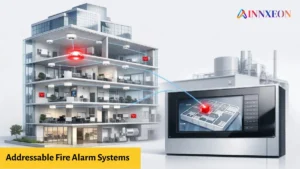
With a properly designed addressable fire alarm panel network:
- Every device has its own identity.
- Events are pinpointed down to the device level.
- Troubles are easy to trace and fix.
- System expansions don’t require redesigning everything.
- The control room gets a clean, centralised view.
Compare that to a basic setup with a conventional fire alarm panel, where zones represent groups of devices and identifying the exact device location can take longer during an emergency.
For a campus environment, seconds matter and so does location accuracy.
Step 1: We Started With Risk Mapping, Not Just Drawings
Many fire alarm projects start with layouts and BOQ. We started with something more practical:
Risk-first planning
We mapped:
- Occupancy type (office, classroom, lab, electrical, parking)
- Fire load (paper storage, server rooms, kitchens, DG rooms)
- Airflow conditions (false ceilings, AHU zones)
- Evacuation complexity (public movement patterns)
- Critical assets requiring early detection (data rooms, electrical panels)
This allowed us to design fire alarm coverage based on behaviour and risk, not just building shape.
Step 2: We Designed a Modular Loop Strategy Per Building
The biggest issue in campus projects is loop overload and poor isolation.
So we designed the structure like this:
One building = one primary loop strategy
Instead of making one huge campus loop, we used:
- Separate loops per building or block
- Clear vertical segmentation (floors separated logically)
- Logical mapping of high-risk areas (electrical rooms, UPS, server rooms) to dedicated loop sections
This design delivered:
- Better fault containment
- Cleaner commissioning
- Easier future additions
- Faster troubleshooting
This is where addressable detectors play a major role because every detector reports individually, which helps the maintenance team pinpoint issues without guesswork.
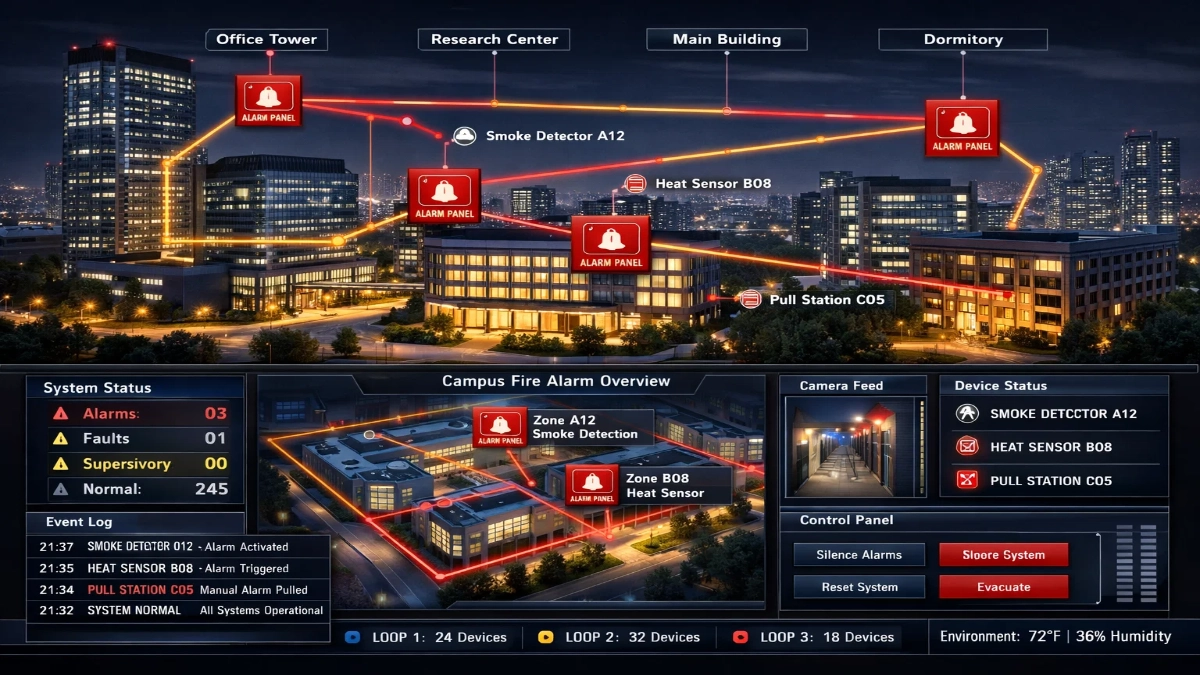
Step 3: We Created a “Network Core + Building Nodes” Model
To keep the system scalable, we followed a campus-style topology:
Central monitoring hub (Main Security Room)
- One main control location
- Central event visibility
- Unified reporting
Distributed panels (Building-Level Nodes)
Each major building had a panel positioned strategically for:
- Shorter wiring routes
- Quicker local access
- Better response control
This approach supports a growing campus because you can add new building panels later without disturbing the network backbone.
Step 4: We Standardized Devices to Reduce Operational Errors
Multiple teams manage a multi-building campus over time, including security, maintenance, facilities and contractors.
So device standardisation reduces long-term confusion.
We standardised:
- Smoke and heat detection types based on the zone environment
- Sounder + strobe logic based on occupancy
- Manual call points at exits and critical locations
- Device labelling rules across all buildings
When the system expands in the future, the same design language continues.
That’s how scalability becomes operational, not just technical.
Step 5: We Balanced Addressable and Conventional Zones Where Needed
Yes, the primary design was addressable. But practical engineering means using the right tool for the right area.
Some areas benefit from conventional wiring due to:
- Smaller isolated rooms
- Predictable fixed layouts
- Minimal change expected over time
- Cost optimisation while staying compliant
So in a few controlled zones, we used a conventional fire alarm panel strategy as sub-coverage while still keeping the campus backbone addressable.
This hybrid thinking is especially helpful in service blocks like:
- Pump rooms
- Small utility cabins
- External storage rooms
- Temporary facility zones
The key is: Use conventional detectors only where they simplify without weakening safety.
Step 6: We Implemented Naming, Grouping, and Location Logic Like a Map
In campus deployments, speed is not only about detection, but it’s also about response clarity.
So every device identity was built using a consistent format:
[Building Code] – [Floor] – [Zone Type] – [Device Number]
Example:
- B2-F3-COR-SD-014 (Building 2, Floor 3, Corridor, Smoke Detector)
This makes it easy for security teams to respond quickly, even if they are new to the site.
And it becomes a lifesaver during:
- Fire drills
- Troubleshooting
- System audits
- Expansions
This is an underrated strength of a well-designed addressable fire alarm panel implementation.
Step 7: We Designed Alarm Cause & Effect for Controlled Evacuation
A scalable campus system must avoid two extremes:
- Full campus evacuation from a small local issue
- No escalation when a major event spreads
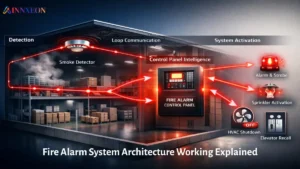
So we built “Cause & Effect” logic in layers:
Local events stay local (when safe)
- Alert the affected building
- Activate local sounders and strobes
- Inform the central control room
Cross-building escalation happens only with rules
Example triggers:
- Multiple detectors in one area
- Detection + manual call point activation
- Fire alarm confirmed by repeated events
This protects the campus from panic while ensuring real emergencies trigger full action.
Step 8: We Planned Cable Routes for Reliability and Maintenance
Campus fire alarm cabling has one major enemy:
distance + interference + physical damage risks
So we planned cable routes with:
- Safer pathways away from heavy electrical loads
- Minimal joints
- Accessible inspection points
- Protected conduits in exposed areas
- Clear separation between signal and power routes
We also ensured that future pathways remain available for campus expansion, so the client doesn’t end up breaking walls again later.
Step 9: We Used Zoning That Matches Campus Movement
Many systems fail because zoning does not match real-life movement.
So we designed zoning based on:
- Entry/exit flow
- Staircases and vertical travel routes
- Lobbies and corridors
- Occupancy density zones
This ensures evacuation instructions feel logical.
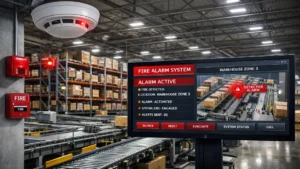
- When fire is detected, responders instantly understand:
- “Which building?”
- “Which floor?”
- “Which section?”
- “Which detector triggered?”
That is exactly why a structured gst fire alarm system delivers better response accuracy on campuses.
Step 10: Commissioning Was Planned as a Phase-Based Checklist
Campus projects usually run in phases. That means:
- Building A starts operating before Building B is ready
- Some zones go live earlier
- Expansion is continuous
So commissioning was structured with:
Stage 1: Device installation validation
- Continuity checks
- Device addressing
- Base wiring verification
Stage 2: Loop testing per building
- Alarm activation tests
- Fault simulation tests
- Power loss simulation
Stage 3: Network integration testing
- Panel-to-panel event visibility
- Central monitoring verification
- Cause & effect validation
Stage 4: Documentation and handover
- Device list
- Loop maps
- Testing reports
- Maintenance SOPs
This approach reduced delays, reduced rework and kept compliance clean during audits.
Real Engineering Challenges We Solved (And How)
1) Long-distance reliability between buildings
Solution: We kept building loops independently and relied on structured panel networking instead of dragging loops across long distances.
2) Different building types within one campus
Solution: Risk-based device planning ensured labs, offices and utilities got the right detection approach.
3) Maintenance team continuity problems
Solution: Standard naming, device mapping and documentation made the service easier even if staff changed later.
4) Expansion readiness
Solution: Extra capacity planning ensured new buildings could join the system with minimal disruption.
Why This Design Becomes Scalable in the Real World
“Scalable” is not just adding more devices.
A scalable fire alarm network means:
- Easy expansions without breaking the existing configuration.
- New building additions without rewiring old blocks.
- Clear event visibility for faster response.
- Low downtime during upgrades.
- Long-term service simplicity.
By designing the system around these principles, the campus gets a fire alarm network that stays stable even after years of growth.
What EPC Teams and Facility Managers Learn From This Approach
If you’re planning a large campus project, here are the top lessons:
- Use building-based loops for fault containment
- Keep the core network design modular
- Standardise device naming and mapping from day one
- Plan cause & effect like traffic control, avoid chaos
- Balance addressable and conventional, where it truly makes sense
- Commission in phases to prevent rework
- Document like you’re designing for the next 5 years, not just handover day
This is how campuses stay compliant and operational without headaches.
Read Also: Why Choose Innxeon Technologies for Fire Alarm Systems Across PAN India?
Read Also: Top Reasons EPC Contractors Partner with Innxeon for Fire Alarm Projects