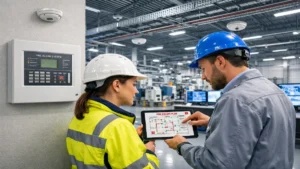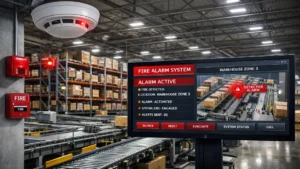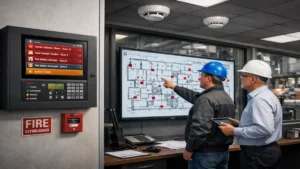
Fire alarm response time is one of the most critical yet misunderstood aspects of fire protection engineering. On paper, many fire alarm designs appear compliant, efficient and well-calculated. But in real buildings, factories, hospitals, malls, data centres and high-rise offices, the response time often fails to match expectations.
The problem is not negligence. Most engineers misjudge fire alarm response time due to outdated assumptions, simplified calculations and limitations of legacy systems. These misjudgments only become visible after commissioning, audits or worse, during an actual fire incident.
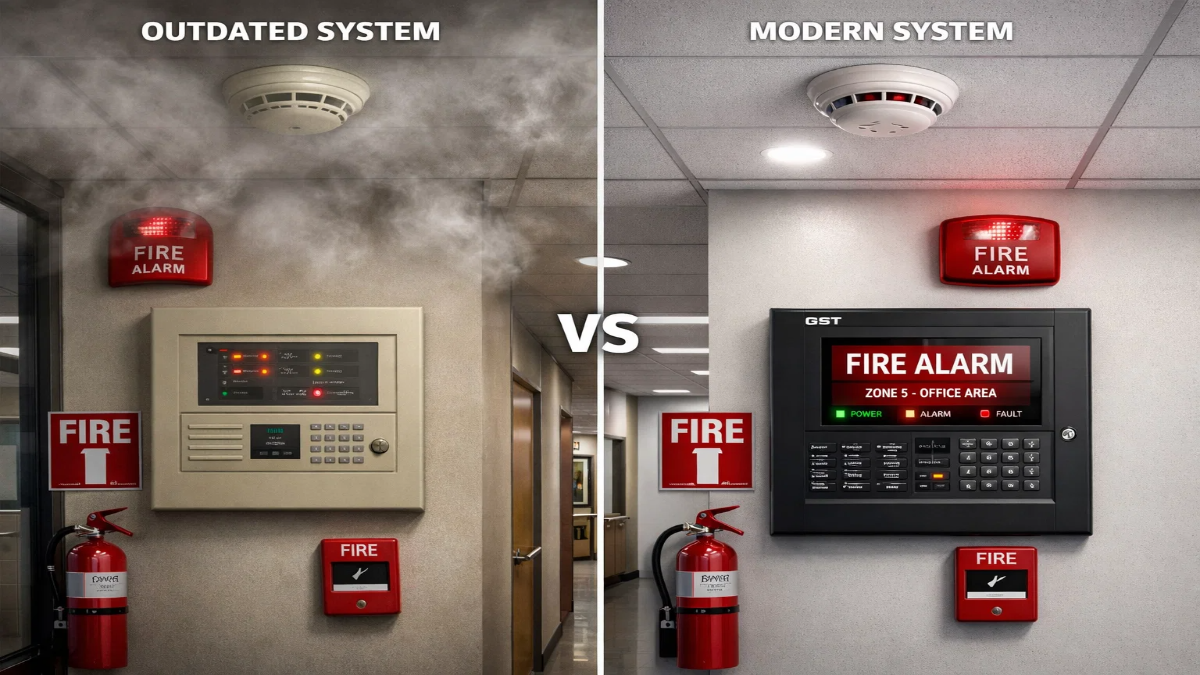
This article explains why engineers misjudge fire alarm response time, the technical and practical factors behind delayed detection and how modern GST fire alarm systems help engineers design faster, more reliable fire detection networks.
What Is Fire Alarm Response Time?
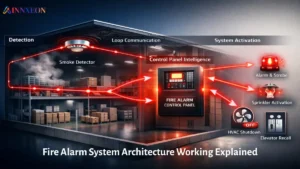
Fire alarm response time is the total time taken from the moment a fire starts to the moment occupants and responders receive a confirmed alarm.
It includes:
- Smoke or heat generation
- Detector sensing time
- Signal transmission to the fire alarm panel
- Panel processing and verification
- Activation of sounders, strobes, and interfaces
- Communication to fire command centres or BMS
Many engineers focus only on detector sensitivity and panel specifications, but real-world response time depends on system design, environmental conditions and technology choices.
Why Fire Alarm Response Time Is Commonly Misjudged
1. Over-Reliance on Ideal Test Conditions
Most fire alarm components are tested under controlled laboratory conditions. Engineers often assume these response times apply directly to real buildings.
In reality:
- Smoke does not rise uniformly
- Airflows dilute the smoke concentration
- Heat stratification delays activation
- Obstructions slow the travel
As a result, detectors take longer to react than expected.
2. Assuming All Detectors Respond the Same Way
A common design mistake is treating all detectors as equal.
In practice:
- Conventional detectors respond more slowly due to zone-based logic
- Older smoke detectors struggle with low-density smoke
- Heat detectors activate much later than smoke detectors
- Poor detector selection delays detection by minutes
Modern addressable detectors provide faster and more precise detection because each device communicates individually with the panel.
3. Zone-Based Thinking Still Dominates Designs
Many engineers still design systems around zones rather than device-level intelligence.
With a conventional fire alarm panel, the panel waits for a zone threshold to be reached before confirming an alarm. This adds processing delay, especially in large zones.
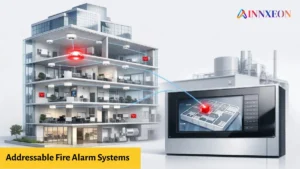
An addressable fire alarm panel, on the other hand, identifies the exact detector instantly, reducing verification time and false delays.
4. Ignoring Environmental Effects
Fire alarm response time varies significantly based on the environment.
Common overlooked factors include:
- High ceilings and atriums
- HVAC airflow patterns
- Dust, steam, and humidity
- Industrial fumes
- Temperature gradients
In such conditions, basic detectors react slowly or produce false alarms, leading engineers to reduce sensitivity, further increasing response time.
5. Delays Inside the Fire Alarm Panel Itself
Engineers often focus on detectors and forget the panel’s processing capability.
Legacy panels:
- Scan devices slowly
- Have limited CPU processing
- Use outdated polling methods
- Struggle with large device counts
Modern panels like the GST fire alarm system use fast loop polling, advanced algorithms and parallel processing to significantly reduce internal delays.
6. Poor Loop Design and Cable Length Miscalculations
Long cable runs and overloaded loops increase communication time.
Common mistakes include:
- Exceeding recommended loop lengths
- Adding too many devices per loop
- Using poor-quality cables
- Ignoring voltage drops
Addressable systems require precise loop engineering to maintain fast response.
7. Misunderstanding Alarm Verification Logic
Some engineers assume alarm verification improves safety by reducing false alarms. While verification has benefits, incorrect configuration causes dangerous delays.
Typical issues:
- Verification timers set too high
- Cross-zone logic misapplied
- Manual confirmation requirements in critical areas
Modern GST panels allow adaptive verification, balancing speed and accuracy intelligently.
Why Faster Detection Matters More Than Ever
Fire Growth Is Exponential
A fire can double in size every 30 to 60 seconds. A delay of even 2 minutes can mean:
- Flashover conditions
- Smoke-filled escape routes
- Structural damage
- Increased casualty risk
Early detection saves lives, not just property.
Regulatory Compliance Is Tightening
Fire safety codes increasingly focus on performance-based design, not just component compliance.
Authorities now evaluate:
- Detection speed
- Alarm clarity
- Integration with suppression systems
- Real incident response effectiveness
Misjudged response time can lead to audit failures and legal exposure.
Addressable vs Conventional Systems: Response Time Comparison
Conventional Fire Alarm Panel
- Zone-based detection
- Slower confirmation
- Limited diagnostics
- Higher false alarm probability
- Delayed fault identification
Best suited only for small, simple buildings.
Addressable Fire Alarm Panel
- Device-level intelligence
- Faster signal transmission
- Real-time status monitoring
- Precise location identification
- Advanced cause-and-effect logic
Modern projects increasingly demand addressable solutions for speed and reliability.
How GST Fire Alarm Systems Solve Response Time Problems
1. Intelligent Addressable Technology
The GST fire alarm system uses an advanced addressable architecture that allows:
- High-speed device polling
- Instant detector identification
- Rapid alarm confirmation
- Reduced processing delays
Each detector communicates independently, eliminating zone-based lag.
2. Advanced Addressable Detectors
GST’s addressable detectors use multi-criteria sensing, combining:
- Smoke
- Heat
- Rate-of-rise analysis
- Environmental compensation
This allows faster detection without increasing false alarms.
3. Smart Algorithms for Real Environments
GST systems dynamically adjust sensitivity based on:
- Ambient conditions
- Time of day
- Airflow patterns
- Historical data
This prevents engineers from manually reducing sensitivity and unintentionally slowing response time.
4. High-Speed Loop Communication
GST panels support:
- Longer loops with stable communication
- Large device counts without delay
- Robust fault isolation
This ensures response time remains consistent even as buildings expand.
5. Scalable Design for Future Growth
Many response time problems appear during expansions.
GST systems allow:
- Easy loop expansion
- Additional panels without reprogramming delays
- Networked panels with synchronised alarms
This makes them ideal for phased projects.
Common Engineering Myths About Fire Alarm Response Time
Myth 1: “Compliance Means Fast Enough”
Compliance only ensures minimum standards. Real safety requires faster-than-minimum response.
Myth 2: “Heat Detectors Are Safer”
Heat detectors activate later than smoke detectors and should be used only where smoke detection is unsuitable.
Myth 3: “False Alarm Reduction Always Slows Systems”
With intelligent systems like GST, false alarms can be reduced without sacrificing speed.
Myth 4: “All Panels Process Alarms the Same Way”
Panel architecture and processing power significantly affect response time.
Best Practices for Engineers to Avoid Response Time Errors
Choose the Right Panel Type
Use an addressable fire alarm panel for any medium to large project.
Select Detectors Based on Risk, Not Cost
Avoid overusing conventional detectors in complex environments.
Design for Airflow and Ceiling Height
Adjust detector placement and type based on real airflow studies.
Plan for Expansion from Day One
Scalable systems prevent future delays.
Use Proven Brands with Engineering Support
Reliable manufacturers like GST provide tools, software and technical guidance that reduce design errors.
Why GST Is the Preferred Choice for Modern Engineers
Engineers choose GST fire alarm systems because they offer:
- Faster response time
- Reliable addressable technology
- Cost-effective scalability
- Strong performance in real environments
- Proven global installations
GST systems bridge the gap between theoretical design and real-world fire behaviour.
Note: Fire alarm response time is not just a technical specification; it is a life-safety performance metric. Engineers misjudge it not due to lack of skill, but because traditional design methods no longer match modern building complexity.
By moving away from outdated assumptions, embracing intelligent addressable technology and selecting proven systems like GST, engineers can design fire alarm systems that respond faster, smarter and more reliably, when every second truly matters.
Read Also: Fire Alarm System Design Trends Engineers Are Adopting
Read Also: Why a Factory Replaced Its Fire Alarm Panel Mid-Project