Modern supply chains are engineered for speed, precision and efficiency. Raw materials move across continents. Production lines run on tight schedules. Warehouses operate 24/7. Distribution centres dispatch thousands of orders every hour.
Now imagine a single ignition point in an electrical room of a warehouse or a cable tray above a production line. Within minutes, heat escalates. Smoke spreads. Operations halt. Orders freeze. Deliveries stop.
That’s how fragile even the strongest supply chain can be.
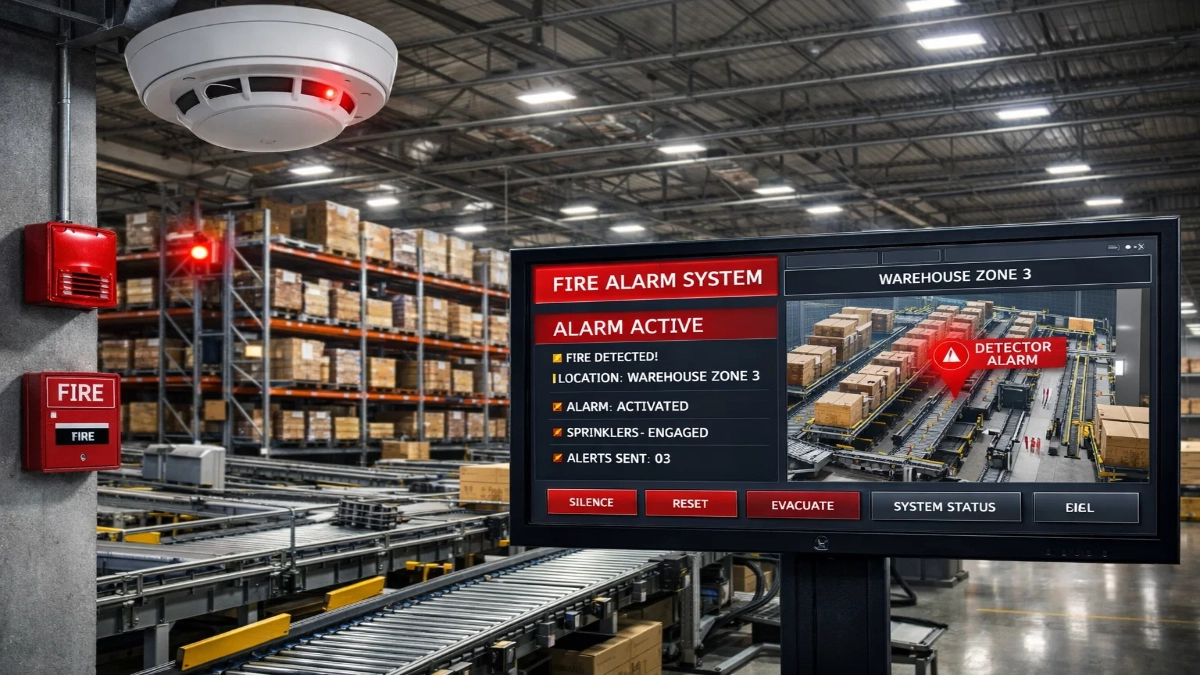
Fire detection systems do more than protect buildings. They protect continuity, contracts, customer trust and revenue flow. When designed correctly, they become silent guardians of industrial resilience.
Let’s walk through how.
The Supply Chain Risk Nobody Talks About
A fire detection system protects supply chains by identifying fire at its earliest stage, triggering alerts and response protocols before disruption spreads across production, storage, or distribution operations. Early detection prevents downtime, financial loss, inventory damage, regulatory penalties and cascading delays across interconnected supply networks.
Supply chains operate as interconnected ecosystems. A disruption in one node factory, warehouse, cold storage, or logistics hub creates ripple effects upstream and downstream.
Fire risk is especially dangerous because:
- It spreads rapidly across combustible materials
- It damages inventory and machinery simultaneously
- It causes prolonged shutdowns for investigation and repair
- It triggers insurance and compliance complications
In industrial environments, a 30-second detection delay versus a 5-minute delay can mean the difference between a minor incident and a multi-million-dollar disruption.
What Is a Fire Detection System in a Supply Chain Context?
A fire detection system is an engineered network of detectors, control panels and alarm devices designed to identify smoke, heat, or flame at the earliest possible stage and initiate automated alerts and response procedures to prevent operational disruption.
In supply chains, fire detection must:
- Identify ignition at the incipient stage
- Pinpoint the exact location
- Integrate with suppression systems
- Notify control rooms and safety teams
- Support compliance reporting
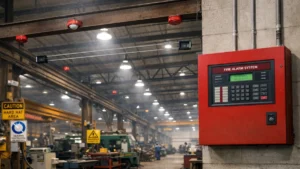
Modern systems like the GST fire alarm system distributed by Innxeon are designed specifically for large-scale industrial applications where uptime is critical.
How Fire Detection Systems Protect Supply Chain Continuity
1. Early Detection Prevents Operational Shutdown
When fire starts in cable trays, server racks, conveyor motors, or storage racks, smoke appears before flames. High-sensitivity detection prevents escalation.
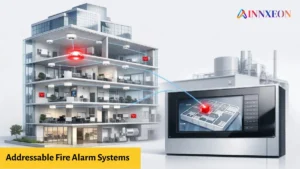
With addressable detectors, each device communicates its exact identity and location to the control panel. This precision allows:
- Targeted intervention
- Isolated shutdown instead of full-plant evacuation
- Faster restoration
By contrast, a conventional fire alarm panel only identifies zones, which can delay pinpoint response.
Protection Benefit: Production resumes faster and downtime is minimised.
2. Localised Response Reduces Supply Chain Ripple Effects
Supply chains are time-bound. A 12-hour shutdown in a manufacturing plant can delay exports, breach SLAs and increase penalty exposure.
An addressable fire alarm panel allows:
- Exact fire origin identification
- Automated system integration
- Compartment-based response
This prevents overreaction. Instead of stopping the entire facility, only the affected sections are isolated.
Engineering Insight: Precision equals continuity.
3. Inventory Protection Preserves Revenue Flow
Warehouses store finished goods, raw materials, spare parts and high-value commodities. Fire in storage areas causes dual loss:
- Physical inventory damage
- Revenue and contractual impact
With the GST fire alarm system, intelligent signal processing reduces false alarms while maintaining high sensitivity, critical for large warehouses where dust or humidity could otherwise create nuisance alerts.
Accurate detection ensures:
- No unnecessary shutdown
- No delayed response
- No missed warning
Technical Breakdown: Components That Safeguard Supply Chains
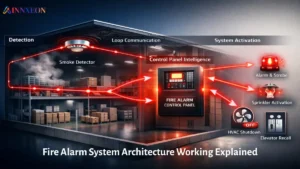
Let’s simplify how the system architecture works.
Fire Detection System Core Architecture
- Detection Layer
- Control Layer
- Notification Layer
- Integration Layer
Each plays a distinct role.
Detection Layer: The First Line of Defence
This includes:
- Smoke detectors
- Heat detectors
- Multi-criteria detectors
Addressable detectors transmit device-specific data.
Conventional detectors transmit zone-based signals.
In high-value logistics hubs, addressable architecture is preferred because it supports:
- Event logging
- Predictive maintenance
- Real-time diagnostics
Control Layer: Decision Intelligence
The control panel processes signals and initiates logic.
An addressable fire alarm panel can:
- Identify detector ID
- Trigger selective outputs
- Interface with BMS and SCADA
A conventional fire alarm panel is simpler and cost-effective for smaller facilities, but lacks device-level precision.
In complex supply chain environments, control-layer intelligence directly influences recovery time.
Notification & Integration Layer
Detection is only effective if the response is immediate.
Integration includes:
- Public address systems
- Emergency lighting
- Fire suppression activation
- CCTV triggers
- Remote monitoring centres
Advanced systems distributed by Innxeon allow seamless integration, creating a synchronised emergency response ecosystem.
Step-by-Step: How a Fire Detection System Prevents Supply Chain Disruption
Step 1: Smoke or Heat Emerges
Micro-level changes occur in air composition or temperature.
Step 2: Detector Identifies Anomaly
Detector transmits a signal to the panel.
Step 3: Panel Validates & Pinpoints
Panel confirms the event and identifies the exact device.
Step 4: Alert & Automation Activate
- Local alarm triggers
- Control room notified
- Suppression system activated
- Targeted evacuation initiated
Step 5: Incident Contained Early
Minimal equipment damage.
Minimal downtime.
Minimal shipment delays.
Result: Supply chain stability preserved.
Real-World Supply Chain Scenarios
Let’s walk through practical environments.
Manufacturing Plants
Electrical faults in motor control centres are common ignition sources. With addressable architecture:
- Exact cabinet location identified
- Local isolation performed
- Entire production line remains operational
Without precision detection, full-line shutdown may occur unnecessarily.
Large Warehouses
High rack storage increases fire load. Delayed detection allows vertical fire spread.
Intelligent detection ensures:
- Early smoke identification
- Quick sprinkler activation
- Protection of high-value goods
This prevents order fulfilment delays.
Cold Storage & Temperature-Controlled Logistics
Cold environments require specialised detectors due to condensation risk.
Reliable systems ensure:
- No false alarms
- Continuous cold chain integrity
- Protection of pharmaceuticals or perishables
Distribution Hubs
24/7 operations require:
- Networked monitoring
- Event logging
- Remote alerting
A robust GST fire alarm system ensures immediate detection without interrupting logistics unnecessarily.
Engineering Best Practices for Supply Chain Protection
1. Choose Addressable Architecture for Critical Nodes
Use addressable systems in:
- Manufacturing plants
- Export warehouses
- High-value storage
Precision reduces downtime.
2. Segment Detection Zones Strategically
Design zones based on:
- Fire load
- Production dependency
- Evacuation pathways
Proper zoning prevents cascading shutdowns.
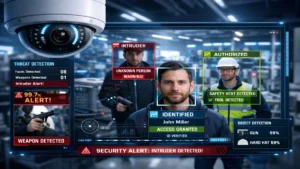
3. Integrate Detection with Monitoring
Fire detection should not operate in isolation.
Integrate with:
- CCTV
- Access control
- SCADA
- BMS
This creates unified visibility.
4. Maintain & Audit Regularly
Supply chain protection fails without maintenance.
Implement:
- Quarterly inspection
- Detector sensitivity testing
- Event log review
- Compliance documentation
5. Plan for Scalability
Supply chains evolve.
Select systems that:
- Support loop expansion
- Allow additional detectors
- Enable software upgrades
Scalable systems future-proof operations.
Addressable vs Conventional Systems in Supply Chains
| Feature | Addressable System | Conventional System |
|---|---|---|
| Location Accuracy | Exact device | Zone only |
| Scalability | High | Limited |
| Integration | Advanced | Basic |
| Suitable For | Large, complex supply chains | Small facilities |
| Downtime Risk | Lower | Higher |
Decision Insight:
If downtime costs exceed equipment cost, choose addressable.
Fire Detection as a Supply Chain Strategy
Supply chains are built on reliability. Every shipment, every production cycle, every delivery window depends on uninterrupted operations.
Fire detection systems are not simply compliance tools. They are operational continuity tools.
When designed with:
- Addressable architecture
- Intelligent detectors
- Integrated monitoring
- Scalable infrastructure
They protect:
- Revenue
- Contracts
- Inventory
- Brand trust
- Regulatory standing
The GST fire alarm system distributed by Innxeon offers the engineering reliability required for industrial supply chain environments, balancing precision, scalability and operational intelligence.
In supply chain management, resilience is a competitive advantage.
Early detection builds resilience.
Resilience protects continuity.
Continuity protects business.
Read Also: Legal Liability & Fire Safety: What Business Leaders Must Know
Read Also: Fire Safety Infrastructure as a Brand Protection Strategy