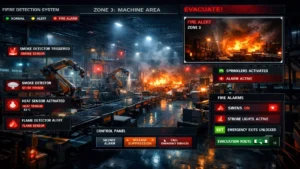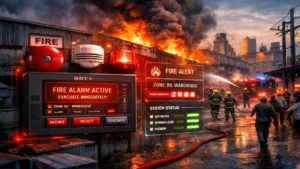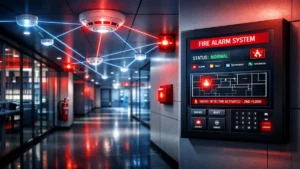
In a large manufacturing facility during peak operations, production lines are active, materials are moving across the floor, and workers are stationed in multiple zones. Then a fire alarm activates in one section of the plant.
In that moment, the biggest challenge is not just detecting the fire, but managing evacuation safely and confidently. We need to know which exit routes are clear, whether people are moving toward assembly points and if any areas remain occupied.
This is where industrial surveillance becomes a critical safety support system, not just a security tool.
Security cameras do not replace fire alarms or emergency procedures; instead, they help us monitor evacuation progress in real time, enabling faster decision-making and safer outcomes. With reliable surveillance infrastructure, we gain operational visibility during emergencies, which is often the difference between confusion and coordination.
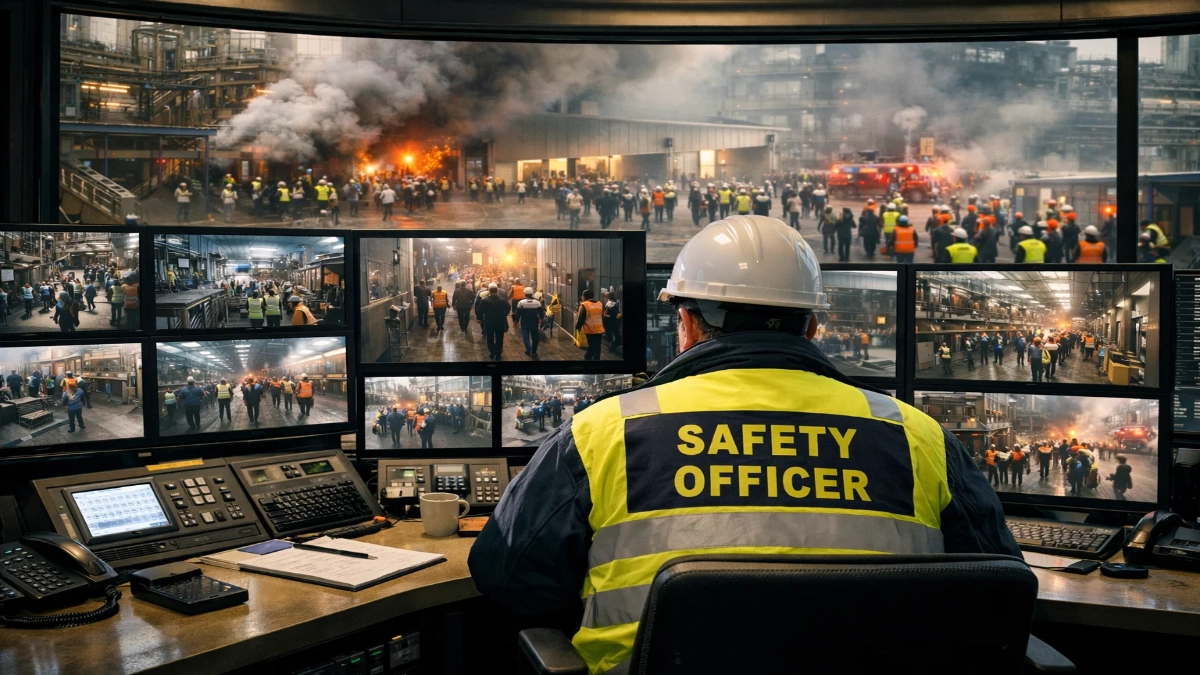
Industrial CCTV and surveillance solutions distributed by Innxeon are designed to support exactly this kind of operational awareness in complex facilities.
Understanding the Role of Surveillance in Fire Evacuation
Security cameras support fire evacuation by providing real-time visibility of exit routes, production areas, corridors and assembly points. This allows safety teams to confirm evacuation progress, detect blocked pathways and coordinate response decisions using visual information from a centralised monitoring system.
When we think about evacuation planning, we usually focus on alarms, extinguishers and emergency exits. But evacuation management also depends heavily on situational awareness.
Surveillance systems allow us to confirm three critical things during an emergency:
- Are people moving safely toward exits?
- Are evacuation routes clear?
- Are the restricted zones empty?
Without visual confirmation, safety teams rely on assumptions. With cameras, we rely on evidence-based decisions.
Modern industrial surveillance cameras provide continuous monitoring, which becomes extremely valuable during emergencies.
Real-Time Visibility During Emergencies
When alarms trigger, security teams can immediately view affected areas through cameras instead of physically entering potentially dangerous zones.
This reduces response time and improves decision-making clarity.
Monitoring Exit Routes and Assembly Points
Cameras positioned near exits and outdoor assembly areas help us confirm whether evacuation procedures are working as planned.
This visibility helps prevent panic and congestion.
Supporting Incident Coordination
Visual monitoring allows coordination between safety teams, supervisors and emergency responders using live information instead of guesswork.
Key Takeaway
Surveillance systems do not detect fires; they support evacuation management by improving visibility, coordination and response confidence.
Core Surveillance Concept: Operational Visibility During Evacuation
Operational visibility means being able to observe facility conditions in real time during an emergency. A well-designed IP CCTV system helps safety teams understand movement patterns, identify risks and guide evacuation decisions using live video feedback from critical locations.
When we design surveillance for industrial environments, we focus on visibility where decisions matter most.
Fire evacuation situations evolve quickly. Conditions change minute by minute, and safety teams must respond accordingly.
An IP CCTV system helps us monitor:
- Production areas
- Corridors
- Exit gates
- Stairwells
- Outdoor assembly zones
Instead of relying only on radio communication or manual reporting, we can see what is happening instantly.
Improving Safety Awareness
Video monitoring reduces uncertainty during evacuation.
We can verify whether instructions are being followed and identify areas needing attention.
Reducing Response Time
Faster decisions become possible when we can visually confirm the situation rather than waiting for updates.
Enabling Post-Incident Review
Recorded footage helps us evaluate evacuation performance and improve future safety planning.
Summary
Operational visibility during evacuation improves:
- Decision speed
- Worker safety
- Emergency coordination
- Process improvement
Technical Breakdown: How Industrial Surveillance Systems Work
A modern surveillance system combines cameras, recording devices, monitoring software and network infrastructure. Together, these components capture, store and display video from across a facility, allowing safety teams to monitor evacuation activity through a centralised monitoring system.
Let’s walk through the system as we would when planning surveillance for a real industrial site.
Cameras: The Visual Sensors
Industrial Monitoring Coverage
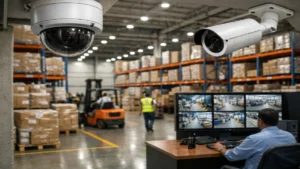
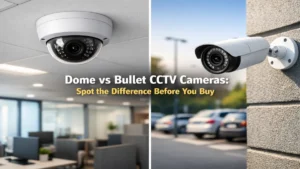
Industrial surveillance cameras are installed in strategic safety zones such as production floors, storage areas, corridors and entry/exit points.
These cameras provide continuous visual coverage before, during and after emergencies.
Environmental Reliability
Industrial environments require cameras that can handle dust, vibration and temperature variations while maintaining clear video output.
Recording Systems: Capturing Events
Network Video Recorder
A network video recorder collects video streams from cameras and stores them securely for playback and investigation.
During evacuation events, recorded footage helps confirm timelines and actions.
Redundant Storage Planning
Industrial facilities often use backup storage to ensure recordings remain available even if one device fails.
Monitoring Software: Managing Video Intelligence
Video Management System
A video management system allows operators to view multiple camera feeds, search recordings and manage alerts from a single interface.
This becomes especially useful when monitoring evacuation across multiple facility zones.
Operator Workflow Efficiency
Instead of switching between systems, teams can monitor everything from one dashboard.
Network Infrastructure
Reliable connectivity ensures video streams remain uninterrupted during emergencies. Industrial surveillance planning includes protected network paths and backup power where needed.
System Components Summary
A typical industrial surveillance setup includes:
- Cameras
- Recording devices
- Monitoring software
- Storage systems
- Network infrastructure
Together, these create a centralised monitoring system that supports evacuation visibility.
Real-World Industrial Applications
Security cameras support evacuation management by providing visual confirmation across different facility types, including manufacturing plants, warehouses, logistics hubs, infrastructure sites and large campuses. Each environment benefits from improved monitoring, coordination and evacuation validation.
Let’s walk through some real scenarios together.
Manufacturing Facilities
In a factory environment, evacuation may involve multiple production zones operating simultaneously.
Cameras help us confirm:
- Machine areas are cleared
- Workers exit safely
- Supervisors follow procedures
Without surveillance, confirming evacuation completion becomes difficult.
Warehouses
Warehouses present unique challenges due to shelving height, forklift movement and wide storage areas.
Surveillance helps us monitor:
- Aisle clearance
- Exit access
- Worker movement patterns
This improves evacuation coordination.
Logistics Hubs
Large logistics sites often operate continuously with vehicle movement and loading docks.
Cameras help verify:
- Dock areas are cleared
- Entry gates remain accessible
- Outdoor assembly points are reached safely
Infrastructure Facilities
Power plants, transport facilities and utility sites require controlled evacuation procedures.
Video monitoring ensures restricted zones are cleared before emergency teams enter.
Large Industrial Campuses
Multi-building facilities benefit from centralised monitoring across locations, allowing safety teams to track evacuation progress site-wide.
This is where surveillance solutions distributed by Innxeon become especially valuable for operational coordination.
Engineering Best Practices for Evacuation-Supporting Surveillance
Effective evacuation-supporting surveillance requires careful camera placement, redundant recording systems, clear monitoring workflows, routine maintenance and scalable infrastructure planning. These engineering practices ensure the surveillance system remains reliable during critical emergencies.
Let’s walk through the decisions we would make during a real project.
Camera Placement Strategy
Safety-Focused Coverage
We prioritise cameras at:
- Exit routes
- Corridors
- Production zones
- Assembly points
- Staircases
Placement should support evacuation visibility, not just security monitoring.
Recording Redundancy
Data Reliability
Backup recording ensures evacuation footage remains available even if hardware fails.
This supports compliance and incident analysis.
Monitoring Workflows
Clear Responsibilities
We define who monitors cameras during emergencies and how communication flows between teams.
This avoids confusion during real incidents.
Maintenance Planning
System Reliability
Routine inspection ensures cameras, storage and software remain operational when needed.
Scalability Considerations
Future-Ready Surveillance
Facilities expand over time. Surveillance infrastructure should allow new cameras and monitoring zones to be added easily.
Innxeon helps industrial clients plan scalable surveillance deployments aligned with long-term facility growth.
Visibility Strengthens Evacuation Safety
When we step back and look at fire evacuation management from an operational perspective, one thing becomes clear: visibility improves safety outcomes.
Fire alarms alert us.
Emergency procedures guide us.
But surveillance systems help us see evacuation progress in real time.
That visibility enables:
- Faster decisions
- Better coordination
- Safer evacuations
- Stronger post-incident learning
Industrial surveillance solutions distributed by Innxeon help organisations build this layer of operational awareness into their safety infrastructure.
Because during emergencies, seeing what is happening matters just as much as knowing what to do.
Read Also: Industrial Surveillance + Fire Safety: A Unified Protection Strategy
Read Also: Designing Scalable CCTV Systems for Growing Enterprise Campuses