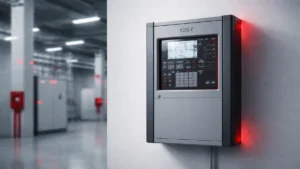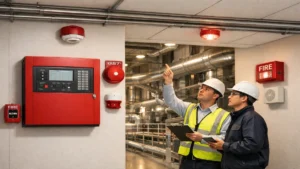
In today’s fast-growing industrial and commercial landscape, organisations often operate across multiple facilities, factories, warehouses, office buildings, hospitals and campuses. While expansion brings growth, it also introduces a critical challenge: maintaining consistent fire safety standards across all locations.

One of the most effective ways to address this challenge is to standardise fire alarm systems, particularly by using a reliable, scalable solution such as a GST fire alarm system.
Standardisation is not just about uniformity; it directly impacts safety, compliance, operational efficiency and long-term cost savings. Yet many organisations overlook this step, leading to fragmented systems, inconsistent responses and increased risk.
This article explains how to standardise GST fire alarm systems across multiple facilities and why doing so is absolutely critical.
What Does Standardisation Mean in Fire Alarm Systems?
Standardisation refers to implementing uniform fire detection and alarm infrastructure, design principles and operational protocols across all facilities.
This includes:
- Using the same addressable fire alarm panel models
- Maintaining consistent configurations of addressable detectors
- Standardising conventional fire alarm panel setups (where required)
- Using uniform conventional detectors in smaller or legacy areas
- Applying identical programming logic, naming conventions and response procedures
When done correctly, a GST fire alarm system becomes predictable, scalable, and easy to manage across locations.
Why Standardising GST Fire Alarm Systems Is Critical
1. Improved Safety and Faster Response
When all facilities use a standardised addressable fire alarm panel, emergency teams can quickly understand alerts no matter where they originate.
- Same alarm tones
- Same zone mapping logic
- Same response protocols
This reduces confusion and ensures faster evacuation and response, which can save lives.
2. Simplified Training Across Teams
Without standardisation, each facility may require separate training. This leads to:
- Increased training costs
- Higher chances of human error
- Operational inefficiency
With a standardised GST fire alarm system, staff can be trained once and deployed anywhere.
3. Easier Maintenance and Troubleshooting
Using uniform components like addressable detectors and conventional detectors allows maintenance teams to:
- Diagnose issues faster
- Keep a consistent inventory of spare parts
- Reduce downtime
Technicians become familiar with one system architecture instead of multiple variations.
4. Regulatory Compliance Across Locations
Different facilities may fall under different compliance requirements, but a standardised system ensures:
- Consistent adherence to fire safety codes
- Easier audits and inspections
- Reduced legal risks
Using a well-recognised GST fire alarm system helps meet international and local compliance standards.
5. Cost Optimisation in the Long Run
While standardisation may require upfront planning, it significantly reduces:
- Procurement complexity
- Maintenance costs
- Training expenses
Bulk purchasing of addressable fire alarm panel units and detectors also leads to better pricing.
Key Components to Standardise
To achieve effective standardisation, organisations must focus on the following components:
1. Fire Alarm Panels
Choose between:
- Addressable fire alarm panel for large and complex facilities
- Conventional fire alarm panel for smaller or simpler setups
For multi-facility organisations, addressable systems are highly recommended due to scalability and precise detection.
2. Detection Devices
Standardise both:
- Addressable detectors (smoke, heat, multi-sensor)
- Conventional detectors for legacy zones
Ensure compatibility with the selected GST fire alarm system to maintain consistency.
3. Communication Protocols
All systems should use:
- Unified communication standards
- Compatible networking protocols
- Centralised monitoring capability
This enables integration across facilities.
4. Naming and Zoning Conventions
Define a universal structure:
- Zone naming (e.g., Floor–Area–Device)
- Device labelling standards
- Alarm priority levels
This makes interpretation easy across all facilities.
5. Software and Configuration
Standardize:
- Panel programming logic
- Alarm thresholds
- Event logging formats
This ensures consistent system behaviour.
Step-by-Step Guide to Standardising GST Fire Alarm Systems
Step 1: Conduct a Multi-Facility Audit
Start by evaluating:
- Existing conventional fire alarm panel and addressable systems
- Types of detectors used
- Compliance status
Identify inconsistencies across facilities.
Step 2: Define a Standard System Architecture
Create a blueprint that includes:
- Preferred addressable fire alarm panel models
- Approved addressable detectors and conventional detectors
- Communication and integration protocols
This becomes your organisation-wide standard.
Step 3: Choose GST as the Core Platform
A GST fire alarm system offers:
- High reliability
- Scalable architecture
- Advanced detection capabilities
- Seamless integration
It is ideal for organisations managing multiple facilities.
Step 4: Develop Standard Operating Procedures (SOPs)
Document:
- Installation guidelines
- Testing procedures
- Maintenance schedules
- Emergency response workflows
Ensure all facilities follow the same SOPs.
Step 5: Implement Phased Upgrades
Avoid replacing everything at once. Instead:
- Prioritise high-risk facilities
- Upgrade legacy systems gradually
- Integrate existing conventional fire alarm panel setups where needed
Step 6: Train Personnel Uniformly
Conduct centralised training programs covering:
- System operation
- Alarm interpretation
- Troubleshooting
Focus on both addressable fire alarm panels and hybrid systems.
Step 7: Establish Central Monitoring
Integrate all facilities into a central system for:
- Real-time monitoring
- Incident tracking
- Performance analysis
This enhances control and visibility.
Common Challenges in Standardisation (and How to Overcome Them)
Challenge 1: Legacy Systems
Older facilities may rely on outdated conventional detectors.
Solution:
Use hybrid integration to combine conventional systems with modern addressable fire alarm panel infrastructure.
Challenge 2: Budget Constraints
Standardisation requires investment.
Solution:
Implement phased deployment and prioritise critical locations.
Challenge 3: Resistance to Change
Staff may be used to existing systems.
Solution:
Provide hands-on training and demonstrate efficiency improvements.
Challenge 4: Different Facility Requirements
Not all facilities have the same risk level.
Solution:
Use a flexible standard, primarily addressable systems with optional conventional fire alarm panel setups where appropriate.
Best Practices for Long-Term Success
To maintain a standardised GST fire alarm system, follow these best practices:
1. Regular System Audits
Evaluate performance across all facilities periodically.
2. Continuous Training
Update teams on new features and system upgrades.
3. Centralised Documentation
Maintain a shared repository of:
- System configurations
- SOPs
- Maintenance logs
4. Use Certified Components Only
Always use approved addressable detectors and conventional detectors to ensure compatibility.
5. Monitor System Performance Metrics
Track:
- Alarm response time
- False alarm rates
- System uptime
This helps improve efficiency.
The Strategic Advantage of GST Fire Alarm Systems
A GST fire alarm system stands out because it supports:
- Multi-site scalability
- Advanced addressable technology
- Seamless integration with other safety systems
- High reliability in critical environments
When standardised across facilities, GST systems create a unified safety ecosystem that is easy to manage and highly effective.
Conclusion
Standardising fire alarm systems is no longer optional; it is a strategic necessity for organisations operating across multiple facilities.
By implementing a consistent GST fire alarm system with a standardised addressable fire alarm panel, a conventional fire alarm panel, addressable detectors, and conventional detectors, organisations can achieve:
- Higher safety levels
- Faster emergency response
- Lower operational costs
- Easier compliance
- Better system reliability
The key lies in planning, phased execution and continuous improvement.
In a world where safety cannot be compromised, standardisation is the foundation of a resilient and future-ready fire protection strategy.
Read Also: How to Measure Fire Alarm System Performance and Why Most Metrics Are Misleading
Read Also: Risk-Based Decision Making in Fire Detection System Selection