Modern buildings are no longer isolated systems. Today’s commercial campuses, data centres, hospitals, malls and smart towers operate on tightly connected ELV (Extra-Low Voltage) ecosystems that combine CCTV, access control, BMS, PA systems, elevators and networking infrastructure.
At the centre of life safety sits the fire alarm system, the one network that must never fail, never delay and never miscommunicate.
But here’s the reality most engineers face:
The biggest failures don’t come from detectors or panels. They come from interfaces between systems.
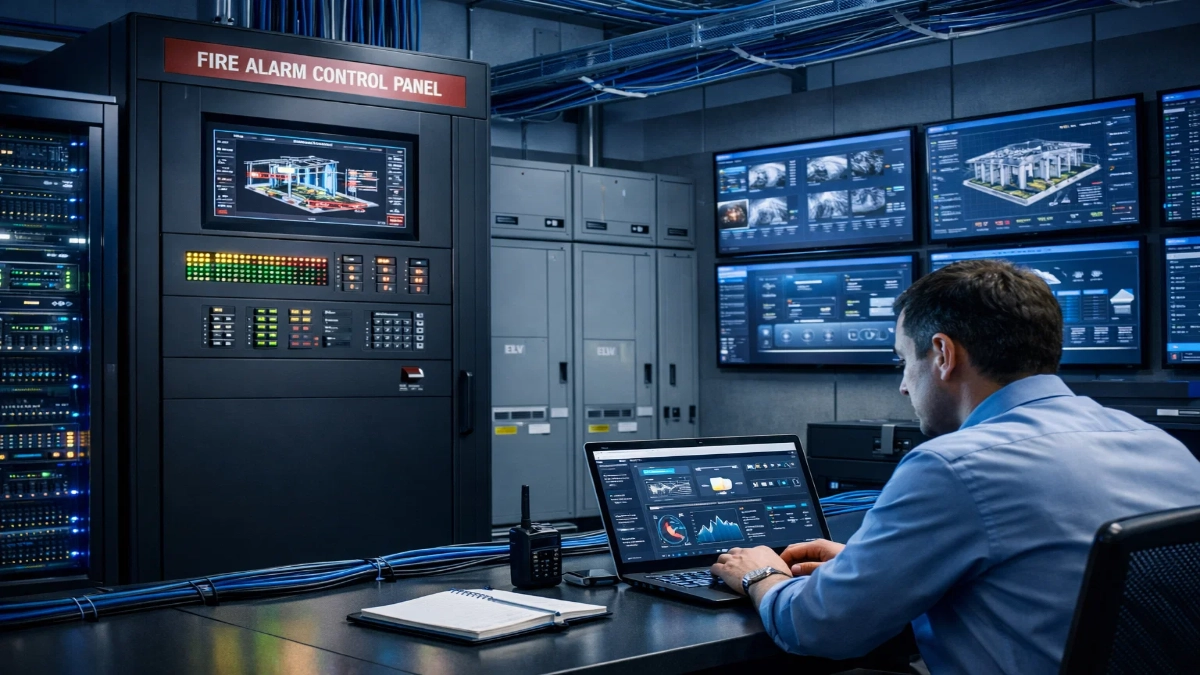
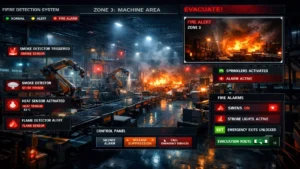
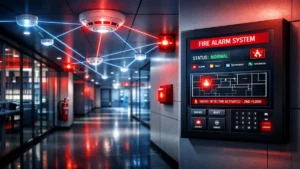
Centralized fire alarm and ELV control room enabling real-time monitoring and seamless life-safety integration.
When fire alarms must talk to elevators, unlock access doors, shut down HVAC, trigger public address and notify the BMS, integration complexity explodes.
This article breaks down:
Real interface challenges engineers face
Technical pitfalls during design and commissioning
Best-practice architecture
Cyber and network risks
Compliance considerations
Proven integration strategies using Gulf Security Technology (GST) solutions
What Are ELV Interfaces in Fire Alarm Systems?
In modern facilities, a fire alarm must automatically communicate with:
Building Management System (BMS)
CCTV / VMS
Access control
Public Address / Voice evacuation
Elevators
HVAC & smoke control
Gas suppression
Emergency lighting
IoT dashboards
Each connection requires electrical + logical + protocol compatibility.
If even one link fails, life safety is compromised.
Common Interface Challenges Engineers Face
Let’s walk through the real-world problems that happen on-site.
1. Protocol Mismatch Between Systems
Different vendors use:
Modbus
BACnet
OPC
TCP/IP
RS-485
Dry contacts
Proprietary protocols
When the fire panel speaks one “language”, and the BMS speaks another, you need:
Gateways
Converters
Interface modules
Custom logic
This adds:
Latency
Complexity
Failure points
Best practice: Use fire panels with native multi-protocol support.
2. Signal Type Conflicts (Digital vs Relay)
Many legacy integrations still depend on:
NO/NC relays
Dry contacts
Hardwired signals
Problems:
Limited status feedback
Only ON/OFF information
No device-level intelligence
Massive wiring complexity
Modern systems require:
Addressable event-level data
Zone-level mapping
Real-time status monitoring
3. Wiring & Ground Loop Issues
When ELV contractors share pathways:
Noise interference occurs
False alarms increase
Communication drops happen
Ground loops damage boards
Especially problematic in:
Large campuses
Industrial plants
High EMI environments
Solution: Separate fire alarm cabling from other ELV runs and use shielded loops.
4. Integration Latency
In fire events, seconds matter.
If:
BMS polling takes 10–15 seconds
Gateway buffers overload
Network switches delay packets
You get:
Elevator recall delays
Doors not unlocking
HVAC not shutting down
This becomes a compliance violation.
Fire alarm signals must be instantaneous, not “eventually delivered”.
5. Software Logic Conflicts
Multiple teams configure:
Fire vendor
BMS vendor
Access control vendor
Integrator
Without coordination:
Duplicate commands
Opposing actions
Missed triggers
Infinite loops
Example: Fire alarm opens doors → Access system locks them again → Evacuation blocked.
6. Cybersecurity Risks
Once fire systems connect to IP networks, they inherit IT risks:
Malware
Unauthorized access
Spoofed signals
DoS attacks
Ransomware
A compromised life-safety system is unacceptable.
Key principle: Fire systems should use segmented, hardened, dedicated networks.
Technical Integration Points Explained
Here’s where most interfaces happen:
System
Integration Type
Typical Challenge
BMS
Modbus/BACnet
Delayed polling
Access Control
Dry contact/IP
Logic conflicts
Elevator
Hard relay
Limited status
PA/VA
Audio trigger
Sync timing
HVAC
Shutdown relays
Feedback missing
CCTV
Event tagging
Metadata mismatch
Addressable vs Conventional Integration Differences
For modern ELV ecosystems, addressable architecture is strongly preferred.
Real-World Interface Failures (and Lessons)
Case 1 — Mall HVAC Not Shutting Down
Cause: Modbus gateway freeze Result: Smoke spread Lesson: Use direct relay fallback
Case 2 — Doors Didn’t Unlock
Cause: Access logic override Result: Evacuation delay Lesson: Fire alarm must have the highest priority control
Case 3 — BMS Missed Alarm
Cause: Slow polling interval Result: Late notification Lesson: Use push notifications or direct events
Best Practices for Reliable Integration
Here’s what experienced engineers now follow.
1. Dedicated Fire Network
Never mix with:
CCTV traffic
Office LAN
Wi-Fi
Internet
Use:
VLAN segregation
Firewalls
Static IPs
2. Native Protocol Support
Avoid too many converters.
Choose systems that support:
Modbus
BACnet
TCP/IP
API outputs
natively.
3. Relay + IP Redundancy
Use:
Primary digital interface
Backup hardwired relay
Fail-safe always wins.
4. Priority-Based Control Logic
Fire system must override:
Access
HVAC
Elevators
Lighting
Always.
5. Early Coordination
Integrate during:
Design phase ❌ not commissioning phase
Hold joint meetings with:
Fire vendor
ELV integrator
IT team
MEP consultant
Why Many Engineers Prefer GST for ELV Integration
In large enterprise and campus deployments, many integrators choose GST fire alarm system solutions from Gulf Security Technology because they provide:
Strong Interface Capabilities
Built-in Modbus/BACnet
Ethernet/IP support
Multi-protocol gateways
Programmable logic
Engineering Advantages
Scalable architecture
Loop redundancy
High device capacity
Fast response time
Integration-Friendly Design
Clear API access
Flexible cause-and-effect programming
Easy BMS linking
Reliability
Stable firmware
Industrial-grade hardware
Low false alarm rate
For campuses where fire systems must coordinate with 5–10 ELV subsystems simultaneously, these features dramatically reduce commissioning headaches.
Design Checklist for Engineers
Before project approval, verify:
Interface protocol confirmed
Number of relays calculated
Network topology designed
Cybersecurity controls defined
Fail-safe behaviour tested
Integration matrix documented
Cause & effect logic mapped
Redundancy planned
Final Note
Fire alarm systems are no longer standalone.
They are:
Command centers
Safety brains
ELV orchestrators
And integration quality directly impacts life safety.
If interfaces fail, the entire building fails.
By choosing:
Addressable architecture
Smart protocol design
Early coordination
Reliable platforms like GST
Engineers can deliver:
Faster response
Lower risk
Easier maintenance
Compliance confidence
Future scalability
Quick Takeaway
If your project involves:
Smart campuses
Large malls
Hospitals
Airports
Industrial sites
Plan integration first, not last.
Your fire alarm isn’t just another system. It’s the one that must work every single time.
I am Harsh Bohot, a Fire Safety Engineer with over 5 years of experience in fire protection system design, installation and compliance audits. Coming from a strong technical background with a Master’s degree in Computer Applications (MCA), I bring both engineering precision and analytical expertise to my work in fire and life safety systems.
My professional focus is on fire alarm control panels, Extra Low Voltage (ELV) solutions and adherence to international fire safety codes. Over the years, I have collaborated with contractors, consultants and building managers to deliver reliable, future-ready and compliant fire safety solutions across residential, commercial and industrial projects.
Passionate about continuous learning and knowledge-sharing, I write to empower engineers, safety professionals and building managers with actionable insights, technical best practices and innovative approaches to building safety. My mission is to contribute to a safer built environment through trustworthy, experience-driven guidance in fire safety engineering.
Disclaimer: The information provided here is for general guidance on fire safety systems and may vary based on site conditions and regulations. While we strive for accuracy, discrepancies may occur. For specific requirements, please consult certified professionals. If you find any errors, contact us for review and correction.