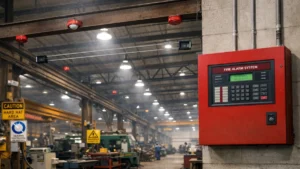
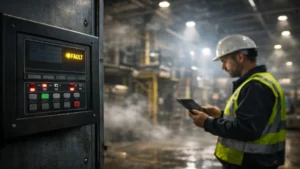
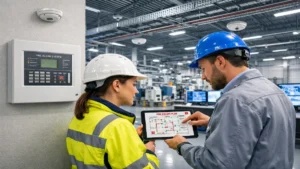
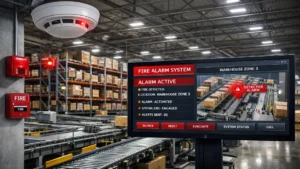
When a building is small, a single fire alarm control panel is usually enough. But the moment a project becomes larger, like a hospital, airport terminal, IT campus, manufacturing plant, mall or multi-tower residential complex, one panel often cannot handle everything efficiently.
That is where networked fire alarm systems become essential.
Instead of forcing one panel to manage every detector, every sounder, every module and every building zone, a networked system allows multiple fire alarm panels to work together as one unified solution. This is exactly what GST network-ready addressable panels are designed for. They help engineers create scalable, reliable and authority-compliant fire alarm architectures without making system expansion complicated.
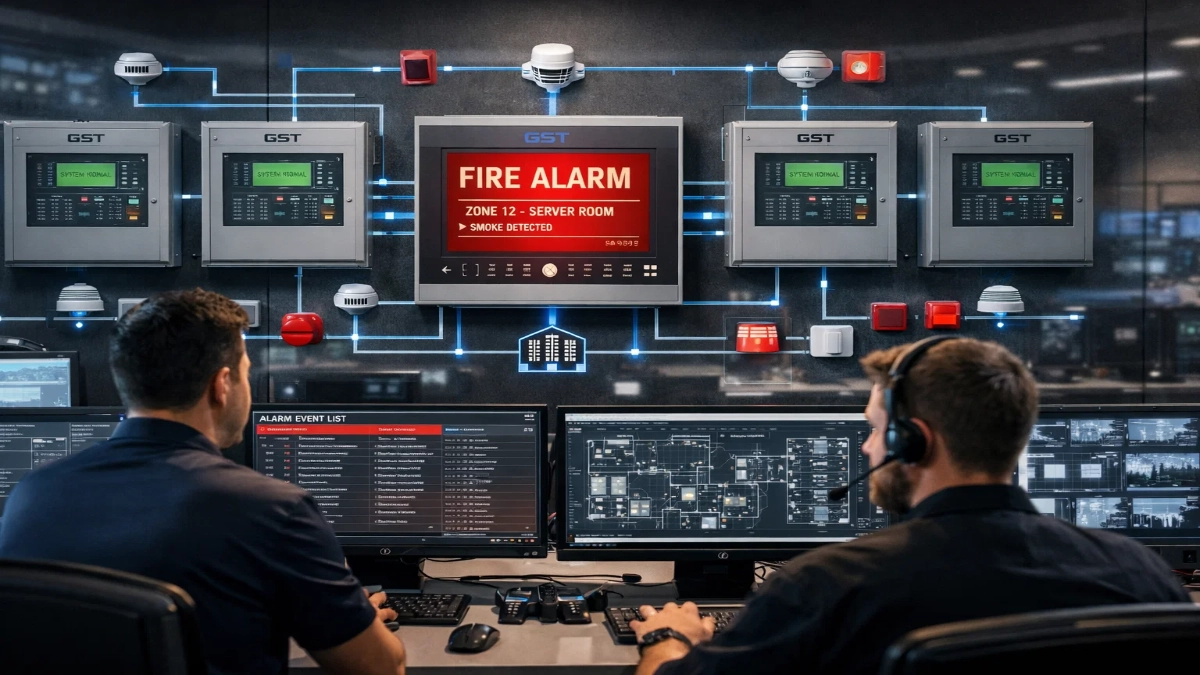
In this article, you will learn how multi-panel fire alarm networking works, why it matters in modern projects and how GST panels support multi-panel integration for smooth site-wide fire safety.
What Is a Networked Fire Alarm System?
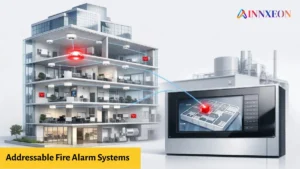
A networked fire alarm system is a setup where two or more fire alarm panels are connected, allowing them to communicate and share critical information such as:
- Fire alarm events
- Faults and supervision alerts
- Device and loop status
- System controls (evacuation, reset, silence)
- Site-wide logic programming coordination
Think of it like multiple brains connected by a reliable communication line. Each panel handles its own building or zone locally, but the entire facility is controlled and monitored together.
This design is extremely useful for:
- Large campuses with multiple buildings
- High-rise towers with multiple wings
- Industrial plants with separated risk zones
- Mixed-use projects (mall + parking + hotel)
- Expansion-ready sites where future phases are planned
Instead of installing one oversized panel and pushing it beyond practical limits, engineers install multiple panels, then network them into a single coordinated system.
Why Multi-Panel Integration Matters in Large Fire Alarm Projects
Fire safety is not only about detection. In large projects, it is about speed, coordination and continuity of operation.
Here’s why networking is a smart engineering decision:
1) Better Coverage Across Multiple Buildings
A single panel may struggle with long cable runs, power loads, and loop capacity. With a multi-panel design, each building gets its own panel, reducing complexity and improving response reliability.
2) Stronger System Redundancy
If one panel is down for service, the rest of the network remains active. This improves uptime and safety for the facility.
3) Faster Troubleshooting and Maintenance
Technicians can isolate faults building-wise instead of hunting across an entire campus from one centralised cabinet.
4) Easier Expansion for Future Phases
When a facility expands, you can add a new panel and integrate it into the network instead of replacing the entire infrastructure.
5) Better Authority Compliance and Inspection Handling
Authorities often expect proper zoning, control logic and event reporting across the project. Networked architecture supports this cleanly.
Understanding the Basics: Single Panel vs. Multi-Panel Systems
Before diving deeper into integration, let’s simplify how systems differ:
Single Panel System
- One control panel handles everything
- Best for small to medium buildings
- Limited scalability
- Longer wiring can reduce design efficiency
- One failure point can impact a larger area
Multi-Panel Integrated System
- Multiple panels distributed across zones/buildings
- Each panel handles local devices and evacuation output
- Network enables centralised monitoring and control
- Easy to expand and maintain
- Suitable for complex infrastructure
If your project includes multiple staircases, separate blocks, or high-risk industrial sections, multi-panel integration often becomes the best practice.
How GST Panels Support Multi-Panel Integration
GST is widely trusted for large-scale deployments because its network-capable addressable solutions support integration in a structured, engineered way.
Here is how GST panels help in real-world multi-panel network design:
1) Distributed Intelligence With Local Control
In a network system, each panel still works independently for its own building. That means:
- Local devices continue to operate even if a network link fails
- Fire alarm activation in Building A triggers immediate outputs within Building A
- The network then shares the event with other panels for coordinated response
This setup improves safety because the system does not rely only on “one central point.”
2) Unified Monitoring Across the Facility
Networking allows operators to monitor the entire facility from one interface or command centre. Events such as:
- “Smoke Detector Activated – Block C, Floor 4”
- “Loop Fault – Building B Service Corridor”
- “Sounder Circuit Fault – Parking Level P2”
can be observed quickly, even if the panel is physically located elsewhere.
That makes site safety management faster, especially for security control rooms.
3) Event Sharing Between Panels
When a fire event occurs, a networked system can share data so that other panels respond correctly.
Example:
A detector triggers in the electrical room of one building. The network can allow:
- Alarm indication on all panels
- Display event location across the system
- Trigger common building controls (if programmed)
This becomes useful when you want synchronised evacuation logic, especially in shared zones like basements, connecting corridors or utility tunnels.
4) Scalable Design for Multi-Phase Projects
Many sites don’t build everything at once. They complete Phase 1, then expand years later.
GST networked panel architecture supports that practical reality:
- Start with a few buildings
- Add more panels for new blocks later
- Integrate without disturbing existing loop wiring
- Extend monitoring and control smoothly
That makes GST a smart option for long-term scalability.
5) Smart Mapping and Location-Based Response
In large facilities, confusion wastes time. Multi-panel integration supports a cleaner event structure where each building and zone is categorised properly.
This improves emergency response because teams immediately know:
- Which building
- Which floor
- Which zone
- Which device type was activated
That is exactly the level of clarity required in major projects.
Core Components in a GST Multi-Panel Network Setup
To understand integration better, it helps to know the building blocks of the system.
Fire Alarm Control Panels (FACPs)
Each building typically has its own addressable fire alarm panel, handling:
- Addressable loops
- Detection devices
- Control modules
- Local evacuation circuits
Addressable Detectors
These devices provide point-level accuracy and allow the panel to identify the exact device in alarm.
Examples include:
- Smoke detectors
- Heat detectors
- Multi-sensor detectors
Conventional Detectors (for specific applications)
Some zones can still use conventional circuits depending on design and budget.
Control & Interface Modules
Modules connect the fire alarm system with:
- AHU shutdown
- Fire dampers
- Lift recall
- Fire pump monitoring
- Door release systems
- Gas suppression interfaces
Notification Appliances
Sounders, hooters, strobes, speakers and PA evacuation interfaces coordinate site-wide alerts.
Typical Architecture: How Multi-Panel Networking Works in Real Projects
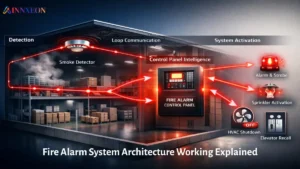
Here’s how engineers commonly design a networked GST fire alarm architecture in a multi-building campus:
Step 1: Create Building-Level Fire Alarm Zones
Each building has its own zones for:
- Floors
- Staircases
- Critical rooms (server room, electrical rooms, generator room)
Step 2: Install One Panel per Building or Wing
Instead of one central cabinet, panels are distributed:
- Tower A: Panel A
- Tower B: Panel B
- Utility Building: Panel C
- Parking Basement: Panel D
Step 3: Link Panels Through a Communication Network
Panels share system data and events. The network can be designed so that:
- Alarm from any building shows on all panels
- Control room gets centralised monitoring
- Selected evacuation outputs can be synchronised
Step 4: Implement Cause-and-Effect Logic
Cause-and-effect helps the system respond intelligently.
Example rules:
- If smoke detector activates in Basement Parking, run exhaust fans and activate strobes
- If alarm occurs in kitchen zone, trigger local evacuation and notify main control room
- If alarm occurs in one building, send event to security and enable emergency voice paging
This is especially important in premium projects where compliance requires tested logic.
How GST Supports Better Coordination During Emergencies
A major benefit of multi-panel integration is coordinated response.
Faster Alarm Verification
In large sites, false alarms happen, such as dust, maintenance activity, steam or minor smoke.
Networking makes it easier to:
- Identify the exact location quickly
- Confirm with nearby zones
- Send response teams efficiently
Controlled Evacuation Strategy
Not all buildings require full evacuation immediately. For example:
- A fire in a utility room may only require evacuation of a specific wing
- A smoke event in a basement may require staged evacuation
Multi-panel systems make this logic practical and manageable.
Better Notification Coverage
Sounder circuits can be managed building-wise, allowing:
- Stronger audio coverage
- Correct zoning
- Reduced confusion among occupants
Networked Systems vs. Large Conventional Systems
Some projects still consider conventional setups for cost reasons. That approach can work for small buildings, but it becomes difficult in large sites.
A conventional fire alarm panel typically groups devices into zones, but it cannot provide the exact device location. Scaling is also harder.
In contrast, a GST fire alarm system with addressable networking provides:
- Exact device identification
- Better event reporting
- Easier maintenance
- Cleaner expansion
- Superior multi-building control
Best Practices for Designing Multi-Panel Fire Alarm Networks
To get the best result from a networked system, engineers should follow practical best practices:
1) Keep Each Panel Responsible for Its Own Building
Even though the panels are networked, avoid overloading one panel with too many external dependencies. Each panel should still run independently for local evacuation.
2) Plan a Clear Naming Structure
Use consistent naming, such as:
- B1-F3-Corridor Smoke Detector
- TowerA-F10-Pantry Heat Detector
- Utility-Genset-Room Smoke Detector
Clean naming improves troubleshooting and audit compliance.
3) Ensure Proper Power Planning
Every panel should have:
- Dedicated power feed
- Battery backup
- Load calculation margin for future devices
4) Use Separate Loops for High-Risk Areas
High-risk zones like:
- Electrical rooms
- Battery rooms
- Diesel storage
- Server rooms
should be designed with proper segmentation for reliability.
5) Document Cause-and-Effect Clearly
During commissioning, testing becomes easier when cause-and-effect is documented in a clear format. This also supports authority inspections.
Common Use Cases Where GST Multi-Panel Integration Fits Perfectly
Multi-Tower Residential Complex
Each tower gets its own panel, but the maintenance and monitoring remain centralised.
Hospitals and Healthcare Campuses
Different blocks like OPD, ICU, wards, labs and service buildings require segmented control but unified reporting.
IT Parks and Corporate Campuses
Buildings expand frequently. Multi-panel networking supports future scalability without major rewiring.
Manufacturing and Industrial Plants
High-risk zones need fast, accurate detection and reliable communication between multiple locations.
Airports and Large Terminals
Separate panels handle different wings, concourses and utility sections while the central command centre monitors everything.
How Networking Improves Maintenance and Troubleshooting
Maintenance teams often prefer networked systems because issues become easier to isolate.
Instead of getting:
- “Zone 3 Fire Alarm”
They get:
- “Tower B – Floor 7 – Addressable Smoke Detector Alarm”
And for faults:
- “Building C – Loop 2 Communication Fault”
This reduces downtime and supports faster rectification.
A properly engineered addressable fire alarm panel system combined with intelligent integration reduces unnecessary manual checks, especially in large projects.
What Engineers Should Check Before Finalising Multi-Panel Integration
Before locking the design, verify these key factors:
- Total devices per panel and per loop
- Loop length and wiring limitations
- Sounder circuit load planning
- Integration points (AHU, lift, dampers, pumps)
- Network topology and communication stability
- Future expansion allowance
- Fire command centre requirements
- Authority compliance requirements and documentation
When these elements are planned early, the system becomes smooth to install, commission and maintain.
Why Many EPCs Prefer GST for Networked Deployments
EPC contractors and system integrators often prefer GST in large deployments because GST offers a practical combination of:
- Scalable multi-panel architecture
- Strong addressable ecosystem
- Reliable event reporting and monitoring
- Easy expansion support
- Proven use in commercial and industrial environments
In short, GST networking enables engineers to design for today’s building size while keeping the project ready for tomorrow’s growth.
Key Takeaways for Your Next Multi-Building Fire Alarm Design
- Networked fire alarm systems are ideal for large sites and campuses
- Multi-panel integration improves scalability, uptime, and maintenance
- GST panels support structured networking for better control and coordination
- Distributed panels reduce wiring complexity and improve response speed
- Clear zoning, proper cause-and-effect, and expansion planning make the system future-ready
If you are designing a new project or upgrading an older infrastructure, a networked GST fire alarm system with multi-panel integration gives you the flexibility to scale without compromising safety, compliance or operational clarity.
Read Also: Why Industrial CCTV Systems Are Designed Differently Than Commercial CCTV
Read Also: Why CCTV Systems Are Becoming More Network Projects Than Security Projects