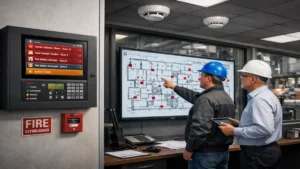
In modern buildings, fire safety is no longer measured only by compliance; it is measured by how fast a system detects, processes and responds to an emergency. When seconds can decide the scale of damage or loss of life, the response time behaviour of a fire alarm system becomes one of its most critical performance indicators.
Among advanced fire detection technologies, GST addressable fire alarm systems have gained strong adoption across commercial, industrial and high-density residential projects. Engineers, consultants and facility managers increasingly prefer them because of their predictable response time, intelligent processing and scalable architecture.
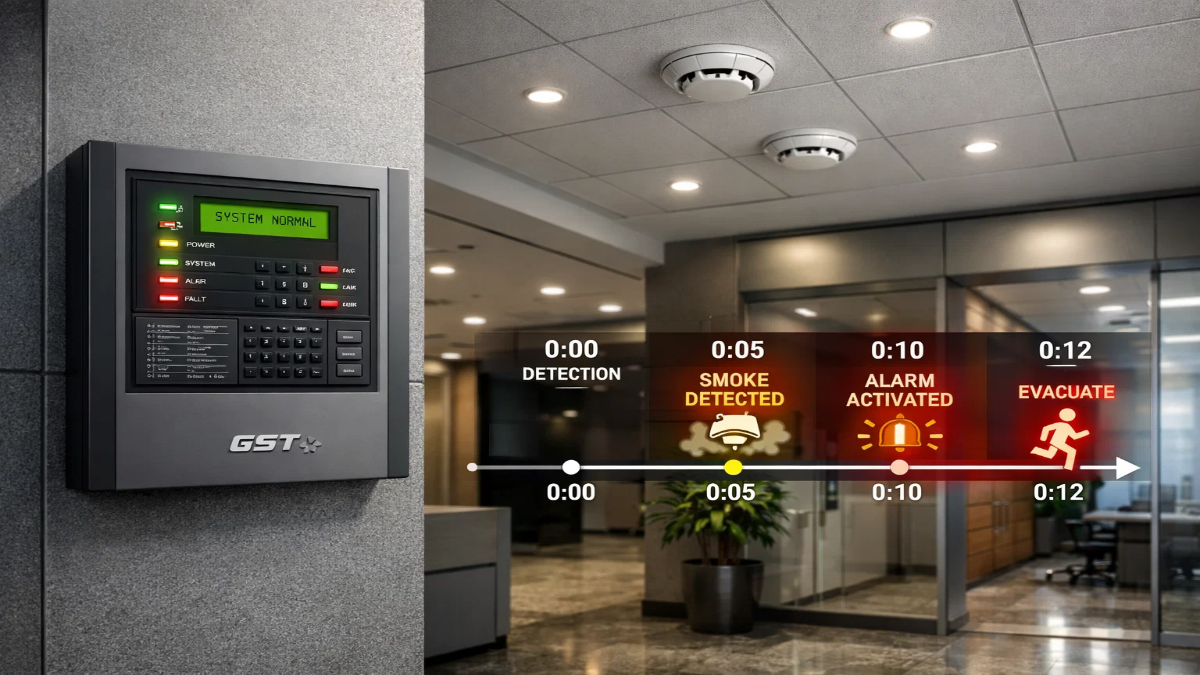
This article explains how response time works in GST addressable systems, what factors influence it, how it compares with traditional systems and why it performs reliably in real-world fire scenarios.
What Is Response Time in a Fire Alarm System?
Response time refers to the total time taken from the initial fire signature (smoke, heat, or flame) to the activation of alarms and control actions.
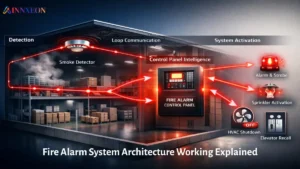
It includes four main stages:
- Detection time – When a detector senses smoke or heat
- Signal transmission time – When data travels to the panel
- Panel processing time – When logic confirms an alarm condition
- Output activation time – When sounders, relays and alerts activate
A well-designed addressable fire alarm panel reduces delay at every stage.
Why Addressable Systems Behave Differently Than Conventional Systems
To understand GST’s response time behaviour, it helps to compare addressable and conventional technologies.
Conventional Fire Alarm Systems: Response Limitations
A conventional fire alarm panel groups detectors into zones. When one device activates:
- The panel knows only the zone, not the exact device
- Signal interpretation is basic
- Multiple devices share the same circuit
This leads to:
- Slower fault identification
- Higher false alarm risk
- Delayed decision-making during emergencies
Conventional systems still work well for small buildings, but response accuracy drops as building size increases.
Addressable Fire Alarm Systems: Intelligent Response
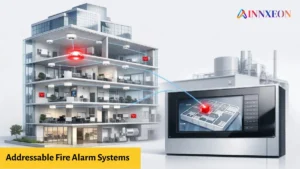
In contrast, a GST fire alarm system using addressable technology assigns a unique digital address to each device.
This enables:
- Exact device identification
- Faster signal validation
- Intelligent alarm logic
- Reduced signal ambiguity
As a result, response time becomes consistent and predictable, even in complex installations.
Core Components That Influence Response Time in GST Addressable Systems
1. Intelligent Addressable Detectors
Addressable detectors from GST continuously communicate with the control panel. Unlike basic detectors, they do not simply switch from “normal” to “alarm.”
Instead, they:
- Monitor smoke or heat trends
- Send analogue values, not just alarm signals
- Allow the panel to evaluate fire growth patterns
This behaviour enables early-stage fire detection without unnecessary delays.
Compared to conventional detectors, this intelligent signalling shortens detection-to-decision time significantly.
2. High-Speed Loop Communication Protocol
GST addressable systems use optimised digital loop protocols designed for fast polling cycles.
Key advantages include:
- Rapid device scanning
- Minimal communication latency
- Stable performance even with high device counts
Even when hundreds of devices share a loop, the system maintains consistent response times without congestion.
3. Panel Processing Logic and Algorithms
The real strength of a GST addressable fire alarm panel lies in its internal processing logic.
The panel:
- Evaluates incoming data instantly
- Applies programmable cause-and-effect rules
- Confirms alarms without unnecessary verification delays
This ensures alarms activate only when conditions are validated, avoiding both slow responses and false triggers.
4. Cause-and-Effect Programming
Response time is not just about detection; it is also about action.
GST panels allow:
- Predefined output responses
- Immediate control of sounders, strobes, lifts, HVAC and fire dampers
- Zoned or device-level activation
This reduces the time between alarm confirmation and emergency response execution.
How GST Addressable Systems Handle Real Fire Scenarios
Scenario 1: Smouldering Fire (Early Smoke)
In slow-developing fires:
- Addressable detectors detect minute smoke particles
- Analogue values gradually rise
- Panel identifies abnormal trends early
Result: Earlier alarm activation compared to conventional systems, which may wait for higher thresholds.
Scenario 2: Fast-Flaming Fire
In rapid-fire growth:
- Detectors hit alarm thresholds quickly
- High-speed communication sends instant alerts
- Panel processes and triggers outputs immediately
Result: Minimal response delay, even under high thermal conditions.
Scenario 3: Dust or Environmental Interference
False alarms increase response hesitation in many systems. GST systems reduce this risk by:
- Distinguishing real fire patterns from transient disturbances
- Applying adaptive sensitivity where supported
This ensures response time remains fast without sacrificing reliability.
Addressable vs Conventional: Response Time Comparison
| Parameter | Addressable Fire Alarm Panel | Conventional Fire Alarm Panel |
|---|---|---|
| Detection accuracy | High | Moderate |
| Signal processing | Intelligent, digital | Basic, zone-based |
| Alarm confirmation | Fast and validated | Simple threshold-based |
| Fault isolation | Device-level | Zone-level |
| Response time consistency | Excellent | Varies with load |
This comparison clearly shows why addressable systems dominate medium to large projects.
Installation Quality and Its Impact on Response Time
Even the best system performs poorly if installed incorrectly.
Proper Loop Design
GST systems require:
- Correct loop lengths
- Balanced device distribution
- Proper cable quality
Poor loop design can introduce communication delays.
Correct Device Selection
Using the right mix of:
- Addressable detectors for high-risk zones
- Heat detectors where smoke is unsuitable
ensures optimal response behaviour.
Professional Programming and Commissioning
Panel configuration directly affects response time. Proper commissioning ensures:
- Logical cause-and-effect mapping
- Correct alarm thresholds
- Efficient output sequencing
Response Time Behaviour in Large and Multi-Building Projects
GST addressable systems perform consistently across:
- High-rise buildings
- Industrial plants
- Campuses and airports
- Hospitals and malls
Their distributed intelligence ensures that response time does not degrade as the system scales.
This makes GST particularly suitable for future expansion, where maintaining performance consistency is critical.
Compliance with International Fire Standards
GST addressable fire alarm systems are designed to align with:
- EN standards
- International fire detection performance requirements
- Project-specific authority guidelines
These standards include strict expectations around alarm response behaviour, reinforcing system reliability.
Why GST Fits Regional Building Needs
In regions with:
- Rapid urban development
- Mixed-use high-density buildings
- Industrial expansion
GST addressable systems provide:
- Stable response under high device loads
- Easy maintenance for local teams
- Cost-effective scalability
This makes them suitable for both emerging and mature infrastructure markets.
Best Practices to Maintain Fast Response Time Over System Life
- Schedule regular detector testing
- Keep firmware updated
- Avoid overloading loops beyond recommendations
- Replace legacy devices during expansions
- Review cause-and-effect logic periodically
These steps ensure response time performance remains optimal year after year.
Why Response Time Is a Core Strength of GST Addressable Systems
The response time behaviour of GST addressable fire alarm systems reflects a balance of speed, intelligence and reliability. From early detection to instant output activation, every component is designed to minimise delay without compromising accuracy.
Compared to conventional fire alarm panels, GST addressable solutions deliver:
- Faster detection
- Smarter decision-making
- Predictable performance at scale
For engineers, consultants and building owners focused on real-world fire safety, not just compliance, this response behaviour makes GST a dependable choice for modern fire protection strategies.
Read Also: What Makes GST Fire Alarm Panels Suitable for High-Density Buildings
Read Also: Fire Alarm System Scalability: The Problem No One Notices Until Phase-2