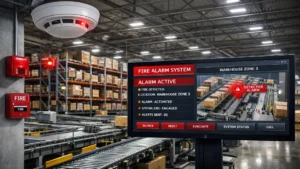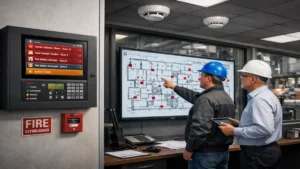
Large campuses, industrial parks, hospitals, universities, airports, IT parks and smart cities rarely operate from a single building. Instead, they function as multi-building environments, often spread across wide geographical areas. In such projects, fire safety becomes more complex and traditional single-panel systems quickly reach their limits.
This is where scalable fire alarm networks become critical.
Modern fire safety planning requires systems that can:
- Monitor multiple buildings centrally
- Communicate seamlessly across long distances
- Expand without redesigning the entire infrastructure
- Maintain reliability during emergencies
GST (Gulf Security Technology) fire alarm panels are purpose-built for these requirements. With strong networking capability, intelligent addressable technology and compatibility with both addressable and conventional devices, GST panels make scaling multi-building fire alarm systems efficient, cost-effective and future-ready.
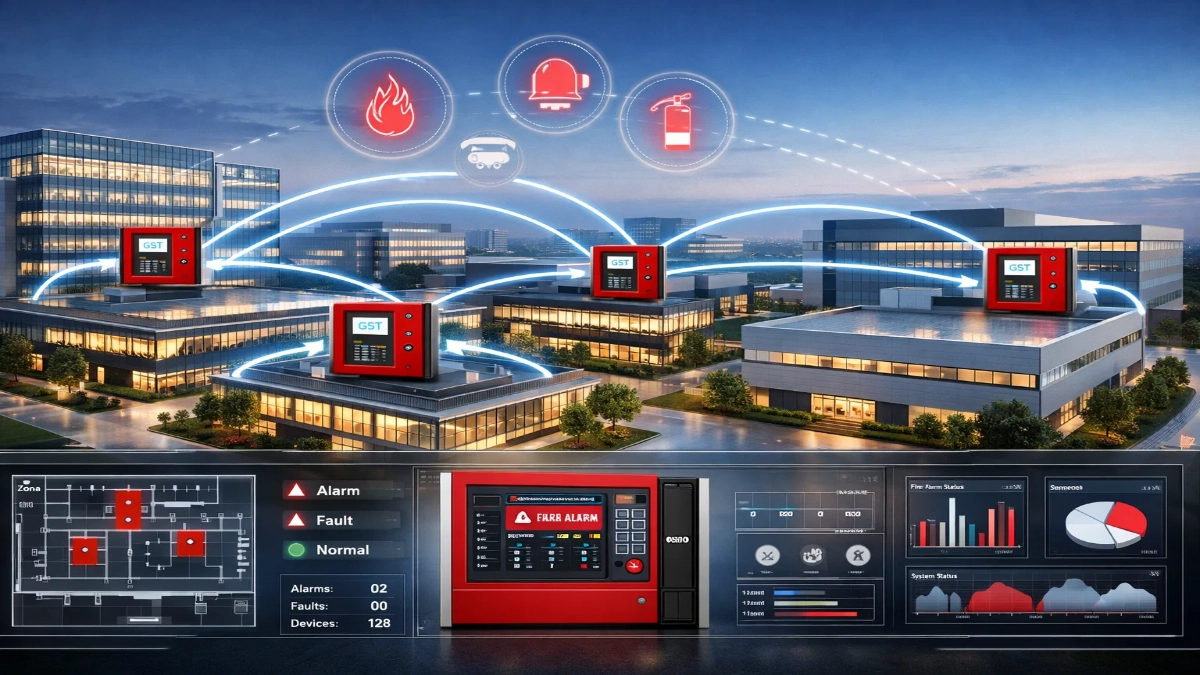
This article explains how to scale a multi-building fire alarm network using GST panels, while meeting international safety standards and real-world operational needs.
Understanding Multi-Building Fire Alarm Networks
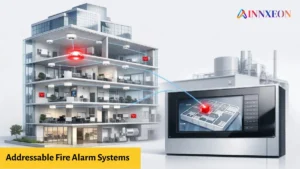
A multi-building fire alarm network connects multiple fire alarm panels installed in different buildings into a unified monitoring and control system. Instead of treating each building as an isolated unit, all panels communicate with each other and with a central fire command centre.
Common Use Cases
- Corporate and IT campuses
- Airports and metro depots
- Hospitals and healthcare clusters
- Universities and residential townships
- Manufacturing and logistics hubs
In such environments, fire safety teams need real-time visibility, quick response coordination and system-wide control.
Why GST Panels Are Ideal for Multi-Building Scaling
1. Native Networking Capability
GST panels are designed with built-in networking support, allowing multiple panels to communicate over:
- RS-485
- Fibre optic networks
- TCP/IP (via gateways)
This enables centralised monitoring without signal degradation over long distances.
2. Modular and Expandable Architecture
Unlike rigid systems, GST panels allow:
- Loop expansion
- Panel-to-panel interconnection
- Easy addition of new buildings
You can scale from 2 buildings to 200+ panels without replacing existing infrastructure.
Addressable vs Conventional Architecture in Multi-Building Projects
Addressable Systems for Large Networks
For large campuses, addressable fire alarm panel architecture offers significant advantages:
- Each device has a unique address
- Exact fire location identification
- Faster response time
- Reduced cabling
GST addressable panels support thousands of devices across multiple loops, making them ideal for complex layouts.
Conventional Systems for Small or Legacy Buildings
Some campuses still include smaller structures where conventional fire alarm panel systems remain practical. GST allows seamless integration of:
- Addressable networks
- Conventional sub-panels
This hybrid approach reduces upgrade costs while maintaining centralised control.
Designing a Scalable Multi-Building Network with GST Panels
Step 1: Centralised vs. Distributed Control Strategy
GST systems support both:
- Centralised command centres for full visibility
- Distributed intelligence, where each building operates independently but reports centrally
This ensures safety even if one network segment fails.
Step 2: Zoning and Building Segmentation
Each building can be:
- Configured as a separate zone
- Assigned priority levels
- Integrated into campus-wide evacuation logic
This helps emergency teams respond precisely rather than evacuating entire campuses unnecessarily.
Role of GST Fire Alarm System in Centralised Monitoring
A fully networked GST fire alarm system allows:
- Real-time alarm reporting
- Fault and maintenance alerts
- Event history logging
- Graphical monitoring via BMS or fire graphics software
Security and facility teams can monitor the entire campus from a single control room, improving response coordination.
Networking Multiple GST Panels: How It Works
Panel-to-Panel Communication
GST panels communicate using:
- High-speed data protocols
- Redundant communication paths
- Auto-panel identification
This ensures reliable data transfer even in high-interference environments like factories or substations.
Distance and Reliability Advantages
With fibre optic support, GST networks can span:
- Several kilometers between buildings
- Harsh industrial environments
- High EMI zones
This makes them suitable for large industrial and infrastructure projects.
Integrating Addressable Detectors Across Multiple Buildings
Addressable detectors are essential in multi-building systems because they:
- Identify the exact device location
- Reduce false alarms
- Enable intelligent cause-and-effect programming
GST addressable detectors integrate seamlessly with GST panels and support:
- Smoke detection
- Heat detection
- Multi-sensor technology
This improves detection accuracy across diverse building types.
Using Conventional Detectors in Hybrid Networks
In retrofit or budget-sensitive buildings, conventional detectors still play an important role. GST panels support:
- Conventional zones
- Interface modules for integration
- Unified reporting at the central panel
This hybrid flexibility allows phased upgrades without compromising safety.
Cause-and-Effect Programming Across Buildings
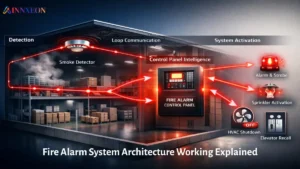
One of the biggest advantages of scaling with GST panels is intelligent cause-and-effect logic, such as:
- Automatic building-specific evacuation
- Elevator recall
- Smoke control activation
- Fire door release
- Public address integration
These actions can be triggered locally or across buildings, depending on fire location and severity.
Compliance with International Fire Safety Standards
GST fire alarm systems comply with:
- EN54
- ISO standards
- Local fire authority requirements
This ensures that multi-building networks meet regulatory approvals across commercial, industrial and government projects.
Maintenance and Diagnostics in Large Networks
Centralised Fault Monitoring
With GST panels, maintenance teams receive:
- Device-level fault alerts
- Cable break notifications
- Power supply warnings
This reduces downtime and improves system reliability.
Simplified Testing and Commissioning
GST software tools allow:
- Remote diagnostics
- Loop testing
- Device replacement without reprogramming
This is critical for large campuses where manual inspection is time-consuming.
Cybersecurity and Network Safety
GST networking solutions support:
- Secure communication protocols
- Isolated fire networks
- Controlled access to configuration tools
This ensures system integrity in smart buildings and IT-heavy environments.
Scalability for Future Expansion
One of the strongest reasons consultants choose GST is future-proof scalability:
- Add new buildings without system redesign
- Expand loops and panels easily
- Integrate with BMS, access control and PA systems
This protects long-term investment and supports phased development projects.
Real-World Applications of GST Multi-Building Networks
Industrial Parks
- Factory-wise zoning
- Central fire command
- High-reliability networking
Hospitals
- Building-specific evacuation
- Life safety priority programming
- Integration with nurse call and BMS
IT Campuses
- Intelligent false alarm reduction
- Seamless expansion
- Minimal downtime
Common Mistakes to Avoid When Scaling Fire Alarm Networks
- Using non-networkable panels
- Ignoring future expansion
- Mixing incompatible brands
- Lack of centralised diagnostics
- Poor cause-and-effect planning
GST panels address all these challenges with a unified ecosystem.
Why Fire Consultants and System Integrators Prefer GST
- Strong networking capability
- Flexible system architecture
- Reliable detection technology
- International compliance
- Excellent scalability
These features make GST a trusted choice for complex, multi-building fire alarm projects.
Building Smarter, Safer Fire Alarm Networks with GST
Scaling a multi-building fire alarm network is no longer just about adding more panels. It is about intelligence, reliability, expandability and centralised control.
With its advanced networking, flexible architecture and seamless integration of addressable fire alarm panel, conventional fire alarm panel, addressable detectors and conventional detectors, the GST fire alarm system offers a future-ready solution for modern fire safety challenges.
For consultants, system integrators and project owners planning large campuses or expanding facilities, GST panels provide the confidence, compliance and control required to protect lives and assets, today and in the future.
Read Also: Why GST Addressable Systems Reduce Risk in Large Fire Safety Projects
Read Also: Why Engineers Choose GST-IFP4E Addressable Fire Alarm Panel for Mid-to-Large Projects