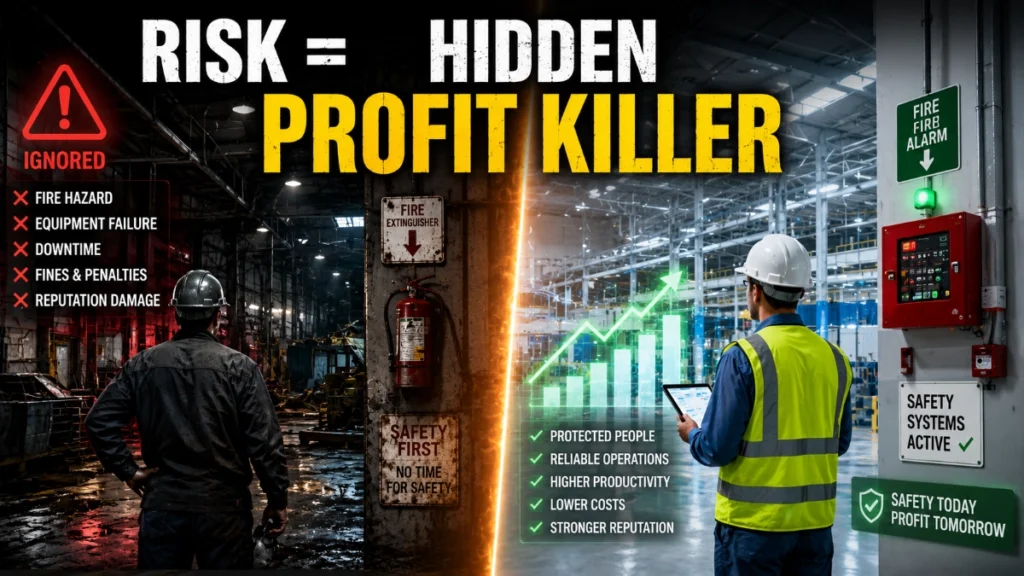
Top Fire Safety Risks in Warehouses and Manufacturing Plants

Top Fire Safety Risks in Warehouses and Manufacturing Plants

Industrial warehouses and manufacturing plants play a critical role in modern supply chains. They store raw materials, manage production processes and distribute finished goods across markets. However, these facilities also face some of the highest fire risks among commercial and industrial environments. A single fire incident in a warehouse or manufacturing plant can cause massive financial losses, operational downtime and even endanger human lives. According to industrial safety reports worldwide, most industrial fires are preventable and are caused by electrical faults, improper storage practices, combustible dust and a lack of adequate fire protection systems. Understanding the top fire safety risks in warehouses and manufacturing plants is essential for safety engineers, facility managers, plant heads and system integrators. By identifying these risks early, organisations can implement proactive safety strategies that reduce fire hazards and ensure regulatory compliance. In this comprehensive guide, we will explore the most common fire hazards in industrial facilities and practical solutions to mitigate them. Why Warehouses and Manufacturing Plants Face Higher Fire Risks Warehouses and industrial plants naturally contain multiple elements that can fuel a fire: When these factors combine with insufficient safety measures, even a small ignition source can quickly escalate into a major fire incident. Additionally, fires in large industrial facilities often spread rapidly due to: Because of these risks, modern fire safety strategies must combine technology, engineering design and operational discipline. 1. Electrical System Failures Electrical faults remain a leading cause of industrial fires in warehouses and manufacturing plants. Electrical systems in industrial facilities operate continuously and power multiple machines, lighting systems, conveyors and automation equipment. Over time, electrical components may deteriorate or become overloaded. Common Electrical Fire Hazards When insulation breaks down or circuits overload, sparks can ignite nearby combustible materials. How to Reduce Electrical Fire Risks Organisations should implement the following measures: Smart monitoring technologies can also detect abnormal heat patterns before electrical failures occur. 2. Combustible Dust Explosions Combustible dust is one of the most underestimated fire hazards in manufacturing plants. Industries such as: often generate fine dust particles during production. When dust particles accumulate in the air and come into contact with an ignition source, they can cause dust explosions. Conditions That Trigger Dust Explosions A dust explosion requires five elements: This combination is known as the Dust Explosion Pentagon. Prevention Strategies To minimise combustible dust risks: Early detection and proper facility design can significantly reduce the risk of catastrophic explosions. 3. Improper Storage of Flammable Materials Warehouses frequently store flammable liquids, chemicals and packaging materials. If these materials are not stored properly, they can easily ignite during an electrical fault or mechanical failure. High-Risk Materials in Warehouses Some common flammable materials include: Stacking these materials without fire protection significantly increases the fire load. Safe Storage Best Practices To reduce fire hazards: Proper inventory management also ensures that outdated or unstable chemicals do not accumulate. 4. Overheated Machinery and Equipment Manufacturing plants operate with heavy machinery that generates heat during production. Examples include: If machinery overheats or operates without proper maintenance, it can become a source of ignition for a fire. Common Causes of Machinery Fires Preventive Measures Facilities should implement: Industrial IoT monitoring systems can now detect abnormal machine behaviour and alert operators before failures occur. 5. Poor Housekeeping Practices Housekeeping is one of the simplest yet most overlooked fire prevention strategies in warehouses and manufacturing plants. Accumulated waste materials can act as fuel sources for fire. Common Housekeeping Issues When these materials accumulate near electrical panels or machinery, they significantly increase fire risks. Effective Housekeeping Policies Facilities should: A clean facility significantly reduces potential fire fuel sources. 6. Inadequate Fire Detection Systems Many industrial facilities rely on outdated fire detection systems that cannot detect fires early enough. Warehouses often have high ceilings and large open spaces, which can delay smoke detection. Challenges in Warehouse Fire Detection Modern Fire Detection Technologies Modern facilities should consider: Early detection dramatically reduces fire damage by allowing faster emergency response. 7. Lack of Fire Suppression Systems Fire detection alone cannot stop a fire. Facilities must also have effective suppression systems. Many warehouse fires spread quickly because suppression systems are either absent or poorly designed. Common Fire Suppression Solutions Industrial facilities may use: The selection depends on: For example, warehouses storing flammable liquids require specialised suppression systems. 8. Human Error and Lack of Safety Training Human error remains a major contributor to industrial fires. Employees may unknowingly create fire hazards due to a lack of awareness. Examples of Unsafe Practices Importance of Fire Safety Training Regular safety training helps employees: Organisations should conduct periodic fire drills and safety workshops to ensure preparedness. 9. Hot Work Activities Hot work refers to operations that produce flames, sparks, or heat. Examples include: These activities frequently occur in manufacturing plants and maintenance operations. Risks of Hot Work Sparks generated during hot work can ignite nearby combustible materials. Many industrial fires occur because proper safety procedures were not followed. Hot Work Safety Controls Facilities should implement: These measures ensure hot work activities remain controlled and safe. 10. Poor Emergency Planning Even with advanced fire protection systems, a lack of emergency planning can worsen fire incidents. Many facilities fail to prepare employees for emergencies. Essential Emergency Preparedness Measures A strong fire emergency plan should include: Emergency response planning ensures faster evacuation and reduces panic during incidents. The Role of Technology in Industrial Fire Safety Modern fire safety systems now integrate advanced technologies to reduce risks in industrial environments. Some of the most effective innovations include: These technologies help identify fire risks before they escalate into major incidents. By combining engineering controls, automation and safety training, organisations can build safer industrial environments. Best Practices for Improving Fire Safety in Industrial Facilities Organisations should adopt a proactive fire safety strategy that includes: Conducting Regular Fire Risk Assessments Fire risk assessments help identify hazards and ensure compliance with safety regulations. Installing Advanced Fire Detection Systems Modern detection systems provide early warning and faster response times. Implementing Preventive Maintenance Programs Regular maintenance reduces the

How Technology Is Transforming Modern Fire Safety Systems?

How Technology Is Transforming Modern Fire Safety Systems

Fire safety has always been a critical pillar of building design and industrial risk management. For decades, traditional fire safety systems relied on basic detection devices, manual monitoring and reactive response strategies. While these systems saved countless lives, they often lacked intelligence, real-time awareness and predictive capability. Today, technology is dramatically transforming modern fire safety systems. With the integration of artificial intelligence, Internet of Things (IoT), advanced analytics and cloud connectivity, fire protection systems are becoming smarter, faster and far more reliable than ever before. Modern fire safety is no longer limited to simply detecting smoke and triggering alarms. Instead, it focuses on early detection, intelligent decision-making, predictive maintenance and coordinated emergency response. For engineers, system integrators, safety consultants and facility managers, understanding these technological advancements is essential. In this article, we explore how technology is reshaping modern fire safety systems and why organisations must embrace these innovations to enhance safety, compliance and operational resilience. The Evolution of Fire Safety Systems To understand the transformation, it is important to look at how fire safety systems have evolved. Traditional fire protection relied on three main components: These systems were effective but limited. Conventional panels typically divide buildings into zones. When a detector triggered, the panel would indicate only the zone where the incident occurred rather than the exact location. This often slowed emergency response. Modern fire safety systems now operate with addressable technology, network connectivity and intelligent control logic. Key improvements include: Instead of isolated devices, modern systems function as interconnected safety networks capable of making intelligent decisions during emergencies. Smart Fire Detection Technologies One of the most significant technological transformations in fire safety is advanced detection technology. Modern detectors use multi-criteria sensing and sophisticated algorithms to identify fire conditions earlier while reducing false alarms. Multi-Sensor Detectors Traditional detectors rely on a single detection principle, such as smoke or heat. However, modern detectors combine multiple sensing technologies, including: These multi-sensor detectors analyse multiple environmental factors simultaneously, improving accuracy and reducing nuisance alarms. Aspirating Smoke Detection (ASD) Aspirating smoke detection systems provide ultra-early warning detection. These systems continuously draw air samples through a network of pipes and analyse them for microscopic smoke particles. ASD technology is widely used in: Because these systems detect smoke at a very early stage, they allow emergency teams to intervene before a fire escalates. Video-Based Fire Detection Another emerging technology is video analytics for fire detection. Intelligent cameras can now detect: This technology is particularly useful in large open environments such as: By analysing visual data in real time, video detection systems can identify fire conditions even before traditional detectors activate. The Role of Artificial Intelligence in Fire Safety Artificial intelligence is revolutionising how fire safety systems analyse risks and respond to emergencies. AI-enabled fire safety systems can process vast amounts of environmental data to recognise fire patterns and trigger alerts more accurately. Intelligent Alarm Verification False alarms are one of the biggest operational challenges in fire safety systems. Frequent false alarms lead to unnecessary evacuations, operational disruptions and reduced trust in alarm systems. AI algorithms can analyse sensor data patterns to determine whether an alarm condition is genuine or caused by environmental factors such as dust, steam or humidity. This significantly reduces nuisance alarms while maintaining high detection sensitivity. Predictive Risk Analysis AI also enables predictive fire risk assessment. By analysing historical data, environmental conditions and equipment performance, AI systems can identify areas with elevated fire risk. For example, AI systems may detect patterns such as: This allows facility managers to address potential hazards before they develop into real fire incidents. Internet of Things (IoT) and Connected Fire Systems The Internet of Things is another major driver of transformation in fire safety systems. IoT technology allows fire safety devices to communicate with each other and share data across networks. Connected Detection Devices Modern fire detectors, alarm panels and sensors can now connect through secure networks to provide real-time system status and event data. Benefits include: Facility managers can monitor fire safety systems from centralised dashboards instead of physically inspecting each device. Remote System Monitoring IoT-enabled fire systems allow remote monitoring through cloud-based platforms. This capability is particularly valuable for organisations that manage multiple facilities. Remote monitoring allows safety teams to: This level of visibility significantly improves operational efficiency and system reliability. Cloud-Based Fire Safety Management Cloud technology has introduced a new level of flexibility and scalability in fire safety systems. Traditional systems relied on on-site monitoring panels. However, modern cloud platforms allow organisations to manage fire safety infrastructure across multiple buildings from a single interface. Centralised System Management Cloud platforms enable centralised management of: Safety teams can monitor multiple facilities in real time, which is particularly beneficial for large enterprises, industrial groups and multi-site organisations. Data Analytics and Reporting Cloud-based systems also provide advanced analytics capabilities. These platforms collect system performance data and generate insights such as: These insights help engineers optimise system performance and ensure regulatory compliance. Integration with Building Management Systems Another major technological advancement is integration between fire safety systems and building management systems (BMS). Instead of functioning independently, modern fire systems can coordinate with multiple building subsystems during emergencies. Integrated systems may automatically control: This coordinated response significantly improves evacuation safety and emergency management. For example, when smoke is detected in a specific area, the system can automatically: This level of automation dramatically improves response time and reduces human intervention during critical situations. Wireless Fire Detection Systems Wireless technology is also transforming fire safety installations, especially in complex or heritage buildings. Traditional fire detection systems require extensive cabling infrastructure, which can be difficult to install in certain environments. Wireless fire detection systems offer several advantages: These systems are widely used in: Wireless detectors communicate with control panels using secure radio protocols while maintaining high reliability. Advanced Notification and Communication Systems Modern fire safety systems now incorporate advanced communication technologies to improve emergency notification. Voice Evacuation Systems Traditional fire alarms rely on simple sirens or bells. However, modern buildings increasingly use voice

What Are the Legal Fire Safety Requirements for Businesses in India?

What Are the Legal Fire Safety Requirements for Businesses in India

Fire safety is not just a regulatory requirement in India; it is a critical responsibility for every business owner, facility manager and safety professional. Every year, fire incidents in commercial buildings, factories, warehouses and offices lead to severe property damage, business disruption and tragic loss of life. To reduce these risks, India has established strict fire safety regulations that businesses must follow. These rules ensure that buildings are designed with proper fire protection systems, emergency exits, alarm systems and trained personnel who can respond quickly during emergencies. However, many organisations still misunderstand the legal fire safety requirements. Some assume installing a few fire extinguishers is enough. Others believe compliance only matters during inspections. In reality, fire safety compliance in India involves multiple laws, building codes and operational practices that must work together. In this detailed guide, we will explain the legal fire safety requirements for businesses in India, including applicable laws, mandatory systems, compliance procedures and best practices for maintaining a safe workplace. Why Fire Safety Compliance Is Critical for Businesses Before we explore the legal framework, it is important to understand why fire safety compliance matters for businesses. Fire incidents can escalate within minutes. Without proper detection, alarm systems and evacuation planning, employees and visitors may not receive enough warning to escape safely. Fire safety compliance helps businesses: For industrial facilities, manufacturing plants and commercial complexes, fire safety compliance is even more critical because the risk of ignition sources and combustible materials is higher. Key Fire Safety Laws and Regulations in India India does not rely on a single national fire safety law. Instead, fire safety compliance is governed by a combination of national codes, state regulations and building approval processes. The most important regulations include: 1. National Building Code of India (NBC) The National Building Code (NBC) 2016 is the primary guideline for fire and life safety in buildings across India. The NBC provides detailed standards for: Although NBC itself is a code and not a law, most state governments adopt it into their local building regulations. As a result, compliance with NBC fire safety guidelines is effectively mandatory. 2. State Fire Service Acts Each Indian state has its own Fire Service Act, which empowers the fire department to enforce fire safety regulations. Examples include: These laws allow authorities to: Businesses must comply with both NBC guidelines and state fire safety regulations. 3. Factories Act, 1948 Industrial facilities and manufacturing plants must also follow the Factories Act, 1948, which includes fire safety provisions for worker protection. Under this act, factories must provide: Failure to comply can result in legal penalties and operational restrictions. 4. Occupational Safety, Health and Working Conditions Code (OSH Code) India’s modern OSH Code strengthens workplace safety regulations, including fire safety responsibilities for employers. Businesses must ensure: This law emphasises proactive safety management rather than reactive compliance. Fire Safety Certificate (Fire NOC): A Mandatory Requirement One of the most important legal requirements for businesses in India is obtaining a Fire NOC (No Objection Certificate). A Fire NOC confirms that a building complies with fire safety regulations and can be safely occupied. When Is Fire NOC Required? A Fire NOC is typically required for: Without this certificate, a building may not receive occupancy approval. How Businesses Obtain a Fire NOC The typical process involves several steps. 1. Fire Safety Design Approval Before construction begins, building plans must include fire safety systems such as: These designs must be submitted to the fire department for approval. 2. Installation of Fire Safety Systems During construction, businesses must install all fire protection systems according to approved plans. These systems may include: Proper installation and testing are essential. 3. Inspection by Fire Authorities After installation, the fire department conducts a site inspection to verify that the building meets safety standards. Inspectors typically check: 4. Issuance of Fire NOC If the building passes inspection, the fire department issues the Fire NOC. However, compliance does not end here. Many states require periodic renewal of Fire NOC, especially for commercial and industrial buildings. Mandatory Fire Safety Systems for Businesses To meet legal requirements, businesses must install specific fire protection systems depending on building type and occupancy. Let us explore the most common mandatory systems. 1. Fire Detection and Alarm Systems Early detection is essential to prevent fire disasters. Businesses must install fire detection systems such as: These systems provide early warning and allow occupants to evacuate safely. In large facilities, addressable fire alarm systems are commonly required because they identify the exact location of a fire. 2. Fire Suppression Systems Fire suppression systems control or extinguish fires before they spread. Common systems include: Industrial facilities often require specialised suppression systems depending on fire hazards. 3. Fire Hydrant Systems Fire hydrant systems allow firefighters to access water quickly during emergencies. A typical hydrant system includes: Large buildings and factories must install both internal and external hydrant systems. 4. Portable Fire Extinguishers Portable extinguishers are mandatory in almost all commercial buildings. Different types are used for different fire classes: Proper placement and regular inspection are required. 5. Emergency Exits and Evacuation Routes Legal fire safety requirements also include building design elements that enable safe evacuation. Buildings must provide: High-rise buildings must also include refuge areas for safe evacuation. Fire Safety Training and Emergency Preparedness Fire safety compliance does not stop with equipment installation. Businesses must also ensure employees know how to respond during a fire emergency. Mandatory safety practices include: Regular drills help employees respond quickly and prevent panic during real incidents. Maintenance and Inspection Requirements Many fire safety systems fail not because of poor design but because of a lack of maintenance. Indian fire safety regulations require businesses to maintain systems in working condition. Routine maintenance typically includes: Maintenance records must be documented and available during inspections. Penalties for Non-Compliance Ignoring fire safety regulations can result in serious legal and financial consequences. Authorities may impose: In cases where negligence leads to loss of life, business owners and facility managers may face criminal liability. For

Importance of Redundancy and Fault Tolerance in Fire Alarm Systems

Introduction: Why Fire Alarm Systems Must Never Fail In fire protection engineering, few systems carry the same level of responsibility as a fire alarm system. Unlike conventional building technologies that improve convenience or efficiency, fire detection and alarm systems are life-safety critical infrastructure. Their primary function is to detect fire conditions early, alert occupants, and trigger emergency response actions that protect lives and assets. When a fire alarm system fails, the consequences extend far beyond equipment malfunction. A system failure can directly delay evacuation, prevent suppression systems from activating, and compromise the safety of everyone inside the building. For this reason, engineers treat fire detection networks differently from other building systems. The design philosophy prioritises continuous availability, fault tolerance and redundancy to ensure the system remains operational even when individual components fail. Life Safety Dependency on Fire Detection In most facilities, occupants rely entirely on the fire alarm system to detect emergencies. People cannot visually monitor every area of a building. Fires often start in concealed spaces such as: A properly designed GST Addressable Fire Alarm System continuously monitors these areas using distributed detectors and signalling networks. The moment abnormal conditions such as smoke or heat appear, the system processes signals and activates alarms. Without this early detection capability, occupants may not recognise a developing fire until conditions become dangerous. Consequences of Fire Alarm System Failure When a fire alarm system becomes unavailable or partially disabled, several risks immediately emerge. Delayed Fire Detection If detectors cannot transmit signals due to network failure or control panel malfunction, the fire may remain undetected for critical minutes. Notification Failure Even if detectors identify a fire, a fault in notification circuits could prevent alarms from sounding. Occupants would remain unaware of the danger. Evacuation Delay Delayed or absent alarms significantly slow evacuation. In large buildings, evacuation depends on coordinated alarm signalling and voice instructions. Suppression System Activation Delay Many suppression systems, including sprinklers, gas suppression systems and smoke control systems, integrate with fire alarm controls. A control panel failure may prevent automatic activation. High-Risk Environments Certain facilities depend heavily on uninterrupted fire detection systems. High-Rise Buildings Vertical evacuation complexity makes early detection essential. Hospitals Patients may not be able to evacuate quickly, requiring a compartmentalised fire response. Airports Large passenger volumes and complex infrastructure demand highly reliable detection networks. Industrial Plants Flammable materials and hazardous processes require immediate alarm signalling. Data Centres Even a small fire can cause catastrophic equipment damage and service disruption. Warehouses Large open storage areas can allow fires to spread rapidly before manual detection occurs. In these environments, the reliability of fire alarm systems directly affects life safety outcomes. Reliability Engineering in Fire Protection Modern fire alarm design integrates principles from reliability engineering, a discipline focused on maintaining system operation under failure conditions. Two key concepts dominate reliability-focused system design: RedundancyInstalling backup components or pathways that allow the system to continue operating when a primary component fails. Fault ToleranceDesigning the system so it continues functioning even when faults occur within the network. A well-designed fire detection network architecture, similar to those found within the Fire Detection System Category, uses these principles extensively. Redundant communication loops, backup power systems and distributed controllers ensure that single failures do not compromise life safety. In the sections that follow, we will explore how redundancy and fault tolerance work in modern fire alarm systems, why they are critical for compliance and reliability and how engineers implement them in real-world projects. Understanding Redundancy and Fault Tolerance in Fire Alarm Systems When engineers design life-safety systems, reliability becomes the central design objective. Fire alarm systems must remain operational during equipment failures, electrical disturbances, or network disruptions. Achieving this level of reliability requires a structured approach built on redundancy and fault tolerance. Although these terms are often used interchangeably, they represent distinct engineering principles that work together to improve system availability. Redundancy: Backup Components for Continuous Operation Redundancy refers to the practice of installing additional components or pathways so the system can continue operating if a primary element fails. In a fire alarm system, redundancy may exist in multiple areas: For example, a modern Addressable Fire Alarm Control Panel may include dual power modules. If the primary module fails, the secondary module automatically maintains power to the panel and field devices. Similarly, redundant communication loops allow detection devices to remain connected even if part of the loop is damaged. The goal of redundancy is simple: eliminate single points of failure. Fault Tolerance: Systems That Continue Operating During Faults While redundancy provides backup components, fault tolerance ensures the system continues functioning even when faults occur within the network. A fault-tolerant fire alarm system detects issues such as: Instead of shutting down the entire system, fault-tolerant architectures isolate the affected section while allowing the rest of the network to operate normally. For example, loop isolation modules can automatically isolate a short circuit on a detection loop. The remaining devices continue communicating with the control panel. Fail-Safe Design vs Fault Tolerance Fire alarm engineers must also distinguish between fail-safe design and fault tolerance. Fail-Safe Design A fail-safe system transitions into a safe condition when a failure occurs. For example, a suppression system valve may open automatically if control signals are lost. Fault Tolerance Fault tolerance allows the system to continue functioning despite faults, preventing the need for fail-safe activation in many cases. Both approaches play roles in fire protection engineering. System Availability and Reliability Metrics Engineers evaluate fire alarm reliability using measurable metrics. Mean Time Between Failures (MTBF) MTBF represents the expected operational time between equipment failures. Higher MTBF values indicate more reliable equipment. Mean Time To Repair (MTTR) MTTR measures how quickly technicians can restore the system after a failure occurs. Lower MTTR values improve system availability. System Uptime Targets Life-safety systems typically aim for very high availability levels, often exceeding 99.99%. Achieving this level of uptime requires redundant components, fault monitoring and rapid fault isolation. How Modern Addressable Systems Implement Redundancy Modern addressable fire alarm systems incorporate redundancy

How to Choose the Right Power Backup System For Fire Safety?

How to Choose the Right Power Backup System For Fire Safety (1)

When we design fire safety systems, we often focus heavily on detection technology, panel architecture, suppression logic and network communication. But in real-world incidents, the most common root cause of total system failure is not detection technology; it is loss of power. Every fire safety system is electrically dependent. If power fails: In a real emergency, even a few seconds of power interruption can reset a fire alarm control panel, corrupt event logs or delay suppression activation. We have seen this in: When we design systems like the GST Addressable Fire Alarm System under the broader fire detection system category, we are not merely meeting specifications; we are designing life safety infrastructure. Power backup is not a checkbox item. It is a reliability engineering decision. Consequences of Power Loss During Fire Let us analyse the technical impact: Failure Type Technical Impact Consequence Detection failure Loop communication stops No fire identification Suppression failure Release panel shuts down Gas discharge blocked Alarm silence NAC circuits de-energised Occupants not alerted Pump failure Motor control panel offline Water supply compromised Code violation System non-compliant Legal & insurance exposure In environments like: Power backup must be engineered with the same rigour as detection logic. Backup power design is not just about compliance. It is life safety engineering. 2. What Is a Power Backup System in Fire Safety? Before choosing a solution, we must clearly define terms. Primary Power Primary power is the normal utility supply, typically 230V/415V AC from the grid. Secondary Power Secondary power is the standby source that activates when the primary supply fails. Standby Power Standby power maintains system readiness under normal (non-alarm) conditions. Alarm Power Alarm power supports the system during active fire conditions when the current draw significantly increases. Backup vs Redundancy vs Emergency Supply These terms are often misused: Term Meaning Duplicate systems to eliminate single-point failure Alternate power source during outage Redundancy Duplicate systems to eliminate single-point failure Emergency supply Dedicated supply for life safety circuits Core Components A properly designed backup system integrates: All integrate with systems like: 3. Fire Safety Systems That Depend on Power Backup Let us examine system-level dependencies. Fire Alarm Control Panels Panels like the GST Addressable Fire Alarm System rely on: If power drops, loop devices disconnect instantly. Detection Loops Devices such as Addressable fire alarm detectors draw continuous standby current. Power instability can: Notification Devices Sounders, strobes and voice evacuation systems increase current 3–5x during alarm. If batteries are undersized, NAC voltage collapses. Fire Pumps Under NFPA 20, fire pumps require a reliable emergency supply. Failure example:A warehouse pump failed during a fire because the generator ATS did not transfer the load properly. Smoke Exhaust Systems Fans require a generator-backed supply. Without smoke extraction, evacuation time increases. 4. Regulatory and Code Requirements for Power Backup Compliance is mandatory. Key standards include: 24-Hour Standby + Alarm Duration Typical requirement: Battery replacement cycles typically occur every 3–5 years. Testing frequency: 5. Types of Power Backup Systems Used in Fire Safety 5.1 Battery-Based Backup Systems Most fire alarm panels include internal sealed lead-acid batteries. Types: Failure Modes: Battery sizing is critical. 5.2 UPS Systems Used in: Online UPS provides zero transfer delay. Limitation:UPS supports short duration unless connected to extended battery banks. 5.3 Generator-Based Backup Diesel generators support: Key components: Failure cases: 6. Key Factors to Consider When Choosing a Power Backup System 6.1 Load Calculation and System Capacity We must calculate: Example: Standby current = 2.5AAlarm current = 8AStandby duration = 24hAlarm duration = 0.5h Battery AH =(2.5 × 24 + 8 × 0.5) × 1.25 safety factor= (60 + 4) × 1.25= 80 AH approx. Refer to systems under the fire detection system category for accurate load sheets. 6.2 Required Standby and Alarm Duration Industrial facilities often require greater autonomy due to delayed emergency response times. High-risk occupancy: Require enhanced autonomy beyond minimum code. 6.3 Redundancy and Reliability We must consider: Reliability engineering eliminates single points of failure. 6.4 Environmental and Installation Conditions Temperature affects battery life drastically. For every 10°C increase above 25°C:Battery life reduces by ~50%. We must consider: 6.5 Battery Sizing and Capacity Calculation Formula: Battery AH =(Standby current × standby hours + Alarm current × alarm hours) × Safety Factor Include ageing factor 1.25–1.3Temperature derating as required. Integrated into systems like Addressable fire alarm control panel installations. 7. Common Power Backup Selection Mistakes Consultants Should Avoid From field audits, we repeatedly see: Consequences Backup power must be engineered, documented and tested. Note: Choosing the right power backup system is not about installing batteries or connecting a generator. It requires: When we design systems like a GST addressable fire alarm system, integrate addressable fire alarm detectors and deploy panels from the fire alarm control panel category, we must treat backup power as a core life safety subsystem. In fire safety engineering, power reliability equals life reliability. Read Also: Fire Alarm Components That Make or Break System Performance Read Also: Why should you use Addressable Fire Alarm Systems for Large-Scale Projects?

Fire Alarm Components That Make or Break System Performance

Fire Alarm Components That Make or Break System Performance

In every engineered fire protection system, performance is never determined by software alone. It depends on the correct selection, configuration and integration of physical components. A fire detection system operates as a coordinated network of sensors, control electronics, communication loops and notification devices. Each component contributes directly to detection reliability, signal transmission and emergency response effectiveness. When even one component is poorly selected, incorrectly sized or improperly installed, the entire system becomes vulnerable. We see this frequently in industrial plants where detection delays occur because inappropriate detectors were used for the environment. In commercial buildings, undersized panels cause communication bottlenecks. In warehouses, improper wiring leads to loop failures. These are not theoretical issues; they are real engineering failures with serious consequences. Why Component Selection Determines System Performance Fire alarm systems are not just compliance requirements; they are real-time life safety systems designed to detect fire early and trigger immediate response. In these systems, performance is defined not by the presence of a control panel or detectors alone, but by the engineering quality, compatibility and reliability of every individual component. Each component plays a specific role in detection, signal transmission, processing and emergency response. If any component underperforms, the effectiveness of the entire system is reduced. To understand this clearly, we must look at how component selection directly influences detection speed, communication reliability, system stability, compliance and long-term operational performance. 1. Fire Alarm Systems Operate in Real Time – There Is No Margin for Delay A fire alarm system functions continuously, monitoring the protected environment every second. The moment fire conditions begin to develop, whether in the form of smoke, heat or combustion particles, the system must detect, process and respond immediately. This process involves three critical stages: Detection:Detectors must identify fire conditions at the earliest possible stage. The sensitivity, sensing technology and environmental suitability of the detector determine how quickly detection occurs. If the detector is not appropriate for the environment, detection may be delayed or inaccurate. Signal Transmission:Once detection occurs, the signal must travel through communication loops or circuits to the control panel. This communication must be fast, stable and immune to electrical noise, voltage drops, or wiring faults. Signal Processing and Response:The fire alarm control panel must process the signal instantly and activate outputs such as sounders, strobes, annunciators and system integrations like HVAC shutdown or fire suppression activation. If any component slows down or interrupts this chain, the system response is delayed. Even small delays can allow fire growth, increasing risk to occupants and assets. 2. Each Component Directly Influences Detection Reliability Detection reliability depends heavily on the type, quality and suitability of the detector used. Different environments require different detection technologies. For example: If an incorrect detector type is selected, the system may either detect fire too late or generate frequent false alarms. Delayed detection allows fire to grow before alarm activation, increasing damage and risk. False alarms, on the other hand, reduce system credibility. When false alarms occur frequently, occupants and facility staff may begin ignoring alarms, which is extremely dangerous during an actual emergency. The correct detector selection ensures both fast detection and operational reliability. 3. Communication Components Determine Signal Integrity and System Stability Once a detector senses fire, the alarm signal must reach the control panel without interruption. This depends on the integrity of communication loops, wiring, interface modules and panel communication capacity. Poor component selection in this area can cause: For example, if the wiring is not properly designed or if the panel capacity is exceeded, the system may experience slow communication polling. This means the control panel takes longer to receive and process alarm signals. In addressable systems, each device has a unique address. This allows precise identification of the alarm location. However, this advantage is only effective if the communication infrastructure and panel capacity are properly engineered. Poor communication design can result in intermittent faults that are difficult to diagnose and dangerous during emergencies. 4. Control Panel Capacity and Processing Capability Are Critical The fire alarm control panel is responsible for managing all system communication and responses. Its processing capacity, loop capacity and system architecture determine how efficiently it can handle alarm signals. If the control panel is undersized, several problems can occur: For example, in a large facility with hundreds of devices, an undersized panel may struggle to communicate with all devices efficiently. This results in delayed signal processing and slower alarm activation. Proper panel selection ensures fast signal processing, stable communication, and long-term scalability. 5. Power Supply and Backup Components Ensure Continuous Operation A fire alarm system must remain operational even during power failures. This is achieved through backup batteries and power supply systems. If backup power components are not properly sized or selected, the system may shut down during electrical outages. This creates a dangerous situation where the facility is left without fire protection. Common power-related failures include: Proper power supply design ensures the system remains operational under all conditions, including extended power outages. 6. Poor Component Selection Leads to Real Operational Problems In real projects, component selection mistakes often lead to serious operational issues. Some common consequences include: Detection delays:Incorrect detector types or low-quality detectors may respond slowly to fire conditions. False alarms:Unsuitable detectors or poor-quality components can generate nuisance alarms, disrupting operations. Communication failures:Improper wiring or insufficient panel capacity can prevent alarm signals from reaching the control panel. System shutdown during power failure:Undersized or poor-quality batteries may fail to support the system during outages. Compliance failures:Using non-compliant or uncertified components can result in regulatory violations. Increased maintenance costs:Poor-quality components fail more frequently, increasing maintenance effort and cost. These problems not only affect safety but also increase operational and financial risks. 7. Real-World Example: Impact of Incorrect Component Selection Consider a large manufacturing facility using conventional fire alarm detectors instead of addressable detectors. In conventional systems, detectors are grouped into zones rather than individually identified. When a fault or alarm occurs, the system only indicates the zone, not the exact device. As a result: In

Why should you use Addressable Fire Alarm Systems for Large-Scale Projects?

Why should you use Addressable Fire Alarm Systems for Large-Scale Projects (2)

Large-scale projects introduce a level of fire-detection complexity far beyond that of standard buildings. When we design fire detection systems for industrial plants and high-rise buildings, we are not just installing detectors; we are building an intelligent safety infrastructure that must operate reliably across vast areas and thousands of devices. These environments present several critical challenges: In such environments, conventional fire alarm systems quickly reach their limitations. They cannot provide precise device-level identification or intelligent system diagnostics at scale. This is where modern intelligent systems, such as the GST addressable fire alarm system and advanced addressable fire alarm control panel architectures, become essential. Addressable fire alarm systems use digital communication and device-level monitoring to provide precise detection, faster response and scalable protection across large facilities. Instead of simply detecting that “something is wrong in Zone 4,” these systems identify the exact device, location and condition, transforming fire detection into a fully intelligent safety network. What is an Addressable Fire Alarm System An addressable fire alarm system is an intelligent fire detection system where every connected device has a unique digital address. The control panel communicates individually with each detector, module and notification device to monitor status in real time. Unlike conventional systems that monitor zones, addressable systems monitor individual devices. This architecture allows the control panel to identify: Modern platforms such as the GST addressable fire alarm system use loop-based communication networks that connect hundreds of devices on a single circuit while maintaining individual identification. Device-Level Communication and Monitoring In addressable systems, the addressable fire alarm control panel continuously communicates with every device connected to the loop. Each device responds with: This continuous communication ensures full system visibility. According to the National Fire Protection Association, intelligent systems improve response efficiency by providing precise alarm location information and real-time monitoring. You can explore their educational resources here:https://www.nfpa.org/news-and-research/resources Difference Between Addressable and Conventional Systems The key difference lies in identification and intelligence. Conventional system: Addressable system: This difference becomes critical in large facilities. Core Components of Addressable System Architecture Addressable fire alarm systems include several key components: 1. Control Panel The addressable fire alarm control panel acts as the system brain. It processes device data, manages communication and activates alarms. 2. Detection Loops Loops are communication circuits connecting addressable devices to the panel. 3. Addressable Detectors Modern addressable fire alarm detectors include: Each detector has a unique digital identity. 4. Interface Modules Modules connect external systems such as: These modules enable system integration and automation. Benefits of Using Addressable Fire Alarm Systems Addressable systems offer several critical advantages that directly improve safety, reliability and operational efficiency in large-scale projects. Precise Fire Location Identification This is one of the most important advantages. When an alarm occurs, the control panel displays the exact device location. For example: Instead of showing: “Zone 3 alarm” It shows: “Smoke detector – Level 5 – Electrical Room 2” This precise information allows emergency teams to respond immediately without wasting time searching. According to IFSEC Global’s fire detection guidance:https://www.ifsecglobal.com/fire-news/fire-alarm-systems-guide/ Precise alarm identification significantly improves emergency response efficiency in large facilities. Faster Fault Detection and Maintenance Addressable systems continuously monitor system health. They detect: The addressable fire alarm control panel immediately displays faults. Maintenance teams can locate and fix issues quickly without manual inspection of entire zones. This reduces downtime and improves system availability. Scalability for Large Projects This makes them ideal for: Reduced False Alarms Improved System Reliability Addressable systems improve reliability through advanced communication and fault isolation. Features include: If a wiring fault occurs, only a small portion of the loop is affected, not the entire system. This ensures continuous protection. Lower Long-Term Maintenance Cost Addressable systems reduce maintenance costs by enabling targeted servicing. Instead of testing entire zones, technicians can identify specific devices requiring maintenance. This reduces: The addressable fire alarm detectors also provide contamination alerts, allowing predictive maintenance. Why Addressable Systems Are the Best Choice for Large-Scale Projects Large-scale facilities require intelligent fire detection systems capable of managing thousands of devices reliably. Handling Large Device Counts Efficiently Addressable systems provide efficient device management and improved monitoring capabilities. Faster Emergency Response in Critical Environments Better System Monitoring and Control Addressable systems provide real-time system visibility. The fire alarm control panel displays: Facility teams can monitor the entire system from one interface. This improves safety management. Integration with Other Safety and Building Systems Modern addressable systems integrate with: This integration enables an automated response. For example: If a detector activates: The integrated fire detection system provides a coordinated safety response. Real-World Example: Industrial Manufacturing Plant; Why Addressable Systems Make a Critical Difference To understand the true impact of addressable fire alarm systems, let us consider a realistic, large-scale industrial manufacturing facility. This facility includes: The total covered area exceeds 85,000 square meters, with high ceilings, multiple hazard zones and different fire risk profiles. The fire detection system includes approximately: Total connected devices: 2,500+ This is a typical device scale in modern industrial environments. Scenario 1: If This Facility Used a Conventional Fire Alarm System In a conventional architecture, detectors are grouped into zones. To cover this facility properly, the system would require: Now consider a real incident scenario. At 2:15 AM, a smoke detector activates inside the warehouse’s electrical maintenance room. The control panel displays: “Zone 117 Alarm – Warehouse Section B” This creates several operational challenges: 1. No Precise Location Visibility The maintenance team only knows the alarm originated somewhere in Zone 117. This zone could include: The response team must physically search the entire zone. This wastes critical response time. 2. Slower Emergency Response Even a delay of 3–5 minutes in locating the fire source can significantly increase fire spread risk. In industrial environments, fire growth can accelerate due to: Delayed identification increases potential damage and safety risk. 3. Difficult Fault Identification Now consider a wiring fault in the same zone. The panel displays: “Zone 117 Fault” Technicians must manually inspect: This process may take hours or even days. During this period, the affected zone

How Does Fire Alarm System Architecture Work?

Fire Alarm System Architecture Work

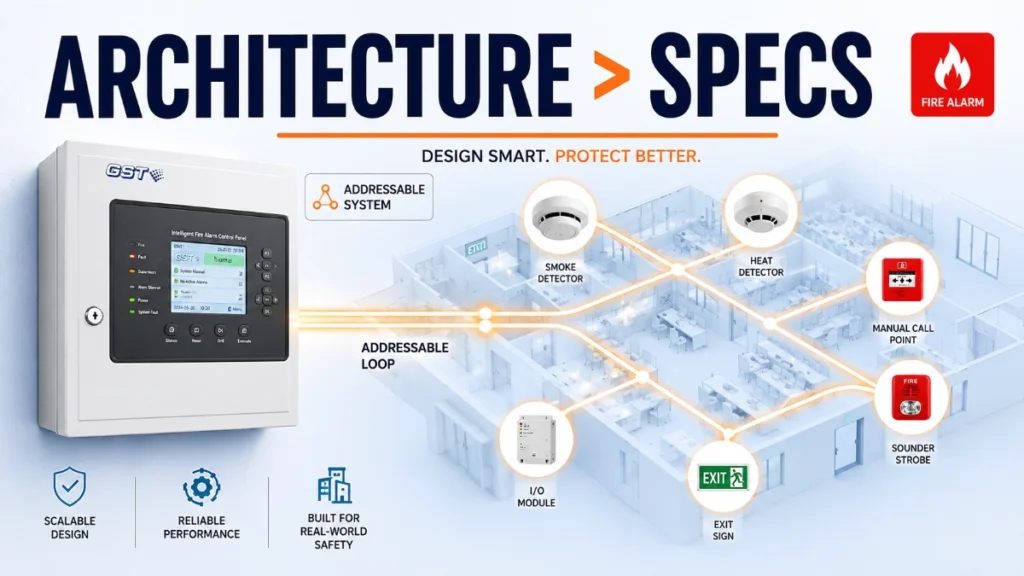
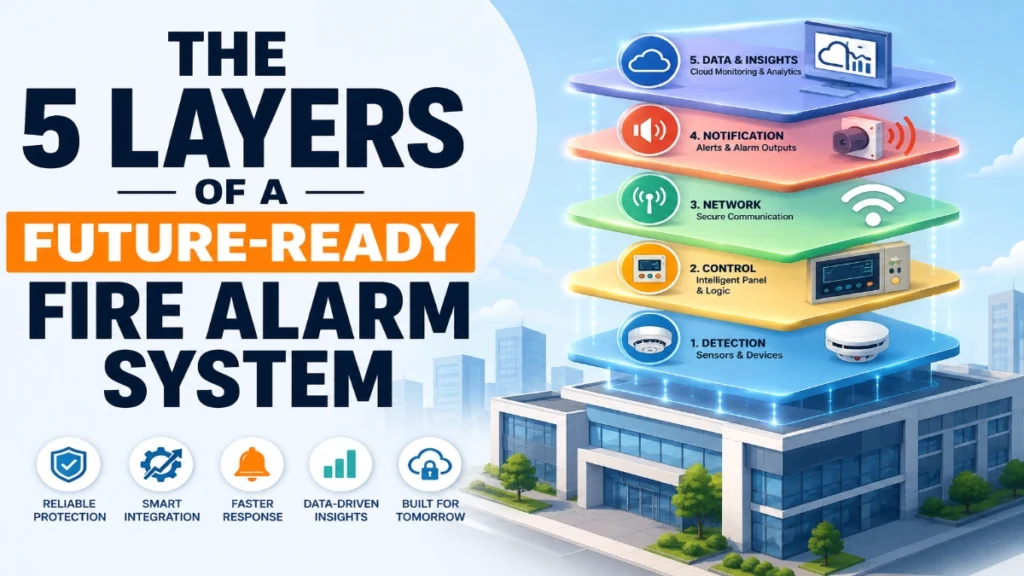
Fire alarm architecture is the foundation of any reliable life safety system. In industrial plants, commercial complexes, data centres and warehouses, the architecture determines how effectively the system performs under real emergency conditions. When we design a fire alarm system, we are not simply placing detectors and panels. We are building a structured communication network that must: Architecture directly impacts the system: For example, in large industrial campuses, we typically prefer a GST Addressable Fire Alarm System because it provides device-level intelligence and network expansion capability. In smaller buildings with defined zones, a GST Conventional Fire Alarm System may be sufficient and cost-effective. Understanding architecture allows us to design systems that are not only compliant but operationally resilient. What Is Fire Alarm System Architecture? Fire alarm system architecture refers to the logical and physical arrangement of system components and their communication pathways. It defines how: We can think of it as a layered structure: Layer 1: Detection Layer (Sensing Intelligence at the Edge) The Detection Layer is the first line of defence. This is where physical fire phenomena are converted into electrical signals. At this layer, devices continuously monitor environmental conditions such as: 1. Types of Detection Technologies Optical Smoke DetectorsUse light scattering principles to detect airborne particulates. Heat Detectors Multi-Sensor DetectorsCombine smoke and heat for higher accuracy and false alarm reduction. Beam DetectorsUsed in warehouses and high-ceiling environments. In advanced systems like a GST Addressable Fire Alarm System, detectors transmit analogue values (not just alarm/no alarm). The panel evaluates smoke density trends and compensates for drift. In contrast, GST Conventional Fire Alarm Detectors operate on fixed threshold activation within a defined zone. 2. Intelligent Features in Modern Detection Modern detection architecture includes: This layer is critical because early detection defines overall response time. If the detection layer fails or generates frequent nuisance alarms, the entire architecture loses credibility. 3. Design Considerations for Detection Layer When we design this layer, we consider: Proper detector spacing, mounting height and technology selection ensure accurate performance. Layer 2: Communication Layer (Structured Signal Transmission) The Communication Layer ensures that signals from detection devices reach the control panel reliably and without delay. This layer includes: 1. Loop-Based Communication (Addressable Architecture) In intelligent systems using GST Addressable Fire Alarm Detectors, devices connect in a ring topology. Key characteristics: If a wire break occurs, communication continues from the opposite direction. This significantly increases system survivability. 2. Zone-Based Communication (Conventional Architecture) In a GST Conventional Fire Alarm System, detectors connect in radial circuits. The panel identifies the affected zone but not the exact device. This architecture is simpler but offers: 3. Communication Layer Design Priorities We design this layer to ensure: In large facilities, we may divide loops per building or floor to improve fault containment. This layer acts as the nervous system of the fire alarm architecture. Layer 3: Processing Layer (Decision Intelligence) The Processing Layer is where raw data becomes actionable intelligence. This layer primarily consists of the Fire Alarm Control Panel (FACP). In a GST Addressable Fire Alarm System, the panel continuously polls devices, sometimes every few seconds. 1. Signal Evaluation The panel performs: For example: If a detector shows a slight increase in smoke but not sustained, the panel may enter pre-alarm instead of full evacuation. 2. Cause-and-Effect Programming This is where architectural intelligence truly emerges. The panel can be programmed to: This structured logic reduces panic and ensures a controlled response. 3. Fault Monitoring & Supervision The panel continuously supervises: If a fault occurs, the system generates a trouble signal immediately. This ensures the architecture remains operational at all times. Layer 4: Response Layer (Execution & Control) The Response Layer converts panel decisions into physical action. It includes: This layer ensures that detection leads to real-world protective action. 1. Notification Logic Outputs can be programmed based on: For example: 2. Integration with Fire Protection Systems The fire alarm panel may interface with: Integration follows best practices discussed in professional platforms such as Fire Engineering. This ensures coordinated emergency response. 3. Integration with Building Systems Advanced architecture also triggers: This coordinated response minimises chaos and speeds evacuation. How These Layers Work Together The four layers operate sequentially but also continuously supervise each other. Detection Layer → Senses fireCommunication Layer → Transmits signalProcessing Layer → Validates & decidesResponse Layer → Activates protection If any layer is poorly designed, the entire architecture becomes weak. When we design projects properly, whether using a GST Addressable Fire Alarm System for complex industrial sites or a GST Conventional Fire Alarm System for defined zones, we ensure these four layers function as a unified safety intelligence network. Addressable vs Conventional Architecture (Conceptual Comparison) Parameter Addressable Conventional Device Identification Individual Zone-based Wiring Loop topology Radial zones Fault Isolation High Limited Scalability Very high Moderate Diagnostics Advanced Basic In a GST Addressable fire alarm system, every detector has a unique address. The panel communicates digitally, allowing pinpoint identification and preventive diagnostics. In a GST Conventional fire alarm system, detectors are grouped by zone. The panel identifies the affected zone but not the specific device. For industrial facilities, architectural flexibility becomes critical when future expansion is expected. Core Building Blocks of Fire Alarm System Architecture A robust architecture relies on well-defined building blocks. Each layer must function independently and collectively. a. Fire Alarm Control Panel (FACP) The FACP is the command centre of the system. It performs: In intelligent systems such as a GST Addressable fire alarm system, the panel evaluates analogue signals from detectors. Instead of waiting for fixed thresholds, it analyses signal patterns and environmental variations. Advanced panels support: For large-scale projects, panel networking allows multiple buildings to operate under centralised supervision. b. Detection & Notification Loops In addressable systems, loops are wired in a ring topology. This architecture offers built-in redundancy. If a short circuit occurs: With intelligent devices like GST Addressable fire alarm detectors, the loop supports: Loop capacity may range from 125 to 250 devices, depending on design. Proper loop planning ensures: For industrial facilities with long

How AI-Based CCTV Cameras Improve Threat Detection

How AI-Based CCTV Cameras Improve Threat Detection

Security threats are becoming more complex. Traditional CCTV systems record footage, but they depend heavily on human monitoring. In large facilities, industrial plants, logistics hubs and commercial buildings, this approach leaves room for delay and human error. AI-based CCTV cameras change this completely. They do not just record events, they analyse, interpret and respond in real time. They transform passive surveillance into intelligent threat detection systems. In this article, you will learn: This guide is written in simple language, uses active voice and focuses on practical value. What Are AI-Based CCTV Cameras? AI-based CCTV cameras combine traditional video surveillance hardware with artificial intelligence software. These systems use: Unlike conventional cameras, AI cameras do not just capture footage. They analyse patterns, detect anomalies and trigger alerts automatically. For example, a traditional camera records someone entering a restricted zone. An AI-based camera detects unauthorised access instantly and sends an alert within seconds. This difference saves time, and sometimes lives. Why Traditional CCTV Systems Fall Short Traditional CCTV systems rely on human monitoring. In large facilities, operators must watch multiple screens simultaneously. Fatigue reduces attention. Important incidents get missed. Common limitations include: When engineers design safety systems, they prioritise reliability and response speed. Traditional CCTV systems often fail to meet these standards in dynamic environments. AI-based CCTV systems address these weaknesses directly. How AI Improves Threat Detection AI enhances surveillance systems through intelligent automation. Let’s break down the core improvements. 1. Real-Time Threat Detection AI algorithms process video streams instantly. They identify: Instead of reviewing footage after an incident, security teams receive immediate alerts. This drastically reduces response time. In industrial environments, even a few seconds can prevent major damage. 2. Reduced False Alarms Traditional motion detection systems trigger alerts for: AI models distinguish between humans, vehicles and environmental movement. This reduces nuisance alarms. Lower false alarms improve operational efficiency. Security teams respond only to genuine threats. 3. Behavioural Pattern Analysis AI systems learn normal patterns over time. They understand: When abnormal behaviour appears, the system flags it automatically. For example: If a warehouse normally closes at 8 PM and someone enters at 2 AM, the system marks this as suspicious immediately. This predictive capability improves risk management. 4. Facial Recognition and Identity Verification AI-enabled cameras can integrate facial recognition technology. This supports: In secure facilities, AI verifies identities in real time. If an unauthorised individual attempts entry, the system triggers an alert. Engineers designing secure infrastructure appreciate this automation because it reduces dependency on manual checks. 5. License Plate Recognition (LPR) AI-powered CCTV systems can read and log vehicle number plates automatically. Applications include: This helps in tracking suspicious vehicles and managing vehicle access efficiently. 6. Object Detection and Classification AI models detect specific objects such as: In manufacturing plants, AI cameras monitor compliance with safety rules. They detect whether workers wear protective gear. This adds a proactive safety layer beyond traditional surveillance. Core Technologies Behind AI-Based CCTV Engineers value understanding the technical backbone. Here are the main technologies that power intelligent surveillance. Computer Vision Computer vision enables cameras to interpret visual information. It converts images into structured data. The system detects shapes, movements and patterns. Deep Learning Deep learning models train on large datasets. These models improve accuracy over time. The more data they process, the better they recognise threats. Edge Computing Modern AI cameras process data at the device level. This is called edge computing. Benefits include: Edge processing is especially useful in industrial zones with limited connectivity. Cloud Integration Some AI CCTV systems integrate with cloud platforms. Cloud systems enable: Organisations with multiple sites benefit significantly from this architecture. Industrial Use Cases of AI-Based CCTV AI surveillance is no longer limited to smart cities. Industrial and enterprise environments use it widely. Manufacturing Plants AI cameras detect: Early detection reduces downtime and protects workers. Warehouses and Logistics Hubs AI-based CCTV improves: In high-value storage environments, real-time detection reduces financial risk. Data Centres Data centres require strict access control. AI cameras: They enhance cybersecurity by strengthening physical security. Critical Infrastructure Power plants, oil refineries, and water treatment facilities rely on intelligent surveillance. AI systems detect abnormal movement patterns that could indicate sabotage or intrusion. Engineers prefer automated systems in such high-risk environments because human-only monitoring is insufficient. Benefits for Engineers and Security Professionals AI-based CCTV cameras offer measurable advantages. Faster Response Time Immediate alerts reduce incident escalation. Operational Efficiency Reducing false alarms improves productivity. Data-Driven Insights AI systems generate analytics reports. Engineers use this data to optimise: Scalability AI solutions scale easily across multiple locations. Cost Optimization While initial investment may be higher, long-term cost savings include: AI-Based CCTV and Compliance Many industries must comply with safety and security regulations. AI systems support: In sectors like pharmaceuticals, logistics and manufacturing, compliance monitoring becomes easier with automated documentation. Privacy and Ethical Considerations Responsible implementation is essential. Organisations should: AI improves security, but ethical governance ensures trust. Best Practices for Implementing AI-Based CCTV Engineers planning deployment should consider the following: Conduct a Risk Assessment Identify critical areas. Define specific threats. Choose the Right Hardware Select cameras with sufficient resolution and edge-processing capabilities. Integrate with Existing Systems Ensure compatibility with: Train Security Personnel AI automates detection, but teams must understand alert protocols. Regular System Updates Update AI models and firmware to maintain accuracy. Future of AI-Based CCTV AI surveillance technology continues to evolve. Future developments may include: Smart infrastructure will increasingly rely on AI-driven monitoring systems. Engineers who adopt intelligent surveillance early will gain operational advantages. Note: AI-based CCTV cameras represent a major advancement in security technology. They transform passive surveillance into proactive threat detection systems. By using real-time analytics, behavioural pattern recognition and intelligent automation, these systems reduce risk, improve response time and enhance operational efficiency. For engineers and security leaders, AI-based CCTV is not just a technology upgrade. It is a strategic investment in smarter, safer infrastructure. Organisations that implement intelligent surveillance today will build more resilient security systems for the future. Read Also: 5 Signs Your Fire Detection System Might

What Makes a Fire Alarm System Reliable in Industrial Environments?

What Makes a Fire Alarm System Reliable in Industrial Environments?

In industrial facilities, reliability is not a luxury; it is survival. When we walk through a manufacturing plant, refinery, warehouse or logistics hub together, one reality becomes clear: the environment is unforgiving. Dust, heat, vibration, humidity, electromagnetic interference and continuous operations create conditions that push safety systems to their limits. In such spaces, a fire alarm system must do more than detect smoke; it must perform accurately, consistently and instantly. If detection fails, consequences escalate quickly: So the real question is not “Do we have a fire alarm system?”It is: “Is our fire alarm system engineered for industrial reliability?” Let’s break this down practically, the way engineers and decision-makers evaluate systems on real projects. What Does “Reliability” Mean in Industrial Fire Alarm Systems? A reliable industrial fire alarm system consistently detects fire hazards accurately under harsh environmental conditions, minimises false alarms, maintains operational continuity during faults and ensures clear communication for rapid response. Reliability combines durable hardware, intelligent detection, redundancy and compliance with safety standards. Reliability is not a single feature. It is a system-level outcome. It depends on how components perform individually and collectively under stress. Industrial reliability means the system works on a dusty Tuesday night shift just as effectively as it does on commissioning day. In industrial environments, reliability has four pillars: If even one pillar weakens, operational risk increases. Core Components That Define Reliability 1. Detection Technology: The First Line of Defence Industrial reliability begins with selecting the right detection technology, heat, smoke, flame or multi-sensor devices, based on environmental risk conditions and process hazards. In heavy industrial areas, smoke detection alone may not be enough. High ceilings delay smoke travel. Dust can trigger false alarms. Temperature fluctuations may confuse sensors. This is where intelligent addressable detectors outperform basic sensing devices. Unlike traditional conventional detectors, addressable devices communicate their status individually to the control panel. That means we can pinpoint exactly which device triggered an alert and assess its health condition in real time. In high-risk industrial facilities, multi-criteria detection often provides better resilience. Practical Engineering Insight: 2. Control Architecture: Addressable vs Conventional An addressable fire alarm panel offers device-level monitoring and diagnostics, making it better suited to complex industrial environments than a conventional fire alarm panel, which groups devices into zones without pinpoint identification. Let’s imagine a 200,000 sq. ft. factory. If a fire alarm activates in a system using a conventional fire alarm panel, we only know the affected zone, not the exact detector. That delays the response. In contrast, an addressable fire alarm panel identifies the exact device location. It also provides real-time fault monitoring, contamination alerts, and performance data. Comparison Snapshot Feature Addressable Fire Alarm Panel Conventional Fire Alarm Panel Device Identification Individual Zone-based Diagnostics Advanced Limited Scalability High Moderate Industrial Suitability Excellent Basic to moderate Maintenance Efficiency Predictive Reactive For industrial reliability, addressable architecture significantly improves operational control. 3. Environmental Resistance Industrial fire alarm systems must withstand dust, vibration, temperature extremes, humidity and electromagnetic interference without performance degradation. Factories are not climate-controlled offices. Equipment vibrates. Metal structures cause signal reflections. Ambient noise interferes with communication circuits. A reliable system should include: The GST fire alarm system distributed by Innxeon is engineered with industrial durability standards in mind, which makes it particularly suited for heavy-duty applications. Reliability means components are designed for real-world stress, not showroom conditions. How Reliability Is Engineered Into the System Let’s walk step-by-step through what makes reliability engineered rather than assumed. Step 1: Hazard Analysis Before selecting equipment, engineers must assess: Without hazard mapping, even the best system fails. Step 2: Correct Detector Placement Improper spacing reduces effectiveness. Industrial airflow patterns often differ from office environments. Key placement considerations: Addressable systems allow fine sensitivity adjustments, improving reliability. Step 3: Redundancy & Loop Design Reliable industrial systems use a loop architecture where: Redundancy ensures operational continuity during faults. Step 4: Integration With Other Systems Industrial fire alarm systems must integrate with: A reliable system communicates clearly and triggers automated responses instantly. The GST fire alarm system supports scalable integration, which strengthens operational resilience. Real-World Industrial Scenarios Scenario 1: Dust-Heavy Manufacturing Plant A plant using conventional detectors experienced frequent false alarms due to airborne particles. Production stopped repeatedly. Switching to heat-based addressable detectors reduced false triggers and provided contamination alerts for maintenance planning. Result: Scenario 2: Large Logistics Warehouse In a high-ceiling warehouse, smoke took time to reach standard detectors. Early detection failed. Solution: Reliability improved because detection matched environmental realities. Scenario 3: Power Plant Control Room High electromagnetic interference affected signalling. Solution: The system maintained stable communication under load conditions. Engineering Best Practices for Reliable Industrial Systems 1. Choose Addressable Over Conventional for Scale Industrial facilities benefit from real-time device monitoring and pinpoint fault detection. 2. Prioritise Detector Suitability Over Cost Incorrect detector selection leads to nuisance alarms, the biggest reliability killer. 3. Design for Maintenance Access Reliability decreases when systems are difficult to service. 4. Plan Preventive Testing Schedules Addressable systems support predictive maintenance by monitoring contamination levels. 5. Partner With Experienced Suppliers Industrial reliability depends on system configuration expertise. Working with experienced distributors like Innxeon ensures proper engineering guidance when deploying a GST fire alarm system. Reliability Checklist Summary A reliable industrial fire alarm system should include: If any of these elements are missing, risk increases. Reliability Is Engineered, Not Assumed In industrial environments, fire alarm reliability determines more than compliance; it protects production, reputation and human life. A reliable system is built on: When we design industrial fire safety systems together, the goal is not just installation; it is operational confidence. The GST fire alarm system, when properly engineered and deployed with the right addressable fire alarm panel and addressable detectors, provides the diagnostic visibility and durability industrial environments demand. Reliability is not a checkbox.It is a design philosophy. And in industrial environments, it is non-negotiable. Read Also: 5 Signs Your Fire Detection System Might Fail When You Need It Most Read Also: Top 10 Reasons to Choose GST Fire Alarm Systems for Industrial Projects

5 Signs Your Fire Detection System Might Fail When You Need It Most

5 Signs Your Fire Detection System Might Fail When You Need It Most

Fire detection systems are designed for one purpose: to respond instantly when danger appears. But in real industrial environments, we’ve seen something uncomfortable: many systems look functional on paper yet fail under real emergency conditions. As engineers and safety leaders, we rarely get a second chance when fire protection fails. A delayed alarm can mean production shutdown, legal exposure, asset loss or worse risk to life. The uncomfortable truth is that most failures are predictable. They leave warning signs long before the emergency. In this discussion, let’s examine five practical signs your fire detection system might not perform when you need it most and how to fix those weaknesses before they become liabilities. Understanding Fire Detection System Failure A fire detection system fails when it cannot detect, communicate or respond to fire conditions within the required time. Failure may result from outdated components, poor maintenance, wiring faults, configuration errors or environmental mismatch. Most failures are gradual and preventable through engineering audits and performance testing. A modern system includes detectors, control panels, communication loops, power supplies and notification devices. Weakness in any one component can compromise the entire system. We must think beyond “Does it turn on?” and instead ask: Let’s walk through the five critical warning signs. 1. Ageing or Obsolete Detection Technology If your system relies on outdated conventional detectors or panels installed more than 10-15 years ago, it may lack sensitivity, accuracy, intelligent diagnostics and fault isolation. Older systems are prone to false alarms, slower detection and component failure. Why Ageing Systems Become Risky Older systems, especially those built around a conventional fire alarm panel, divide buildings into zones rather than pinpointing exact device locations. When an alarm triggers, you know the zone, not the device. In large factories or warehouses, that delay matters. Additionally: Engineering Perspective Modern addressable detectors communicate individually with an addressable fire alarm panel. They provide: If your site still depends on conventional detectors, upgrading to a modern architecture like a GST fire alarm system improves reliability, scalability, and fault isolation. Quick Audit Checklist: If yes, your system may already be in decline. 2. Frequent False Alarms or Unexplained Faults Repeated false alarms indicate sensor contamination, wiring instability, improper detector selection or calibration drift. A system that cries wolf trains occupants to ignore real emergencies, making it one of the most dangerous early warning signs of failure. What False Alarms Really Mean False alarms are rarely random. They usually signal: In industrial environments, dust, humidity, vapours and temperature swings significantly impact performance. Conventional vs Addressable Behaviour Feature Conventional Fire Alarm Panel Addressable Fire Alarm Panel Fault identification Zone-level Device-level Contamination alerts No Yes Maintenance alerts Limited Predictive Troubleshooting time Longer Faster Addressable systems provide device-specific diagnostics, reducing downtime and improving response speed. Warning Sign Summary: These are not minor inconveniences; they’re predictive indicators of system stress. 3. Inadequate Maintenance and Testing Protocols A fire detection system without documented periodic testing and preventive maintenance is statistically more likely to fail. Dust accumulation, battery degradation and sensor drift reduce sensitivity and reliability over time. The Reality of Maintenance Gaps We often encounter facilities where: Fire detection systems are electronic systems, and electronics degrade. What Proper Maintenance Includes Step-by-step preventive checklist: Modern systems like a GST fire alarm system provide maintenance alerts, helping facility managers move from reactive to preventive strategies. Engineering Insight:Maintenance is not compliance; it’s performance assurance. 4. Poor System Design for Current Risk Profile If your facility layout, storage materials, or production processes have changed without updating detection coverage, your system may no longer match the fire risk. Detection must evolve alongside operational changes. When Design Becomes Outdated Common real-world scenarios: Yet the detector layout remains unchanged. Detection Engineering Considerations Upgrading from conventional detectors to intelligent addressable detectors allows fine-tuned sensitivity and location-specific calibration. Design Review Trigger Points: If yes, system redesign may be necessary. 5. Power Supply and Communication Vulnerabilities A fire detection system fails if power redundancy or communication loops are compromised. Weak batteries, single-point wiring failures, or a lack of redundancy can disable detection during emergencies. Hidden Weak Points We’ve seen facilities where: During a power failure, these weaknesses surface immediately. Best Practice Engineering Modern addressable fire alarm panel systems incorporate: The difference between a minor fault and a total system blackout often comes down to design redundancy. Critical Checks: Real-World Application: What We See in Industrial Projects In manufacturing plants, logistics hubs, and commercial complexes, the pattern is consistent: Eventually, the system becomes background noise instead of a trusted safety layer. Organisations that proactively migrate to intelligent systems, such as those built around the GST fire alarm system architecture, experience: Reliability is not accidental. It’s engineered. Engineering Best Practices to Prevent Failure Let’s summarise what proactive facilities do differently: 1. Conduct Annual Risk-Based System Audits Not just inspection, but also engineering evaluation. 2. Upgrade from Conventional to Addressable Architecture Improves precision and fault isolation. 3. Implement Predictive Maintenance Use diagnostic alerts instead of reactive repairs. 4. Document All System Changes Track device replacements, battery changes and firmware updates. 5. Plan for Scalability Choose systems that support expansion and network integration. Fire detection should evolve with the facility, not lag behind it. Reliability Is an Engineering Decision Fire detection systems rarely fail without warning. They show signs: The difference between system survival and system failure lies in proactive engineering. As safety professionals, consultants and project leaders, we must treat fire detection not as a regulatory checkbox but as mission-critical infrastructure. When designed correctly, maintained intelligently and upgraded strategically, especially with modern addressable systems, detection becomes dependable, predictable and resilient. And in fire safety, predictability saves everything. Read Also: Why Large Enterprises Allocate Budget Early for Fire Safety Read Also: How Fire Detection Systems Protect Supply Chains

Why Large Enterprises Allocate Budget Early for Fire Safety

Why Large Enterprises Allocate Budget Early for Fire Safety

When we walk into a large industrial project during its early design stage, one thing becomes immediately clear: the most resilient enterprises don’t treat fire safety as a last-minute compliance expense. They plan for it from day one. If we’ve worked on factories, data centres, oil & gas terminals, logistics parks or large commercial campuses, we know that fire safety decisions made early influence everything, layout planning, electrical load distribution, network architecture, insurance approvals and even brand credibility. Large enterprises allocate budget early for fire safety not because they “have extra funds,” but because they understand risk, lifecycle cost and operational continuity at a strategic level. Let’s break this down step by step, practically, technically and from a real-world engineering perspective. The Core Concept: Fire Safety as a Strategic Infrastructure Investment Large enterprises allocate fire safety budgets early because early integration reduces risk, lowers lifecycle cost, ensures regulatory compliance, improves insurability and prevents operational disruption. Fire protection systems influence building design, electrical planning and emergency protocols, making early investment more efficient and cost-effective than retrofitting later. Early budgeting allows fire detection systems to be integrated into architectural and electrical design rather than added as an afterthought. This improves system performance, scalability and compliance while avoiding costly redesigns. When we delay fire safety planning, we introduce structural constraints, cable routing challenges, panel placement limitations and integration issues. Early allocation solves these before they become expensive problems. Why Early Planning Changes the Entire Design Approach When fire detection is part of the initial design discussion: Compare this to retrofitting a system after civil work is completed. Suddenly, ceilings need modification, conduits must be exposed and detection coverage becomes compromised. Engineering Reality:Retrofitting can increase total system cost by 20–40% due to rework and labour disruption. Technical Breakdown: How Early Budgeting Improves System Architecture Early fire safety budgeting enables the correct selection of system type, panel architecture, detector technology, loop configuration and redundancy strategy. It ensures the project uses scalable, addressable technology where required and avoids under-specification that may compromise safety and compliance. Let’s go deeper into the technical side. 1. Choosing Between Addressable vs Conventional Systems In early planning stages, engineers assess: This determines whether the project requires an addressable fire alarm panel or a conventional fire alarm panel. Addressable Systems An addressable fire alarm panel identifies the exact detector or device that triggered an alarm. This is ideal for: Addressable systems use addressable detectors that communicate digitally with the panel. Benefits: Conventional Systems A conventional fire alarm panel divides a building into zones. It identifies the affected zone but not the exact detector. These systems use conventional detectors and are suitable for smaller facilities with limited risk complexity. If budgeting is delayed, projects often default to lower-spec systems due to remaining financial constraints. Early allocation allows the right decision, not the cheapest decision. 2. Loop Design and Network Architecture Addressable systems rely on loop architecture. Early design ensures: If we install without planning, loop lengths exceed recommended parameters, voltage drops increase and reliability decreases. When enterprises allocate early budget, engineers can design optimal loop topology, ring configurations, isolator modules and segmented networks. 3. Integration with Other Safety Systems Modern industrial projects require integration between: The GST fire alarm system, distributed by Innxeon, supports seamless integration with industrial monitoring ecosystems. But integration only works effectively when considered during the design phase. If fire safety is added later, integration becomes complex and costly. Real-World Scenario: Factory Expansion vs Fire Incident Let’s imagine two manufacturing plants. Plant A: Early Fire Safety Budgeting Result: Plant B: Delayed Fire Safety Investment Result: This is why large enterprises treat fire safety as infrastructure, not optional equipment. Financial Perspective: Early Budgeting Reduces Lifecycle Cost Allocating fire safety budgets early reduces lifecycle cost by avoiding retrofit expenses, design rework, system under-sizing, compliance penalties and downtime losses. It ensures a scalable architecture that supports expansion and reduces long-term maintenance costs. Let’s quantify this practically. Cost Components Affected by Late Budgeting Early allocation eliminates most of these variables. Insurance & Risk Management Impact Insurance providers assess: A robust system like the GST fire alarm system strengthens compliance documentation and risk scoring. Over time, this can influence insurance premiums and claim approvals. Engineering Best Practices Large Enterprises Follow Leading enterprises follow structured fire safety planning: early risk assessment, technology selection based on hazard profile, integration design, lifecycle cost analysis and compliance validation before construction begins. Let’s break down best practices step by step. Step 1: Conduct Hazard & Risk Assessment Identify: This guides detector type and placement. Step 2: Select Detector Technology Based on Environment Industrial environments may require: Using addressable detectors improves precision in complex facilities. Step 3: Design for Scalability Large enterprises rarely remain static. Early budgeting allows: Without this, future upgrades require full system replacement. Step 4: Choose a Reliable Technology Platform Selecting a proven solution like the GST fire alarm system ensures: When distributed and supported by experienced suppliers like Innxeon, enterprises also gain engineering consultation—not just equipment. Comparison: Early Allocation vs Delayed Allocation Factor Early Budgeting Delayed Budgeting System Design Integrated with architecture Added after construction Cost Efficiency Optimized lifecycle cost Higher retrofit cost Compliance Seamless approval Risk of rework Scalability Designed for expansion Limited flexibility Downtime Risk Reduced Higher Summary Insight:Early budgeting improves safety, cost control and operational stability simultaneously. Why Early Allocation Reflects Strategic Leadership When we evaluate how mature enterprises operate, one pattern becomes clear: they invest in risk mitigation before risk materialises. Fire safety is not a decorative compliance checklist. It is operational insurance, brand protection, legal protection and engineering integrity combined. Early budgeting enables: For industrial and commercial facilities that demand reliability, choosing robust solutions such as the GST fire alarm system supported by experienced partners like Innxeon ensures the system is not just installed, but engineered correctly from the beginning. In large enterprises, safety planning is not reactive. It is strategic. And strategic organisations always plan early. Read Also: How Fire Detection Systems Protect Supply Chains Read Also: How Security Cameras