Fire safety standards are getting stricter, technologies are evolving faster and building owners today want systems that protect people without increasing long-term operational costs. As 2025 begins, one question rises in almost every commercial, industrial and residential project:
“What is the most cost-efficient fire safety setup that actually works in the long run?”
Cost-efficiency is no longer about choosing the cheapest equipment. It is about choosing a system that reduces installation cost, minimizes false alarms, lowers maintenance expenses, avoids downtime and meets compliance requirements without last-minute spending.
This detailed guide breaks down the smartest and most financially sustainable fire safety setup for 2025, explains how modern technologies reduce costs and highlights where brands like GST (Gulf Security Technology) fit in.
Why Cost-Efficiency Matters More Than Ever in 2025
Buildings today are becoming more complex, energy-efficient and automated. Fire risks come not only from flames but also from:
- Electrical overloads
- HVAC failures
- Industrial automation
- Battery storage systems
- High-density server rooms
- Flammable materials used in modern interiors
At the same time, project budgets are shrinking and operation teams are under pressure to reduce recurring service costs.
A cost-efficient fire safety setup helps in:
✔ Lower installation expenses
Better architecture, optimized wiring and modular systems reduce project cost.
✔ Minimum false alarms
False alarms waste manpower, cause panic and invite penalties in many cities.
✔ Low maintenance overheads
A system that is easy to test and service cuts yearly service cost drastically.
✔ Faster issue detection
Modern panels identify exactly where the fault is, saving hours of manpower.
✔ Compliance without extra spending
When a system meets EN standards, local regulations and NOC requirements, owners avoid repeated modification costs.
✔ Long-term savings
A high-quality system survives for 10–15 years, reducing replacement frequency.
In short, a cost-efficient setup is not basic or cheap, it is smart, scalable and low-maintenance.
Core Components of a Cost-Efficient Fire Safety Setup
To build a financially sustainable fire protection system, you need a well-balanced combination of:
- Intelligent detectors
- Smart control panels
- Power backup
- Notification systems
- Suppression options
- Monitoring and reporting tools
Let’s break down each element and understand how to make cost-efficient choices.
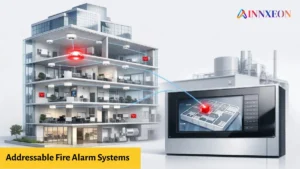
1. Choose Addressable Systems Over Conventional Systems
Why Addressable is More Cost-Efficient in 2025
Initially, addressable panels seem costlier, but their lifetime savings are significantly higher because:
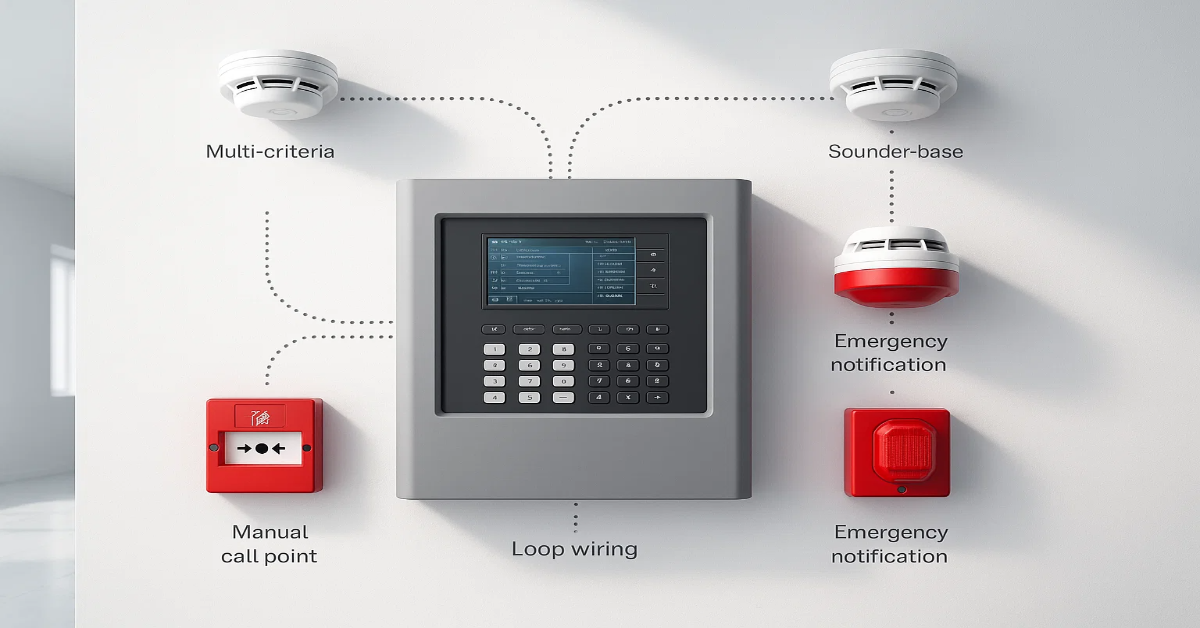
✔ Faster installation due to loop wiring
Addressable devices run on a loop instead of individual wiring, reducing cable costs.
✔ Pinpoint identification
The system shows the exact detector that triggered an alarm.
Result: zero time wasted searching floors and rooms.
✔ Lower troubleshooting cost
Faults, wiring issues, and device failures are identified automatically.
✔ Scalable as your building grows
You can add devices, floors, or zones without replacing the entire panel.
✔ Minimum false alarms
Addressable detectors are more intelligent and less sensitive to dust, moisture and small disturbances.
Note: Brands like GST include addressable panels widely used in commercial and industrial projects because of their stable loop architecture and large device support.
2. Use Multi-Criteria Detectors Instead of Single-Sensor Devices
Traditional smoke detectors easily give false alarms due to:
- Steam
- Dust
- Heat
- Aerosols
Multi-criteria detectors analyze a combination of smoke, heat and sometimes CO levels. This makes them more reliable and more cost-efficient.
Benefits of Multi-Criteria Detectors
- Reduce false alarms by up to 60–70%
- Lower annual service calls
- Work better in mixed environments (corridors, basements, workshops)
- Stay stable even in dusty industrial areas
- Reduce frequent replacements
Over 10 years, a multi-sensor detector saves several times its cost in unwanted alarm prevention.
3. Modular Fire Alarm Panels for Future-Proof Savings
A modular panel allows you to add cards, loops and communication modules only when required.
Cost Advantages
- No need to buy large panels upfront
- Expand only as the building expands
- Easy upgrades
- Minimal downtime
- Lower service cost due to replaceable sub-modules
This is especially beneficial for:
- Schools
- Hospitals
- Shopping complexes
- Factories
- IT parks
Note: GST addressable panels are known for their modular structure, enabling cost-efficient scalability.
4. Use Loop Isolators to Prevent Entire-System Failure
Loop isolators are small devices that isolate short circuits.
Without them, a single line fault can shut down the entire system.
Cost-Saving Benefits
- Reduced downtime
- Faster fault tracing
- Lower repair cost
- System stays active even during faults
- Protects expensive detectors and modules
For large buildings, loop isolators are essential and save money over time.
5. Choose Sounder-Base Detectors for Faster Installation
Installing separate sounders, detectors and bases increases:
- Wiring length
- Labor cost
- Maintenance time
Sounder-base detectors combine these into one device.
Advantages
- Less wiring
- Reduced installation time
- Lower material cost
- Easy replacement
- Cleaner ceiling design
Modern projects prefer these for time and labor savings.
6. Use Addressable Manual Call Points With LED Indicators
Addressable MCPs provide accurate signaling, help in faster emergency communication and reduce inspection effort.
Cost-Efficiency
- Quick testing
- Automatic monitoring
- Maintenance alerts
- Longer lifespan
Their LED indicators also help easily identify active units.
7. Invest in Long-Life Batteries and Smart Power Management
Many people try to save cost by choosing inexpensive batteries, but these end up failing quickly.
In 2025, the best cost-efficient approach is:
- Sealed maintenance-free batteries
- Panels with built-in battery health monitoring
- Energy-saving device loops
Benefits
- Longer backup
- Fewer replacements
- Reduced service cost
- Better performance during power cuts
UPS-backed fire panels also reduce load on batteries and extend their life.
8. Integrate Fire and Building Automation
When fire safety connects with building automation, the system becomes more efficient and reduces manual work.
Examples
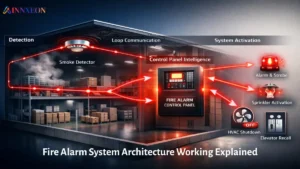
- Fire panel triggers HVAC shut-off
- System controls access doors
- Elevators go to safe floors
- PA system plays emergency announcements
Cost Advantage
This reduces the need for separate manual interventions and prevents property damage during an emergency.
9. Remote Monitoring for Reduced Manpower Cost
In 2025, remote monitoring is one of the biggest cost savers.
Central monitoring software allows:
- Real-time alerts
- Remote diagnostics
- Automated reporting
- Centralized control for multiple sites
When issues are identified early, on-site visits reduce by 40–50%.
Note: Brands like GST support various remote monitoring tools that improve system oversight without increasing cost.
10. Regular Preventive Maintenance to Avoid Heavy Repairs
Preventive maintenance avoids large breakdowns and extends life.
A cost-efficient schedule includes:
- Monthly detector checks
- Quarterly device cleaning
- Battery health testing
- Loop voltage checks
- Software updates
Smart panels help automate these reminders, reducing the workload on teams.
The Most Cost-Efficient Setup for 2025 (Complete Formula)
Below is a practical configuration that balances cost, safety and long-term performance:
✔ Addressable fire panel with modular expansion
Reduces wiring and future upgrade cost.
✔ Multi-criteria smoke/heat detectors
Lower false alarms = lower service bills.
✔ Sounder-base detectors or integrated notification devices
Simplifies wiring and installation.
✔ Addressable manual call points with indicators
Ensures faster emergency response.
✔ Loop isolators at correct intervals
Protects the system and reduces repair cost.
✔ Long-life SMF batteries + smart charging
Less frequent replacements, better reliability.
✔ Remote monitoring software
Lower manpower cost, faster detection of issues.
✔ Clean agent suppression (optional based on building type)
Ideal for server rooms, labs, or electrical spaces.
✔ Regular preventive maintenance
Ensures devices last long and stay compliant.
This combination is the most cost-efficient because it reduces:
- Installation cost
- Electrical load
- Cable consumption
- Downtime
- False alarm expenses
- Maintenance visits
- Replacement frequency
Where Brands Like GST Fit In
GST (Gulf Security Technology) is widely used in many markets because the brand manufactures:
- Addressable panels
- Detectors
- Modules
- Sounder bases
- Loop isolators
Their systems are often selected in cost-conscious projects because of their scalability, modular design and stability. However, the decision should always depend on technical requirements, compliance needs and project budgets.
Cost-Efficiency Is a Strategy, Not a Shortcut
Choosing a cheap fire alarm system is never cost-efficient.
Choosing a smart, scalable, low-maintenance system is.
A cost-efficient fire safety setup for 2025 focuses on:
- Intelligent detection
- Lower installation cost
- Minimum false alarms
- Modular expandability
- Remote monitoring
- Automatic fault reporting
- Longer device life
When these elements work together, buildings remain safe and owners save money year after year.
Read Also: How to Future-Proof Your Fire Alarm System Using GST Panels
Read Also: 7 Fire Safety Innovations You’ll See in Every Building by 2030