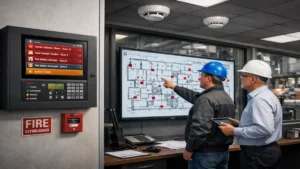
High-density buildings are becoming the new standard across cities. From high-rise residential towers and large hospitals to IT parks, malls, airports and industrial campuses, modern infrastructure now houses thousands of occupants under one roof. While these buildings deliver efficiency and scale, they also introduce serious fire safety challenges.
In such environments, a fire alarm system must do more than detect smoke. It must identify the exact location, communicate instantly, scale effortlessly and remain reliable even under heavy load. This is where GST fire alarm panels have proven to be a practical and trusted choice for engineers, consultants, and facility managers.
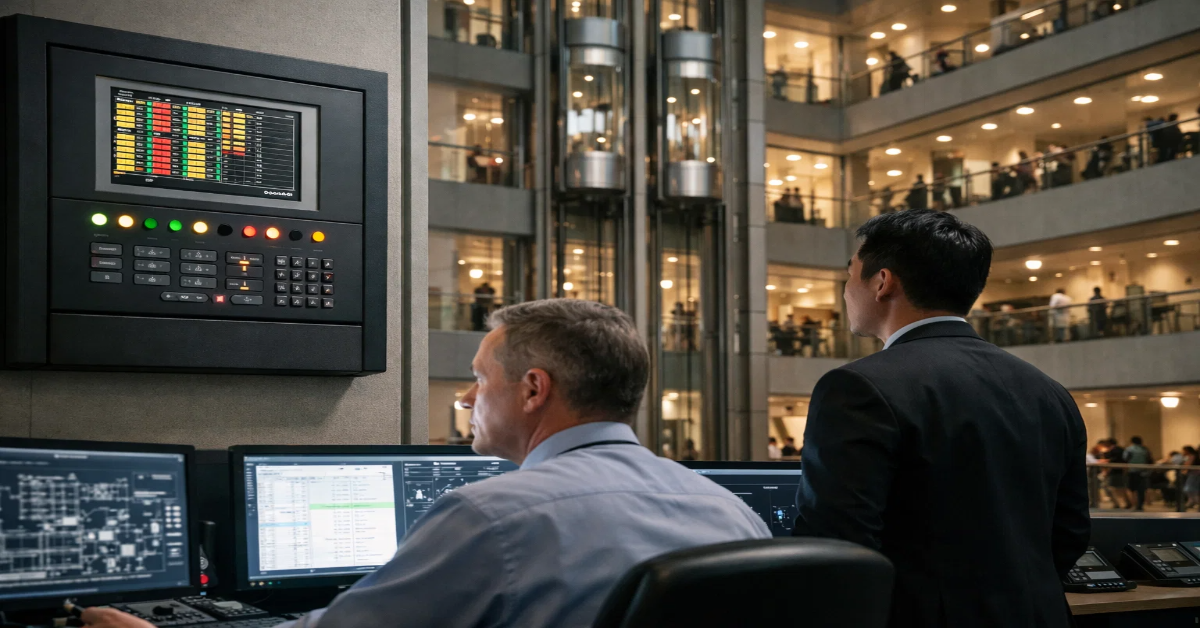
This article explains why GST fire alarm panels are particularly suitable for high-density buildings, how they address real-world design challenges and what makes them stand out compared to traditional solutions.
Understanding Fire Safety Challenges in High-Density Buildings
Before selecting a fire alarm system, it is important to understand the unique risks that high-density buildings present.
Common Challenges Include:
- Thousands of detectors and devices are operating simultaneously.
- Multiple floors, zones, and usage types within the same structure.
- High occupant load requiring fast and accurate evacuation.
- Long cable runs and communication delays.
- Frequent expansions or tenant modifications.
- Need for integration with BMS, elevators, HVAC and suppression systems.
In such scenarios, basic or poorly designed fire alarm systems fail quickly. False alarms increase, response time slows and maintenance becomes costly.
This is why modern projects increasingly rely on GST fire alarm systems, especially in complex and high-occupancy environments.
Why Fire Alarm Panel Selection Matters in High-Density Buildings
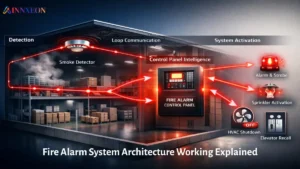
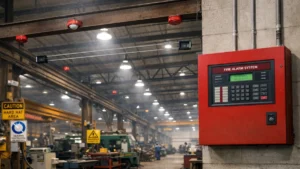
The fire alarm panel acts as the brain of the entire fire detection system. In high-density buildings, the panel must:
- Process thousands of signals without delay
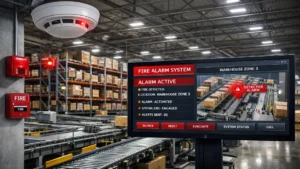
- Display clear, location-specific alarms
- Remain stable during power fluctuations
- Support phased evacuation strategies
- Allow future scalability without replacement
GST fire alarm panels are designed specifically to meet these demands.
1. Advanced Addressable Architecture for Precise Detection
One of the strongest reasons GST panels excel in high-density buildings is their addressable system architecture.
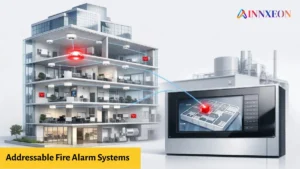
An addressable fire alarm panel assigns a unique digital address to every device connected to the loop. This allows the system to identify exactly which detector or module has triggered an alarm or fault.
Benefits of High-Density Buildings:
- Exact fire location displayed instantly
- Faster response from emergency teams
- Reduced evacuation panic
- Easier fault identification and maintenance
In a 40-floor residential tower or a multi-block hospital, knowing “Smoke detected in Room 1207, Block B” instead of “Fire on Floor 12” makes a significant difference.
GST addressable panels handle large device counts per loop, making them ideal for dense installations.
2. High Device Capacity Without Performance Drop
High-density buildings often require thousands of detectors, call points and modules. Many systems struggle when pushed to their maximum limits.
GST fire alarm panels are engineered to support:
- High device count per loop
- Multiple loops per panel
- Networked panels across large campuses
This ensures:
- No communication delay
- Stable performance during peak activity
- Accurate alarm processing even during multiple simultaneous events
Engineers prefer GST because the system performs consistently even in large-scale, fully populated buildings.
3. Flexible Use of Addressable and Conventional Technologies
Not all areas in a high-density building have the same risk profile. Some spaces require intelligent detection, while others can operate efficiently with simpler solutions.
GST allows seamless use of both:
- Addressable detectors for critical, high-risk or occupied areas
- Conventional detectors for low-risk or utility spaces
Similarly, projects can combine:
- Addressable fire alarm panel systems for main zones
- Conventional fire alarm panel solutions for smaller sections
This hybrid flexibility helps:
- Optimise project cost
- Maintain compliance
- Simplify design without compromising safety
GST systems make this integration smooth and reliable.
4. Faster Alarm Response Time in Crowded Environments
In high-density buildings, seconds matter. Delayed alarms can lead to smoke spread, confusion and increased risk to occupants.
GST fire alarm panels use:
- High-speed communication protocols
- Intelligent signal processing
- Advanced loop diagnostics
As a result:
- Alarm signals reach the panel instantly
- Visual and audible alerts activate faster
- Evacuation begins without delay
This fast response is critical in locations such as:
- Shopping malls
- Airports and metro stations
- Corporate offices
- Large residential complexes
5. Reduced False Alarms Through Intelligent Detection
False alarms are a major issue in high-occupancy buildings. They disrupt operations, reduce trust in the system and lead to unnecessary evacuations.
GST fire alarm systems minimise false alarms by:
- Using intelligent addressable detectors
- Offering multi-criteria detection (smoke, heat, rate-of-rise)
- Providing programmable sensitivity settings
- Supporting cause-and-effect logic
This ensures alarms activate only when real fire conditions exist, not due to dust, steam or transient smoke.
6. Clear, User-Friendly Interface for Emergency Situations
During a fire event, clarity is crucial. Security staff and facility managers must understand the situation instantly.
GST fire alarm panels feature:
- Clear LCDs
- Simple menu navigation
- Multi-language support (project dependent)
- Event history and alarm logs
Even non-technical staff can quickly:
- Identify alarm location
- Acknowledge events
- Initiate response procedures
This usability makes GST panels suitable for buildings with round-the-clock operations.
7. Seamless Integration With Other Building Systems
High-density buildings rely on integrated safety and automation systems. GST fire alarm panels support easy integration with:
- Elevators (fire recall)
- HVAC systems (smoke control)
- Fire suppression systems
- Public address and voice evacuation systems
- Building Management Systems (BMS)
This integration ensures a coordinated emergency response, not isolated actions.
8. Scalability for Future Expansion
One of the most overlooked issues in large buildings is future expansion. New floors, tenants or functional changes often require system upgrades.
GST fire alarm systems are designed with scalability in mind:
- Additional loops can be added
- Panels can be networked
- Devices can be addressed without rewiring
This avoids:
- Panel replacement mid-project
- Costly system downtime
- Compliance issues during expansion
For long-term projects, GST offers an excellent return on investment.
9. Cost-Effective for Large-Scale Projects
High-density buildings require significant capital investment. Fire alarm systems must balance performance and budget.
GST panels are widely recognised for:
- Competitive pricing
- Low maintenance costs
- Long product life
- Easy availability of spares
By supporting both gst fire alarm system addressable and conventional configurations, GST helps project owners control costs without compromising safety.
10. Compliance With International and Local Standards
Fire safety compliance is non-negotiable. GST fire alarm panels are designed to meet:
- International fire safety standards
- Local authority requirements
- Consultant and insurer expectations
This simplifies:
- Approvals
- Inspections
- Handover documentation
For large commercial and residential projects, compliance confidence is a major advantage.
Real-World Applications of GST in High-Density Buildings
GST fire alarm systems are commonly deployed in:
- High-rise residential towers
- Corporate office campuses
- Hospitals and healthcare facilities
- Airports and metro stations
- Shopping malls and multiplexes
- Educational institutions
Their consistent performance across diverse environments proves their suitability for dense occupancy.
Addressable vs Conventional: Choosing the Right GST Solution
| Feature | Addressable Fire Alarm Panel | Conventional Fire Alarm Panel |
|---|---|---|
| Location Accuracy | Exact device-level | Zone-level |
| Scalability | High | Limited |
| False Alarm Control | Advanced | Basic |
| Best For | High-density buildings | Small buildings |
GST offers both options, allowing engineers to design custom-fit solutions.
Final Thoughts
High-density buildings demand intelligent, scalable and reliable fire alarm solutions. GST fire alarm panels meet these demands through advanced addressable technology, robust performance and practical design flexibility.
Whether it is a high-rise residential tower or a massive commercial complex, GST fire alarm systems provide the accuracy, speed and reliability that modern buildings require.
For engineers, consultants and developers seeking long-term value and dependable safety, GST remains a smart and proven choice.
Read Also: How Engineers Misjudge Fire Alarm Response Time
Read Also: Fire Alarm System Design Trends Engineers Are Adopting