A Real-World Case Study on Scalability, Risk and Smart Fire Safety Decisions
Fire alarm system decisions are often treated as routine checklist items during factory construction. Panels are selected, drawings are approved, and installation begins, usually early in the project timeline. But what happens when a system that looked sufficient on paper fails to keep up with real project growth?
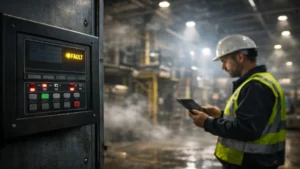
This case article explains why a manufacturing factory replaced its fire alarm panel when the project was already 60% complete, what triggered the decision and how switching to GST Fire Alarm Systems helped the project stay on schedule.
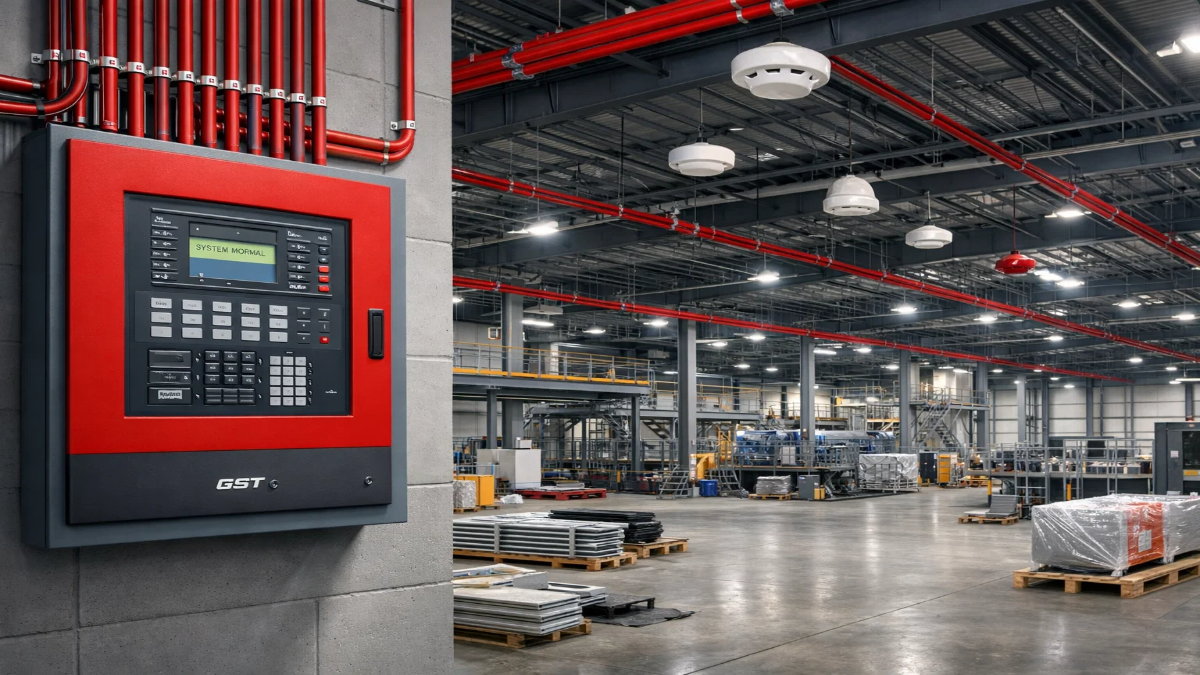
More importantly, this case highlights a critical lesson for engineers, consultants and project owners:
Scalability is not a future concern. It becomes a mid-project crisis if ignored.
Background: A Factory Project Midway to Completion
A large manufacturing facility was under construction in an industrial zone. The project involved multiple production halls, utility areas, control rooms, storage sections and administrative blocks. The fire alarm system design was finalised early, based on the initial layout and production scope.
By the time the project reached 60% construction completion, the following milestones were already achieved:
- Civil structure is largely completed
- Cable trays installed
- Initial fire alarm cabling underway
- Detectors and modules are partially planned for installation
- Fire alarm control panel already procured
At this stage, the project was expected to move smoothly toward system commissioning.
Instead, execution was suddenly halted.
The Unexpected Halt: Why Engineers Stopped the Work
The stoppage did not happen due to labour issues, supply delays or budget overruns.
The reason was more fundamental.
👉 The fire alarm system design could no longer support the evolving factory layout.
As construction progressed, the factory’s operational plans changed. Management approved the implementation of new production lines to meet the increasing demand. This expansion significantly altered the fire detection requirements.
Engineers realised that continuing with the existing fire alarm panel would introduce serious long-term risks.
What Triggered the Change in Fire Alarm Design
1. New Production Lines Were Added
The factory owner decided to install additional production lines to improve capacity. These lines required:
- More smoke and heat detectors
- Additional manual call points
- Extra input/output modules
- Expanded zoning and cause-and-effect logic
The original fire alarm design did not account for this growth.
2. Detector Count Exceeded Original Estimates
During recalculation, engineers found that the total detector and device count exceeded the panel’s loop capacity.
This was not a small overrun. The gap was large enough that:
- Adding devices would overload loops
- Signal response times could degrade
- Compliance with fire codes would be compromised
At this point, minor adjustments were no longer possible.
3. Panel Expansion Limitations Were Discovered Late
The originally selected fire alarm panel had limited scalability:
- Restricted loop expansion options
- Limited networking capability
- No practical provision for future buildings or phases
Although technically functional, the panel was not suitable for a growing industrial environment.
This limitation was not obvious during early design stages but became critical once the project expanded.
4. Redesign Would Have Caused Major Delays
Engineers evaluated the option of continuing with the existing panel using workarounds, such as:
- Splitting zones unnaturally
- Installing additional sub-panels
- Creating complex cause-and-effect logic
However, these workarounds introduced new problems:
- Redesign approval delays
- Increased wiring complexity
- Higher future maintenance cost
- Risk of authority rejection during inspection
The project team realised that patchwork solutions would delay commissioning and create long-term operational issues.
The Decision Point: Patch the Problem or Fix It Properly
At this stage, the project faced a clear decision:
Option 1: Continue with Workarounds
- Avoid immediate panel replacement
- Accept technical compromises
- Risk future failures and redesigns
Option 2: Replace the Fire Alarm Panel Early
- Incur a one-time corrective cost
- Choose a scalable, future-ready system
- Protect long-term compliance and reliability
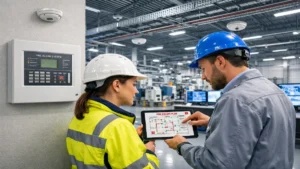
After multiple coordination meetings between consultants, engineers and the factory management, the decision was made.
👉 The team chose early replacement.
Why the Factory Switched to GST Fire Alarm Systems
The replacement decision was not just about changing hardware. It was about choosing a platform that could grow with the factory.
After a technical evaluation, the project team selected GST Fire Alarm Systems due to their proven performance in industrial environments.
Key Reasons for Choosing GST Fire Alarm Systems
1. High Loop Capacity for Industrial Scale
GST addressable fire alarm panels support higher device counts per loop, making them suitable for large manufacturing facilities with expanding layouts.
2. Seamless Expansion Without Redesign
The system allowed engineers to add detectors, modules and zones without reworking the original design philosophy.
3. Flexible Networking for Future Phases
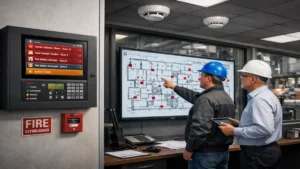
GST panels support networking between multiple panels, making them ideal for factories planned in phases.
4. Clear Programming and Logic Control
Complex cause-and-effect requirements for industrial risks were easier to configure and manage.
5. Strong Compliance Support
The system aligned well with applicable fire safety standards and local authority expectations.
Implementation: Replacing the Panel Mid-Project
Replacing a fire alarm panel at 60% project completion is not a simple task. However, early action minimised disruption.
How the Replacement Was Managed
- The panel change happened before detector installation began
- Existing cabling layouts were retained where possible
- Loop planning was revised, not rebuilt
- Programming logic was updated to support future expansion
- Coordination with other systems avoided rework conflicts
Because the replacement happened before final commissioning, the overall project timeline remained intact.
Results: What Changed After the Replacement
The impact of switching to GST Fire Alarm Systems was immediate and measurable.
1. Expansion Became Seamless
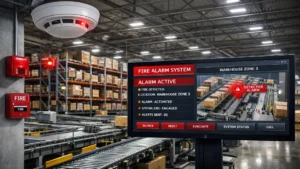
New production areas were added without redesigning the fire alarm system. Engineers simply extended loops and addressed new devices.
2. Loop Capacity Issues Were Eliminated
The upgraded panel handled the increased detector count comfortably, without overloading or performance concerns.
3. Future Phases Were Accommodated
The factory planned additional buildings for future years. The new system already had the capacity and networking capability to support them.
4. Project Handover Stayed on Schedule
Despite the mid-project replacement, the factory achieved timely system testing, authority approval and handover.
This outcome would not have been possible if the issue had been ignored until commissioning.
Scalability Is Not a “Later” Problem
This case highlights a critical truth in fire alarm system design:
Scalability is not something you plan after construction. It directly affects project execution.
In industrial projects, production requirements change frequently. Fire alarm systems must be designed to absorb these changes without becoming obstacles.
Ignoring scalability can lead to:
- Mid-project redesigns
- Costly replacements at the commissioning stage
- Authority rejections
- Delayed factory operations
Lessons for Engineers and Project Owners
1. Design for Growth, Not Just Approval
A system that passes today’s drawings may fail tomorrow’s expansion.
2. Validate Panel Capacity Early
Loop limits, networking options and future zones should be reviewed before procurement.
3. Avoid “Just Enough” Designs
Minimum compliance designs often break under real-world conditions.
4. Early Replacement Is Cheaper Than Late Failure
Fixing scalability issues mid-project is far less painful than fixing them post-handover.
A Thought for Growing Projects
👉 If your project will grow, your fire alarm system must grow first.
Designing for scalability is not an upgrade; it is risk management.
Note: This factory avoided a major operational setback by recognising a fire alarm design limitation early and acting decisively. By switching to GST Fire Alarm Systems, the project team turned a potential crisis into a controlled correction.
In fire safety engineering, the right decision at the right time is often invisible, but its impact lasts for decades.
Read Also: Fire Alarm Failures That Force Immediate System Replacement
Read Also: Reliable and Cheapest Fire Alarm Panel Replacement for Legacy Systems