Fire safety technology has seen a major shift over the last decade, especially in medium and large-scale facilities. While conventional fire alarm systems were once the standard, modern businesses now prioritize long-term value, higher accuracy and cost efficiency. This shift has pushed addressable fire alarm panels into the spotlight, not simply as an upgrade, but as a better Return on Investment (ROI) decision.
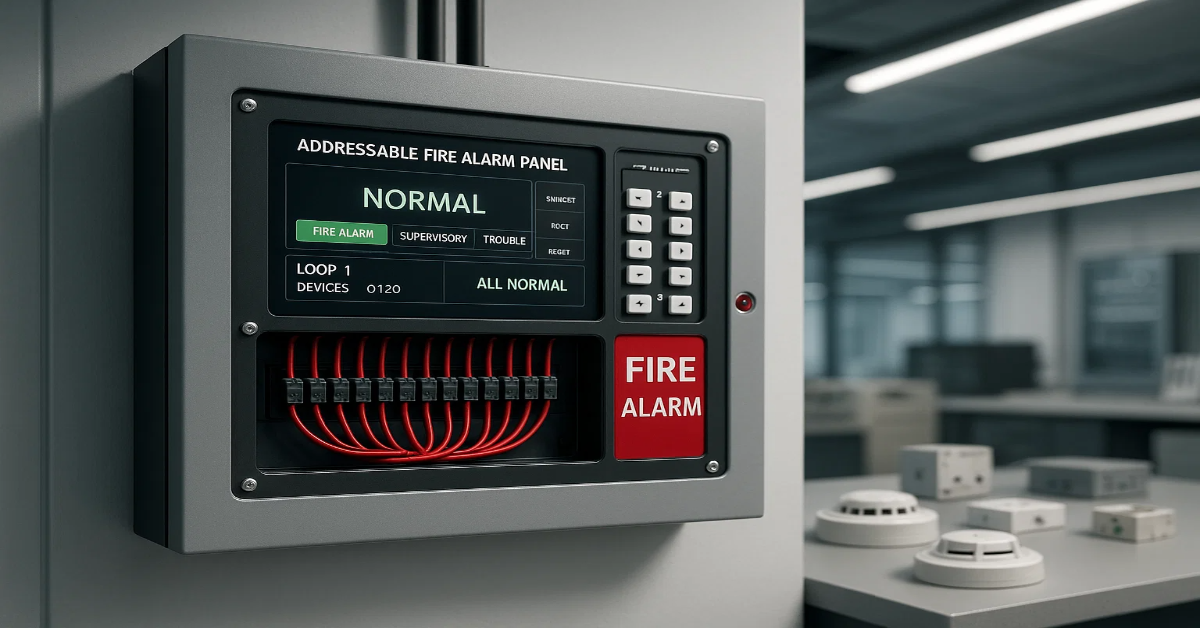
Today, facility owners, engineers and safety consultants are increasingly selecting addressable systems because they deliver measurable economic and operational benefits over time. This article breaks down those advantages and explains why addressable panels offer a significantly higher ROI compared to conventional panels. The discussion is based on real industry needs, life-cycle costs and performance expectations.
1. The Real Cost of Fire Alarm Systems: Not Just the Panel Price
Most procurement teams still initiate fire alarm purchases by comparing the panel’s upfront cost. A conventional panel appears cheaper at first glance, but hidden costs add up over the life of the system.
Key cost factors often overlooked
- Cabling length and type
- Labor required for installation
- Commissioning time
- False alarm impact
- Maintenance frequency
- Availability and future-proofing of spares
- Integration with building systems
- Upgrade pathways
Conventional panels often seem economical during purchase but become cost-heavy in long-term operation. Addressable panels reduce these expenses significantly.
2. Addressable Panels Reduce Cabling Costs by Up to 40%
Cabling is a major portion of the project budget, especially in larger buildings. Conventional panels require separate wiring for each device (multiple loops), making them cable-intensive.
How addressable panels improve cabling efficiency
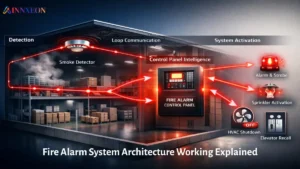
- Devices are linked using a single loop
- Fewer cable runs reduce material cost
- Installation becomes faster and simpler
- Lower conduit and tray requirements
This structure can reduce cabling and installation costs by up to 40% depending on project scale.
Why this adds to ROI
Less cabling means:
- Lower installation labor
- Faster commissioning
- Reduced material transportation
- Better scalability for future expansions
Addressable systems such as those typically used in modern commercial sites are designed to minimize infrastructure waste. This delivers immediate and long-term financial benefits.
3. Faster, More Accurate Detection Reduces Downtime Costs
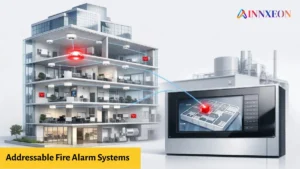
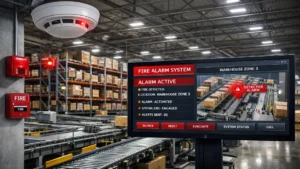
One of the biggest contributors to ROI is the system’s performance during an actual event. Addressable systems pinpoint the exact device or room in alarm. Conventional systems only show “Zone 3 Alarm” or “Zone 6 Fault,” leaving teams to search for the source.
Impact of improved accuracy
- Reduced response time
- Faster evacuation decisions
- Minimised disruption to operations
- Lower risk of asset loss
For facilities like hotels, hospitals, IT parks and manufacturing plants, every minute saved during an alarm reduces financial risk. Addressable panels offer this precision, making them a safer and more financially sound choice in the long run.
4. False Alarm Reduction Directly Saves Money
False alarms are not just annoying; they are expensive. Each false alarm can disrupt:
- Business operations
- Guest experience (in hospitality)
- Production lines (in manufacturing)
- Occupant confidence in the fire safety system
Conventional panels are more prone to false alarms because the system cannot identify which device is causing the issue.
How addressable systems reduce false alarms
- Each device has its own unique address
- Panels monitor device health in real time
- Sensitivity levels can be customized
- Faulty detectors are quickly identified
- Smart algorithms filter environmental factors
Many modern addressable systems (including those widely used across global projects) incorporate intelligent detection to minimize nuisance alarms.
ROI advantage
Fewer false alarms mean:
- Lower maintenance callouts
- Less system downtime
- No unnecessary evacuation
- Fewer disruptions to workflow
Over the life of a building, this can save lakhs of rupees.
5. Simplified Maintenance Lowers Life-Cycle Costs
Maintenance often becomes the biggest cost over a fire alarm system’s lifespan. Conventional systems require manual checking, zone-by-zone testing and time-consuming inspections.
Addressable panels deliver smarter maintenance
- Display specific fault locations
- Offer pre-alarm and device-health information
- Allow remote diagnostics (in many models)
- Support predictive maintenance
Technicians spend less time troubleshooting, which translates into reduced maintenance contracts and fewer emergency repairs.
Long-term ROI impact
By making maintenance faster and more predictable:
- Operational costs drop
- TCO (Total Cost of Ownership) reduces
- Building teams spend less on diagnostics
- Replacement planning becomes easier
This is one of the strongest reasons modern buildings prefer addressable systems.
6. Scalable Architecture Reduces Upgrade Costs
Most buildings expand and remodel over time. Conventional systems are rigid, while addressable panels are designed to grow with the building.
Advantages of scalability
- Add devices without major rewiring
- Extend loops easily
- Integrate new modules without replacing panel
- Adapt system as occupancy loads change
A scalable system ensures your initial investment stays relevant even as your facility evolves.
For example, many addressable platforms (including those widely used in commercial infrastructure) support modular expansions, making them suitable for multi-phase projects. This adaptability contributes heavily to long-term savings.
7. Integration With Modern Building Systems Enhances Value
Modern buildings rely on automation, HVAC control, access systems, CCTV, BMS platforms and emergency communication networks.
Addressable systems integrate seamlessly with:
- Building Management Systems
- Voice Evacuation
- Fire suppression systems
- Emergency lighting
- Access control
Conventional systems struggle with advanced integration because of their limited communication ability.
ROI gains from integration
- Streamlined building control
- Real-time monitoring across departments
- Improved emergency coordination
- Centralized command reduces manpower
Integration readiness ensures that the system remains valuable for decades.
8. Higher Data Transparency Helps Improve Safety Planning
Addressable fire panels generate detailed logs:
- Alarm history
- Fault history
- Device trends
- Sensitivity changes
- Loop performance
This data supports reliable audits and compliance reporting.
How data transparency boosts ROI
- Improves safety planning
- Makes insurer audits smoother
- Supports risk-based decision-making
- Helps reduce insurance premiums (in some cases)
Better data leads to better decisions and long-term operational savings.
9. Longer Lifespan Compared to Conventional Panels
Addressable systems typically have a longer service life because:
- Their components are more robust
- Software updates extend usability
- Modular replacements keep hardware relevant
Conventional panels often require complete replacement once hardware becomes obsolete.
Lifecycle impact
A longer lifespan means:
- Lower replacement frequency
- Better component availability
- Lower disruption during upgrades
This dramatically increases overall ROI.
10. Future-Proof Technology Ensures Sustained Value
Building safety is evolving rapidly. Addressable systems are continuously upgraded with new:
- Detection algorithms
- Communication protocols
- Integration options
- Energy-efficient components
This technology-forward nature ensures the system remains compliant with future fire safety standards. Many well-established brands including those commonly used in airports, malls, hospitals and hotels, design addressable platforms with long-term growth in mind.
ROI impact
By choosing a future-ready system, businesses avoid:
- Reinstallation
- Full rewiring
- Large-scale device replacement
- Code non-compliance penalties
Future-proofing is one of the most underrated ROI factors.
Comparison Table: Addressable vs Conventional Panels (ROI Perspective)
| Feature / Cost Factor | Conventional Panel | Addressable Panel |
|---|---|---|
| Cabling Cost | High | Low |
| False Alarms | Higher chance | Very low due to intelligent detection |
| Maintenance | Manual & time-consuming | Automated, faster, predictive |
| Scalability | Limited | High |
| Fault Identification | Only zone-level | Exact device-level |
| Integration Capability | Basic | Advanced |
| Lifespan | Medium | Higher |
| Long-Term ROI | Moderate to low | High |
11. Why Businesses Specifically Prefer Addressable Systems Today
Growing building complexity
Modern buildings have more floors, more occupants and more interconnected services.
Stricter compliance requirements
Auditors now prefer detailed logs and reporting, only possible with addressable systems.
Higher risk management awareness
Businesses today quantify operational risks, making addressable systems the logical choice.
Better facility management culture
FM teams value data-driven monitoring and quick troubleshooting.
12. GST Addressable Panels as Industry Benchmark
When engineers look for reliability, they often compare addressable systems based on:
- Stability of loop communication
- Device compatibility
- Scalability options
- False alarm performance
- Real-time diagnostics
Systems like those widely deployed in commercial, industrial and hospitality projects are frequently used as benchmarks because they deliver proven long-term value. GST panels are known for dependable loop performance, intelligent device communication and stable architecture, qualities that naturally contribute to higher ROI.
Addressable Panels Deliver Long-Term ROI That Conventional Panels Cannot Match
Addressable fire alarm panels are not just a technical upgrade, they are a smarter financial decision. When you account for cabling savings, reduced false alarms, simplified maintenance, scalability, integration capability and extended service life, the ROI becomes clear and measurable.
Conventional panels still have use cases in very small projects, but for any building that expects to grow, requires detailed monitoring or wants long-term cost predictability, addressable systems are the superior choice.
The shift in the industry is unmistakable: businesses are choosing solutions that deliver value beyond installation and addressable panels consistently prove their worth.
Read Also: Fire Safety Myths That Put Your Business at Risk
Read Also: The Real Reason Your Fire Alarm System Has Frequent False Alarms