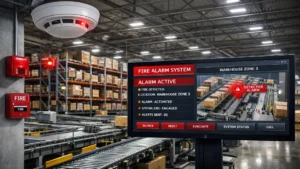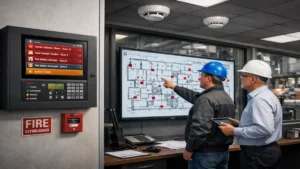
In real-world buildings, fire alarm systems rarely fail. Instead, they face partial failures, a damaged cable, a faulty detector, a short circuit on one loop or a device that stops responding.
During these moments, the true quality of a fire alarm panel becomes visible. A poorly designed system may lose entire zones, confuse operators or stop communicating altogether. A well-engineered system, however, continues to protect occupants while clearly reporting the fault.
This is exactly where GST Addressable Fire Alarm Panels stand out.
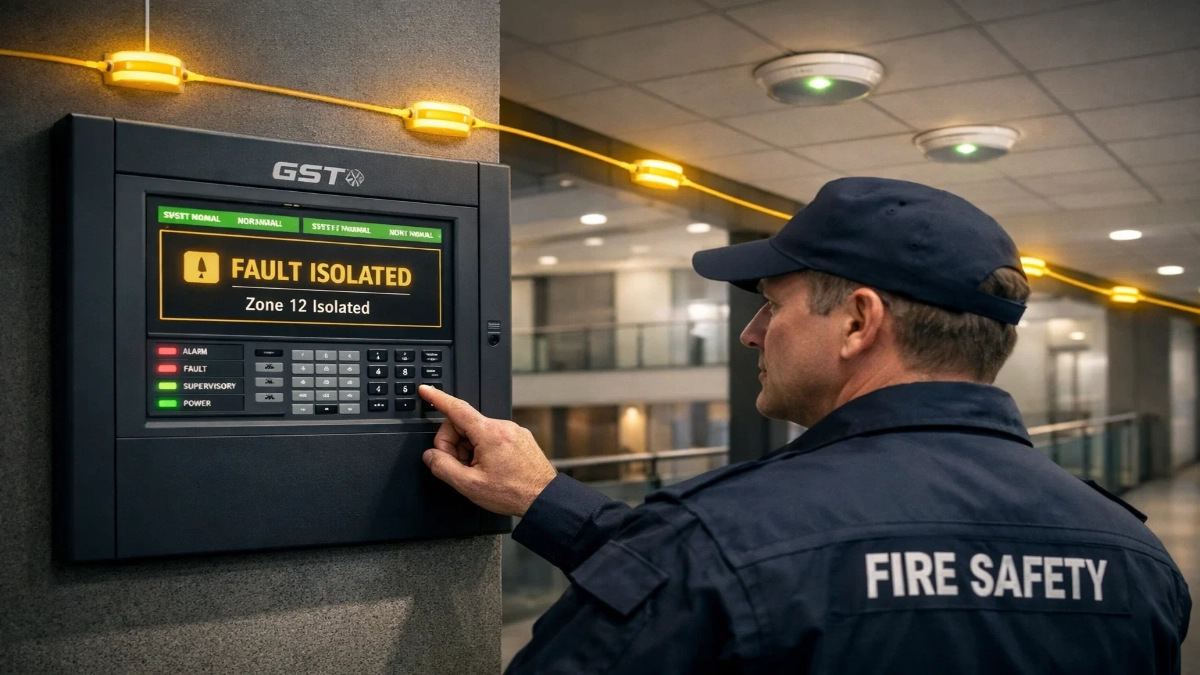
Large commercial buildings, hospitals, airports, data centres, factories and high-rise projects increasingly choose GST fire alarm systems because they maintain operational reliability even when part of the system fails. This article explains why GST addressable panels perform better during partial failures, how their architecture differs from legacy designs and why this matters for life safety, compliance, and operational continuity.
What Is a Partial Failure in a Fire Alarm System?
A partial failure occurs when a portion of the fire alarm system stops functioning, while the rest of the system remains intact.
Common Partial Failure Scenarios
- A loop cable is damaged during renovation
- One addressable detector malfunctions
- Moisture causes a short circuit in a section of wiring
- A device is removed or incorrectly replaced
- Power issues affect a sub-panel or loop
In such cases, the question is not “Will the system fail?” but rather:
How much of the system continues to protect the building?
Why Traditional Systems Struggle During Partial Failures
Limitations of Conventional Architecture
In a conventional fire alarm panel, multiple conventional detectors are connected to a single zone circuit. When a fault occurs:
- The panel often loses visibility of the entire zone
- Fault identification becomes vague (“Zone Fault”)
- Operators cannot pinpoint the exact device
- Maintenance response time increases
- Fire detection coverage may be compromised
Even modern conventional fire alarm panel designs still rely on shared circuits, which creates single points of failure.
Addressable Systems: Designed for Failure Tolerance
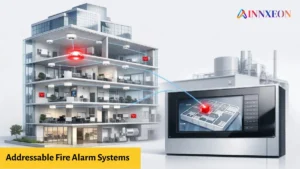
An addressable fire alarm panel works differently.
Each device, manual call point, smoke detector, heat detector, module, has a unique digital address. The panel communicates individually with every device on the loop.
This design alone significantly improves performance during faults. However, not all addressable systems are built the same.
GST’s Design Philosophy: Faults Should Not Become Disasters
GST (Gulf Security Technology) has designed its addressable fire alarm panels with a clear philosophy:
A fault should reduce functionality, not eliminate protection.
This principle shapes both hardware architecture and software intelligence across GST panels.
1. Advanced Loop Isolation Protects the Rest of the System
The Problem with Standard Addressable Loops
In many addressable systems, a short circuit on the loop can disable a large section of devices until the fault is cleared.
How GST Solves This
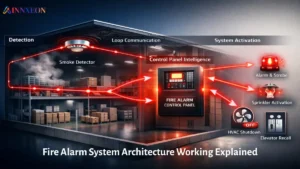
GST addressable panels support loop isolators, either built into devices or installed as dedicated modules.
What Happens During a Short Circuit?
- The isolator detects abnormal current
- It automatically disconnects the faulty segment
- Communication continues on the healthy parts of the loop
- The panel reports the exact fault location
Result: Only a small section is affected, not the entire loop.
This is a major reason why GST addressable fire alarm panels perform better during partial failures compared to generic systems.
2. Device-Level Intelligence Keeps Detection Active
GST addressable detectors are not passive components. They contain onboard intelligence that allows them to:
- Self-monitor contamination levels
- Maintain communication integrity
- Respond independently to alarm conditions
- Report pre-fault warnings before failure
If one detector fails:
- The panel identifies the exact address
- Neighbouring devices continue operating
- Fire detection coverage remains largely intact
This is fundamentally different from conventional detectors, where a single fault can impact an entire zone.
3. Accurate Fault Identification Reduces Human Error
Why Fault Clarity Matters
During emergencies, confusion is dangerous. A vague fault message wastes time and increases risk.
GST’s Advantage
GST addressable panels display:
- Exact device address
- Device type
- Loop number
- Fault nature (open, short, missing, communication loss)
This precision allows:
- Faster troubleshooting
- Reduced downtime
- Minimal disruption during maintenance
- Better coordination between safety teams and technicians
In contrast, a conventional fire alarm panel often provides only zone-level fault information.
4. Distributed Power Architecture Improves Survivability
Partial failures are not limited to data lines. Power issues are equally critical.
GST systems support:
- Distributed power supplies
- Intelligent power monitoring
- Battery health diagnostics
- Automatic load management
If one power segment experiences an issue:
- Other loops remain operational
- Alarms and sounders continue functioning
- The system enters a controlled fault state instead of shutting down
This level of resilience is essential for large buildings and mission-critical facilities.
5. Software Logic Prevents Cascade Failures
Many systems fail not because of hardware, but because of poor software logic.
GST fire alarm systems use:
- Event prioritisation algorithms
- Alarm-over-fault logic
- Fault containment strategies
- Redundant communication checks
This ensures:
- Fire alarms always take priority over faults
- A single device failure does not trigger false alarms
- Operators receive clear, actionable information
6. Networked Panels Maintain Global Visibility
In large projects, multiple panels are networked together.
GST networking architecture allows:
- Panel-to-panel redundancy
- Continued operation even if one panel segment fails
- Central monitoring systems to stay informed
- Event synchronisation across buildings
So even during a partial failure in one area:
- The rest of the site remains protected
- Control rooms maintain situational awareness
7. Compliance Under Fault Conditions
Fire safety standards do not only evaluate performance during normal operation. They also assess fault behaviour.
GST panels are designed to meet:
- Fault monitoring requirements
- Audible and visual fault indication standards
- Alarm integrity requirements during faults
- International and regional compliance expectations
This is one reason consultants and authorities prefer GST fire alarm systems for high-value projects.
8. Maintenance Without Shutdown
One of the most overlooked advantages of GST addressable systems is live maintenance capability.
Technicians can:
- Isolate a single device
- Replace addressable detectors
- Test modules
- Resolve faults
All without shutting down the entire system.
This is impossible with most conventional fire alarm panel designs.
9. Real-World Scenario: Partial Failure in a Commercial Complex
Imagine a shopping mall under renovation.
- One contractor accidentally damages a loop cable
- A section of devices goes offline
- The panel instantly isolates the fault
- Remaining devices continue monitoring
- Security receives precise fault details
- Fire protection remains active
With a conventional system:
- An entire zone might go offline
- Fire detection coverage drops
- Risk increases until repairs finish
This real-world resilience explains why large projects consistently prefer GST addressable fire alarm panels.
10. Long-Term Cost Benefits of Fault Resilience
Partial failures are not rare events; they are inevitable over a building’s lifecycle.
GST systems reduce:
- Emergency maintenance costs
- False alarms
- Downtime penalties
- Repeated troubleshooting visits
Over time, this results in:
- Lower total cost of ownership
- Higher system availability
- Better safety reputation for facility managers
Addressable vs Conventional: Fault Performance Comparison
| Aspect | Addressable Fire Alarm Panel (GST) | Conventional Fire Alarm Panel |
|---|---|---|
| Fault isolation | Device/segment level | Zone level |
| Fault identification | Exact device address | Entire zone |
| Operation during fault | Mostly active | Often degraded |
| Maintenance flexibility | High | Limited |
| Scalability | Excellent | Restricted |
Why Engineers and Consultants Trust GST
Professionals do not select fire alarm systems based on brochures. They choose systems that behave predictably when things go wrong.
GST delivers:
- Proven reliability
- Intelligent fault handling
- Strong device ecosystem
- Scalable architecture
- Clear operational logic
This is why GST addressable fire alarm panels are specified in airports, hospitals, factories, IT parks and large commercial developments.
Safety Does Not Stop at the First Fault
Fire alarm systems must protect lives even when components fail. Partial failures are not exceptions; they are part of reality.
GST understands this reality and designs its systems accordingly.
By combining:
- Intelligent addressable detectors
- Robust loop isolation
- Clear fault reporting
- Distributed power design
- Smart software logic
GST ensures that fire protection continues, even under imperfect conditions.
That is the real reason GST Addressable Fire Alarm Panels perform better during partial failures and why they remain a trusted choice for modern, large-scale projects.
Read Also: Response Time Behaviour of GST Addressable Fire Alarm Systems
Read Also: What Makes GST Fire Alarm Panels Suitable for High-Density Buildings