Large construction projects do not fail because of a lack of ambition. They fail when systems do not scale, comply or perform reliably during real-world conditions. Among all life safety systems, fire alarm systems carry the highest compliance responsibility. A single design error or unreliable panel can delay approvals, halt occupancy or expose owners to serious legal and safety risks.
This is why large commercial, industrial and infrastructure projects consistently choose GST Fire Alarm Panels. From airports and metro stations to IT parks, hospitals, factories and high-rise buildings, GST fire alarm systems have become a preferred choice for compliance and long-term reliability.
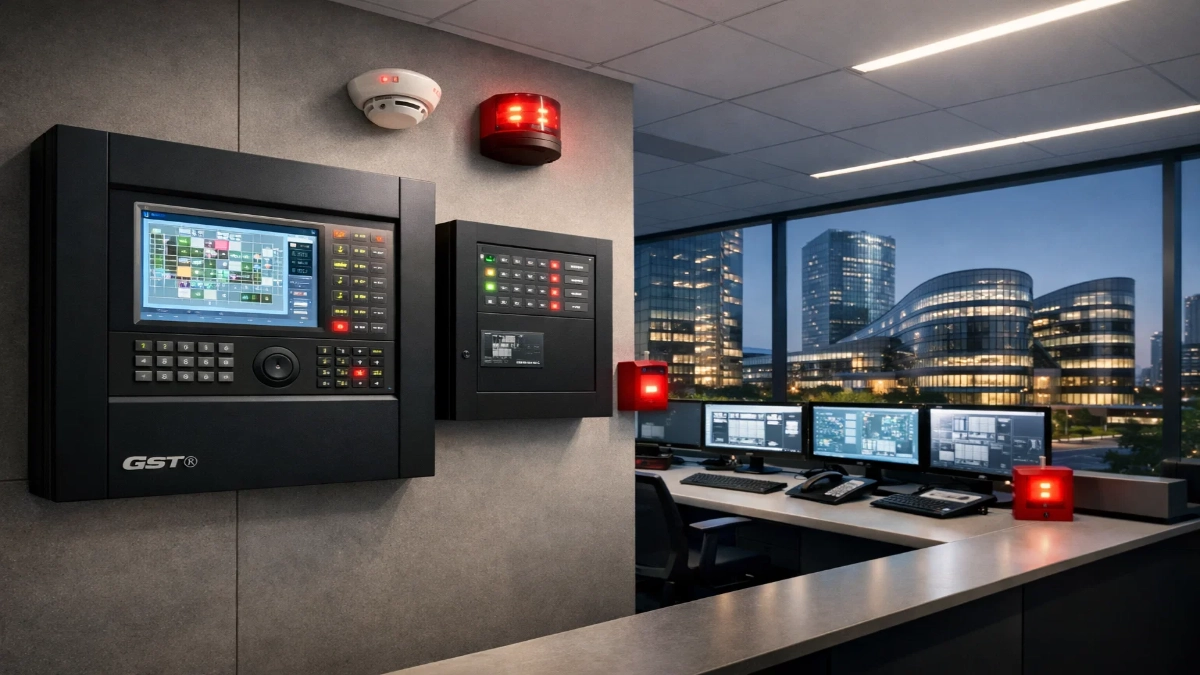
This article explains why GST fire alarm panels dominate large projects, how they meet international and local fire codes and why engineers trust them for complex, high-density environments.
Understanding the Compliance Challenge in Large Projects
Large projects face very different fire safety challenges compared to small buildings.
Key Compliance Pressures
- Multiple fire zones and sub-zones
- Thousands of detectors and devices
- Long cable loops and distributed panels
- Multiple authorities having jurisdiction (AHJ)
- Strict deadlines for approvals and occupancy
- Future expansion requirements
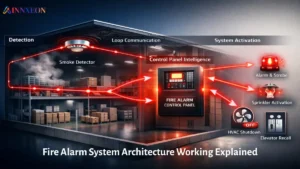
Fire alarm systems must comply not only on paper, but also in real-time performance, fault tolerance and event accuracy.
GST fire alarm panels are designed specifically to address these challenges.
What Makes GST Fire Alarm Systems Ideal for Large Projects?
GST (Gulf Security Technology) is globally recognised for designing fire alarm solutions engineered for scale, stability and compliance. Their systems are widely used in mission-critical environments where failure is not an option.
Core Design Philosophy of GST
- Compliance-first engineering
- High device capacity per loop
- Stable communication architecture
- Intelligent diagnostics and fault isolation
- Long-term system availability
These principles make GST fire alarm systems highly suitable for large projects that demand both technical excellence and regulatory approval.
Compliance with Global and Local Fire Standards
One of the biggest reasons large projects select GST is certification confidence.
International Standards Compliance
GST fire alarm panels are tested and certified to major international standards, such as:
- EN 54 series
- LPCB approvals
- CE conformity
These certifications simplify approval processes for:
- Airports
- Metro rail projects
- International hotels
- Data centers
- Industrial plants
Local Code Alignment
In markets like India, the Middle East and Southeast Asia, GST systems align well with:
- NBC requirements
- Local fire department guidelines
- Insurance inspection norms
This dual compliance approach reduces redesign risk and speeds up approvals.
Reliability Under High Device Load
Large projects often exceed 2,000 to 20,000 fire alarm devices. Not every system handles this reliably.
The Problem with Many Fire Alarm Panels
- Communication delays under heavy load
- False alarms due to voltage drops
- Loop instability at high device counts
- Frequent fault conditions during peak operation
How GST Solves This
GST fire alarm panels are built with:
- High-capacity loop controllers
- Stable polling algorithms
- Optimised communication protocols
- Strong power management
This ensures consistent response time even when loops are fully populated, which is critical in large installations.
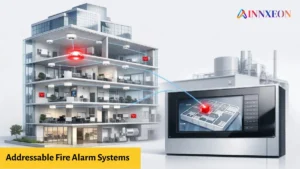
Addressable Technology: A Must for Large Projects
Most large projects today mandate an addressable fire alarm panel rather than conventional systems.
Why Addressable Systems Matter
- Precise device identification
- Faster fault diagnosis
- Reduced cable requirements
- Easier maintenance
- Better event logging
GST offers a full range of addressable fire alarm panel solutions designed for complex architectures.
GST Addressable Detectors: Accuracy at Scale
Detection accuracy directly impacts safety and compliance.
Challenges in Large Buildings
- Environmental variations
- Dust, humidity and temperature changes
- Mixed occupancy types
- Long detector loops
GST Addressable Detectors Advantages
GST addressable detectors use:
- Advanced sensing algorithms
- Drift compensation
- Environmental adaptability
- Stable address communication
This reduces:
- False alarms
- Missed detections
- Maintenance frequency
For large projects, this reliability translates into lower operational risk and higher system trust.
Conventional Fire Alarm Panels Still Matter
While addressable systems dominate large projects, certain zones still require conventional fire alarm panel solutions.
Typical Use Cases
- Small auxiliary buildings
- Utility rooms
- Remote substations
- Temporary structures
GST provides seamless integration between addressable and conventional fire alarm panel architectures, allowing engineers to design cost-effective hybrid systems without compromising compliance.
Robust Network Architecture for Large Campuses
Large projects often span multiple buildings or blocks.
Common Challenges
- Distance limitations
- Network failures
- Single-point failures
GST Networked Panel Advantage
GST fire alarm systems support:
- Multi-panel networking
- Redundant communication paths
- Central monitoring
- Distributed control
This architecture ensures that:
- Fire events propagate instantly
- One panel failure does not cripple the system
- Control rooms receive accurate data
Faster Approvals from Fire Authorities
Fire authorities prefer systems they trust.
Why Authorities Recognise GST
- Proven installation base
- Predictable performance
- Clear event reporting
- Strong documentation
Engineers often report fewer objections and faster NOCs when GST systems are used in large projects.
Reduced Maintenance Burden Over Project Life
Compliance does not end at commissioning. Large projects operate for decades.
Maintenance Risks in Large Systems
- Frequent faults
- Spare part unavailability
- Complex diagnostics
- High downtime
GST Long-Term Reliability
GST fire alarm panels are known for:
- Long product life cycles
- Consistent backward compatibility
- Easy device replacement
- Clear fault diagnostics
This significantly reduces the total cost of ownership, a major concern for large asset owners.
Scalability for Phase-2 and Phase-3 Expansion
Large projects almost always expand.
Expansion Risks
- Panel capacity exhaustion
- Protocol incompatibility
- Costly replacements
GST designs panels with:
- High spare capacity
- Expandable loops
- Network scalability
This makes future expansion smoother and more economical, protecting the original investment.
Why Engineers Trust GST in Critical Environments
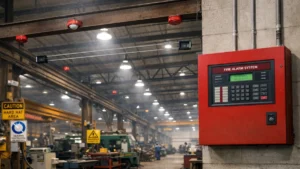
GST fire alarm systems are widely deployed in:
- Airports
- Hospitals
- Data centers
- Oil & gas facilities
- Manufacturing plants
These environments demand:
- Zero tolerance for failure
- Accurate event differentiation
- Immediate response
GST delivers consistent performance even under harsh conditions.
GST vs Generic Fire Alarm Brands
| Criteria | Generic Brands | GST Fire Alarm Systems |
|---|---|---|
| Certification | Limited | Global approvals |
| Device Capacity | Moderate | High |
| Network Stability | Inconsistent | Proven |
| Expansion Support | Restricted | Excellent |
| Authority Acceptance | Variable | High |
Compliance Is Not Optional, Reliability Is Not Negotiable
Large projects cannot afford experimentation with life safety systems. Compliance failures delay occupancy. Reliability failures endanger lives.
This is why GST fire alarm panels are repeatedly chosen for large projects worldwide. Their proven design, certification strength, scalability and long-term reliability make them a safe and strategic choice for engineers, consultants and asset owners.
When compliance, performance and future readiness matter, GST fire alarm systems stand out as a trusted solution.
Read Also: Why GST Addressable Fire Alarm Panels Perform Better During Partial Failures