Security cameras look similar from a distance. A bullet camera is a bullet camera, right?
Not exactly.
Industrial CCTV systems are built for environments that can destroy “normal” cameras and networks. We’re talking about heat, dust, chemicals, vibration, electrical noise, explosive gases, long distances and 24/7 operations where downtime is not acceptable. Commercial CCTV systems, on the other hand, focus more on clean visuals, ease of installation and smooth integration with IT networks inside offices, malls, schools and hotels.
If you’re designing, upgrading, or specifying surveillance, this difference is everything. A camera that works perfectly in a corporate lobby may fail in a refinery within weeks. An industrial-grade design approach may feel “overkill” and expensive for a retail store.
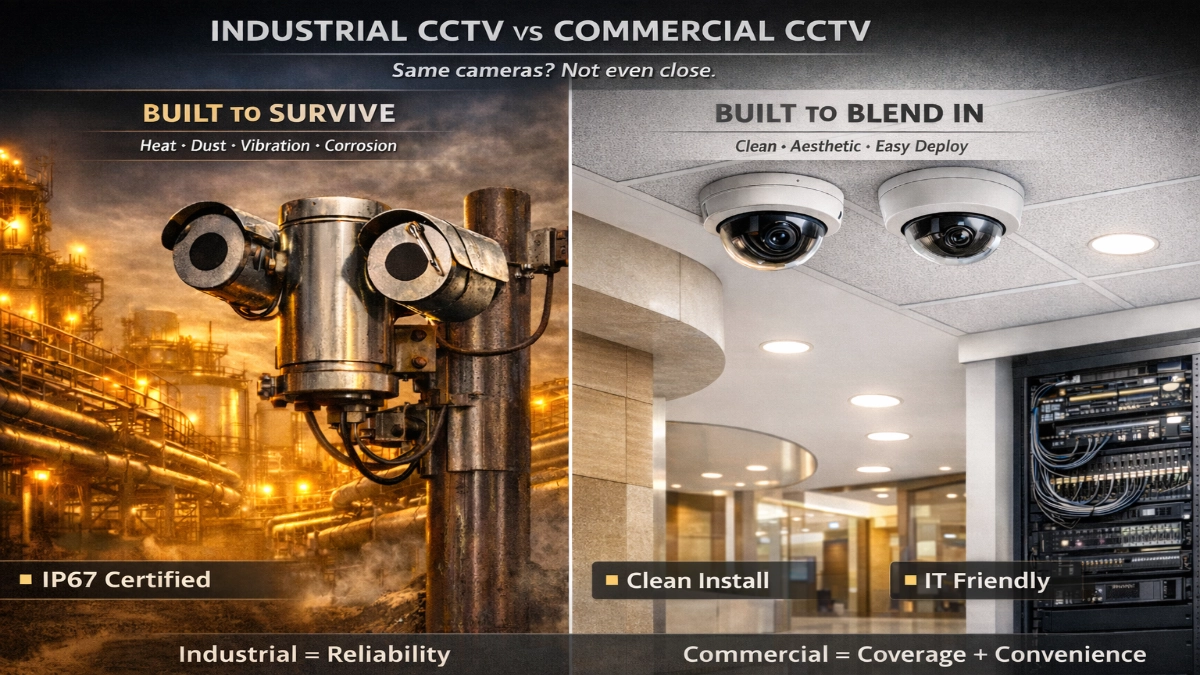
This article breaks down why industrial CCTV is designed differently, what engineers should consider and how to choose the right architecture.
Industrial vs Commercial CCTV: The Quick Definition
Industrial CCTV
Industrial CCTV is built for harsh, high-risk and high-reliability environments, such as:
- Oil & gas refineries
- Power plants and substations
- Manufacturing lines and heavy engineering plants
- Ports, mining sites and cement plants
- Pharmaceutical and chemical industries
- Water treatment facilities
- Critical infrastructure and perimeter security
Commercial CCTV
Commercial CCTV is built for public-facing and business environments, such as:
- Offices and business parks
- Malls and retail stores
- Hotels and hospitals
- Residential towers
- Warehouses and logistics hubs (non-harsh)
- Schools and campuses
Both use IP cameras today, but the design philosophy is fundamentally different.
1) Environment Comes First: Industrial Sites Are Brutal
Commercial areas are “controlled environments.” Even when they are busy, they stay within predictable conditions. Industrial environments are the opposite.
What industrial CCTV must survive:
- Extreme temperatures (hot furnaces or cold outdoor sites)
- Dust and micro-particles (cement, coal, grain, metal shavings)
- Oil mist and chemical vapours
- Constant vibration (compressors, turbines, heavy machines)
- High humidity + corrosion (coastal plants, cooling towers)
- High-pressure washdowns (food & pharma lines)
That is why industrial cameras often come with:
- Higher IP ratings like IP66/IP67/IP68
- Stronger IK impact resistance
- Stainless steel or coated housings
- Better seals, gaskets, and pressure equalisation membranes
- Certified operating ranges and thermal management
Engineering truth: In industrial CCTV, image quality is important, but survivability and uptime are priority #1.
2) Hazardous Areas Demand Explosion-Proof Design
Commercial CCTV rarely deals with explosive gas zones. Industrial sites often do.
In oil & gas, chemical plants and paint industries, you may face hazardous areas where a simple electrical spark could cause ignition.
That’s why certain industrial deployments require:
- ATEX / IECEx certified cameras
- Explosion-proof enclosures
- Flameproof junction boxes
- Approved glands and conduit practices
These are not “optional upgrades.” These are safety and compliance requirements.
Key difference: Commercial CCTV is designed to deter crime. Industrial CCTV is designed to support safety, compliance and process continuity.
3) Industrial CCTV Must Cover Massive Distances
Commercial CCTV is usually deployed inside buildings, so distances are manageable. Industrial plants are huge.
Typical industrial requirements include:
- Long perimeter fencing and boundary zones
- Remote pump houses and storage yards
- Tank farms and pipeline corridors
- Multiple buildings spread across kilometres
This changes the design dramatically:
- Fibre backbone becomes essential
- Industrial PoE switches are placed in field cabinets
- Surge and lightning protection becomes mandatory
- Redundancy is often required
If you design industrial CCTV like a commercial office network, you will face:
- Frequent link failures
- Voltage drop issues on long PoE runs
- Network loops and instability
- Troubleshooting nightmares
4) Video Is Not Just “Security” in Industry — It’s Process Visibility
In commercial setups, CCTV mostly means:
- Entry/exit coverage
- Cash counter monitoring
- Public area surveillance
- Theft deterrence
- Investigation playback
In industrial setups, CCTV is also used for:
- Monitoring production processes
- Operator safety verification
- Quality checks at critical steps
- Remote maintenance observation
- Incident prevention and root-cause analysis
- SOP enforcement in restricted zones
- Vehicle movement and site logistics
This is why industrial CCTV designs are shaped around operational needs:
- Fixed views to watch gauges, valves and conveyors
- PTZ cameras for long-range operational scanning
- Thermal cameras for overheated equipment or perimeter detection
- ANPR for industrial vehicle logging
- AI analytics for PPE detection, intrusion alerts, smoke/flame detection
In short, commercial CCTV records incidents.
Industrial CCTV helps prevent incidents and supports operations.
5) Industrial Sites Need Stronger Electrical and Surge Protection
Commercial sites usually have stable power and clean earthing systems.
Industrial sites often have:
- Heavy motors switching on/off
- High-voltage yards nearby
- Lightning-prone open areas
- Electrical noise (EMI) and ground potential differences
That’s why industrial CCTV design includes:
- Industrial-grade surge protectors (power + data)
- Shielded cable practices (correct termination matters)
- Proper bonding and earthing
- Fiber use to isolate electrical interference
- Outdoor-rated PoE injectors and cabinets
A normal PoE switch in a dusty outdoor panel can die quickly.
Industrial switches are built for:
- Wide temperature operation
- Fanless designs
- DIN rail mounting
- Better surge tolerance
6) Industrial Cabling Standards Are More “Hardcore”
Commercial CCTV often uses:
- Cat6 cabling in conduits/false ceilings
- Standard patch panels and racks
- Indoor-rated cable routes
- Shorter cable runs
Industrial CCTV may require:
- Armored cables
- Conduit and cable trays across plant areas
- Chemical-resistant jackets
- UV-rated outdoor cables
- Termination inside junction boxes
- More fibre, less copper
This is why industrial CCTV installation looks “heavier”:
- More glands, ferrules and protection tubing
- Weatherproof enclosures
- Field termination points
- Labelling standards for maintenance
Industrial cabling is designed for serviceability and durability.
7) Industrial Cameras Need Different Optics and Viewing Logic
Commercial cameras often prioritise:
- Wide-angle views (cover more area with one camera)
- Face capture at doors and lobbies
- Balanced lighting environments
- Pretty night colour performance
Industrial cameras prioritise:
- Long-range capture (perimeter or process points)
- Stable exposure under harsh lighting
- High contrast scenes (welding sparks, furnace glow, sunlight/shadow shifts)
- Reliable performance under fog/smoke/dust
- Speciality imaging (thermal or anti-corrosion)
Example: A normal camera vs an industrial process view
A commercial lobby camera might work at 2.8mm wide-angle.
But a refinery perimeter camera might need:
- 6mm/8mm/12mm lens
- IR performance tuned for distance
- Better WDR for headlight glare
- Smart detection to avoid false alarms from vibration
8) Industrial CCTV Needs Reliability and Redundancy
Commercial sites can tolerate:
- A camera going offline for a few hours
- Rebooting a switch
- A recorder restart
Industrial sites can’t.
Because:
- Safety teams rely on live monitoring
- Shutdowns cost serious money
- Compliance requires recording retention
- Incident footage becomes critical evidence
So industrial CCTV design often includes:
- Redundant uplinks (ring topology)
- Failover recording
- RAID storage
- N+1 power supplies
- UPS backup for core nodes
- Hot standby VMS servers
Commercial CCTV is often cost-optimised.
Industrial CCTV is uptime-optimised.
9) Industrial Systems Use Different Network Architecture
Commercial CCTV design is often simple:
Camera → PoE Switch → NVR/VMS → Viewing
Industrial CCTV is more structured:
- Edge layer (field cameras + local switches)
- Distribution layer (fibre aggregation)
- Core layer (server room + recording + SOC)
This layered design allows:
- Better fault isolation
- Easier scaling
- Reduced downtime
- Higher cybersecurity control
Engineers love this because it becomes an actual network project, not just a camera installation.
10) Cybersecurity Is Bigger in Industrial Networks
Commercial systems are commonly deployed inside IT networks, but industrial deployments face more serious risks.
Industrial sites may have:
- OT networks (SCADA, PLCs, DCS)
- Critical infrastructure restrictions
- Air-gapped or segmented networks
- Strict vendor onboarding policies
So industrial CCTV should follow:
- VLAN segmentation
- Strong credential policies
- Secure firmware management
- Audit logs and user roles
- Network access control
- Restricted remote access
The goal is simple:
A CCTV network should never become a gateway into industrial control systems.
Industrial CCTV is designed with stronger network discipline because failure is more expensive.
11) Maintenance Strategy Shapes the System Design
Commercial CCTV maintenance usually means:
- Cleaning lenses sometimes
- Replacing an adapter or camera
- Occasional NVR checkups
Industrial CCTV maintenance planning is different:
- Cameras need cleaning schedules due to dust/oil mist
- Housing windows may require frequent inspection
- Fans/heaters need checks in extreme climate sites
- Connectors face corrosion risk
- Vibration loosens mounts over time
So engineers design industrial CCTV with:
- Accessible mounting height
- Service loops and proper junction points
- Clear labeling and documentation
- Standard spare strategy (common models to reduce inventory)
- Health monitoring dashboards (camera offline alerts, storage alerts)
Industrial CCTV is designed like an asset management system, not just a surveillance tool.
12) Industrial CCTV Often Needs Specialised Cameras
Commercial setups mostly use:
- Dome cameras
- Bullet cameras
- PTZ cameras
Industrial sites may need:
- Explosion-proof cameras (ATEX/IECEx)
- Thermal cameras (intrusion + equipment heat)
- Corrosion-resistant housings
- Vibration-resistant mounts
- Low-light sensors for dark zones
- Mobile cameras for heavy equipment monitoring
This changes both the project cost and design complexity.
Common Mistakes When Industrial CCTV Is Designed Like Commercial CCTV
Here are the real-world mistakes that create failures:
Using indoor-rated cameras outdoors
Result: Moisture ingress, lens fogging, corrosion.
Choosing wide lenses for the perimeter
Result: No usable identification at distance.
Ignoring surge protection
Result: Camera failures after lightning events.
Copper everywhere, no fibre planning
Result: Unstable links, ground noise issues and long-run PoE problems.
Consumer-grade switches inside dusty panels
Result: Overheating, random shutdowns, packet drops.
No redundancy for recording and uplinks
Result: Total blind spots during failures.
Engineers don’t hate CCTV projects.
They hate CCTV projects that fail because someone treated an industrial site like a shopping mall.
How to Choose the Right Design: A Practical Checklist
Use this quick engineering checklist:
Environment checklist
- Temperature range?
- Dust level?
- Chemical exposure?
- Coastal corrosion risk?
- Washdown requirement?
Compliance checklist
- Hazardous area zones (ATEX/IECEx)?
- Recording retention requirements?
- Audit and access control requirements?
Network checklist
- Fibre backbone needed?
- VLAN and segmentation plan?
- UPS for core equipment?
- Redundant paths required?
Camera selection checklist
- Required identification distance?
- Lighting conditions at night?
- WDR requirements?
- Thermal or analytics needed?
Maintenance checklist
- Cleaning schedule feasible?
- Camera mounting access?
- Spare parts plan?
- Health monitoring alerts?
Industrial CCTV Is Engineering-First, Not Aesthetic-First
Commercial CCTV systems are designed for convenience and coverage in predictable environments.
Industrial CCTV systems are designed for:
- Harsh conditions
- Safety and compliance
- High uptime
- Long-distance connectivity
- Tough electrical environments
- Process monitoring use cases
That’s why industrial CCTV needs a different approach from cameras and cabling to network architecture and redundancy.
When you design it correctly, industrial CCTV becomes more than surveillance.
It becomes a reliability tool for operations, safety and decision-making.
Read Also: Industrial vs Enterprise CCTV: Engineering Differences That Matter on Site
Read Also: Why CCTV Systems Are Becoming More Network Projects Than Security Projects
FAQ’s
Industrial CCTV focuses on rugged reliability, harsh-environment survivability and operational continuity. Commercial CCTV focuses more on ease of installation, clean aesthetics and general security coverage.
You can use them only in clean, controlled parts of the site, like offices. For outdoor, dusty, chemical or high-vibration areas, commercial cameras often fail early.
Fibre supports long distances, electrical isolation, and EMI resistance, making it ideal for large plants and high-interference industrial environments.
No. Only hazardous zones require certified equipment. But many industries have specific areas where explosion-proof design is mandatory.
It depends on distance and lighting. Common choices include long-range bullet cameras, PTZ cameras and thermal cameras for detection in darkness or fog.