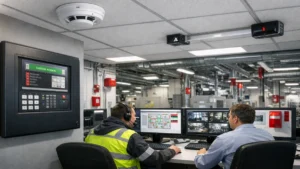
If you ask most people what makes a CCTV project “successful,” they will say:
- Cameras are installed
- Video is coming
- Recording is working
But every engineer knows the truth:
A CCTV system is only successful when it survives real site conditions day after day without surprises.
That’s why Industrial CCTV and Enterprise CCTV are not the same thing.
They might use similar cameras, similar VMS platforms and the same networking terms like PoE, VLAN and NVR. Yet, on a live site, these two CCTV approaches behave very differently.
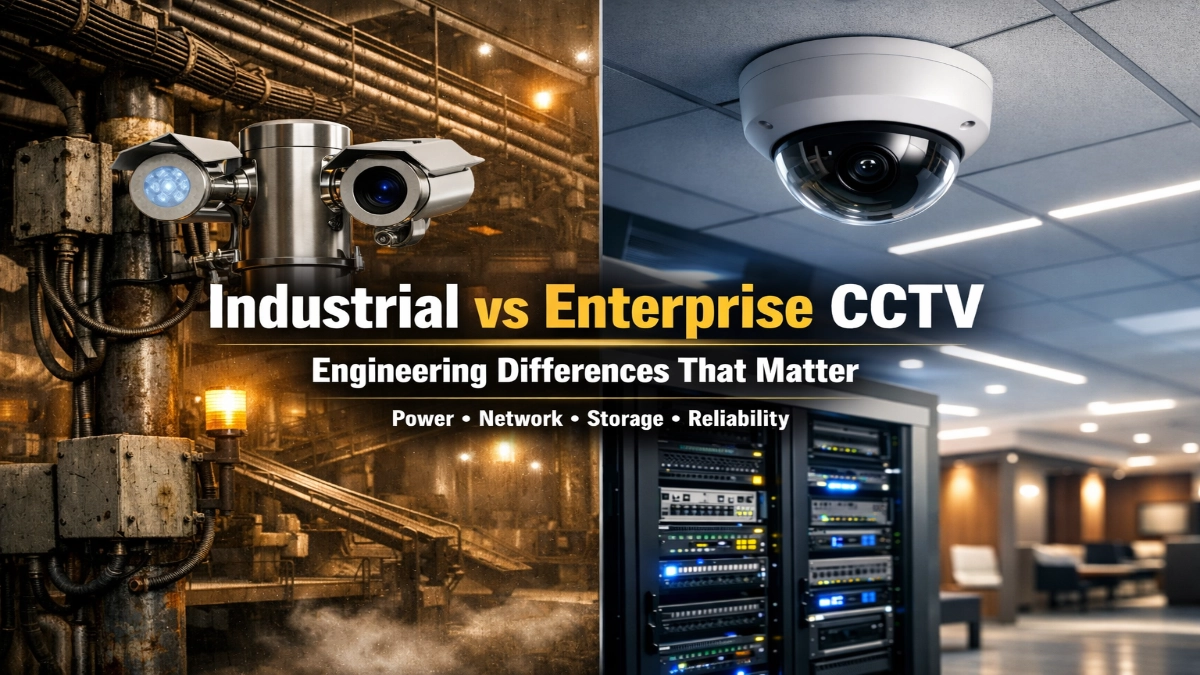
This article explains the engineering differences that actually matter on site, especially when you are designing, installing and commissioning CCTV systems in:
- Factories and production plants
- Warehouses and logistics yards
- Oil & gas, cement, steel, power utilities
- Corporate campuses, IT parks, commercial buildings
If your goal is to design a CCTV system that engineers respect and managers trust, you’re in the right place.
Why This Comparison Matters (More Than You Think)
Most CCTV problems don’t come from wrong brands.
They come from wrong assumptions.
For example:
- “Indoor camera performance will be fine outdoors.”
- “PoE will work because it worked in office buildings.”
- “Storage estimation is easy. We’ll add hard drives later.”
- “The network team will handle bandwidth.”
- “CCTV is just security, it’s not critical.”
These assumptions break projects.
And the damage is real:
- Frequent camera offline complaints
- Poor night footage during incidents
- Missing recordings when you need evidence
- Network congestion affecting business systems
- Site teams losing trust in CCTV as a system
That is why understanding Industrial vs Enterprise CCTV helps you design smarter from day one.
What Is Industrial CCTV vs Enterprise CCTV?
Let’s define it in an engineering-friendly way.
Industrial CCTV
Industrial CCTV is built for survival + uptime in harsh environments like:
- High dust/cement dust/coal dust
- Heat and high ambient temperature
- Vibration from heavy machinery
- Moisture, steam, wash-down areas
- Electrical noise from motors, VFDs and welders
- Outdoor yards with lightning exposure
In industrial sites, CCTV is often treated like a safety-grade operational system.
It supports:
- Incident investigation
- Process monitoring
- Compliance documentation
- Security and perimeter management
Enterprise CCTV
Enterprise CCTV is built for scalability + manageability in controlled spaces like:
- Corporate offices
- Commercial buildings
- Retail, hospitality
- IT parks, campuses
- Public-facing reception areas
Enterprise CCTV is typically managed like an IT application:
- Centralized policies
- Consistent network and power
- Clean environments
- Predictable camera placement and lighting
1) Environmental Engineering: The Hidden Difference That Decides Everything
This is the biggest site-level difference.
Industrial Environments: Where Cameras Get Tested Daily
Industrial CCTV faces conditions like:
Dust and airborne particles
Dust is not just “dirty air.”
It creates real problems:
- IR reflection = white haze at night
- Lens contamination = blurred footage
- Junction box dust sealing failures = moisture entry later
High temperature zones
Heat affects:
- Sensor performance
- IR LED stability
- Internal camera power regulation
- Focus stability (especially in long lenses)
Vibration
Vibration causes:
- Micro movement in the camera angle
- Loosened mounts over months
- Shaky footage that ruins analytics
- Connector looseness and intermittent faults
Moisture + wash-down
Many plants wash floors and equipment areas.
That means:
- Water can enter weak sealing points
- Poorly designed glands fail
- Corrosion attacks connectors and brackets
Industrial CCTV design must assume worst-case conditions.
Not “normal day conditions.”
Enterprise Environments: Stable, Predictable, Easy to Maintain
Enterprise CCTV typically has:
- Stable indoor temperature
- Controlled lighting
- Clean cable routes
- Protected network racks
- Easy access for maintenance
So enterprise CCTV becomes easier to run:
- Fewer surprises
- Faster fault detection
- Cleaner footage quality
- Better analytics stability
Engineer’s site truth:
A camera that performs perfectly in a lobby may fail quickly on a dusty plant floor.
2) Power Engineering: PoE Is Great… Until It Starts Rebooting Cameras
Power issues are one of the most common reasons why CCTV fails during commissioning.
Industrial Power Challenges
Industrial sites often have:
- Longer cable distances
- Outdoor pole cameras
- Variable power conditions
- Frequent surge events
- Complicated earthing
- Heavy load equipment nearby
In industrial CCTV, random camera reboots often happen because of:
- PoE budget mismatch
- Voltage drop on long cables
- Poor grounding/surge exposure
- Heater/blower load on outdoor cameras
- Unstable power during shift change loads
Industrial Power Best Practice Checklist
Engineers usually plan:
- PoE budget per switch (with margin)
- Industrial-grade PoE switches where needed
- Separate supply for long-distance cameras
- Surge protection in outdoor and yard networks
- Proper earthing at cabinet level
Enterprise Power Setup: Cleaner and More Controlled
Enterprise setups usually have:
- closer IDF/MDF locations
- structured cabling standards
- UPS-backed switches and servers
- less electrical interference
So PoE works smoothly and consistently.
Reality:
Industrial CCTV is not “PoE by default.”
It’s “PoE after engineering validation.”
3) Network Architecture: Why Industrial CCTV Feels Like a Network Project
In modern systems, CCTV traffic is heavy.
And the network decides performance.
Enterprise Network Style: IT-Ready from Day One
Enterprise environments typically support:
- VLAN segmentation
- Central VMS monitoring
- Controlled access policies
- Standard uplink speeds
- Security practices already in place
So enterprise CCTV scales easily.
Enterprise CCTV Design Benefits
- Faster deployments
- Predictable bandwidth
- Easier remote access setup
- Centralised user management
Industrial Network Style: Real Sites Don’t Look Like Diagrams
Industrial CCTV networks deal with:
- Remote buildings and outdoor yards
- Fiber transitions
- Long-distance distribution
- Limited maintenance windows
- Cable routes near heavy electrical lines
That’s why industrial CCTV network planning must include:
- Fibre backbone decisions
- Cabinet placement strategy
- Redundancy planning for critical zones
- Segment separation from OT networks
Site reality:
In industrial projects, the network is not a background system.
It is the backbone of CCTV reliability.
4) Camera Engineering: Where Specs Stop Being “Specs” and Become “Results”
Many cameras look similar in brochures.
But in real deployments, the difference shows up in:
WDR performance in glare zones
Industrial sites have high glare sources:
- Metal reflections
- Furnaces and hot zones
- Overhead high-bay lighting
IR performance in dusty air
Dust particles reflect IR and create:
- White haze
- Ghosting
- Unusable footage at night
Lens selection for long distances
Outdoor yards need:
- Correct lens selection
- Stable focus
- Correct mounting height
Mechanical strength
A weak mount can destroy your footage quality even if the camera is excellent.
Enterprise Camera Priorities
Enterprise projects prioritise:
- Face capture near entry/exit
- Reception area clarity
- Aesthetics (clean dome installs)
- Standardised models across sites
Enterprise cameras also benefit from:
- Stable lighting
- Clean backgrounds
- Predictable movement patterns
5) Storage Engineering: The Most Underestimated Part of CCTV Design
Storage planning is where many projects break after handover.
Enterprise Storage: Predictable Bitrate Patterns
Enterprise sites often have:
- Fixed working hours
- Predictable activity
- Stable lighting
- Lower bitrate variation
This makes retention planning straightforward.
Industrial Storage: Bitrate Spikes Are Normal
Industrial environments cause bitrate instability due to:
- Dust movement
- Steam clouds
- Low light noise
- Constant operational movement
- Higher FPS needs for process zones
Industrial Storage Must Consider:
- 24×7 recording
- Higher average bitrate
- Long retention for audits and investigations
- Rapid retrieval workflow
Very important:
Industrial CCTV is not only for security.
It’s for operational accountability.
Examples:
- Material theft disputes
- Loading/unloading proof
- Safety incident review
- Equipment failure investigation
6) Reliability Engineering: Enterprise Tolerates Downtime, Industry Doesn’t
Enterprise downtime is inconvenient.
Industrial downtime is risky.
Industrial Reliability Demands
Industrial CCTV must survive:
- Power disturbances
- Dust exposure
- Fibre link faults
- Cabinet heat buildup
- Physical cable damage risk
That’s why industrial designs often require:
- Redundancy for critical links
- Better cabinet thermal planning
- Robust labeling and maintenance planning
- Fibre-first thinking for distance
7) Commissioning Reality: The Work That Makes Engineers Respect You
This is where projects are won or lost.
Enterprise Commissioning
Enterprise commissioning focuses on:
- User roles and permissions
- Central monitoring
- Integration with IT systems
- Neat rack work and patching
Industrial Commissioning
Industrial commissioning focuses on:
- Sealing and gland work
- Surge/earthing checks
- Stable mounting and vibration management
- Night testing in real conditions
- Stress testing links and recording stability
Pro tip, engineers follow:
Never approve industrial CCTV without a night test.
8) Cybersecurity: Different Priorities, Same Exposure
Enterprise is strong on cybersecurity policies.
Industrial is strong on uptime priorities.
Enterprise typically enforces:
- Password policies
- Patch cycles
- NAC / access controls
- Centralized monitoring
Industrial needs:
- Segmentation from OT systems
- Controlled remote access
- Firmware baselines
- Strict admin access discipline
Best engineering direction:
Separate CCTV networks from OT networks unless the cybersecurity design is validated.
9) Analytics: Where It Works and Where It Lies
AI is powerful, but the environment decides success.
Analytics struggles in industry when:
- Dust creates false triggers
- Steam hides human outlines
- Lighting changes continuously
- Vibration affects detection stability
Analytics works well in industry for:
- Perimeter protection in yards
- Intrusion in restricted zones
- Vehicle tracking in logistics
- PPE compliance in stable visibility areas
Enterprise analytics performs better because:
- Lighting is stable
- Background is cleaner
- Entry points are structured
Industrial vs Enterprise CCTV: Practical Decision Table
Choose Industrial-Grade Engineering When:
- Harsh environmental conditions exist
- Cameras sit outdoors or in process zones
- Long distances are involved
- Uptime is critical
- Maintenance access is difficult
- Power and surge risk is high
Choose Enterprise-Style Design When:
- Controlled indoor environment
- Structured IT network exists
- Centralised management is needed
- Scalability across many sites matters
- Aesthetic installation matters
The “Engineer’s CCTV Blueprint” (Field-Proven Checklist)
Before final design approval, validate:
Site Validation
- Dust/steam zones mapped
- Lighting checked in day + night
- Mounting height and angle confirmed
- Cable routing finalized
Power Validation
- PoE budget calculated with margin
- Switch capacity validated
- Surge protection planning done
- UPS requirement confirmed
Network Validation
- VLAN structure planned
- Uplink capacity validated
- Fibre vs. copper decided correctly
- Redundancy planned for critical paths
Storage Validation
- Retention requirement finalized
- Bitrate tested realistically
- RAID and failover planned
- Playback and export tested
Handover Validation
- labelling and documentation completed
- Admin access defined
- Training done for the site team
- maintenance plan prepared
The Systems Look Similar, But Engineering Makes Them Different
Industrial vs Enterprise CCTV is not a “category difference.”
It is an engineering difference.
Industrial CCTV must survive:
- Harsh environment
- Unpredictable power
- Long distances
- Uptime expectations
- Operational dependence
Enterprise CCTV must deliver:
- Scalability
- Easy management
- Clean integration
- Standard deployment
When you engineer CCTV based on real site conditions, not assumptions, you get:
- Fewer breakdowns
- Stable recordings
- Smoother handover
- Satisfied managers
- A system your client trusts
And that’s what separates a CCTV installer from a CCTV engineer.
Read Also: Why CCTV Systems Are Becoming More Network Projects Than Security Projects