A smoke detector in a packaging hall starts raising repeated nuisance alarms. A week later, the panel shows a dirty-detector warning on the same device. The detector still communicates normally, so the maintenance team asks the obvious question: should they clean it, test it, investigate further or replace it?
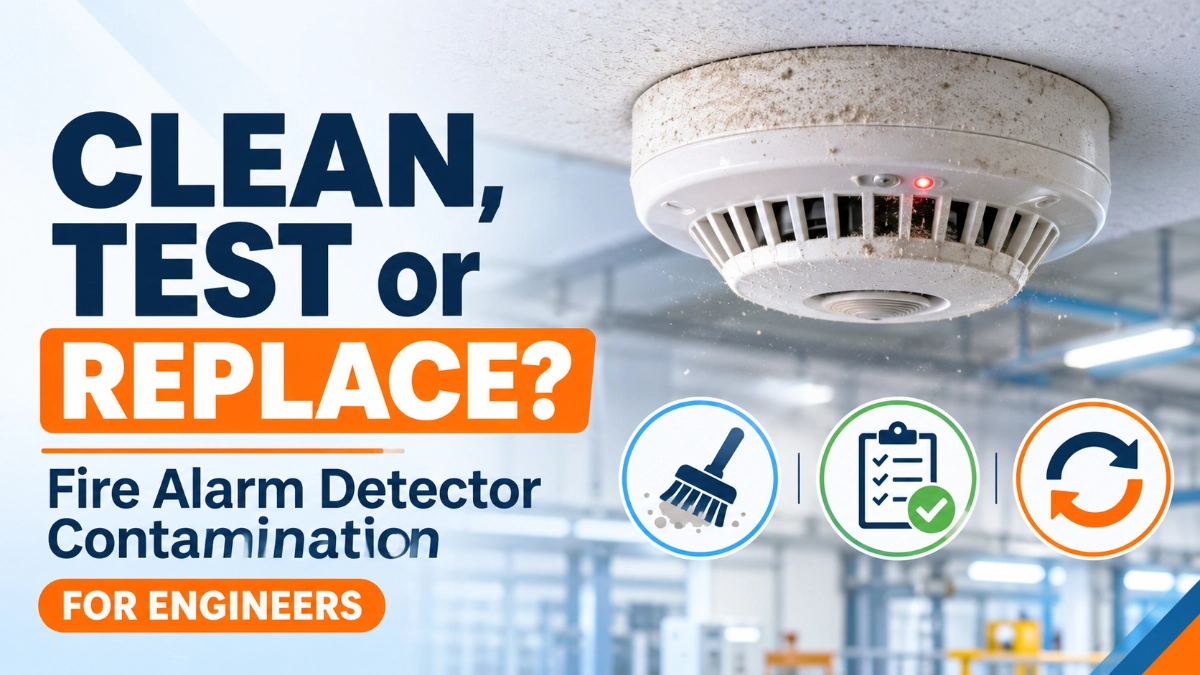
The answer is not visible from outside the housing. Communication with the fire alarm control panel proves the device is polling. It does not prove the detector senses smoke correctly. Fire alarm detector contamination can change the operating condition of a device while its communication status looks healthy.
Engineers face three separate decisions:
- Clean: The contamination can be removed with an approved cleaning procedure.
- Test: The team must verify operation and assess performance.
- Replace: The detector is damaged, deteriorated, outside acceptable limits, or cannot be restored under manufacturer requirements.
The right choice depends on detector technology, contamination type, manufacturer instructions, test results and the applicable standards.
What Causes Fire Alarm Detector Contamination?
Contamination comes from the environment around the detector. Dust, oil, moisture, insects and chemical vapours are the most common sources in commercial and industrial buildings. Each affects detector technologies differently, so no single cause produces a single failure pattern.
- Dust and airborne particles: Manufacturing, warehouses, construction, packaging and cement or bulk-material handling release fine particles that settle on or enter detectors.
- Oil, grease and industrial residues: Workshops, machinery areas and processing lines produce films that can coat surfaces and trap dust.
- Steam and moisture: Food processing, industrial kitchens, boiler rooms and washdown areas expose detectors to condensation and humidity.
- Insects and biological debris: Small insects, cobwebs and debris can enter sensing chambers, especially where housekeeping is poor.
- Chemical vapours and aerosols: Cleaning chemicals, process vapours, aerosol sprays and combustion by-products can leave residues or create airborne particles.
How Does Contamination Affect Smoke Detector Performance?
Contamination changes the conditions inside the sensing chamber, and the effect depends on detector construction, contaminant type, concentration and operating conditions.
An optical smoke detector uses a light source and a light receiver arranged so that the receiver normally sees very little light. Smoke entering the chamber scatters light toward the receiver, and the detector evaluates that signal.
Can dust affect smoke detector performance?
Yes. Dust can change how much light reaches the receiver, which may raise the background signal, cause drift or trigger nuisance alarms. Dust may also coat optical components and alter response. The result depends on the design. Many detectors compensate for gradual drift, but only within the limits the manufacturer specifies.
Engineers should separate five conditions that are often confused:
- Detector contamination: Foreign material in or on the sensing path.
- Reduced performance: A change in response that may or may not trigger a warning.
- Nuisance alarm: An alarm without a fire, which contamination can cause but which has other causes too, such as steam, aerosols or process emissions.
- Device fault: An internal failure of the detector.
- Communication fault: A loss of signalling between detector and panel, often caused by wiring or loop problems.
A detector communicating normally with an addressable panel is not proof of correct sensing performance.
Warning Signs That a Fire Alarm Detector May Need Attention
Watch for these indicators:
- Repeated nuisance alarms
- Contamination or dirty-detector warnings
- Unusual fault indications or persistent trouble signals
- Visible dust, debris or insects
- Physical damage, corrosion or moisture exposure
- Failed functional tests
- Abnormal sensitivity readings, where the system supports them
- Recurring problems in the same area
These symptoms call for investigation. They do not prove the detector needs replacement. Visual inspection also has limits: a clean-looking housing can hide a contaminated chamber, and a dusty exterior may sit on a healthy detector.
When Should Engineers Clean a Fire Alarm Detector?
Clean a detector when contamination is light or removable, and the manufacturer permits a cleaning method. Cleaning suits light dust accumulation, not every contaminated detector.
A sound cleaning process includes:
- Following the manufacturer’s cleaning instructions exactly.
- Inspecting the sensing chamber only where the manufacturer allows it.
- Checking for visible damage while the detector is accessible.
- Rechecking device condition after cleaning.
Keep these limits in mind:
- Do not assume every detector can be opened or cleaned in the same way.
- Do not use compressed air, solvents, water or household cleaners unless the manufacturer explicitly permits them.
- Do not damage sensing components.
- Do not bypass or disable protection without an approved impairment procedure, including any interim measures your local rules require.
Cleaning does not automatically restore sensitivity. It removes contamination. A test must confirm the result.
When Is Functional Testing Necessary?
Test whenever the team needs proof that a detector responds correctly: after cleaning, after replacement, after repeated faults, or whenever operation is in doubt. Cleaning alone does not establish correct operation.
A functional test typically covers:
- Applying a manufacturer-approved stimulus with approved test equipment.
- Confirming the detector activates.
- Checking that the fire alarm control panel receives and displays the signal.
- Reviewing detector status and confirming correct restoration afterwards.
- Recording the results.
What is the difference between a functional test and a sensitivity test?
A functional test verifies that the detector responds and the system reports it. A sensitivity test measures how the detector performs against applicable limits, using a calibrated instrument or a manufacturer-supported diagnostic method. Cleaning is neither of these: it is a corrective action that a test then verifies.
The correct method depends on detector technology and the applicable maintenance standard. Never test with uncontrolled smoke, open flames or improvised materials.
When Should a Fire Alarm Detector Be Replaced?
Replace a detector when it cannot meet the required operating condition after approved maintenance. Replacement may be necessary when:
- The detector is physically damaged.
- Corrosion or moisture has damaged it.
- Contamination persists after approved cleaning.
- It fails an approved functional test.
- Sensitivity falls outside permitted limits.
- Faults recur after appropriate maintenance.
- It reaches the end of its manufacturer-defined service life.
- The model is obsolete or unsupported.
- It is incompatible with system requirements.
- The manufacturer’s instructions call for replacement.
Repeated cleaning must not become a substitute for replacing a device that cannot perform. The opposite error also costs money: dust alone is not a reason to replace every detector.
A replacement detector needs compatibility verification with the existing panel and loop, correct installation, and the commissioning and testing steps your project requires.
Cleaning vs Testing vs Replacement: What Is the Difference?
These are different maintenance decisions, and one maintenance visit may involve all of them.
| Maintenance Action | When It May Be Appropriate | What Engineers Must Verify |
|---|---|---|
| Cleaning | Removable contamination within approved limits | Manufacturer-approved cleaning method and device condition |
| Functional testing | After maintenance or when operation needs verification | Correct response using approved test equipment |
| Sensitivity testing | Where required or supported by the applicable procedure | Measured performance against permitted limits |
| Replacement | Damage, failed performance, unacceptable contamination or end of service life | Compatibility, correct installation and commissioning/testing requirements |
No single action always replaces the others. A cleaned detector still needs verification, and a failed test does not always mean replacement before the team has followed the manufacturer’s recovery steps.
Addressable vs Conventional Detectors: Does Contamination Monitoring Differ?
Can an addressable fire alarm panel identify contaminated detectors?
Often, but only where the detector and panel support it. An addressable fire alarm panel identifies each device individually and may display device-level status or maintenance alerts. Not every addressable detector offers a contamination warning, so engineers should confirm the feature in the product documentation.
Addressable systems typically provide:
- Individual device identification
- Device-level status where supported
- Possible contamination or maintenance alerts on supported products
- Easier location of the affected device
Conventional systems typically provide:
- Zone-based indication
- Less individual device detail at the panel
- Greater reliance on inspection records and systematic troubleshooting
A conventional fire alarm panel can still support effective maintenance. Teams simply work through the devices in the alarming zone, supported by good records. When specifying either architecture, review addressable detectors and conventional detectors against the panel’s documented capabilities. Both fall within the wider range of the GST fire alarm system, where compatibility between detectors and panels should be confirmed from product documentation.
Why Industrial Environments Require More Attention to Detector Condition
Industrial processes expose detectors to more contamination than offices do. Manufacturing plants, warehouses, food-processing facilities, textile factories, cement and bulk-material sites, workshops, packaging lines and areas with steam or high humidity all deserve closer attention.
How often should industrial fire alarm detectors be inspected?
There is no universal frequency. Base inspection and cleaning intervals on environmental exposure, manufacturer instructions, applicable standards such as NFPA 72 or the EN 54 series, inspection findings and a site-specific risk assessment. Follow the local authority having jurisdiction and record why each interval was chosen.
How to Build a Practical Fire Alarm Detector Maintenance Strategy
- Keep an accurate detector inventory with locations and device types.
- Mark contamination-prone areas.
- Track repeated nuisance alarms by device and zone.
- Record inspection findings.
- Use manufacturer-approved cleaning procedures.
- Perform appropriate functional and sensitivity tests.
- Keep replacement records.
- Investigate recurring contamination sources.
- Review production and environmental changes.
Fixing the source matters as much as cleaning the detector. Recurring dust may point to a process, housekeeping or ventilation problem. A detector cleaned every month in the same spot is reporting a problem the facility has not yet solved.
Practical Decision Checklist for Engineers
- Is visible contamination present?
- What type of contaminant is affecting the detector?
- Does the manufacturer permit cleaning?
- Is the detector physically damaged?
- Has the panel reported a contamination or fault warning?
- Does the detector pass the approved functional test?
- Is sensitivity within the applicable permitted range, where measured?
- Does the problem return after cleaning?
- Is the device within its supported service life?
- Does the manufacturer recommend replacement?
- Has the underlying contamination source been addressed?
- Have all maintenance and restoration activities been documented?
Decision principle: lean when approved cleaning can restore the device’s condition, test to verify its operation, and replace when the device cannot meet the required performance or manufacturer criteria.
This is a general framework, not a substitute for the applicable maintenance procedure.
Conclusion
Fire alarm detector contamination calls for a diagnosis, not a reflex. Cleaning removes contamination, testing proves response, and replacement applies when the device cannot be restored. Combine all three with manufacturer instructions, local requirements and a fix for the contamination source.
Teams that also need compatible GST devices can approach a GST fire alarm system distributor in India such as Innxeon Technologies Pvt Ltd, a PAN-India distributor of GST (Gulf Security Technology) fire alarm systems, and should confirm detector and panel compatibility from the official technical documentation.
Read Also: Industrial Fire Alarm Device Selection: How Process Conditions Should Influence the Specification