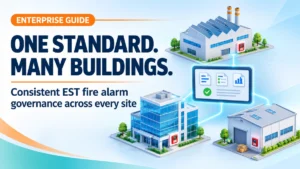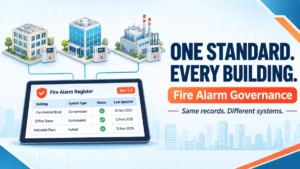
A central engineering team receives a request: compare fire alarm configuration across eight facilities, all running EST infrastructure. The answer takes weeks. One site names devices by floor and room, another by loop and address, a third by the contractor’s own shorthand. Some sites have configuration records in different formats, and nobody is sure which backup matches the live panel.
None of this means the systems are poorly engineered. Different contractors, project teams and maintenance staff worked without a shared governance framework. That gap is where enterprise fire alarm standardisation begins.
How Can Enterprises Standardise EST Fire Alarm Configuration Across Multiple Sites?
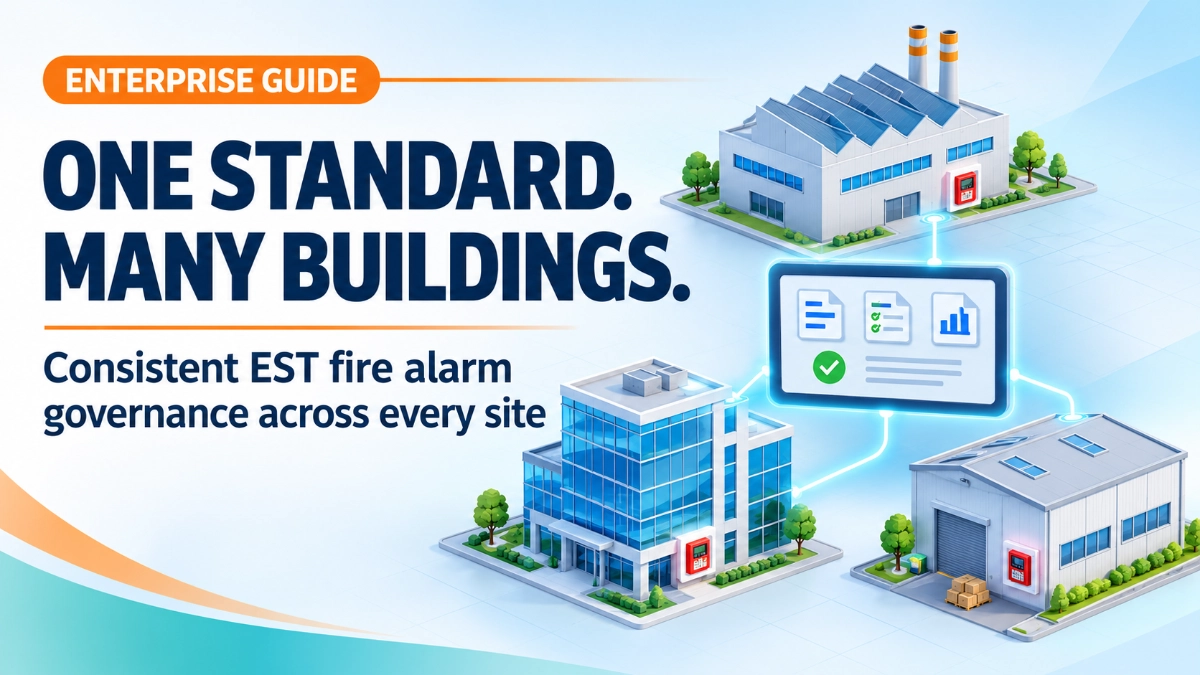
Enterprises standardise EST configuration by fixing the governance, not the design. Define common naming conventions, documentation templates, change-approval workflows, backup and version-control procedures, and testing-evidence formats. Then let each building keep its own device layout, detection strategy and cause-and-effect logic, validated against its occupancy, fire strategy and applicable requirements. Assess EST3 and EST4 environments individually, using current manufacturer documentation.
Why Multi-Site EST Fire Alarm Management Becomes Difficult
Most multi-site estates grow by accumulation: new builds, acquisitions, expansions, changes of tenant. Each adds another set of habits.
- Different installation and commissioning teams: Each team brings its own programming style. Years later, an engineer opening a panel database cannot tell whether an unusual arrangement was deliberate or accidental.
- Inconsistent naming and identification: When the same type of device is labelled differently across sites, event logs cannot be compared, and a fault report from one building cannot be read quickly by someone who knows another.
- Variable documentation: Some sites hold a full configuration record; others hold a commissioning certificate and little else. Central teams end up reconstructing information instead of using it.
- Different approval practices: If one site requires written authorisation for programming changes and another accepts a verbal request, the enterprise cannot demonstrate control.
- Uncontrolled change during building modifications: Partition changes, tenant fit-outs and equipment relocations alter the fire alarm configuration. Without a change trail, records drift away from reality.
- Difficulty comparing sites: Without common structures, benchmarking, audit preparation and upgrade planning all become manual exercises.
The consequence is operational: slower troubleshooting, higher risk of error during upgrades, and reduced confidence in what each panel is actually doing.
Standardisation Does Not Mean Identical Configuration
A warehouse with high racking, a hospital ward block and an office campus have different fire strategies. Copying one configuration across all of them would be an engineering error.
The distinction is between:
- Enterprise-wide standards: How information is named, recorded, approved and evidenced.
- Building-specific design: What is installed and where.
- Site-specific cause-and-effect requirements: What happens when a device activates.
- Local operational and occupancy conditions: Shift patterns, interfaces to other systems, and risk profile.
The table below is an illustrative governance framework, not a manufacturer-prescribed configuration standard.
| Enterprise-wide standards | Site-specific decisions |
|---|---|
| Naming conventions | Device locations |
| Documentation templates | Detection strategy |
| Approval workflows | Cause-and-effect requirements |
| Backup and version-control procedures | Building-specific programming |
| Testing evidence formats | Local operational interfaces |
Five Areas to Standardise Across EST Fire Alarm Sites
1. Device Naming and Identification
Set principles for how buildings, floors, zones, loops and devices are identified, for example, a fixed order of elements and a controlled abbreviation list. The structure is common; the location content remains site-specific. A good convention lets an engineer read a device reference and know where to go.
2. Configuration Documentation
Keep a structured record for each site: the approved configuration, revision history, recorded site-specific variations, and the people responsible. Use the same template everywhere so records can be compared. These fire alarm documentation standards matter most during audits, handovers and upgrades.
3. Programming and Change Approval
Define who may request, review, approve, implement and verify a configuration change, and keep those roles separate where practical. This is the core of fire alarm change control: every change has an owner, a reason, an approval and a verification record.
4. Backup and Version Control
Controlled backups, clear revision history, managed access and recovery readiness all matter. However, holding a backup does not prove it is complete, current or restorable. Validate backups periodically against the live system, using the procedures in the applicable manufacturer documentation, and record the outcome.
5. Testing and Verification Records
Standardise how evidence is captured and reported, so results look the same across the estate. But each site’s actual functions must still be tested individually. A common report format never substitutes for verifying that a particular building’s alarm, cause-and-effect and interface functions work as designed.
How to Maintain Configuration Consistency Across EST3 and EST4 Environments
Many enterprises run a mixture of older and newer platforms. Governance practices can span both, but engineering decisions cannot be assumed to.
Before applying a common framework, assess for each site the installed platform, approved configuration, system architecture, available documentation and site-specific requirements. Legacy and newer environments may differ in their records, tools and support arrangements, so each needs platform-specific engineering review.
Key cautions:
- Do not assume practices are interchangeable: A workflow that suits one platform may not suit another.
- Validate before migrating: Any migration or standardisation project needs technical validation by qualified engineers.
- Verify compatibility first: Check current manufacturer documentation and confirm compatibility before changing hardware, software or configuration.
- Do not rely on assumptions: This article makes no claims about EST3 or EST4 specifications, compatibility or migration procedures; confirm these with the manufacturer.
For product-level information, engineers can review EST3 and EST4 Panels when scoping extensions or upgrades.
Building an Enterprise EST Configuration Governance Framework
A workable model has eight components:
- Central engineering ownership of standards and templates.
- Site-level technical responsibility for day-to-day accuracy.
- Approved configuration baselines for every site.
- Change request and approval procedures applied uniformly.
- Revision tracking for all records.
- Backup management with periodic validation.
- Periodic configuration reviews, comparing live systems to baselines.
- Testing and closure evidence retained for every change.
An illustrative allocation of responsibility:
| Activity | Central engineering | Site facility team | Authorised service/integration partner |
|---|---|---|---|
| Standards and templates | Owns | Follows | Follows |
| Change request | Reviews | Raises | Advises |
| Change approval | Approves | Endorses | Does not approve |
| Implementation | Oversees | Coordinates access | Executes |
| Backs up and records | Audits | Maintains | Supplies updates |
| Testing evidence | Reviews | Witnesses | Produces |
Adapt this to your organisation and contractual arrangements.
A Practical Example: Standardising EST Configuration Across Three Facilities
This is a hypothetical illustration, not a real Innxeon customer project.
An organisation operates three sites:
- Site A: An established manufacturing facility on an older EST environment.
- Site B: A modern commercial facility on an EST4 environment.
- Site C: A warehouse with a different occupancy and operational layout.
The central team introduces four common practices. First, a shared naming structure: each device reference follows the same element order, while the content reflects each building. Second, one documentation template recording baseline, revisions and variations. Third, one approval workflow for all changes. Fourth, one testing-report format.
Device arrangement and programming stay different. Site A’s records may take longer to reconstruct, and its platform needs its own engineering review. Site B’s newer environment may allow easier record-keeping, subject to manufacturer documentation. Site C’s detection and cause-and-effect reflect warehouse risks, not office ones.
The result: the central team can compare baselines, track changes and prepare audits across all three, yet no site’s engineering was copied from another.
Enterprise EST Standardisation Checklist
Before starting or reviewing a programme, ask:
- Does every site have an approved configuration baseline?
- Are device identification and naming conventions documented?
- Are configuration changes formally authorised?
- Are revision histories traceable?
- Are backups controlled and periodically validated?
- Are site-specific variations recorded?
- Are testing records available after modifications?
- Are responsibilities clearly assigned?
- Are EST3 and EST4 environments reviewed according to their respective technical requirements?
Conclusion: Standardise the Governance, Not Every Building
Successful enterprise standardisation rests on consistent engineering governance, traceable configuration records, controlled changes and site-specific technical validation. The buildings stay different; the way you manage them does not.
Innxeon works as a technical distribution and project-support partner, helping system integrators, consultants and enterprise buyers evaluate requirements for EST fire alarm systems, including EST devices and detectors, and plan infrastructure. Organisations seeking an EST fire alarm system distributor in India can use that support during product selection and project planning.
Read Also: Fire Alarm Design Coordination With MEP Services: What Must Be Resolved Before Ceiling Closure?