Introduction: The Same Detector Does Not Suit Every Industrial Environment
A smoke detector performs reliably in an electrical room. Installed near a dusty production process, the same model generates repeated unwanted alarms, and operators start isolating it. Elsewhere, a detector above a hot process area was never checked against the area’s normal ambient temperature, so nobody can confirm it will respond as intended.
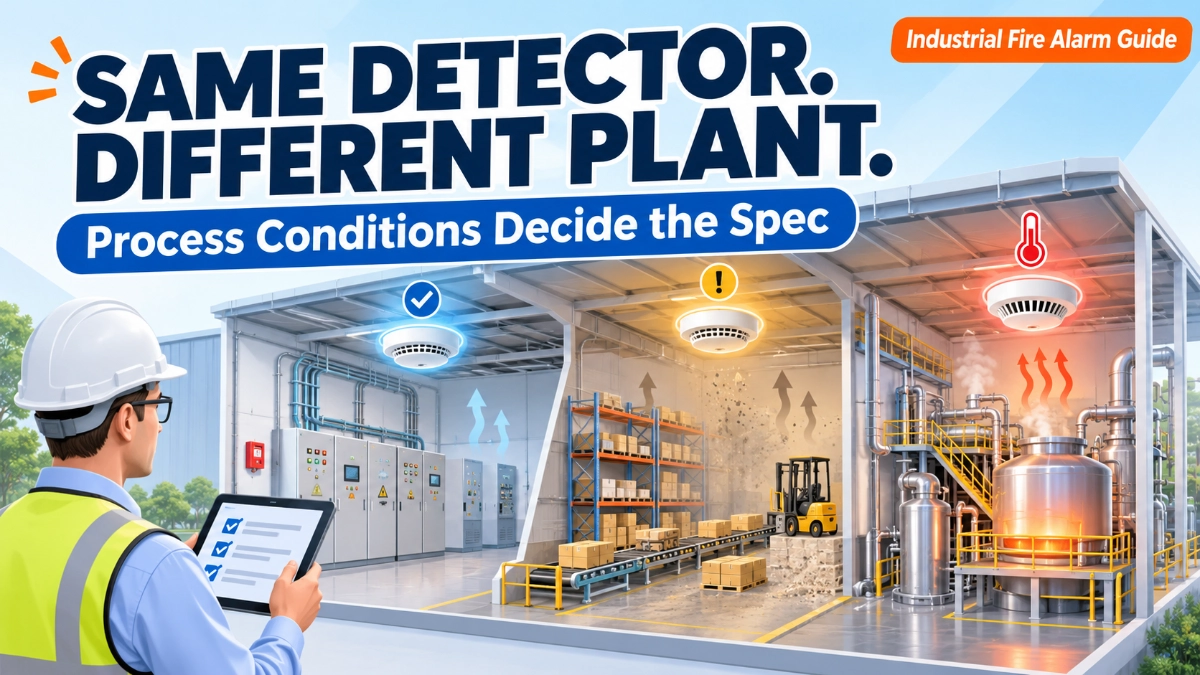
Both are specification failures, not product failures. One industrial building can contain clean rooms, dusty handling areas, steam-affected zones and hot process spaces, each placing different demands on a device.
Detector selection must weigh fire risk, process activity, environmental conditions, installation constraints, and maintenance strategy. Building type alone is not a defensible basis for an industrial fire alarm device specification.
How Should Industrial Fire Alarm Devices Be Selected?
Evaluate the expected fire signature, process conditions, ambient environment, airflow, mounting location, equipment suitability, system compatibility and maintenance requirements together. No single detector type suits every industrial area. Smoke, heat, multi-sensor and flame detection respond to different fire characteristics and tolerate different conditions. Final selection must follow the fire risk assessment, local codes, product approvals and manufacturer instructions, documented area by area rather than copied from another facility.
Why Industrial Process Conditions Change Fire Detection Requirements
Why does industrial fire alarm device selection depend on process conditions? Process conditions determine what a fire looks like, what “normal” looks like, and whether a device survives in service. Dust, heat, moisture and airflow affect response, unwanted alarm risk, accessibility and maintenance, so one device can suit one area and fail in another.
Which environmental factors affect fire detector performance? Airborne dust, ambient temperature, humidity, condensation, steam, corrosive vapours, oil mist, airflow, vibration, weather exposure and production changes. Actual impact depends on detector technology, product approval, installation conditions and manufacturer guidance. Environmental suitability and detection performance must be assessed separately.
| Process condition | Potential detection challenge | Specification consideration |
|---|---|---|
| Dust and oil mist | Contaminated sensing openings; unwanted alarms | Assess particle type; plan cleaning access |
| High temperature | Ambient approaching detector limits | Compare operating limits with normal and fire conditions |
| Steam, humidity, condensation | Droplets resembling smoke; moisture ingress | Review release points and environmental suitability |
| Corrosive atmosphere | Degraded housings and contacts | Verify chemical compatibility; plan replacement |
| Strong airflow, vibration, outdoor exposure | Diluted smoke; loosened mounts; weather impact | Locate by airflow; secure mounting; protect installation |
Understanding Different Fire Detection Device Types
When should engineers consider smoke detectors versus heat detectors? Consider smoke detection where early warning of smouldering or developing fires is needed, and the environment is acceptably clean. Consider heat detection where particles, steam or dust make smoke detection unsuitable, accepting slower response and sensing only temperature rise near the detector.
Smoke Detectors
Point-type photoelectric detectors sense smoke entering a chamber. Aspirating systems draw air through sampling pipes to a central detector, which can help where access or height is difficult. Both are affected by contamination, airflow and moisture.
Heat Detectors
Fixed-temperature units respond at a set threshold; rate-of-rise units respond to rapid temperature increase; combination units, where supported, use both. Response is later than smoke detection.
Multi-Sensor Detectors
Combined sensing, such as optical and thermal, may support detection decisions where conditions vary. It does not automatically eliminate unwanted alarms.
Flame Detectors
Flame detectors suit high-risk areas where open-flame fires are credible. They need line of sight, correct mounting and application-specific suitability; obstructions and contaminated optics reduce coverage.
| Detector type | Detection principle | Potential industrial application | Key selection consideration |
|---|---|---|---|
| Smoke | Particles in chamber or sampled air | Clean electrical rooms, warehouses | Contamination, airflow, moisture |
| Heat | Fixed temperature or rate-of-rise | Areas unsuitable for smoke detection | Slower response; ambient limits |
| Multi-sensor | Combined optical and thermal inputs | Variable environments | Product-specific performance |
| Flame | Radiation from open flame | Ignitable liquid handling | Line of sight; contamination |
These are considerations, not recommendations. Actual fire risk and product approvals decide. Where relevant, review Edwards SIGA Smoke Detectors and Edwards SIGA Heat Detectors against manufacturer documentation.
How Specific Process Conditions Should Influence Device Selection
How can dust and steam influence detector selection? Both produce particles or droplets that some smoke detectors may interpret as smoke, and both can contaminate or wet equipment. Detector behaviour differs by technology and product, so engineers should evaluate actual site conditions against manufacturer guidance.
Dusty Manufacturing and Material Handling Areas
Airborne dust can trigger unwanted alarms; accumulation can contaminate detector openings over time. Assess dust quantity, particle characteristics and process cycles, then confirm maintenance access. Do not default automatically to one technology.
High-Temperature Production Areas
Evaluate normal conditions and fire conditions separately. The detector must tolerate normal ambient temperature, fluctuations, local heat sources and equipment surface temperatures within its stated limits, and still respond to abnormal heat.
Steam, Humidity and Condensation
Steam releases, washdown and temperature swings can create droplets and ceiling condensation. Review release points, ventilation, and the device’s environmental suitability for wet conditions.
Corrosive or Chemically Aggressive Atmospheres
Chemical vapours and gases can degrade housings, contacts and sensing elements. Check material compatibility against the specific chemicals; enclosure protection alone does not prove chemical suitability. Plan inspection and replacement.
Strong Airflow and Ventilation
Supply, return and exhaust airflow can dilute or divert smoke before it reaches a detector. Plan locations around real airflow patterns, not geometric spacing alone.
Vibration and Heavy Machinery
Vibration can loosen mounts and fatigue cables. Specify stable mounting, secure terminations and periodic inspection of fixings.
Outdoor and Semi-Open Industrial Areas
Weather, wind, temperature variation, moisture, dust and impact act together. Evaluate environmental suitability and installation design as one decision.
Process Area vs Detector Type: Practical Selection Framework
An engineering starting point, not a final design specification.
| Industrial area | Typical environmental challenge | Detection options to evaluate | Important verification |
|---|---|---|---|
| Electrical room | Heat and electrical equipment risks | Smoke or other suitable detection | Fire risk and ventilation |
| Warehouse | Storage configuration, ceiling height | Suitable smoke or other approved detection | Storage arrangement and airflow |
| Dust-producing area | Airborne particles | Technologies suited to the actual environment | Dust characteristics, maintenance |
| Boiler or high-temperature area | Elevated ambient temperature | Suitable heat or application-specific detection | Ambient limits, fire scenario |
| Chemical process area | Corrosive atmosphere | Environmentally suitable detection | Chemical compatibility, approvals |
| Fuel handling area | Flammable liquid or gas fire | Application-specific flame or other detection | Hazard assessment, coverage |
Hazardous-area classification, process hazards, applicable standards and manufacturer instructions may impose additional requirements. Fire detection is not gas detection or explosion protection.
Why Detector Location Is as Important as Detector Selection
Why is detector placement important in industrial facilities? Detectors respond only to what reaches them. Ceiling height, beams, airflow, obstructions and equipment layout determine whether smoke, heat or flame is detected promptly, so a suitable device in a poor location can still perform badly.
Consider storage arrangements, maintenance access and production layout changes too.
Example: a suitable smoke detector mounted directly beneath a supply diffuser may see smoke diluted or diverted, delaying detection, while repeated airflow-driven nuisance conditions invite isolation.
What Should an Industrial Fire Alarm Device Specification Include?
What should be included in an industrial fire alarm device specification? Include area and process description, fire hazards, expected fire signature, environmental limits, detector technology, approvals, mounting, addressing compatibility, maintenance access and commissioning requirements. Establish these before finalising device schedules and procurement.
- Area and process description
- Identified fire hazards
- Expected fire signature
- Environmental conditions
- Normal and maximum ambient temperature
- Humidity and condensation exposure
- Dust or airborne contamination
- Corrosive exposure
- Airflow and ventilation
- Detector technology and principle
- Applicable product approvals
- Mounting and installation
- Addressing and system compatibility, including the addressable fire alarm system
- Maintenance and inspection access
- Testing and commissioning
Common Mistakes in Industrial Detector Selection
| Mistake | Potential consequence | Better approach |
|---|---|---|
| Selecting by building type only | Mismatch with area conditions | Specify area by area |
| Ignoring process conditions | Unwanted alarms, impaired response | Survey actual conditions |
| Smoke detection without contamination review | Nuisance alarms, isolation | Assess airborne contamination |
| Ignoring normal ambient temperature | Unsuitable operation | Check manufacturer limits |
| Overlooking airflow | Delayed detection | Plan around air movement |
| Equating enclosure rating with chemical compatibility | Premature degradation | Verify material compatibility |
| Ignoring maintenance access | Neglected devices | Design for access |
| Copying another facility’s schedule | Hidden mismatches | Reassess each site |
| Skipping reassessment after process changes | Outdated coverage | Review on change |
| Choosing on purchase price alone | Higher lifecycle cost | Compare suitability and maintenance |
Practical Example: Detector Specification for a Mixed-Use Manufacturing Facility
Illustrative engineering scenario, not a design recommendation.
- Electrical room. Clean and stable. The team confirms fire scenarios, ventilation and room airflow, then evaluates suitable detection and mounting away from supply air.
- Dusty material handling area. The team characterises dust, process cycles and cleaning practice, evaluates candidate technologies against manufacturer guidance, and confirms that detectors are reachable for maintenance.
- High-temperature process area. The team records normal and maximum ambient temperature, local heat sources and fire scenarios, then verifies operating limits and response suitability before selecting any device.
Final selection waits for approvals, local codes, fire risk assessment and manufacturer data. Explore Industrial Fire Protection Solutions for wider context.
Industrial Fire Alarm Device Selection Checklist
- Process conditions documented
- Fire hazards identified
- Environmental conditions assessed
- Detector technology evaluated
- Manufacturer operating limits checked
- Product approvals reviewed
- Installation location assessed
- Maintenance access considered
- System compatibility verified
- Drawings and schedules updated
- Commissioning requirements defined
Key Takeaways
- Process conditions, not building type, drive selection.
- No detector technology is universally best.
- Assess normal and fire conditions separately.
- Suitability and performance are different questions.
- IP ratings do not prove chemical compatibility.
- Location matters as much as device choice.
- Design for maintenance access.
- Reassess after process changes.
Read Also: Value Engineering in ELV Projects: How to Reduce Cost Without Compromising System Performance