
The Surveillance Shift in India
Imagine you’re managing a 40,000 sq. ft. warehouse in Noida’s Sector 63. Your traditional CCTV system records everything on a local NVR but last week, a theft happened at 3 AM and by the time you arrived the next morning, the footage had already been overwritten. You couldn’t check it from home. You couldn’t even get an alert.
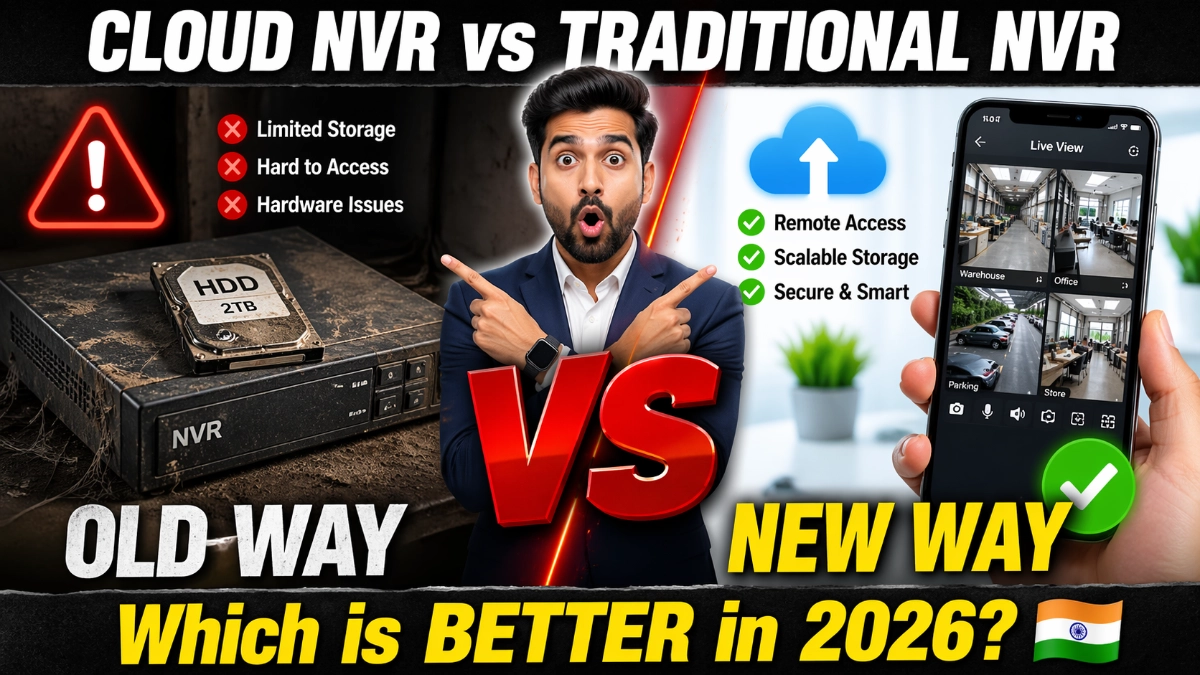
Now imagine a different scenario: you get a motion alert on your phone at 3:07 AM, pull up the live feed from your bed and have crystal-clear footage backed up on cloud storage before you even call security. That’s the difference Cloud NVR is making for businesses across India in 2026.
The CCTV surveillance market in India is undergoing a fundamental shift. Businesses in Delhi NCR, Mumbai, Bangalore and industrial hubs like Pune, Ludhiana and Coimbatore are increasingly asking: Should I stick with my traditional NVR setup, or switch to Cloud NVR?
This guide breaks down everything you need to know without technical jargon so you can make the right call for your specific business in 2026.
What is a Traditional NVR?
A Traditional NVR (Network Video Recorder) is a hardware device that records and stores video footage from IP cameras locally on internal hard drives. It works on your local network and does not require an internet connection for basic recording.
The traditional NVR has been the backbone of IP camera surveillance for over a decade. Your IP cameras send footage over your local network (LAN) to the NVR box, which processes and stores it onto hard drives housed inside it.
Commonly Used In:
- Factories and industrial units where internet connectivity is unreliable
- Banks, government offices, and compliance-heavy environments that mandate local storage
- Large campuses with 32 to 128+ cameras and high storage volume needs
- Locations where recurring cloud subscription costs are not preferable
Traditional NVRs typically support 4 to 128+ camera channels and use HDDs from 1TB to 20TB+. Brands like Honeywell dominate this segment in India.
What is a Cloud NVR?
A Cloud NVR is a surveillance solution where video footage is recorded and stored on remote cloud servers instead of local hardware. IP cameras upload footage directly to the cloud and users can access live feeds and recordings from anywhere through a mobile app or web browser.
Think of Cloud NVR as “NVR as a Service.” Instead of a physical box in your server room, the recording and storage infrastructure lives in a data center managed by a cloud provider.
What Makes Cloud NVR Different:
- No physical recorder required — cameras connect directly to the cloud
- Footage is accessible 24/7 from any device, anywhere in the world
- Storage scales automatically — add cameras or increase retention without buying new hardware
- SaaS-based subscription model — monthly or annual plans, just like Zoho or Netflix
- AI-powered features — facial recognition, object detection and crowd monitoring often built in
In 2026, leading cloud surveillance platforms in India include AWS-backed systems, Azure-integrated solutions and homegrown platforms compliant with India’s DPDP Act 2023.
4. Cloud NVR vs Traditional NVR: Key Differences
Complete side-by-side comparison for Indian businesses in 2026:
| Parameter | Cloud NVR | Traditional NVR |
| Storage Location | Remote cloud servers (data centers) | On-premise HDDs / NAS devices |
| Remote Access | Seamless — any device, anywhere | Possible but needs port-forwarding setup |
| Initial Setup Cost | Low to moderate (no recorder hardware) | Higher — NVR unit + HDDs + installation |
| Ongoing Cost | Monthly subscription (OPEX) | Low after initial investment (CAPEX) |
| Scalability | Instant — add cameras in minutes | Requires hardware upgrade each time |
| Internet Dependency | High — needs stable broadband | Low — works fully offline |
| Maintenance | Minimal — managed by cloud provider | Regular HDD checks & firmware updates |
| Data Security | Encrypted; cyber-attack surface exists | Physical theft risk; no internet attacks |
| Disaster Recovery | Excellent — safe even if hardware stolen | Data lost if NVR stolen or damaged |
| AI & Analytics | Built-in on most platforms | Needs extra hardware/software |
| Multi-location Mgmt | Unified dashboard for all sites | Separate systems per location |
| Best For | Retail chains, SMBs, multi-branch | Factories, banks, govt, large camera counts |
Pros and Cons of Cloud NVR
Advantages
- Access live and recorded footage from any smartphone or laptop, anywhere
- No physical NVR to maintain, replace, or upgrade
- Footage is safe even if cameras or premises are physically compromised
- Scale from 4 to 400 cameras instantly without touching hardware
- Real-time alerts via push notification, SMS, or email
- AI analytics, people counting, intrusion detection, facial recognition often included
- Easy multi-site management from a single unified dashboard
- Lower upfront investment, ideal for startups and SMBs
Disadvantages
- Requires reliable high-speed internet, risky in Tier-2/3 cities
- Monthly subscription costs add up significantly over 3 to 5 years
- Data privacy concerns if cloud server is hosted outside India
- Dependent on cloud provider’s uptime and SLA
- High-resolution 24/7 footage needs significant upload bandwidth
- Not suitable for highly classified or compliance-heavy environments
Pros and Cons of Traditional NVR
Advantages
- Works 100% offline, no internet needed for recording and playback
- One-time CAPEX investment with very low recurring costs
- Full control over data, everything stays on your premises
- Preferred in factories, manufacturing plants, and regulated industries
- Supports very high camera counts (32 to 128+) cost-effectively
- No bandwidth consumption for cloud upload
- Proven, mature technology with wide integration support
Disadvantages
- Footage permanently lost if NVR is stolen, damaged, or destroyed
- Remote access setup is complex and often unreliable without IT help
- Harder to scale, requires new hardware for every expansion
- HDDs fail without warning, regular replacement adds cost
- No real-time alerts or smart analytics without extra investment
- Very difficult to manage and audit across multiple locations
Which is Better for Different Use Cases in India?
The right choice depends on your business type, location, budget and operational priorities:
| Business Type | Best Choice | Why |
| Small Shops & Retail | Cloud NVR | Easy remote monitoring, theft alerts, no on-site IT needed. Low upfront cost suits retailers in Delhi, Mumbai, Bangalore. |
| Warehouses & Logistics | Hybrid (Cloud + Local) | Local NVR for uninterrupted recording + cloud backup for critical zones. Ideal for hubs in Bhiwandi or Manesar. |
| Factories & Industrial | Traditional NVR | Limited internet, 60-128+ cameras. Traditional NVR is cost-effective and internet-independent for Pune, Chennai, Rajkot. |
| Multi-Location Business | Cloud NVR | Unified dashboard, centralized management. No on-site technician needed at every branch. |
| IT Parks & Tech Offices | Cloud NVR | High-speed fibre available. Integrates with access control and visitor management systems. |
Cost Comparison in India — 2026 Pricing (16 Cameras)
| Cost Component | Cloud NVR | Traditional NVR |
| Hardware (cameras + recorder) | Rs. 60,000 – Rs. 90,000 (cameras only, no NVR needed) | Rs. 90,000 – Rs. 1,50,000 (cameras + NVR + HDDs) |
| Installation Cost | Rs. 8,000 – Rs. 15,000 | Rs. 12,000 – Rs. 25,000 |
| Monthly Subscription | Rs. 3,000 – Rs. 8,000/month (30-day retention, 16 cameras) | Rs. 0 – Rs. 500/month (optional cloud backup only) |
| 3-Year Total Cost (approx.) | Rs. 1,90,000 – Rs. 3,80,000 | Rs. 1,10,000 – Rs. 1,80,000 |
| HDD Replacement (3 yr) | Not applicable | Rs. 8,000 – Rs. 20,000 expected |
Key Insight: Traditional NVR is cheaper over 3 to 5 years for static, high-camera-count setups. Cloud NVR suits businesses that prefer predictable monthly costs and need scalability.
Pro Tip: GST-registered businesses can claim ITC on surveillance equipment purchases. Traditional NVR hardware qualifies more cleanly than cloud subscriptions. Consult your CA.
Security & Data Privacy — Which is Safer in 2026?
Both have distinct risk profiles. Cloud NVR faces cyber threats; Traditional NVR faces physical risks. A Hybrid approach provides the strongest security posture for Indian businesses in 2026.
Cloud NVR Security
Reputable providers use AES-256 encryption for data in transit and at rest. However, account hijacking and API vulnerabilities are real risks. Under India’s DPDP Act 2023, choose cloud providers with Indian data centres, AWS Mumbai, Azure India, or domestic providers, to meet data localization norms.
Traditional NVR Security
Local NVRs are air-gapped from the internet during recording, eliminating cloud-based attack vectors. However, physical theft of the NVR is a serious risk, a burglar who steals the NVR also destroys your evidence. Many businesses also run default passwords on remote access ports, creating easy network intrusion targets.
Internet Dependency — A Real Indian Challenge
A single 4MP camera at 25fps needs 4 to 8 Mbps upload bandwidth. A 16-camera setup needs 64 to 128 Mbps stable upload, not available at most Indian industrial premises outside metros.
Practical Solutions Available in 2026:
- Edge Recording + Cloud Backup: cameras record locally and only upload clips to cloud. Saves up to 85% bandwidth.
- Hybrid NVR Systems: local NVR with automatic cloud sync during off-peak hours (2 to 6 AM).
- Motion-Triggered Cloud Upload: upload only when motion is detected, reduces bandwidth use dramatically.
- 4G/5G Backup Links: secondary SIM-based connection for critical premises in case fibre goes down.
Traditional NVR remains the safer bet for any location where internet reliability cannot be guaranteed, which still covers a significant portion of industrial India.
Future Trends: AI, Hybrid & Beyond (2026 and Beyond)
AI-Powered Video Analytics (AIoT)
Both Cloud and Traditional NVR platforms are integrating AI but cloud has a significant edge. Real-time person detection, license plate recognition, heatmaps and behavior analytics are now standard in cloud platforms. For factories in Pune or warehouses in Gurugram, AI alerts are reducing incident response time from hours to seconds.
Hybrid NVR — The Rising Middle Ground
The fastest-growing segment in India’s surveillance market. Hybrid systems combine local NVR recording (for reliability and cost) with selective cloud sync (for remote access and backup). Most leading brands now offer hybrid-ready NVRs straight out of the box.
5G & Edge Computing Enabling True Cloud Surveillance
With India’s 5G rollout accelerating in 2025 to 2026, bandwidth constraints are easing. Reliance Jio and Airtel’s enterprise 5G packages are making cloud-first surveillance viable even outside metro areas.
Regulatory Push Toward Secure & Compliant Storage
The DPDP Act 2023 and upcoming amendments are pushing businesses to maintain documented data retention policies for surveillance footage. Cloud platforms with automated compliance features, retention schedules, audit logs are increasingly preferred by corporate and compliance teams.
Expert Recommendation: What Should You Choose in 2026?
For most Indian businesses in 2026, a Hybrid NVR approach is the smartest investment.
It gives you the offline reliability of local storage, the remote access convenience of cloud, the disaster recovery safety net of off-site backup and the flexibility to scale without betting everything on a single technology.
| Business Profile | Recommended Solution |
| Small to mid-sized business with good internet connectivity | Full Cloud NVR |
| Large factory or industrial plant with 60+ cameras and unreliable internet | Traditional NVR |
| Warehouse, logistics hub, or growing business | Hybrid NVR (Cloud + Local) |
| Retail chain or multi-branch enterprise | Cloud NVR with centralised dashboard |
| Government, bank, or compliance-heavy environment | Traditional NVR with optional cloud backup |
Read Also: Best STQC-Compliant CCTV Cameras for Commercial Use in India
Read Also: Why More Indian Businesses Are Upgrading to Smart CCTV