Choosing a CCTV camera isn’t simply a choice between a bullet-shaped camera and a dome-shaped camera. The right decision depends on what the system needs to detect, how much detail operators must capture, the installation environment, lighting conditions, and the level of protection required.
A camera that works well at a warehouse entrance may not deliver the same results in a retail store, parking area, production facility, or office corridor. Even cameras with similar resolutions can produce very different results because of their lens, field of view, mounting position, lighting performance, and scene coverage.
The best CCTV camera is the one that reliably performs the required surveillance task, not necessarily the one that looks better or has more megapixels.
This guide explains how engineers, security consultants, system integrators, and facility managers can select bullet and dome cameras according to real-world surveillance requirements.
When Should You Choose a Bullet or Dome Camera?
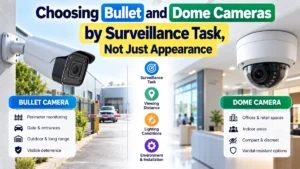
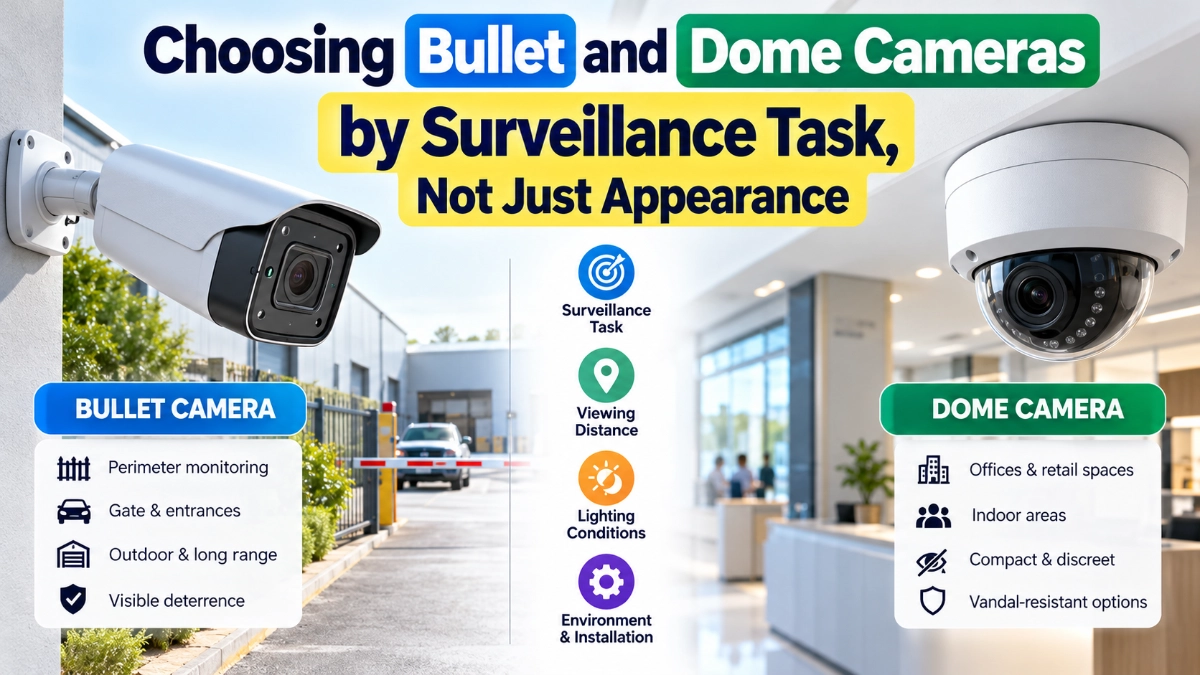
Choose a bullet camera when you need a clearly visible camera, directional coverage, or monitoring along a defined route, such as a boundary wall, driveway, loading bay, or warehouse perimeter.
Choose a dome camera when you need a compact installation for indoor spaces, retail environments, reception areas, corridors, or locations where a lower-profile design is preferred. A properly rated vandal-resistant dome can also suit areas exposed to physical interference.
However, neither camera type automatically delivers better image quality, wider coverage, or stronger night vision. Those capabilities depend on the specific model, lens, sensor, illumination, environmental rating, and installation.
1. Start With the Surveillance Task
Before comparing camera designs, define what the surveillance system must achieve.
Security teams generally need cameras to perform one or more of these tasks:
- Detection: Determine whether a person or vehicle is present.
- Observation: Understand activity, direction of movement, or general behaviour.
- Recognition: Determine whether a person or object matches something already familiar.
- Identification: Capture sufficient detail to establish identity or distinguish a specific subject with reasonable confidence.
These tasks require different levels of image detail.
For example, a camera monitoring a large parking area may only need to detect vehicles entering the premises. A camera monitoring a payment counter may need enough detail to document transactions or distinguish individuals.
A wide-angle camera may cover a large area but show limited detail on a distant face. A narrower view may capture more detail in one location while leaving other areas uncovered.
Engineering principle: Define the required outcome first, then select the camera, lens, mounting position, and recording configuration.
2. When Bullet Cameras Make More Sense
Bullet cameras typically feature an elongated housing and a clearly defined viewing direction. Their shape makes them useful for applications where the surveillance area follows a particular route or direction.
Perimeter and boundary monitoring
Bullet cameras are commonly considered for boundary walls, fences, gates, and external access roads.
Their directional appearance can also make surveillance more visible to people entering a controlled area. This may support a deterrence strategy, although visible cameras alone cannot guarantee prevention of theft or trespassing.
Warehouses and loading bays
Warehouses often contain vehicle routes, loading docks, dispatch gates, and material movement areas.
A bullet camera with a suitable lens can monitor a particular loading bay or vehicle approach. Engineers should check the expected distance, target size, lighting, and mounting height before selecting the lens.
Outdoor surveillance
Many bullet models include weather-resistant housings and features designed for outdoor installation. However, engineers should verify the individual product’s IP rating, operating temperature, corrosion resistance, and suitability for the actual environment.
A camera’s shape alone does not confirm that it can withstand rain, dust, heat, or industrial conditions.
Long, defined viewing areas
A suitable bullet camera may work well when the objective is to monitor a relatively narrow field, such as a driveway or access lane.
However, not every bullet camera has a long-range lens. Some models use wide-angle lenses, so engineers must review the actual lens specifications rather than assume the housing determines the viewing distance.
3. When Dome Cameras Make More Sense
Dome cameras use a rounded housing that can provide a compact appearance and suit installations where equipment should blend into the surroundings.
Offices and reception areas
Dome cameras are often suitable for reception desks, office entrances, meeting areas, and internal corridors.
Their compact form can fit neatly into ceilings or walls. Engineers should still assess the viewing angle to avoid blind spots created by partitions, furniture, and architectural features.
Retail stores and commercial interiors
Retail environments may require monitoring of aisles, entrances, billing counters, and customer movement.
A dome camera with an appropriate field of view can provide effective coverage without drawing excessive visual attention. However, wide coverage does not necessarily provide enough detail for identifying a person at a distant counter or aisle.
Areas with a risk of tampering
A vandal-resistant dome may be appropriate in public-facing areas, corridors, lifts, or other accessible locations.
Check the camera’s IK impact-protection rating where physical resistance matters. Not every dome camera is vandal-resistant, and a protective housing does not eliminate every risk of tampering.
Installations requiring a compact appearance
Dome cameras can suit locations where a smaller visual footprint is desirable.
However, engineers should consider lens adjustment, maintenance access, cleaning requirements, and infrared reflections before finalising the installation.
4. Bullet vs Dome Cameras: An Engineering Comparison
| Selection factor | Bullet camera | Dome camera |
|---|---|---|
| Typical applications | Perimeters, gates, driveways, loading bays | Offices, retail areas, corridors, reception spaces |
| Visual presence | Often more noticeable | Often more discreet |
| Viewing direction | Clearly defined by housing | May be less obvious to observers |
| Lens options | Vary by model | Vary by model |
| Outdoor suitability | Depends on product rating | Depends on product rating |
| Vandal resistance | Depends on housing and rating | Vandal-rated versions are available |
| Night performance | Depends on sensor and illumination | Depends on sensor, illumination, and dome design |
| Maintenance | Requires access to housing and lens | Dome cover may need regular cleaning |
| Best selection method | Match lens and protection to the task | Match lens, housing, and protection to the task |
This comparison describes common design tendencies, not universal rules. Always verify the specifications of the individual camera.
5. Match the Lens to the Required Viewing Distance
Lens selection is one of the most important steps in CCTV design.
A wide-angle lens covers more of a scene but spreads the available image detail across a larger area. A narrower field of view concentrates the image on a smaller area and can provide more detail on distant subjects when the sensor and other conditions support it.
Consider two warehouse applications.
Application A: General warehouse overview
The security team needs to monitor vehicle movement and general activity across a large area. A wider field of view may be suitable.
Application B: Dispatch gate monitoring
The team needs to distinguish vehicle details at a specific entry point. A narrower field of view may be more appropriate, provided it captures the required area.
Engineers should evaluate the target distance, sensor resolution, lens focal length, pixel density, lighting, and subject movement.
Where identification matters, validate the camera’s performance at the actual mounting distance. Do not rely only on the megapixel rating.
6. Do Not Ignore Lighting and Night Vision
A camera that performs well in daylight may struggle at night.
Common challenges include:
- Poorly illuminated entrances
- Headlights shining directly into the lens
- Strong backlighting near windows
- Uneven lighting across a parking area
- Reflective floors or metal surfaces
- Infrared reflections from nearby objects
Bullet cameras may include a sunshield or an integrated illumination arrangement, depending on the model. Dome cameras can also provide effective night performance, but reflections from a dirty or poorly fitted dome cover may reduce image clarity when infrared illumination is active.
Engineers should check low-light sensitivity, wide dynamic range (WDR), infrared range where applicable, and the camera’s performance under the site’s actual lighting conditions.
Practical tip: Test day and night scenes before finalising camera placement. A specification sheet cannot fully represent every real-world lighting condition.
7. Consider the Environment Before Choosing the Housing
The installation environment can determine whether a camera remains reliable over time.
For outdoor installations, check:
- IP rating for protection against dust and water
- IK rating where impact resistance is required
- Operating temperature range
- Exposure to direct sunlight
- Corrosion risk
- Mounting stability
- Cable entry and sealing arrangements
For indoor installations, consider ceiling height, dust accumulation, cleaning access, lighting, and the risk of physical interference.
In industrial facilities, vibration, airborne particles, heat, and cleaning chemicals may influence camera selection. A camera designed for a typical office environment may not suit a demanding production area.
Choose the housing according to documented environmental requirements, not its appearance.
8. Think About the Complete CCTV System
Camera selection does not end with the hardware.
A well-designed surveillance system also depends on network capacity, recording settings, storage, interoperability, and maintenance.
Before deployment, verify:
- Camera resolution and supported frame rates
- Available video codecs and bitrate settings
- Network bandwidth and PoE requirements
- NVR compatibility
- Recording duration and storage capacity
- Remote viewing requirements
- Cybersecurity and access controls
- Firmware support and update procedures
For example, adding several high-resolution cameras to a warehouse may increase bandwidth and storage requirements. If the NVR or network cannot support the additional load, the system may experience recording gaps or reduced performance.
When evaluating Impact by Honeywell CCTV, consider the intended application and verify the specifications of the selected products against the complete system design.
For directional outdoor applications, compare the available Impact by Honeywell bullet cameras against the required lens, environmental protection, and viewing distance. For indoor commercial spaces, evaluate Impact by Honeywell dome cameras according to coverage, lighting, mounting, and protection requirements.
Likewise, assess Impact by Honeywell NVR’s against the required camera count, supported resolutions, recording capacity, storage duration, and network throughput. Confirm the current product specifications before finalising a design.
Organisations sourcing equipment can also consult an Impact by Honeywell distributor in India to check product availability and obtain relevant product information.
The objective is to build a compatible, reliable surveillance system, not simply select cameras with similar appearances.
9. Common Camera Selection Mistakes to Avoid
Even experienced teams can overlook practical factors when choosing CCTV cameras.
- Choosing by appearance alone: A compact camera may look appropriate but fail to capture sufficient detail at the required distance.
- Assuming more megapixels means better evidence: Resolution is only one factor. Lens selection, focus, lighting, compression, and camera placement also affect image usability.
- Ignoring mounting height: A camera mounted too high may capture the top of a person’s head rather than useful facial detail.
- Using one camera for too many tasks: A single wide-angle view may provide an overview but insufficient detail for identification.
- Ignoring nighttime conditions: Daytime testing may conceal problems caused by headlights, poor illumination, or infrared reflections.
- Overlooking recording requirements: A camera may produce excellent live video while the NVR lacks the capacity or configuration needed to retain useful recordings.
- Failing to test the actual scene: Reviewing a live view from the final mounting position helps reveal blind spots and image-quality issues before handover.
10. A Practical Camera Selection Checklist
Before approving a CCTV camera, answer these questions:
- What must the camera detect, observe, recognise, or identify?
- What is the distance between the camera and the target?
- How wide should the viewing area be?
- What lens or focal length suits the task?
- What lighting conditions will occur during the day and at night?
- Does the location require weather or impact protection?
- Can the mounting position provide useful image angles?
- Does the camera meet network and PoE requirements?
- Is the selected NVR compatible with the camera?
- Can the system store and retrieve footage for the required period?
- Has the camera been tested under realistic operating conditions?
This process helps engineers compare products objectively and explain their recommendations to clients, consultants, and project stakeholders.
Conclusion
Choosing between bullet and dome cameras should begin with the surveillance objective, not the camera’s shape.
Bullet cameras often suit directional monitoring, perimeter protection, and defined outdoor viewing areas. Dome cameras frequently suit indoor commercial applications, compact installations, and locations where a lower-profile design is preferred. Both types can serve other purposes when their specifications match the application.
The most reliable design considers the task, lens, field of view, lighting, environmental conditions, mounting position, network, and recording system together.
Choose the camera that captures the evidence you need under real operating conditions. That is a better engineering decision than choosing by appearance or megapixels alone.
Read Also: AI CCTV False Positives: How Engineers Can Investigate Alerts
Read Also: CCTV Camera Selection by Task: Detection, Observation, Recognition or Identification?