Choosing a CCTV camera is not just about megapixels, lens size, or night vision. The right camera must capture enough detail to support the task it is expected to perform.
A camera installed to monitor a warehouse entrance may need to identify individuals, while a camera covering a large parking area may only need to detect movement and observe activity. Using the same camera specification for both locations can create blind spots in the security design.
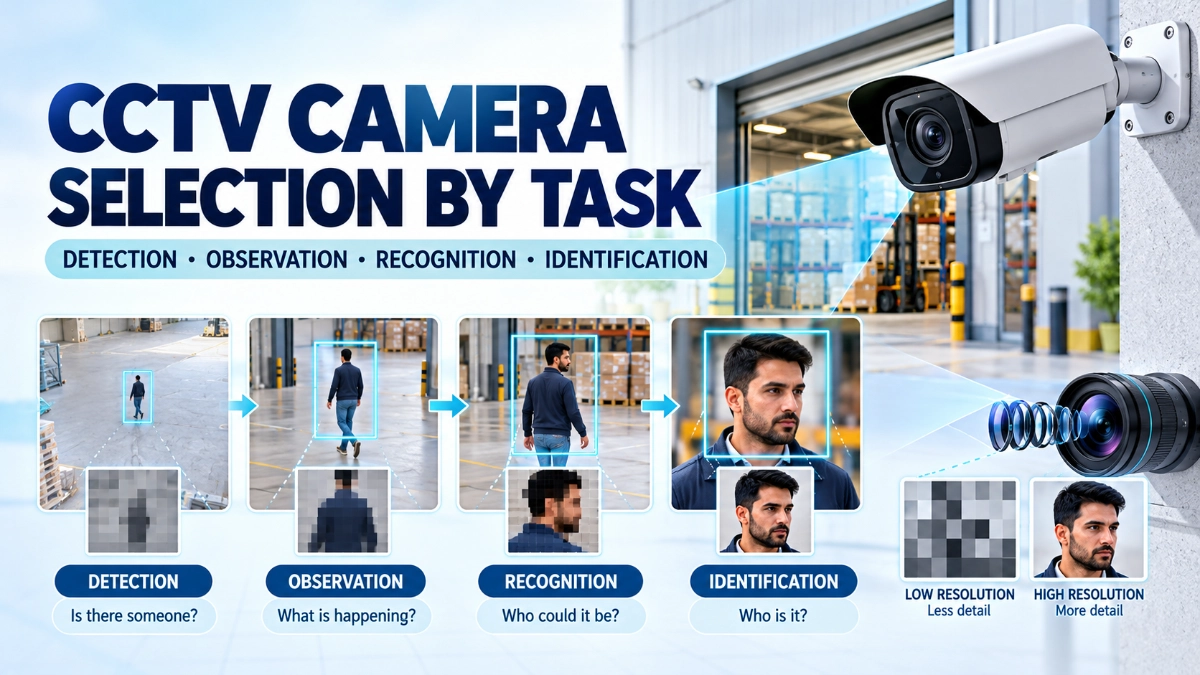
This is where DORI – Detection, Observation, Recognition and Identification becomes an important concept in CCTV system design.
DORI helps engineers define the level of visual detail required at a specific location. It provides a practical starting point for selecting camera resolution, lens, mounting position, and coverage.
In this guide, we explain how each DORI level works, how engineers can apply it to real-world installations, and what to check before selecting an IP CCTV camera.
What Are Detection, Observation, Recognition and Identification?
Detection, observation, recognition and identification describe four different levels of visual detail in video surveillance.
- Detection: Determine whether a person or object is present.
- Observation: Monitor activity and general behaviour.
- Recognition: Determine whether a person or object is familiar or matches a known description.
- Identification: Capture enough detail to support identifying a specific person or object.
Each level has a different purpose. Detection requires less detail than identification, which generally demands greater pixel density, better image quality and more careful camera positioning.
Engineers should define the required task before selecting a camera. This prevents a common design mistake: installing a high-resolution camera that still cannot capture useful evidence at the required distance.
1. What Is DORI in CCTV Camera Selection?
DORI is a framework used in video surveillance to describe the operational detail a camera should provide.
It helps translate a security requirement into practical camera-design decisions.
For example, consider a distribution centre with three security zones:
- A perimeter fence where operators need to detect movement.
- A loading bay where staff need to observe vehicle and personnel activity.
- An entrance where security staff need to identify individuals.
Each zone has a different operational requirement. Therefore, each may need a different camera position, lens, resolution or field of view.
DORI is associated with the IEC 62676 series of video surveillance standards. Pixel-density figures commonly used in traditional DORI guidance provide useful starting points, but engineers should verify the applicable edition of the standard and the manufacturer’s calculation method before finalising a design.
2. Detection: Is Something There?
Detection is the first level of surveillance detail.
At this level, the operator needs to determine whether a person, vehicle or other relevant object has entered a monitored area. The operator may not need to recognise the individual or identify specific features.
Typical applications include:
- Perimeter fences
- Large outdoor yards
- Open parking areas
- Warehouse boundaries
- Restricted zones
- General movement monitoring
For example, a camera covering a long industrial boundary may help operators identify movement near a fence. The objective is to detect activity and direct attention to the relevant area.
What should engineers consider?
Detection cameras often cover large areas, so field of view becomes an important design factor. A wide-angle lens can cover more ground, but it spreads the available pixels across a larger scene.
This creates a trade-off between coverage and detail.
A camera may show that someone is present without providing enough information to determine who the person is.
Use detection as the design target when the operational requirement is to identify the presence of an object or activity rather than capture detailed evidence of identity.
3. Observation: What Is Happening?
Observation provides more detail than detection. It helps operators understand activity, movement and general behaviour within a monitored area.
Typical applications include:
- Warehouse aisles
- Loading and unloading areas
- Factory floors
- Vehicle movement zones
- Building entrances
- Logistics and distribution centres
For example, a camera at a loading bay may allow an operator to observe whether a person is entering a restricted area, handling a package or moving around a vehicle.
However, observing an activity does not necessarily mean the footage can identify the person involved.
What should engineers consider?
Camera placement, viewing angle and scene lighting affect how well operators can interpret activity.
A camera mounted too high may show the top of a person’s head rather than useful facial detail. A camera facing strong sunlight may struggle to capture clear images of people entering the building.
For observation, engineers should assess the complete scene, including movement patterns, expected object size, lighting conditions and the operator’s viewing requirements.
4. Recognition: Does the Person or Object Look Familiar?
Recognition requires enough detail to distinguish a person or object from others or determine whether it matches a known description.
For example, an operator may need to distinguish between a uniformed employee and a visitor, or recognise a particular type of vehicle.
Typical applications include:
- Staff entrances
- Reception areas
- Building access points
- Vehicle entry lanes
- Restricted internal corridors
- Controlled warehouse access points
Recognition requires more visual detail than general observation.
The camera must capture useful features at the point where the person or object appears in the scene. Simply increasing resolution may not solve the problem if the subject remains too far away or the image is blurred.
What should engineers consider?
Review the distance between the camera and the subject, the available lighting, the angle of approach and the expected movement speed.
For example, a person walking quickly past a camera may produce less useful footage than a person standing briefly in front of it. Motion blur, poor exposure and an unsuitable viewing angle can reduce recognition performance.
Recognition should therefore be treated as a practical image-quality requirement, not just a resolution specification.
5. Identification: Can the Footage Support Identifying the Individual?
Identification is generally the most demanding of the four traditional DORI tasks.
The objective is to capture enough visual detail to support identifying a specific person or object in the recorded footage.
Typical applications include:
- Main building entrances
- Security checkpoints
- Cash handling areas
- High-security access points
- Vehicle entry and exit lanes
- Locations where incident evidence is important
For example, a camera covering a building entrance may need to capture clear facial features as individuals approach the door.
A wide-angle camera mounted far away might show the entire entrance but fail to capture sufficient facial detail. A dedicated camera positioned closer to the subject may deliver better results.
What should engineers consider?
Identification depends on more than the camera’s advertised resolution. Engineers should evaluate:
- Pixel density at the subject’s position
- Lens focal length
- Distance to the subject
- Mounting height and viewing angle
- Lighting and exposure
- Motion blur
- Image compression
- Recording quality
- Whether the subject’s face is visible
Identification also does not automatically mean that a video system can establish a person’s identity with certainty. Image quality, context and the verification process still matter.
6. DORI Comparison: Which CCTV Camera Task Do You Need?
The following table summarises the four traditional DORI levels and their common design targets.
| Task | Main objective | Example location |
|---|---|---|
| Detection | Establish presence | Perimeter fence |
| Observation | Understand activity | Warehouse floor |
| Recognition | Distinguish a familiar person or object | Staff entrance |
| Identification | Capture detail that supports identification | Main entrance |
Traditional DORI guidance associated with IEC 62676-4 commonly uses the following approximate pixel-density benchmarks:
| DORI level | Traditional benchmark |
|---|---|
| Detection | 25 pixels per metre |
| Observation | 62.5 pixels per metre |
| Recognition | 125 pixels per metre |
| Identification | 250 pixels per metre |
These figures are planning benchmarks, not guarantees of real-world performance. The applicable standard edition, camera specifications, test method and actual scene conditions can affect the requirements. Confirm the relevant criteria before using them for formal system acceptance.
7. How Resolution and Lens Selection Affect DORI
Camera resolution determines how many pixels are available across an image. However, the number of pixels that fall on a subject depends on how much of the scene the camera covers.
Consider two cameras with the same resolution.
One uses a wide-angle lens to cover a large warehouse floor. The other uses a narrower field of view to monitor a specific doorway.
The second camera may capture more pixels across a person’s face at the doorway, even though both cameras have the same megapixel rating.
This is why engineers should consider resolution and lens selection together.
Key factors to evaluate
Resolution: Higher resolution can provide more image detail, provided the subject occupies enough of the frame.
Lens focal length: A suitable focal length helps balance scene coverage with detail at the required distance.
Mounting position: Excessive height or an unsuitable angle can limit facial and object detail.
Lighting: Poor lighting can reduce image clarity, even when the camera has a high-resolution sensor.
Frame rate and shutter speed: Fast movement may require settings that reduce motion blur while maintaining appropriate exposure.
Compression and recording: Excessive compression or unsuitable recording settings can reduce useful detail.
Engineers should assess these factors at the actual target location rather than relying only on the manufacturer’s maximum resolution.
8. How to Apply DORI to Real-World CCTV Projects
A practical CCTV design begins with a task-based assessment.
Step 1: Divide the site into security zones
Identify entrances, exits, perimeters, loading bays, storage areas, corridors and restricted locations.
Step 2: Define the required task for each zone
Decide whether operators need to detect presence, observe activity, recognise a person or object, or capture sufficient detail for identification.
Step 3: Establish the target distance
Measure the distance between the proposed camera position and the point where the subject must be captured clearly.
Step 4: Select the lens and resolution
Choose a camera and lens combination that can deliver the required pixel density across the target area.
Step 5: Check environmental conditions
Assess day and night lighting, glare, weather exposure, movement speed, mounting constraints and possible obstructions.
Step 6: Verify the recording path
Confirm that the NVR or video management system supports the selected resolution, frame rate, codec and recording requirements.
Step 7: Validate the installation
Test the camera at the actual scene. Review recorded footage, not just the live preview, and confirm that the footage meets the intended task.
This process helps avoid both under-specification and unnecessary spending on resolution that the application does not require.
9. Does Camera Type Affect DORI Performance?
Yes, but camera type alone does not determine the result.
Bullet and dome cameras can both support different surveillance tasks. The correct choice depends on the lens, sensor, installation environment, mounting position and required coverage.
For example, Impact by Honeywell bullet cameras may suit applications where a directional camera form factor is appropriate, such as selected perimeter or outdoor monitoring locations. Impact by Honeywell dome cameras may suit entrances, corridors or indoor areas where a compact form factor is preferred.
When evaluating Impact by Honeywell CCTV, engineers should compare the specifications of individual models against the required DORI task rather than assume that a particular camera shape guarantees identification or recognition.
The recording system matters as well. Impact by Honeywell NVRs should be assessed for supported camera resolution, recording capacity, stream compatibility and storage requirements.
For projects sourcing equipment locally, an Impact by Honeywell distributor in India may help confirm current product specifications and availability for the intended application.
The engineering objective remains the same: match the equipment to the operational task and validate its performance at the installation site.
10. Common CCTV Camera Selection Mistakes
Engineers can avoid many design problems by checking for these common mistakes:
- Selecting cameras based only on megapixels.
- Using one camera specification for every zone.
- Choosing a wide field of view when identification requires greater detail.
- Ignoring night-time lighting and glare.
- Mounting cameras at unsuitable heights or angles.
- Assuming digital zoom can recover detail that the camera never captured.
- Overlooking NVR recording settings and storage capacity.
- Accepting a design without testing recorded footage.
The most important lesson is that a camera can provide an attractive live image and still fail to meet the site’s operational requirements.
Conclusion
The best CCTV camera is the one that delivers the required visual detail at the location where it matters.
Detection supports perimeter monitoring. Observation helps operators understand activity. Recognition provides more detail for distinguishing people or objects. Identification requires the highest level of visual detail among these four traditional tasks.
For engineers, the correct selection process starts with defining the security objective, measuring the target distance, choosing an appropriate lens and resolution, assessing lighting, and verifying recorded footage.
By applying DORI principles to each security zone, organisations can build surveillance systems that deliver useful evidence instead of simply installing cameras with higher megapixel ratings.
Read Also: CCTV Storage Calculations That Fail in Practice: Recording Days vs. Usable Evidence
Read Also: Fire Alarm Cybersecurity: What Changes When Safety Systems Become More Connected?