A facility alters its floor layout, and the fire alarm sequence serving the affected zone must follow. The programming edit looks simple. Yet the team still has to confirm which devices and approved cause-and-effect entries are involved, whether HVAC, BMS or PAVA interfaces depend on the sequence, what must be retested, and which records change afterwards.
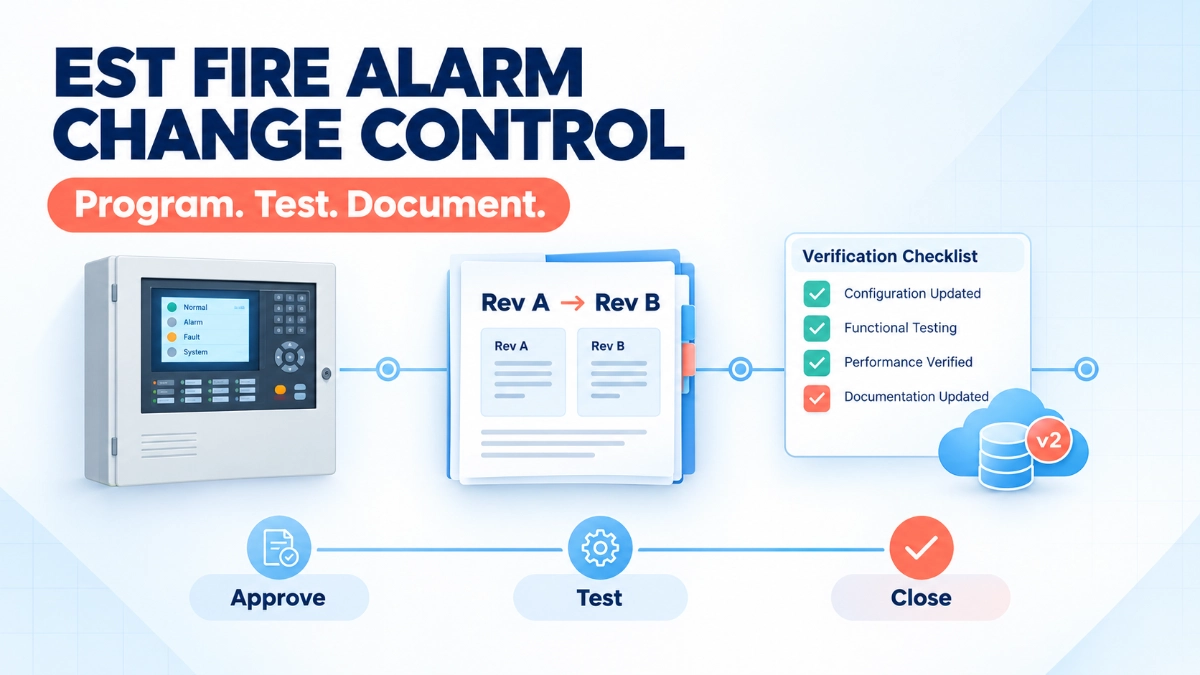
When programming, verification and records run as separate activities, small changes leave gaps: a drawing showing a sequence the panel does not execute, a configuration nobody can identify as the verified one, or a service team working from outdated information.
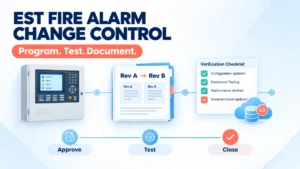
Not every modification is hazardous, and most do not touch the whole system. The controls required depend on the nature and potential impact of the change. The principle stays constant: effective change control connects the reason for a modification to its authorisation, implementation, verification evidence and updated records. This guide sets out a practical governance workflow for an EST fire alarm system.
EST fire alarm change control is a structured process for assessing, authorising, implementing, testing, documenting and closing changes to an installed system. It keeps approved design intent, actual configuration, verified functionality and maintenance records aligned, so later maintenance can rely on them. Post-change testing should follow the affected functions and their dependencies, not an arbitrary universal test list.
What Is Change Control in an EST Fire Alarm System?
A change passes through distinct stages that are related but not interchangeable:
- Proposed engineering change: A documented request, not yet approved.
- Approved design revision: Updated design intent.
- Programming modification: The configuration actually edited.
- Physical installation change: Devices, wiring or hardware altered on site.
- Verified and accepted change: Tested against expected behaviour and approved.
- Updated service record: Information passed to those maintaining the system.
A revised drawing does not prove the programming was updated, and completed programming does not prove the modified function was tested. This matters most in networked, multi-building and interface-rich addressable fire alarm system installations, where one edit can have consequences far from the panel being edited.
Which Changes Require Formal Review?
| Change Type | Example | Potential Impact | Review Consideration |
|---|---|---|---|
| Add or replace field device | Detector swapped after fit-out | Address, type and location mismatch | Confirm records match installed device |
| Change device ID or location records | Room renamed | Misleading event messages, schedules | Check labels, drawings, service data |
| Modify cause-and-effect logic | New zone output action | Altered outputs and dependencies | Review against approved matrix |
| Alter alarm or supervisory sequences | Revised delay or verification | Changed response behaviour | Engineering approval, AHJ input if applicable |
| Change BMS, HVAC, access, smoke control or PAVA interfaces | New release command | Receiving-system behavior | Coordinate with interface owner |
| Expand or modify network | Added building node | Networked functions | Assess system-wide dependencies |
| Change notification zoning or sequencing | Re-zoned sounders | Occupant notification coverage | Verify against approved design |
| Correct a configuration error | Wrong output mapping | Corrects, but may shift behaviour | Treat as a change, not a silent fix |
| Modify panel or system settings | Timing or operating parameters | Platform-wide effects possible | Follow manufacturer documentation |
| Update records after verified field change | As-built correction | Record accuracy only | Confirm the field change was itself verified |
Documentation-only corrections and functional configuration changes call for different review and verification. Authorisation and testing requirements depend on the approved design, manufacturer instructions, project procedures, applicable codes and the authority having jurisdiction (AHJ).
The EST Fire Alarm Change-Control Workflow
This is a recommended governance workflow, not a claim that every step is a manufacturer-mandated procedure.
| Stage | Required Action | Evidence or Record |
|---|---|---|
| 1. Identify and register | Record reason, location, originator, current condition and desired outcome; assign a unique reference | Change register entry |
| 2. Establish baseline | Gather approved drawings, device schedules, cause-and-effect matrix, configuration records and interface documents; verify the installed state where records may be outdated | Baseline record, site verification notes |
| 3. Assess impact | Identify affected devices, sequences, interfaces, buildings and dependencies beyond the edited component | Impact assessment |
| 4. Authorise | Obtain approval from the responsible engineer, integrator, consultant, commissioning team, client or facility representative as project governance requires | Signed approval |
| 5. Implement | Use authorised personnel, platform-specific procedures, controlled access and clear revision identification; coordinate with affected contractors | Implementation log, revision identifier |
| 6. Verify and test | Build a test scope from the impact assessment; compare expected and observed behaviour; record remaining issues | Test results, issue list |
| 7. Update records | Revise configuration references, drawings, schedules, cause-and-effect records, interface documents and test reports | Updated document set |
| 8. Back up and close | Identify the verified configuration state, preserve controlled backups, record limitations, obtain review and approval | Backup inventory, closure sign-off |
How to Assess the Impact of a Programming Change
Assess more than the component being edited. Ask:
- Which initiating devices or input conditions are affected?
- Which alarm, supervisory or fault sequences may change?
- Could notification behaviour or zoning be affected?
- Are BMS, HVAC, smoke control, access control or PAVA interfaces involved?
- Could networked functions or other buildings be affected?
- Do drawings, labels, schedules or maintenance instructions depend on the change?
- Which tests will show the intended behaviour is correct?
Illustrative example: changing an approved interface sequence may require verifying the initiating event, the expected local panel response, the relevant output or interface, the receiving system’s indication, and the associated event records where applicable. The exact scope depends on the actual architecture and approved sequence.
Post-Change Testing: What Should Be Verified?
| Modification | Potential Verification Focus | Evidence to Retain |
|---|---|---|
| Device replacement or addressing change | Correct address, type, location text, signal at panel, linked outputs | Device test record, updated schedule |
| Cause-and-effect modification | Each altered initiating condition and its outputs; unchanged neighbouring functions where dependent | Annotated matrix, test results |
| BMS interface change | Initiating event, panel response, interface output, BMS indication | Interface test sheet, event log |
| Notification sequence change | Activation order, zone coverage, audibility or indication as specified | Notification test record |
| Network expansion or topology change | Communication status, networked events, fault behaviour across nodes | Network test report, topology record |
| Documentation-only correction | Comparison against verified installed state | Reviewed document, correction note |
Checking an individual component is not the same as verifying the complete affected functional path, from initiating condition through panel logic to final output and indication. Plan testing from the change’s impact and the applicable acceptance requirements. Not every modification needs a full system retest, and testing only the edited item is not always enough.
Configuration Backups, Version Control and Documentation
Preserve traceability between the pre-change and post-change states:
- Identify the pre-change configuration record.
- Record the change reference and implementation date.
- Use clear revision and version identifiers.
- Control access to configuration files.
- Retain the verified post-change backup where the platform and approved procedures support it.
- Update drawings and schedules, and keep test and approval records.
- Record unresolved issues and operating restrictions.
| Record | Purpose | When to Update |
|---|---|---|
| Change register | Traceability of each change | At registration and closure |
| Approved drawings | Design intent and layout | After approved, verified changes |
| Device schedules | Address, type, location data | After device or ID changes |
| Cause-and-effect documentation | Approved logic | After logic changes |
| Interface matrix | Signals between systems | After interface changes |
| Test evidence | Proof of verification | After each test |
| Configuration backup inventory | Identifies verified states | After verified change |
| Service history | Maintenance context | When service team is informed |
| Handover records | Final project documentation | At handover, where relevant |
Do not assume every EST platform uses identical configuration tools, file formats, backup procedures or recovery methods.
EST3 and EST4: Why Platform-Specific Procedures Matter
Change-control principles apply across EST installations, but implementation must follow the installed platform and configuration. Whether the system is built on EST3 or EST4, verify:
- Installed platform, hardware and software versions
- Approved configuration tools and procedures
- Applicable manufacturer documentation
- Supported backup and recovery methods
- Device and interface compatibility, including EST detectors and devices
- Project-specific approval and testing requirements
Do not assume EST3 and EST4 share tools, file formats, network arrangements or migration procedures, or that configuration files and components are interchangeable, unless verified documentation says so. For wider context, see the EST Fire Alarm System overview and related fire alarm control panels.
Common Fire Alarm Change-Control Mistakes
| Mistake | Why It Creates Problems | Better Practice |
|---|---|---|
| Changing without a documented request | No traceable reason or approval | Register every change |
| Modifying before assessing dependencies | Unintended effects on interfaces | Complete impact assessment first |
| Using outdated drawings as baseline | Changes built on wrong assumptions | Verify installed state |
| Unclear programming access | Unrecorded edits | Define and log authorised access |
| Testing only the edited component | Missed functional-path faults | Test the affected path |
| Not retaining test evidence | Cannot demonstrate performance | File results against the reference |
| Unidentified or outdated backups | Uncertain recovery state | Label verified backups by reference |
| Updating drawings but not service records | Maintenance works from old data | Update both |
| Closing before verification is complete | False assurance | Close only with evidence |
| Not informing maintenance staff | Misread events and faults | Issue updated information |
Practical EST Fire Alarm Change-Control Checklist
- The change has a unique reference.
- The reason is documented.
- Approved baseline and actual installed condition were reviewed.
- Affected devices, sequences and interfaces are identified.
- Required approvals are obtained.
- Authorised personnel completed implementation.
- Verification scope reflects the assessed impact.
- Test results and unresolved issues are documented.
- Drawings and records are updated.
- Verified configuration state and backup records are identifiable.
- Technical review and acceptance are recorded.
- The service team has the updated information.
This checklist supports governance. It does not replace manufacturer instructions, commissioning procedures, statutory inspection or formal acceptance requirements. If sourcing is part of the change, a verified EST Fire Alarm System distributor in India can help with supply, but technical approval remains with the responsible engineers.
Key Takeaways
- Treat every functional change as a controlled event, not a programming task.
- Verify the installed baseline before editing.
- Assess dependencies beyond the edited component.
- Define who authorises and who implements.
- Control programming access and revision identifiers.
- Scope testing from impact, not habit.
- Verify functional paths, not just components.
- Keep identifiable pre- and post-change backups.
- Update drawings, schedules and service records together.
- Close only with traceable evidence and approval.
Read Also: Fire Alarm Deviations Register: How to Manage Unresolved Design and Site Issues Before Handover
Read Also: EST Fire Alarm Configuration Governance: Keep Records Aligned