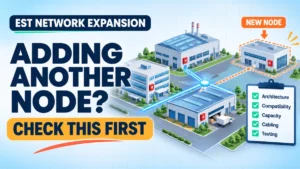
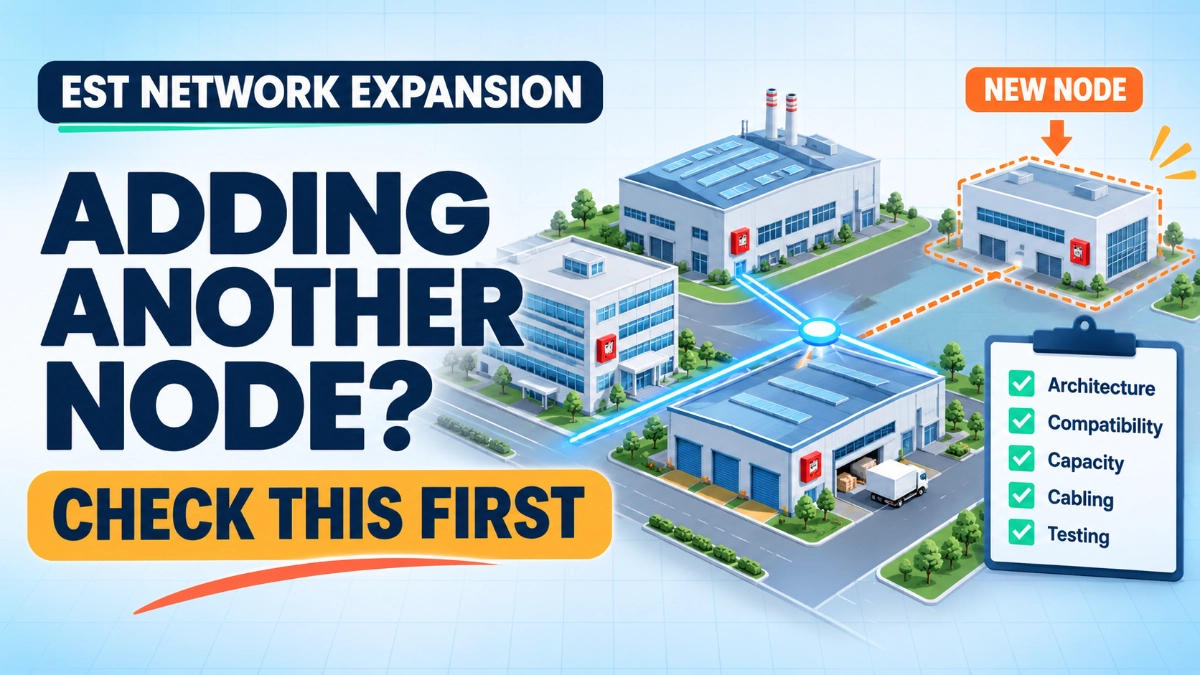
An industrial facility is adding a new production block. The existing EST fire alarm network already connects several buildings, and the project team plans to add another panel node. The physical connection may appear straightforward, but the real engineering work begins before the cable is connected.
Facilities expand their fire alarm networks because operations grow. New production lines, warehouses, and utility buildings all need life safety coverage that integrates with existing monitoring. Connecting a new building is more than a cabling task, though. A new node can change how events are reported, how operators see them, how faults are presented, and how maintenance teams isolate problems across the whole system.
Skipped evaluations tend to surface late, usually during commissioning and occasionally during a real event. Typical causes are configuration conflicts, communication limitations, inconsistent event visibility, incomplete cause-and-effect logic, and narrow testing. This guide covers what to evaluate first and how to verify the result.
Adding another node is not simply a connection exercise. It is a controlled change to an existing life safety system.
Before adding an EST network node, review the as-built network architecture, confirm panel and software compatibility against current Edwards documentation, and verify capacity for the actual system. Then approve the inter-building communication route and hardware, plan configuration and node identification, reassess cause-and-effect and event visibility, and define testing for the whole affected network. Update drawings, backups, and records at handover.
What Does EST Fire Alarm Network Expansion Actually Mean?
EST network expansion is the controlled process of adding a control panel, building, or node to an existing Edwards EST fire alarm network. It spans design review, configuration, physical installation, and functional testing, so the new node operates consistently with established event, monitoring, and control arrangements.
Four changes are often grouped but need different review depth:
- Adding addressable devices to an existing panel: mainly a loop and panel-configuration question. Network behaviour is largely unchanged.
- Adding another panel or node: changes network membership, addressing, and event routing.
- Extending physical communication infrastructure: introduces new routes, interface hardware, and environmental exposure.
- Modifying network architecture: alters topology or monitoring arrangements.
The last three affect existing nodes, not just the new one, so they warrant formal change control.
The 8 Critical Evaluations Before Expanding an EST Network
| Evaluation Area | What Must Be Checked | Risk If Ignored |
|---|---|---|
| Network architecture | As-built topology, node relationships, monitoring points | Node doesn’t fit approved design |
| Compatibility | Panel family, firmware/software, network interface | Unsupported combination |
| Capacity | Existing and proposed nodes against system-specific limits | Degraded or unsupported operation |
| Communication infrastructure | Route, medium, interface hardware, protection | Intermittent or lost communication |
| Configuration | Node ID, programming, backups, change control | Conflicts, lost baseline |
| Cause-and-effect | Event visibility, interfaces, response procedures | Incorrect or missing actions |
| Reliability | Fault monitoring, failure behaviour, impairment planning | Unmanaged outages |
| Testing and handover | End-to-end verification, records | Undetected defects, poor maintainability |
1. Existing Network Architecture
Document the current topology, panel locations, inter-building paths, and whether monitoring is centralised or distributed. Confirm the proposed node fits the approved architecture. Use current as-built drawings, not the original design. Years of modifications often leave them different.
2. Panel and Network Compatibility
Identify the existing panel family, hardware, firmware, and software versions, along with the approved network interface for the proposed node. EST3 and EST4 are not automatically interchangeable on one network. Support depends on the exact architecture and must be verified against current Edwards documentation.
3. Network Capacity and Expansion Limits
Compare existing nodes plus proposed additions against the limits documented for your specific system. Consider communication and processing load, and any planned future expansion. Nominal capacity is not proof of operational suitability, so confirm it against the real configuration and event traffic.
4. Communication Infrastructure Between Buildings
Review route, distance, approved medium, interface hardware, environmental conditions, cable protection, and surge protection, grounding, and isolation where applicable. Not every EST network supports every medium or topology. Evaluate the physical layer together with the logical design, since a sound configuration can still fail over a poorly protected route.
5. Configuration and Network Programming
Plan node identification and addressing, event reporting, and display requirements before programming. Secure a verified backup of the approved baseline first. Route every change through documented approval so the team can always return to a known-good configuration.
6. Cause-and-Effect and System-Wide Operations
A new node can affect alarm visibility, common alarm monitoring, supervisory and fault reporting, control interfaces, smoke control interfaces, emergency procedures, and operator workflows. Existing cause-and-effect logic is not automatically correct for the expanded facility. Reassess it against the new building.
7. Reliability, Fault Management, and Operational Continuity
Establish how the network responds if communication to the new building is lost, and what operators see. Plan fault isolation, maintenance access, and arrangements for protecting the existing system during planned impairment. Do not assume added redundancy. Rely only on what the approved design provides.
8. Testing, Commissioning, and Handover Requirements
Verify new-node communication, network event visibility, alarm, supervisory and fault reporting, control interfaces, cause-and-effect sequences, communication fault responses, and operator display identification. Testing must follow the approved design, applicable codes, manufacturer procedures, and the project commissioning plan. Hand over updated drawings and configuration records.
What Can Go Wrong When a New EST Node Is Added Without Proper Evaluation?
Without reviewing capacity and configuration, an expansion may operate outside supported limits, produce conflicting node settings, or show events inconsistently across displays. These are possible risks of skipped evaluation, not confirmed product defects, and not every expansion will experience them.
| Oversight | Possible Consequence | Preventive Action |
|---|---|---|
| Unsupported panel/software combination | Unreliable networking | Verify against Edwards documentation |
| Incorrect network configuration | Node conflicts, missing events | Baseline backup, peer review |
| Inter-building communication weakness | Intermittent loss of node | Approve route, medium, protection |
| Events not appearing where expected | Delayed operator response | Verify display and event routing |
| Cause-and-effect not updated | Incomplete system actions | Formal impact assessment |
| Inadequate fault monitoring | Silent communication loss | Test fault responses |
| Outdated drawings/backups | Difficult recovery | Update records before handover |
| Testing limited to the new panel | Faults elsewhere missed | Test the complete affected network |
Practical Example — Expanding an Existing EST Network to a New Production Building
This is an illustrative scenario, not a manufacturer-approved design or universal EST configuration.
A manufacturing facility operates a networked EST system serving its administration building, warehouse, and production block. A new production building is proposed, with an additional panel node.
- Review drawings and configuration: Confirm the as-built topology matches the approved configuration backup.
- Confirm compatibility: Verify the proposed panel, firmware, and network interface against current Edwards documentation.
- Evaluate capacity and communication: Check node count against system limits and assess the proposed inter-building route.
- Review new building requirements: Define alarm zones, interfaces, and monitoring needs.
- Assess existing impact: Identify changes to event display and cause-and-effect.
- Approve the change: Issue an implementation plan covering impairment arrangements.
- Install, configure, and test: Test the new node and affected existing nodes.
- Update records and hand over: Deliver revised drawings, configuration backups, and test records.
EST Network Expansion — Pre-Implementation Checklist
- Existing network drawings reviewed
- Current configuration backup secured
- Panel and software compatibility confirmed
- Network capacity verified
- Communication route and medium approved
- Node identification plan prepared
- Configuration changes documented
- Cause-and-effect impact assessed
- Existing system impairment risks evaluated
- Testing plan approved
- Stakeholders and responsibilities identified
- Updated as-built documentation included in handover
How to Keep an Expanded EST Network Maintainable
Use consistent naming and node identification. Keep topology drawings current, version-control configurations, and maintain a documented change history. Schedule periodic inspection and testing, assign clear responsibility for future modifications, and keep accurate service and fault records. Expansion is a lifecycle activity. The installation ends at handover, but the system’s configuration and records must stay accurate for years afterwards.
For sourcing and project planning, an experienced EST Fire Alarm System Distributor in India can help confirm product availability and technical documentation early. Compatibility should still be verified against Edwards documentation.
Key Takeaways
- Network expansion begins with engineering evaluation.
- Physical connectivity does not establish compatibility.
- Capacity must be verified against the actual architecture.
- Configuration changes can affect system-wide operations.
- Cause-and-effect requirements must be reassessed.
- Communication infrastructure deserves the same review as logical design.
- Testing must cover all affected network functions.
- Operational continuity during installation must be planned.
- Updated documentation is essential for future maintenance.
Read Also: Fire Alarm Deviations Register: How to Manage Unresolved Design and Site Issues Before Handover
Read Also: EST Fire Alarm Change Control: How to Manage Programming, Testing and Documentation