A fire alarm system rarely fails because the panel was weak. It fails because nobody planned for what happens after installation day.
Ask any facility manager who has lived through a building expansion, a renovation, or a merger of two wings into one campus. The panel usually still works. What breaks down is everything around it: the wiring topology, the addressable loop capacity, the way new devices were forced onto an old backbone.
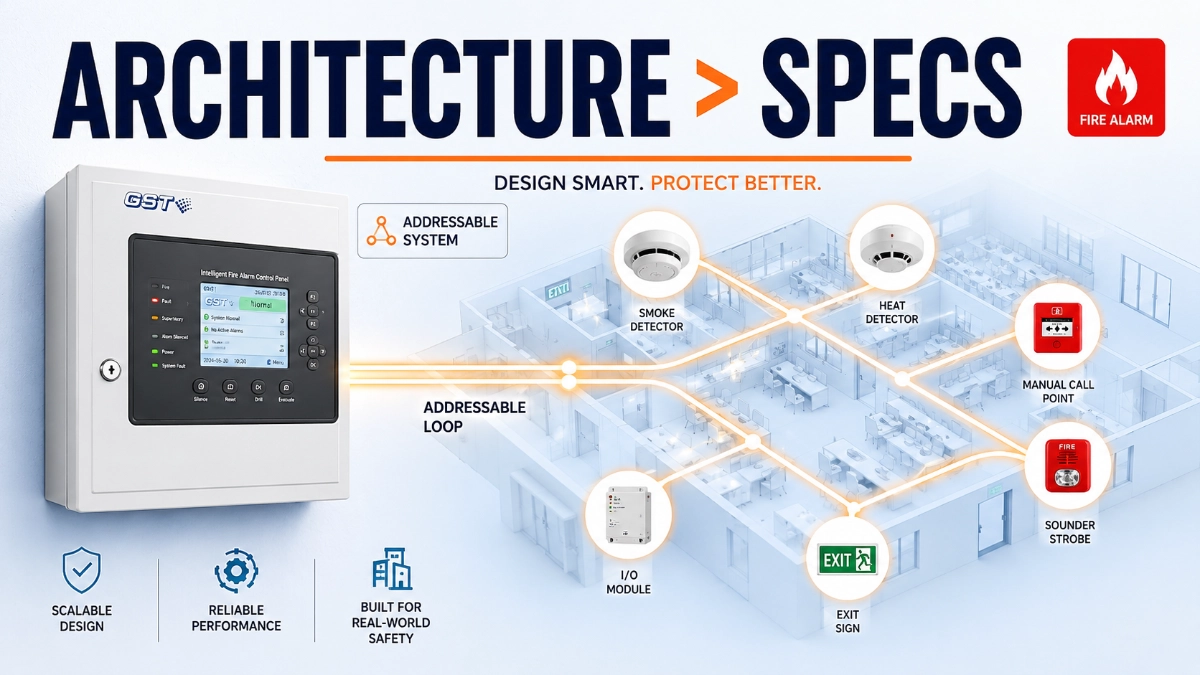
This is the part buyers overlook. Procurement teams compare panel brochures side by side, checking zone counts and display features, while the real question goes unasked: how well does this system grow, recover, and adapt over the next fifteen years?
That question has an answer, and it isn’t found on a spec sheet. It’s found in the architecture.
What Fire Alarm Architecture Really Means
Fire alarm architecture is the overall structural design of a fire detection and notification system: how panels, devices, networks, and control logic are organised to work together across a building or campus, not just how one panel performs in isolation.
Architecture covers decisions such as:
- Whether the system uses a single-panel or networked multi-panel design
- How addressable loops are segmented and how many devices each loop can safely carry
- Whether communication between panels runs on a redundant ring topology or a single point-to-point line
- How the system integrates with access control, HVAC shutdown, elevator recall, and building management platforms
- How much spare capacity exists for future devices without a full re-architecture
A panel is a component. Architecture is the system it lives in. Confusing the two is the single most common mistake in fire alarm procurement.
Why Most Buyers Focus Too Much on Panel Specifications
Panel specifications are easy to compare. They come as numbers on a page: zone count, loop capacity, display type, memory size. That makes them convenient for procurement teams working against a checklist.
Architecture is harder to compare because it depends on context. The right topology for a ten-story hospital looks nothing like the right topology for a single-story warehouse. There’s no universal number that captures it, so it gets skipped in the evaluation.
This creates a predictable pattern. A building owner buys a panel with generous specifications, assuming that headroom alone guarantees future flexibility. Two years later, a new wing needs twenty more addressable devices, and the installer discovers the loop was never segmented to allow for it. The panel had capacity. The architecture didn’t.
Architecture vs Specifications: What’s the Difference?
| Aspect | Panel Specification | System Architecture |
|---|---|---|
| Focus | Individual panel capability | How panels, loops, and networks interact |
| Comparison | Easy — numbers on a datasheet | Harder — depends on building context |
| Impact horizon | Day one performance | Performance over the system’s full lifecycle |
| Failure mode if ignored | Panel underperforms immediately | System becomes rigid, costly to expand or repair |
| Typical buyer focus | High | Low |
| Long-term cost impact | Moderate | High |
Specifications tell you what a panel can do in a lab. Architecture tells you what the system will actually do inside a real, changing building.
How System Architecture Influences Long-Term Performance
Reliability
A resilient fire alarm architecture distributes risk. If one panel or one communication path fails, the rest of the network should keep functioning. Systems built on a single point of control tend to fail when that point goes down, regardless of how capable the panel itself is.
Scalability
Fire alarm scalability depends on whether loops, panels, and network links were designed with spare structural capacity, not just spare device slots. A system architected for growth lets new buildings, floors, or zones join the network without redesigning the backbone each time.
Redundancy
Redundant architecture means no single cable run, panel, or network node is a single point of failure. This matters most in hospitals, data centres, and high-occupancy buildings, where NFPA 72 and similar codes place strong emphasis on survivability of the notification path during an actual event.
Maintenance
Well-architected systems isolate faults quickly. A poorly segmented network can turn a single faulty detector into a diagnostic search across an entire floor. Clear architecture, logical loop grouping, clean addressing, and documented network maps cut maintenance time significantly.
Network Performance
Fire alarm network architecture governs how fast information travels between panels during an alarm condition. Long, poorly segmented communication lines introduce delay and vulnerability. Structured, well-planned networks keep response times consistent as the system grows.
Device Capacity
An addressable fire alarm system is only as flexible as its loop design. Overloaded loops, even on a powerful panel, limit how many addressable detectors, modules, or notification devices can be added later.
Future Expansion
Buildings change. Tenants move in and out, floors get repurposed, campuses add new blocks. Architecture built for fire alarm expansion treats future device additions as a planned event, not an emergency retrofit.
Cybersecurity
As fire alarm systems increasingly connect to IP networks and building management platforms, architecture determines exposure. Segmented networks with controlled gateways limit the attack surface far more effectively than a single flat network carrying every device.
Compliance
Codes such as NFPA 72, EN 54, and ISO 7240 address survivability, circuit integrity, and system behaviour during fault conditions requirements that live at the architecture level, not the panel level. A panel can be code-listed and still sit inside a non-compliant network design.
Total Cost of Ownership
Fire alarm lifecycle cost is driven more by re-cabling, re-architecture, and downtime during upgrades than by the original panel purchase price. A system designed with structural headroom avoids the disruptive, expensive overhauls that poorly planned architecture eventually forces.
Key Takeaways
- Architecture determines how a fire alarm system behaves over its entire lifecycle, not just on day one.
- Panel specifications describe a component; architecture describes the system.
- Reliability, scalability, and maintenance costs are architectural outcomes, not panel features.
- Future-ready fire alarm systems are built with structural headroom, not just device capacity.
- Compliance with standards like NFPA 72 and EN 54 depends heavily on network design, not panel selection alone.
Real-World Example: Same Panel, Two Different Outcomes
Consider two mid-size hospitals that installed the identical fire alarm control panel model in the same year.
Hospital A’s integrator planned the loop architecture around future floors, leaving spare addressing capacity on each loop and running a ring network topology between panels. When the hospital added a new diagnostic wing three years later, the integrator extended the existing loops and added one panel to the ring. The work took a few days.
Hospital B’s integrator used the same panel but filled each loop to near capacity during the initial rollout and connected the panels in a simple daisy chain with no redundancy. When Hospital B needed to expand, the team had to re-segment loops, add new home-run cabling, and briefly take sections of the system offline during the changeover.
Same panel. Same manufacturer. Completely different outcomes because the architecture, not the specification, determined how each system aged.
Common Design Mistakes
- Treating panel capacity as future-proofing: A high device count on paper doesn’t guarantee flexible expansion if loops aren’t segmented properly.
- Ignoring network topology: Choosing a linear or single-path network over a redundant ring for buildings that need survivability.
- Skipping multi-building connectivity planning: Assuming a single-building design will scale to a campus without rework.
- Underestimating integration needs: Not planning for HVAC, access control, or BMS integration until after installation.
- No documented growth plan: Selecting a system size for today’s building, not tomorrow’s.
- Overlooking cybersecurity segmentation: Placing every device on one flat network without gateway controls.
- Choosing conventional detectors where addressable detectors would better serve future diagnostics: A conventional fire alarm panel groups devices by zone, while an addressable fire alarm panel identifies each device individually, a difference that matters enormously once a building grows past a certain size.
Decision Framework: Evaluating Architecture Before Panels
| Evaluation Step | What to Check |
|---|---|
| 1. Map the building’s growth plan | Floors, wings, or buildings expected over 10–15 years |
| 2. Assess network topology | Ring vs daisy chain; redundancy at panel and cable level |
| 3. Review loop segmentation | Spare capacity per loop, not just per panel |
| 4. Confirm integration scope | BMS, access control, HVAC, elevator interfaces |
| 5. Check compliance alignment | NFPA 72 / EN 54 / ISO 7240 requirements at network level |
| 6. Evaluate cybersecurity segmentation | Gateway control, IP exposure, network isolation |
| 7. Only then compare panel specifications | Zone count, display, memory, aesthetics |
Notice that panel comparison sits last. That ordering isn’t arbitrary; it reflects where the real long-term risk sits.
Checklist: Signs of a Future-Ready Fire Alarm System
- Redundant communication paths between panels
- Documented spare capacity on every addressable loop
- Clear expansion plan built into the original design
- Defined integration pathways for building systems
- Network segmentation for cybersecurity
- Architecture reviewed against applicable codes, not just the panel model
Future Trends in Fire Alarm Architecture
Fire alarm infrastructure is shifting toward more networked, data-rich designs. Intelligent fire alarm systems increasingly report device-level diagnostics, not just alarm and trouble states, giving facility teams predictive maintenance data instead of reactive alerts.
Multi-building connectivity is becoming standard rather than optional, particularly for campuses, industrial parks, and hospital networks that want centralised monitoring across sites. This trend places even more weight on network architecture, since a design that can’t bridge buildings cleanly becomes a bottleneck as organisations grow.
Integration with broader building safety ecosystems mass notification, video verification, IP-based monitoring is also accelerating. Systems architected with open, well-documented integration points adapt to these additions far more easily than systems designed around a closed, single-panel mindset.
Final Thoughts
Panel specifications will always matter. Nobody should ignore build quality, listing certifications, or core detection performance. But specifications answer a narrower question than most buyers realise: how does this one device perform?
Architecture answers the question that actually determines long-term outcomes: how does this entire system behave, five, ten, or twenty years from now, across a building that will inevitably change?
Engineers and consultants who evaluate architecture first network topology, loop segmentation, redundancy, and integration pathways make decisions that protect building owners from the expensive, disruptive re-architecture that so often follows a specification-only purchase.
For teams researching addressable fire alarm system options built around this kind of structured, scalable architecture, Innxeon Technologies maintains a range of GST fire alarm system product resources worth reviewing as part of that evaluation process. As a GST fire alarm system distributor in India, Innxeon Technologies focuses on making well-architected, standards-aligned fire detection solutions accessible to consultants and building owners planning for the long term.
Read Also: Why Networked Fire Alarm Systems Are the Future of Large Facilities
Read Also: How Fire Alarm Panels Coordinate Complex Emergency Responses