Airports, hospitals, data centres, manufacturing plants, and power stations all share one uncomfortable truth: a fire event rarely stays contained to the physical damage it causes. A single false alarm can halt a production line. A single undetected fault can take down a monitoring zone for hours. A single poorly designed system can turn a minor incident into a full facility shutdown. For these environments, fire detection has quietly evolved from a compliance checkbox into a core pillar of operational resilience.
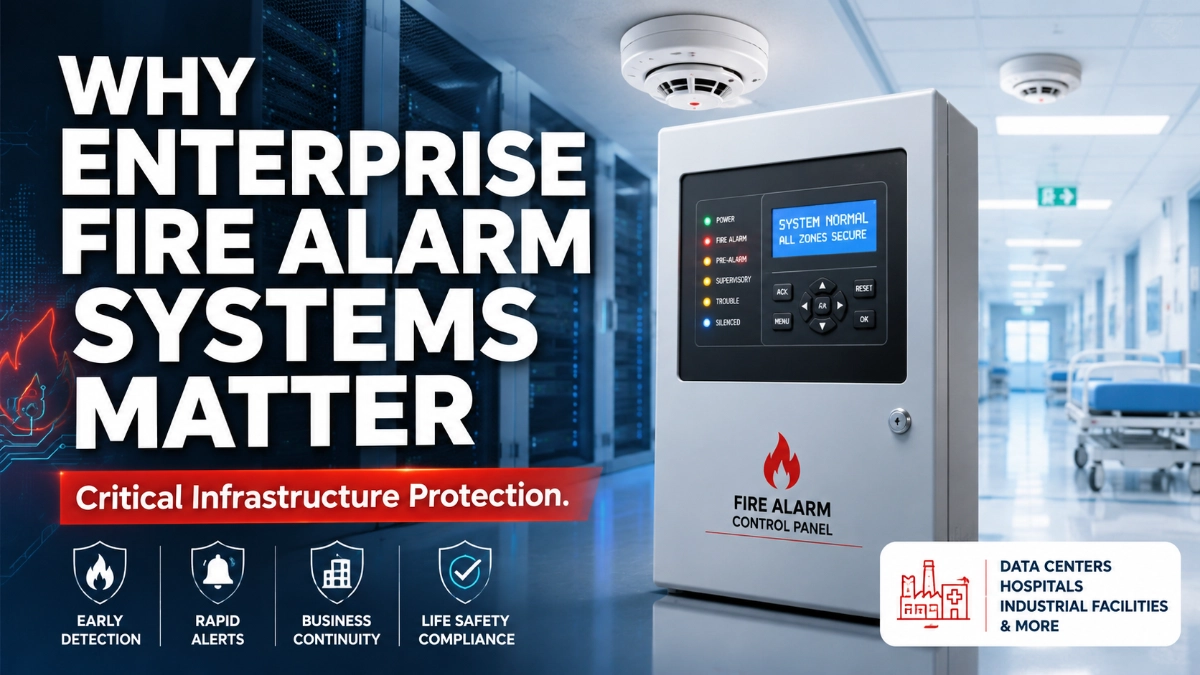
Over the past two decades, critical infrastructure has grown larger, denser, and more interconnected. Hospitals now operate as 24/7 campuses with surgical suites, imaging equipment, and server rooms under one roof. Data centres run thousands of racks that cannot tolerate even a brief, unnecessary shutdown. Airports coordinate life safety across terminals, baggage systems, fuel farms, and control towers simultaneously. As these facilities have grown more complex, the fire alarm systems protecting them have had to grow with them from simple zone-based detection into fully networked, intelligent, enterprise-grade platforms.
This shift is why fire protection engineers, MEP consultants, and infrastructure owners increasingly specify enterprise fire alarm ecosystems rather than conventional panels. Edwards, a long-established name in life safety technology, is frequently used as a reference point in these conversations not because of marketing, but because its platform architecture illustrates many of the engineering principles that critical infrastructure now demands: scalability, networked intelligence, diagnostic depth, and long-term lifecycle planning.
This article uses the Edwards ecosystem as a practical, educational lens for understanding what enterprise fire alarm systems actually need to do, why conventional systems fall short in high-stakes environments, and how consultants and facility owners should evaluate a platform before it gets specified into a critical building.
What Is Critical Infrastructure?
Critical infrastructure refers to facilities and systems whose failure or disruption would have a significant impact on public safety, economic activity, or essential services. In the context of fire protection, this typically includes:
- Hospitals and healthcare campuses: Where evacuation is often not an option and life-support equipment must remain powered
- Airports: Where terminals, control towers, and fuel infrastructure operate around the clock
- Data centres: Where even minutes of unplanned downtime can carry high financial and reputational cost
- Manufacturing plants: Where a shutdown halts production lines and supply chains
- Pharmaceutical facilities: Where cleanroom environments and batch processes are highly sensitive to disruption
- Government buildings: Which often house sensitive operations and require high assurance systems
- Industrial campuses and utilities: Including power generation, water treatment, and oil & gas sites
- Logistics hubs: Including ports, warehouses, and distribution centres running continuous operations
These facilities share a common demand: fire protection systems must detect real threats quickly, avoid unnecessary disruptions, and keep operating reliably across large, complex, and often 24/7 environments. A basic fire alarm control panel designed for a single building with a handful of zones is simply not built for this level of demand.
Why Conventional Fire Alarm Systems May Not Be Enough
Conventional, entry-level fire alarm systems are well suited to smaller, simpler buildings. But when applied to critical infrastructure, several limitations tend to surface:
- Limited scalability: Many conventional panels are designed around a fixed device capacity, making future expansion costly or technically difficult.
- Basic diagnostics: Fault reporting is often limited to a general “trouble” condition rather than pinpointing the exact device or circuit segment involved.
- Difficult expansion: Adding new buildings, zones, or wings frequently requires significant rewiring or panel replacement rather than modular addition.
- Lower network capability: Conventional systems are typically built for single-panel or single-building operation, which does not translate well to multi-building campuses.
- Operational limitations: Without deep integration options, conventional systems struggle to communicate meaningfully with building management systems, security platforms, or centralised monitoring software.
None of this makes conventional systems unsafe for their intended use; it simply means they were not engineered for the scale, complexity, and uptime expectations of critical infrastructure.
What Makes Enterprise Fire Alarm Systems Different?
Enterprise fire alarm systems are built around a different set of engineering assumptions: continuous operation, distributed intelligence, and long-term adaptability. The core concepts include:
- Intelligent addressable architecture: Rather than treating a zone as a single unit, every detector and module has its own address on the loop, allowing the panel to identify the exact device reporting an event.
- Device-level communication: Each addressable device a smoke detector, heat detector, or monitor module communicates continuously with the loop controller, reporting not just alarm states but ongoing analogue values and health status.
- Networked fire alarm panels: Multiple panels across buildings or floors are connected into a single logical network, allowing centralised visibility and coordinated response across a large site.
- Intelligent diagnostics: Enterprise panels apply onboard processing to interpret detector readings, filter out environmental noise such as dust or steam, and flag degrading devices before they fail outright.
- Centralised monitoring: Facility teams can view the status of every connected panel, zone, and device from a single interface rather than checking multiple standalone systems.
- Modular expansion: New panels, loops, or device types can be added to the network without redesigning the entire system architecture.
- Event prioritisation: When multiple conditions occur simultaneously, the system logic determines which events require immediate attention versus which are lower-priority maintenance items.
- Faster fault isolation: Because every device is individually addressed, technicians can locate a fault to a specific device or short segment rather than searching an entire circuit.
Together, these characteristics turn a fire alarm system from a passive compliance device into an active, self-monitoring part of the facility’s operational infrastructure.
Why Edwards Fire Alarm Systems Are Trusted in Critical Infrastructure
Edwards Fire Systems has built its intelligent panel families, including EST4, EST3, EST3X, and the iO Series, around the engineering principles described above. Examining how these platforms are structured helps illustrate why enterprise architecture matters in practice.
Enterprise Architecture
The Edwards EST4 platform is built as a modular, node-based system rather than a single fixed panel. Each node manages local device communication while participating in a broader network of nodes across a facility or campus. This node-based design allows engineers to configure a system around the actual layout of a facility rather than forcing the facility to conform to a rigid panel structure.
High Reliability
Reliability in fire alarm engineering is a function of redundancy, communication stability, and consistent power management. Edwards panels support redundant network segments and multiple topology options, so that a single point of failure on the network does not compromise the entire system’s ability to report events.
Scalability
The EST3 platform, for example, supports standalone operation or networking configurations ranging from a handful of nodes up to significantly larger networks, giving consultants room to design for a facility’s current needs while planning for future growth. This kind of tiered scalability is a defining feature of enterprise systems; the same underlying architecture can serve a mid-sized building today and expand as that building’s footprint grows.
Advanced Networking
Modern Edwards platforms are designed around flexible network architectures that can operate over copper, fibre, or Ethernet, and support multiple topology classes including rings, stars, and full mesh configurations. This flexibility matters enormously for large campuses, where physical distances, existing IT infrastructure, and redundancy requirements vary building to building.
Intelligent Detection
Edwards SIGA-series detectors use onboard microprocessors to continuously analyse sensing data, applying environmental compensation and pattern analysis to distinguish real smoke conditions from nuisance sources such as dust, steam, or cooking aerosols. This device-level intelligence, combined with automatic device mapping, reduces false alarms while preserving fast response to genuine fire conditions, a balance that matters enormously in facilities where an unnecessary evacuation carries real operational cost.
Simplified Maintenance
Because addressable devices report individual status and diagnostic history, maintenance teams can identify degrading detectors, dirty sensing chambers, or wiring faults well before they become failures. This shifts fire system maintenance from reactive troubleshooting toward planned, predictive servicing.
Future Expansion
Backwards-compatible design is a recurring theme across Edwards platforms, allowing newer control equipment to work alongside existing field devices and wiring during upgrades. This reduces the disruption and cost associated with migrating an ageing system to a current platform, an important consideration for facilities that cannot tolerate extended downtime during upgrade work.
Lifecycle Value
Enterprise systems are typically evaluated over a 15–25 year operating horizon, not just an initial installation cost. Modular architecture, backward compatibility, and long-term parts availability all factor into the true cost of ownership, often making an enterprise platform more economical over the life of a facility than repeated replacement of conventional panels.
Business Continuity
Ultimately, every architectural decision networking flexibility, redundancy, diagnostics, scalability serves one operational goal: keeping the facility running safely without unplanned interruptions. In critical infrastructure, the fire alarm system is not a peripheral safety device; it is a core part of the operational risk management strategy.
Industry Applications
- Hospitals face continuous occupancy, life-support equipment, and specialised areas like operating rooms and imaging suites where evacuation is rarely the first response. Intelligent detection with precise fault isolation helps hospital engineering teams respond to real events without unnecessary disruptions to patient care.
- Airports operate around the clock across terminals, concourses, fuel storage, and control facilities. Networked fire alarm architecture allows centralised monitoring across a sprawling footprint while maintaining independent zone-level response.
- Data centres cannot tolerate unnecessary alarm-triggered shutdowns or delayed fault detection. Intelligent, addressable detection combined with deep diagnostics helps operators distinguish real incidents from environmental noise in rooms filled with sensitive electronic equipment.
- Manufacturing facilities often contain a mix of combustible materials, industrial processes, and high-value equipment. Scalable networking allows fire protection to expand alongside plant growth without requiring a full system overhaul.
- Warehouses present large open volumes, high-rack storage, and variable occupancy loads, all of which benefit from addressable detection that can pinpoint alarm locations precisely across vast floor areas.
- Commercial campuses with multiple buildings benefit from networked panels that unify monitoring under a single operational view, simplifying both daily management and emergency response coordination.
- Pharmaceutical facilities operate cleanrooms and batch-controlled environments where nuisance alarms can compromise a production run. Intelligent detection that filters environmental noise directly protects both safety and product integrity.
- Government buildings frequently require high-assurance systems with cybersecurity considerations built into the network architecture, given the sensitivity of the operations they house.
- Utilities, including power generation and water treatment sites, combine industrial hazards with a strict uptime mandate, making reliable, redundant fire alarm networking an operational necessity rather than a convenience.
The Five Pillars of Enterprise Fire Protection
| Pillar | What It Means | Why It Matters |
|---|---|---|
| Early Detection | Intelligent, addressable devices that analyse conditions at the sensor level | Reduces false alarms while catching real fire conditions sooner |
| Reliability | Redundant networking, stable communication, robust power design | Ensures the system keeps functioning even if one component fails |
| Scalability | Modular architecture that grows with the facility | Avoids costly rip-and-replace projects as the facility expands |
| Operational Visibility | Centralised monitoring across panels, zones, and devices | Gives facility teams a single, accurate operational picture |
| Lifecycle Planning | Backward compatibility and long-term parts strategy | Protects the total cost of ownership over 15–25 years |
How Consultants Evaluate Enterprise Fire Alarm Systems
Fire protection engineers and MEP consultants typically assess candidate platforms against a consistent set of criteria before specifying a system for a critical facility:
- System architecture: Is the platform genuinely modular, or does scaling require a redesign?
- Future expansion: Can new buildings, loops, or devices be added without replacing existing infrastructure?
- Maintenance strategy: Does the system support predictive maintenance through detailed diagnostics, or only basic trouble signals?
- Device capacity: What is the practical device limit per loop and per network, and does it comfortably exceed projected needs?
- Integration: Can the system communicate with building management systems, security platforms, and mass notification tools?
- Lifecycle cost: What is the total cost of ownership across the system’s expected operating life, not just the upfront quote?
- Reliability: What redundancy options exist at the network and panel level?
- Business continuity: How does the system minimise false alarms and unplanned disruptions while preserving fast, accurate response to genuine events?
Common Mistakes When Planning Fire Protection for Critical Infrastructure
- Planning only for code compliance: Meeting the minimum code requirement does not guarantee the system will scale or perform well operationally over time.
- Ignoring future expansion: Facilities that plan for today’s footprint alone often face expensive retrofits within a few years of growth.
- Poor detector strategy: Selecting basic detectors for environments with dust, steam, or process aerosols leads to chronic false alarms and eventual system distrust.
- Limited networking: Designing standalone panels for a multi-building campus creates fragmented monitoring and slower emergency response.
- No redundancy planning: A single point of failure in the network can compromise visibility across an entire facility during a critical event.
- Short-term thinking: Evaluating systems purely on installation cost, without factoring in lifecycle maintenance and expansion costs, often leads to a higher total cost over the system’s life.
Future Trends
Enterprise fire detection continues to evolve alongside broader building technology trends:
- AI-assisted diagnostics are increasingly used to analyse detector history and flag degrading devices before they cause nuisance alarms or failures.
- Predictive maintenance models are shifting fire system servicing from scheduled inspections toward condition-based interventions.
- IoT connectivity allows fire alarm data to feed into broader facility monitoring platforms alongside HVAC, security, and energy systems.
- Digital twins of facilities are beginning to incorporate fire system data for simulation and emergency planning purposes.
- Smart building integration is pushing fire alarm platforms toward deeper interoperability with BACnet- and Modbus-based building management systems.
- Cloud-based remote monitoring gives facility teams and service partners visibility into system health without an on-site visit.
- Enterprise analytics are turning historical alarm and fault data into actionable insight for long-term facility planning.
- Cybersecurity is becoming a core design consideration, given that networked fire alarm systems now sit on IT infrastructure that must be protected from external threats.
Expert Recommendations
- For consultants: Evaluate platforms on architecture and lifecycle economics, not just upfront panel cost. A system that scales cleanly will save significant rework later.
- For facility managers: Build a relationship with a qualified service partner early, and prioritise systems with strong diagnostic reporting to reduce unplanned downtime.
- For infrastructure developers: Involve fire protection engineering in the earliest design phases, particularly for multi-building or campus-style projects where network architecture decisions are hard to reverse later.
- For project owners: Request a lifecycle cost model, not just an installation quote, before committing to a fire alarm platform.
- For safety officers: Treat false alarm rates and fault response times as key performance indicators for the fire protection system, not just its code compliance status.
Key Takeaways
- Critical infrastructure facilities face operational risks from fire incidents that extend well beyond physical damage.
- Conventional fire alarm systems are often insufficient for large, complex, or multi-building facilities.
- Enterprise fire alarm systems are built around intelligent, addressable device architecture.
- Networked panel architecture enables centralised monitoring across large campuses.
- Intelligent diagnostics reduce false alarms while improving fault isolation speed.
- Scalability and backward compatibility protect long-term investment value.
- Lifecycle cost, not just installation cost, should drive system selection.
- Different industries hospitals, airports, data centres, and more have distinct fire protection needs that enterprise systems can address.
- Redundant network design is essential for maintaining visibility during a critical event.
- Early involvement of fire protection engineers in facility design leads to better long-term outcomes.
Read Also: Edwards Fire Alarm Systems for Educational Institutions: What to Know
Read Also: Why Mission-Critical Facilities Choose Intelligent Fire Detection Platforms