A single smoke detector activates on the seventh floor. Within seconds, elevators stop and recall to the ground floor, smoke control fans start pressurising stairwells, fire doors release and swing shut, evacuation messages begin playing over speakers, and firefighters arriving downstairs already know exactly which zone triggered the alarm. None of this happens by chance. Every action is calculated, sequenced, and executed by one device sitting quietly in an electrical room: the fire alarm control panel.
Most people picture a fire alarm system as a bell and a few smoke detectors. In a modern building, that picture is outdated. Today’s fire alarm control panel behaves more like an emergency operations coordinator, making rapid decisions across dozens of connected systems the moment a threat is confirmed. Understanding how that coordination actually works reveals why building safety has become as much an engineering discipline as an electrical one.
This article walks through what a fire alarm control panel does, how it makes decisions, and why coordinated response, not just a loud alarm, is what actually saves lives and protects buildings.
How an Emergency Response Begins
An emergency response begins the moment a detector or manual call point sends a signal to the panel. The panel then verifies the signal, confirms whether it represents a genuine fire condition, and assigns it a priority before triggering any outputs.
Four things happen in rapid succession:
- Detector activation: A smoke, heat, or flame detector crosses its activation threshold, or someone operates a manual call point.
- Signal verification: On addressable systems, the panel checks the device’s reported analogue value against expected fire-condition ranges rather than reacting to a simple on/off signal.
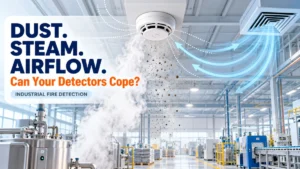
- Alarm confirmation: Depending on programming, the panel may wait for a second detector activation or a brief verification period to reduce nuisance alarms, particularly in areas prone to steam, dust, or cooking smoke.
- Event prioritisation: The panel classifies the event (fire alarm, supervisory, or trouble) and assigns it a response priority so genuine fire conditions are never delayed behind lower-priority signals.
This verification step is one of the most misunderstood parts of fire alarm engineering. According to fire safety engineering principles, a system that reacts too aggressively to every fluctuation creates alarm fatigue, while a system that is too slow risks delaying evacuation. Panel programming has to balance both.
Step-by-Step Sequence During an Emergency
During a confirmed fire event, the panel executes a fixed sequence: detection, transmission, analysis, confirmation, notification, and then a series of building-control actions that continue until the event is cleared and logged.
- Smoke or heat detection: The initiating device senses a condition outside normal parameters.
- Signal transmission: The device sends its status and location over the signalling line circuit to the panel.
- Panel analysis: The panel cross-references the device address, zone, and programmed logic.
- Alarm confirmation: The event is validated as a genuine alarm condition rather than a fault.
- Occupant notification: Horns, strobes, or voice messages activate in the appropriate zones.
- Fire door release: Magnetically held doors release to compartmentalise smoke and fire.
- Smoke management: Pressurisation fans and smoke extraction systems activate per the designed sequence.
- HVAC shutdown: Air handling units shut down or switch to smoke control mode to prevent smoke recirculation.
- Elevator recall: Elevators are recalled to a designated floor and taken out of normal service.
- Emergency lighting: Backup lighting activates along designated escape routes.
- Voice evacuation: Pre-recorded or live voice messages guide occupants, often with staged evacuation instructions in high-rise buildings.
- Fire brigade notification: A signal is transmitted to the monitoring station or directly to the fire department.
- Event logging: Every action, timestamp, and device address is recorded in the panel’s event history.
- Continuous monitoring: The panel keeps watching for additional activations, changes in status, or resolution of the event.
This sequence rarely runs in isolation. Most of these steps trigger simultaneously across different zones, which is why the coordination logic inside the panel matters more than any single component.
How Fire Alarm Panels Coordinate Other Building Systems
Fire alarm panels coordinate other systems through relay outputs, dedicated interface modules, or network-level integration, allowing one confirmed alarm to trigger a synchronised response across HVAC, elevators, access control, and life safety equipment.
HVAC Systems
During a confirmed fire event, HVAC units are typically shut down or switched into smoke-control mode. Uncontrolled air movement can spread smoke through duct systems into unaffected floors, so the panel’s interface with the HVAC controller is a critical safety function rather than a convenience feature.
Smoke Extraction and Pressurisation
In integrated life safety systems, smoke extraction fans remove smoke from the fire floor while pressurisation fans keep stairwells and lobbies smoke-free, giving occupants a clear escape path and firefighters a safer point of entry.
Elevators
Elevators are recalled to a safe floor and locked out of normal passenger use, preventing occupants from unknowingly opening doors onto a smoke-filled floor.
Access Control
Fire-rated doors on card-access systems are commanded to unlock during an alarm, allowing free egress even in areas normally restricted.
Emergency Lighting
Backup lighting circuits activate to illuminate escape routes, particularly important if the fire has also caused a loss of normal power.
Voice Evacuation (PAVA)
Public address and voice alarm (PAVA) systems deliver clear, zoned instructions often prioritising evacuation of the fire floor and floors immediately above it before instructing the rest of the building.
BMS Integration
Modern addressable fire alarm systems frequently interface with the building management system (BMS), giving facility teams a single dashboard view of fire, HVAC, and access events during an emergency.
Fire Pumps and Sprinkler Monitoring
The panel monitors sprinkler flow switches, valve tamper switches, and fire pump run status, escalating a supervisory signal if pressure or valve position falls outside normal range.
Gas Suppression Systems
In server rooms, archives, or other sensitive areas, the panel can coordinate with clean-agent or gas suppression systems, typically requiring cross-zoned detection before releasing an agent to avoid unnecessary discharge.
| System | Panel Action | Safety Benefit |
|---|---|---|
| HVAC | Shutdown or smoke-control mode | Prevents smoke spread through ducts |
| Elevators | Recall to safe floor | Prevents occupants from entering smoke zones |
| Access control doors | Unlock | Enables free egress |
| Smoke extraction | Activate extraction/pressurization fans | Clears escape routes |
| Voice evacuation | Zoned announcements | Reduces panic, staged evacuation |
| Fire pumps | Monitor pressure/run status | Ensures sprinkler water supply |
Intelligent Decision Making Inside Modern Addressable Panels
Quick answer: Addressable panels make decisions using individually identified devices, programmable zone logic, and cause-and-effect rules that determine exactly which outputs activate for a given input, rather than reacting the same way to every signal.
- Device identification: Every detector and module has a unique address, so the panel knows the exact location of an event, not just the general zone.
- Zone logic: Devices are grouped logically so the panel can trigger a localised response first and expand it if the event escalates.
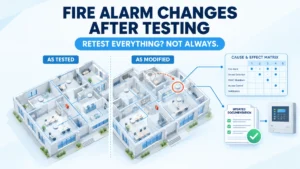
- Cause-and-effect programming: Engineers define exactly which outputs (doors, fans, elevators) respond to which inputs, tailored to the building’s layout and risk profile.
- Multi-stage alarms: Larger buildings often use a two-stage alarm: an initial alert to staff for investigation, followed by a general evacuation signal if the condition is confirmed.
- False alarm reduction: Analogue addressable detectors report a range of values rather than a simple trigger, allowing the panel to filter out conditions like dust or steam that don’t represent genuine fire.
- Priority handling: If multiple events occur simultaneously, the panel processes them according to a fixed priority hierarchy, ensuring fire alarms are never delayed by lower-priority troubles.
Real Building Scenario
Consider a ten-story office building during a weekday afternoon. A smoke detector on the fifth floor, near a server room, reports an analogue value climbing steadily.
- 0:00 — The detector crosses its alarm threshold and reports its address to the panel.
- 0:03 — The panel verifies the signal and classifies it as a confirmed alarm.
- 0:05 — Horns and strobes activate on the fifth floor; a pre-alert tone sounds on the fourth and sixth floors.
- 0:08 — Magnetic door holds throughout the fifth floor release, closing fire-rated doors.
- 0:10 — HVAC units serving the fifth floor shut down; stairwell pressurisation fans start.
- 0:12 — All elevators recall to the ground floor and disable normal service.
- 0:15 — Voice evacuation begins, instructing the fifth floor to evacuate immediately and adjacent floors to prepare for evacuation.
- 0:20 — The monitoring station receives the signal and dispatches the fire department.
- 0:35 — Firefighters arrive and consult the panel’s annunciator, which displays the exact device address, giving them the precise location before they even enter the stairwell.
- Ongoing — The panel continues logging every event, device status, and operator action for later review.
None of these actions required a person to make a real-time decision. The building’s response was pre-engineered, tested, and executed automatically within seconds of detection.
Why Coordination Is More Important Than Loud Alarms
Quick answer: Coordinated system response is more effective than notification alone because it actively shapes the evacuation environment, clearing smoke, securing escape routes, and guiding occupants, rather than simply alerting people to a danger they still have to navigate unaided.
- Faster evacuation: Elevator recall, unlocked doors, and voice guidance remove obstacles that would otherwise slow occupants down.
- Reduced panic: Clear, zoned voice instructions are generally more effective than sirens alone at guiding calm, orderly movement.
- Better firefighter response: Exact device addresses and pre-established annunciator panels let responders act on precise information instead of searching floor by floor.
- Asset protection: Early HVAC shutdown and gas suppression activation limit smoke damage to equipment and inventory.
- Reduced property damage: Compartmentalisation through fire door release slows fire spread, buying time and reducing structural loss.
- Regulatory compliance: International fire safety standards generally require integrated system response as part of a building’s approved fire strategy, not just a functioning alarm bell.
Common Mistakes That Reduce Emergency Effectiveness
- Poor detector placement: Detectors installed too close to HVAC diffusers or in dead-air pockets may respond too slowly or too erratically.
- Incorrect cause-and-effect programming: A mismatch between the fire strategy document and the actual panel programming can leave critical outputs unlinked to the correct inputs.
- Disabled interfaces: Interface modules left disconnected during renovations sometimes never get reconnected, silently breaking the coordination chain.
- Lack of maintenance: Detectors accumulate dust and lose sensitivity over time without regular cleaning and calibration.
- Poor commissioning: Systems that are never fully tested end-to-end may look functional on paper while failing during an actual event.
- Ignoring routine testing: Skipping scheduled testing means faults can go unnoticed for months, defeating the purpose of continuous monitoring.
Each of these mistakes shares a common consequence: the panel may still detect the fire, but the coordinated response it’s supposed to trigger doesn’t happen the way it was designed to.
Future of Intelligent Emergency Response
Fire alarm technology continues to evolve well beyond basic detection and notification.
- AI-assisted fire detection: Algorithms that analyse detector data patterns to distinguish genuine fire signatures from nuisance sources more reliably.
- Predictive maintenance: Systems that flag detectors likely to fail or drift out of calibration before they cause a fault.
- IoT-enabled monitoring: Networked devices that report status continuously rather than only during scheduled tests.
- Cloud dashboards: Remote visibility into multiple building panels from a single interface, useful for facility teams managing several sites.
- Digital twins: Virtual models of a building’s fire strategy used to simulate and validate cause-and-effect programming before deployment.
- Smart building integration: Deeper convergence between fire, security, and energy management systems under unified platforms.
- Cybersecurity considerations: As panels become more networked, protecting them from unauthorised access becomes as important as protecting them from physical failure.
Manufacturers such as GST offer addressable fire alarm systems that reflect many of these trends, representing one example among several modern platforms used in commercial and industrial buildings today.
Read Also: The Five Layers of a Future-Ready Fire Alarm System
Read Also: What Makes GST Fire Alarm Systems So Popular in Industries?