Introduction: Why Fire Alarm Systems Must Never Fail

In fire protection engineering, few systems carry the same level of responsibility as a fire alarm system. Unlike conventional building technologies that improve convenience or efficiency, fire detection and alarm systems are life-safety critical infrastructure. Their primary function is to detect fire conditions early, alert occupants, and trigger emergency response actions that protect lives and assets.
When a fire alarm system fails, the consequences extend far beyond equipment malfunction. A system failure can directly delay evacuation, prevent suppression systems from activating, and compromise the safety of everyone inside the building.
For this reason, engineers treat fire detection networks differently from other building systems. The design philosophy prioritises continuous availability, fault tolerance and redundancy to ensure the system remains operational even when individual components fail.
Life Safety Dependency on Fire Detection
In most facilities, occupants rely entirely on the fire alarm system to detect emergencies. People cannot visually monitor every area of a building. Fires often start in concealed spaces such as:
- Electrical rooms
- Cable shafts
- HVAC ducts
- Storage areas
- Server rooms
A properly designed GST Addressable Fire Alarm System continuously monitors these areas using distributed detectors and signalling networks. The moment abnormal conditions such as smoke or heat appear, the system processes signals and activates alarms.
Without this early detection capability, occupants may not recognise a developing fire until conditions become dangerous.
Consequences of Fire Alarm System Failure
When a fire alarm system becomes unavailable or partially disabled, several risks immediately emerge.
Delayed Fire Detection
If detectors cannot transmit signals due to network failure or control panel malfunction, the fire may remain undetected for critical minutes.
Notification Failure
Even if detectors identify a fire, a fault in notification circuits could prevent alarms from sounding. Occupants would remain unaware of the danger.
Evacuation Delay
Delayed or absent alarms significantly slow evacuation. In large buildings, evacuation depends on coordinated alarm signalling and voice instructions.
Suppression System Activation Delay
Many suppression systems, including sprinklers, gas suppression systems and smoke control systems, integrate with fire alarm controls. A control panel failure may prevent automatic activation.
High-Risk Environments
Certain facilities depend heavily on uninterrupted fire detection systems.
High-Rise Buildings
Vertical evacuation complexity makes early detection essential.
Hospitals
Patients may not be able to evacuate quickly, requiring a compartmentalised fire response.
Airports
Large passenger volumes and complex infrastructure demand highly reliable detection networks.
Industrial Plants
Flammable materials and hazardous processes require immediate alarm signalling.
Data Centres
Even a small fire can cause catastrophic equipment damage and service disruption.
Warehouses
Large open storage areas can allow fires to spread rapidly before manual detection occurs.
In these environments, the reliability of fire alarm systems directly affects life safety outcomes.
Reliability Engineering in Fire Protection
Modern fire alarm design integrates principles from reliability engineering, a discipline focused on maintaining system operation under failure conditions.
Two key concepts dominate reliability-focused system design:
Redundancy
Installing backup components or pathways that allow the system to continue operating when a primary component fails.
Fault Tolerance
Designing the system so it continues functioning even when faults occur within the network.
A well-designed fire detection network architecture, similar to those found within the Fire Detection System Category, uses these principles extensively. Redundant communication loops, backup power systems and distributed controllers ensure that single failures do not compromise life safety.
In the sections that follow, we will explore how redundancy and fault tolerance work in modern fire alarm systems, why they are critical for compliance and reliability and how engineers implement them in real-world projects.
Understanding Redundancy and Fault Tolerance in Fire Alarm Systems
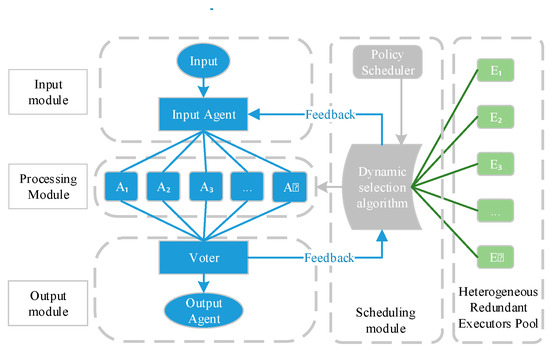
When engineers design life-safety systems, reliability becomes the central design objective. Fire alarm systems must remain operational during equipment failures, electrical disturbances, or network disruptions. Achieving this level of reliability requires a structured approach built on redundancy and fault tolerance.
Although these terms are often used interchangeably, they represent distinct engineering principles that work together to improve system availability.
Redundancy: Backup Components for Continuous Operation
Redundancy refers to the practice of installing additional components or pathways so the system can continue operating if a primary element fails.
In a fire alarm system, redundancy may exist in multiple areas:
- Dual power supplies
- Backup batteries
- Redundant communication loops
- Multiple network gateways
- Secondary control processors
For example, a modern Addressable Fire Alarm Control Panel may include dual power modules. If the primary module fails, the secondary module automatically maintains power to the panel and field devices.
Similarly, redundant communication loops allow detection devices to remain connected even if part of the loop is damaged.
The goal of redundancy is simple: eliminate single points of failure.
Fault Tolerance: Systems That Continue Operating During Faults
While redundancy provides backup components, fault tolerance ensures the system continues functioning even when faults occur within the network.
A fault-tolerant fire alarm system detects issues such as:
- Short circuits
- Ground faults
- Device failures
- Communication interruptions
Instead of shutting down the entire system, fault-tolerant architectures isolate the affected section while allowing the rest of the network to operate normally.
For example, loop isolation modules can automatically isolate a short circuit on a detection loop. The remaining devices continue communicating with the control panel.
Fail-Safe Design vs Fault Tolerance
Fire alarm engineers must also distinguish between fail-safe design and fault tolerance.
Fail-Safe Design
A fail-safe system transitions into a safe condition when a failure occurs. For example, a suppression system valve may open automatically if control signals are lost.
Fault Tolerance
Fault tolerance allows the system to continue functioning despite faults, preventing the need for fail-safe activation in many cases.
Both approaches play roles in fire protection engineering.
System Availability and Reliability Metrics
Engineers evaluate fire alarm reliability using measurable metrics.
Mean Time Between Failures (MTBF)
MTBF represents the expected operational time between equipment failures.
Higher MTBF values indicate more reliable equipment.
Mean Time To Repair (MTTR)
MTTR measures how quickly technicians can restore the system after a failure occurs.
Lower MTTR values improve system availability.
System Uptime Targets
Life-safety systems typically aim for very high availability levels, often exceeding 99.99%.
Achieving this level of uptime requires redundant components, fault monitoring and rapid fault isolation.
How Modern Addressable Systems Implement Redundancy
Modern addressable fire alarm systems incorporate redundancy at multiple levels.
For example, advanced systems like the GST Addressable Fire Alarm System implement several reliability features:
- Distributed system architecture
- Loop isolation technology
- Network redundancy
- Intelligent fault monitoring
- Backup processors
Each detector on the system communicates digitally with the control panel. If part of the network experiences a fault, the system can isolate the affected area while maintaining communication with other devices.
The result is a detection network that remains operational even under abnormal conditions.
Why Single-Point Failures Are Dangerous in Fire Alarm Systems
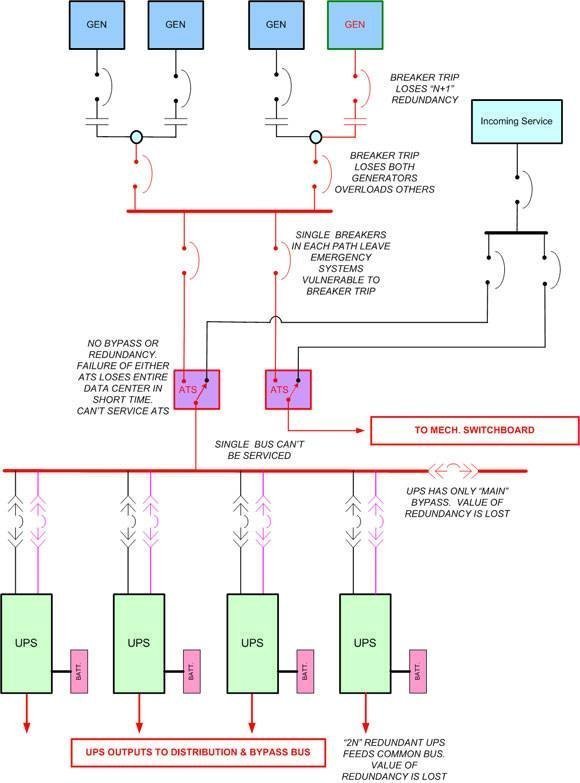
A single-point failure occurs when one component failure causes the entire system to stop functioning.
In fire alarm systems, this situation is unacceptable because it directly compromises life safety. If a single device, cable, or power module can disable the entire system, the design does not meet reliability expectations for critical infrastructure.
Unfortunately, single-point failures still appear in poorly designed installations.
Common Single-Point Failure Areas
Fire alarm systems consist of multiple interconnected subsystems. Each layer introduces potential failure points.
Power Supply
The control panel and field devices depend on reliable power sources.
If the panel uses a single power module without redundancy, a power module failure can disable the entire system.
Control Processor
The processor inside the fire alarm panel manages device communication, signal processing and alarm activation.
If the processor fails and no backup processor exists, the panel cannot operate.
Communication Loop
Addressable fire alarm systems typically use communication loops connecting detectors and modules.
If the loop wiring is designed incorrectly, a short circuit can disable the entire detection network.
This is why engineers frequently use Class A wiring and loop isolation modules.
Network Interface
In large buildings, multiple fire alarm panels communicate through network gateways.
If the network uses a single communication path, a gateway failure may disconnect entire buildings from the monitoring system.
Detection Circuits
Faults within detection circuits can prevent alarm signals from reaching the control panel.
Advanced Addressable Fire Alarm Detectors provide digital communication that allows the system to monitor device status and detect circuit faults.
Real-World Failure Scenarios
Example 1: Power Module Failure
In one industrial facility, a power supply module inside the fire alarm panel failed due to overheating.
Because the panel lacked redundant power modules, the entire fire alarm system shut down until technicians replaced the unit.
During that period, the building operated without fire detection protection, creating a significant safety risk.
Example 2: Network Gateway Failure
A multi-building campus connected several fire alarm panels through a single network gateway.
When the gateway hardware failed, the monitoring centre lost visibility of multiple buildings simultaneously.
Although local alarms still functioned, centralised monitoring was unavailable.
Example 3: Loop Short Circuit
In a warehouse installation, a damaged cable caused a short circuit on the detection loop.
Because the loop lacked isolator modules, the short disabled communication with all detectors on the loop.
The building temporarily lost detection coverage in multiple zones.
Impact of Single-Point Failures
When fire alarm systems suffer from single-point failures, several risks emerge:
- Alarm signals may not reach occupants
- Detection coverage may be lost
- Building compliance requirements may be violated
- Emergency response may be delayed
- Legal liability may increase
Facilities that rely on centralised monitoring through a Fire Alarm Control Panel Category must therefore eliminate single-point failures during the design stage.
The most effective method is to incorporate redundancy and fault tolerance throughout the system architecture.
Key Areas Where Redundancy Is Applied in Fire Alarm Systems
Redundancy in fire alarm systems is not limited to one component. Reliable system architecture distributes redundancy across power systems, communication networks, control processors and detection loops.
Engineers design these systems so that failure in one part of the infrastructure does not disable detection or notification capabilities.
Below, we examine the primary areas where redundancy is implemented in modern fire alarm system architecture.
Power Supply and Backup Redundancy
Power supply is the most fundamental element of a fire alarm system. Without reliable electrical power, even the most advanced detection network cannot operate.
Fire alarm systems, therefore, use multiple layers of power redundancy.
Primary Power Source
The primary power source normally comes from the building’s electrical distribution system.
Control panels receive power from dedicated circuits that are:
- Permanently connected
- Protected against accidental disconnection
- Clearly labelled at the distribution board
Secondary Power Supply (Battery Backup)
All fire alarm control panels must include battery backup systems capable of operating the system during power outages.
Backup batteries typically provide:
- 24-hour standby operation
- 5–30 minutes of alarm operation
Battery capacity depends on system size and load calculations.
Dual Power Modules
Advanced systems integrate redundant power modules within the panel.
If one module fails, the second module automatically maintains system operation.
Large installations often deploy parallel power supplies that share load responsibility.
Generator Integration
Critical facilities such as hospitals and airports integrate fire alarm systems with emergency generators.
If utility power fails and battery capacity becomes limited, the generator restores system power automatically.
A robust Addressable Fire Alarm Control Panel, therefore, includes:
- Primary power input
- Battery backup
- Redundant power modules
- Generator interface
Failure Scenario
During a routine inspection at a manufacturing plant, technicians discovered that a battery bank had deteriorated and could no longer maintain standby power.
Because the system lacked redundant battery banks, the entire fire alarm system became non-compliant until replacements were installed.
This example highlights the importance of redundant power architecture.
Detection and Signalling Circuit Redundancy
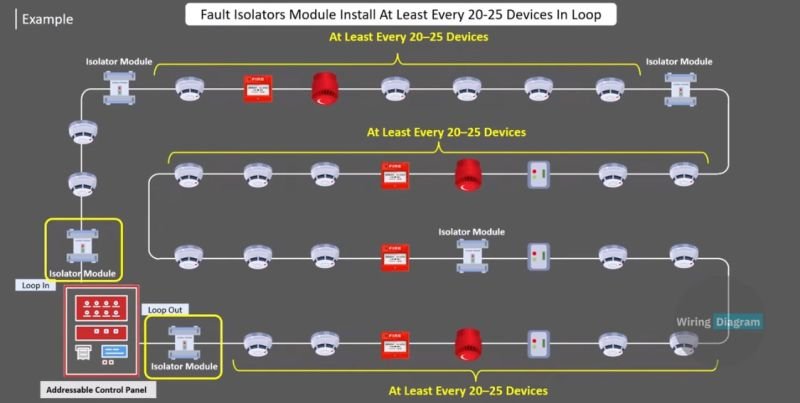
Detection loops connect fire detectors and modules to the control panel. In modern addressable systems, each device communicates digitally with the panel.
However, cable faults can interrupt this communication.
Class A Circuit Architecture
A Class A circuit returns to the control panel, forming a closed loop.
If a cable break occurs, communication continues from the opposite direction.
This ensures devices remain connected even when part of the loop becomes damaged.
Loop Isolation Modules
Loop isolators automatically disconnect sections of the loop that experience faults, such as:
- Short circuits
- Ground faults
- Device failures
This prevents a single fault from disabling the entire loop.
Modern Addressable Fire Alarm Detectors communicate through these isolated segments, maintaining system operation despite localised faults.
Example Scenario
In a logistics warehouse, a forklift accidentally damaged a cable tray containing fire alarm wiring.
Because isolator modules were installed throughout the loop, the damaged section was automatically isolated while the rest of the detection devices remained operational.
Without isolators, the entire detection network could have gone offline.
Control Panel and Processor Redundancy
The fire alarm control panel acts as the central intelligence of the system.
It processes signals from detectors, activates notification devices, and coordinates system responses.
Because of its importance, advanced fire alarm panels incorporate processor redundancy.
Dual Processor Architecture
High-reliability panels contain:
- Primary processor
- Backup processor
The primary processor manages normal operations.
If the processor fails due to a hardware fault or a firmware error, the backup processor takes control within milliseconds.
Hot Standby Controllers
Hot standby systems continuously monitor the health of the primary processor.
If abnormal behaviour is detected, the standby controller immediately assumes control.
This architecture is widely used in critical facilities, including:
- Airports
- Metro rail systems
- Data centres
- Industrial plants
These facilities often deploy distributed architectures such as the GST Addressable Fire Alarm System, which combines multiple redundant panels across the facility.
Communication and Network Redundancy
Large facilities often contain multiple fire alarm panels connected through communication networks.
Network redundancy ensures these panels remain connected even if communication paths fail.
Ring Topology Networks
In a ring topology, panels connect in a closed communication loop.
If one network segment fails, data can travel through the opposite direction.
Dual Ethernet Networks
Some systems deploy two independent Ethernet networks.
Panels automatically switch to the secondary network if the primary path fails.
Fibre Optic Redundancy
Fibre optic networks are commonly used in:
- Airports
- Industrial campuses
- Large hospitals
Fibre provides high bandwidth and immunity to electromagnetic interference.
Redundant communication networks ensure the Fire Detection System Category remains fully functional even when the network infrastructure experiences faults.
Fault Tolerance Mechanisms in Modern Fire Alarm Systems
Modern fire alarm systems incorporate intelligent mechanisms that allow them to continue operating during faults.
These technologies form the foundation of fault tolerance.
Loop Isolation Technology
Loop isolators automatically isolate sections of wiring that experience short circuits.
Devices outside the faulted section remain operational.
Continuous Fault Monitoring
The system continuously monitors:
- Communication loops
- Power supply status
- Device health
- Ground faults
Faults are immediately reported to operators.
Self Diagnostics
Many advanced panels run internal diagnostic routines that verify processor health, memory integrity and communication functionality.
Automatic Signal Rerouting
When communication paths fail, redundant networks automatically reroute signals through alternative pathways.
Watchdog Timers
Watchdog timers detect software failures or processor stalls.
If abnormal conditions occur, the system automatically resets or switches to backup processors.
Together, these mechanisms ensure that devices connected to the Addressable Fire Alarm Control Panel and Addressable Fire Alarm Detectors continue functioning despite localised failures.
6. Role of Redundancy in Large and Complex Buildings
Redundancy becomes even more important as building size and complexity increase.
Large facilities contain thousands of detection devices distributed across multiple zones.
Airports
Airports contain extensive terminal areas, baggage systems and passenger facilities. Redundant fire alarm networks ensure detection remains active across the entire airport campus.
Industrial Plants
Industrial environments often contain hazardous materials and large processing areas. Redundant detection networks improve safety in these high-risk facilities.
Hospitals
Hospitals require continuous operation of fire alarm systems to protect patients who may not be able to evacuate quickly.
Data Centres
Even small fires can cause major disruptions to digital infrastructure. Redundant detection and suppression systems are therefore essential.
Large facilities frequently deploy distributed architectures like the GST Addressable Fire Alarm System, where multiple panels coordinate through redundant networks.
Code and Standard Requirements for Redundancy
International fire safety standards emphasise system reliability and survivability.
Key standards include:
NFPA 72
The National Fire Alarm and Signalling Code, published by the National Fire Protection Association, establishes requirements for fire alarm system design and installation.
Learn more: https://www.nfpa.org
NFPA 72 defines requirements for:
- Circuit classification
- Power supply reliability
- System supervision
- Fault monitoring
EN 54
European fire detection standards define performance requirements for detection devices and control equipment.
IS 2189
India’s IS 2189 standard governs the installation and maintenance of fire detection systems in buildings.
These standards require system architectures that minimise the impact of failures and ensure continuous life-safety protection.
Additional insights can be found from industry resources such as:
- Fire Protection Association
- IFSEC Global
- Fire Engineering Magazine
Common Design Mistakes That Reduce Fault Tolerance
Despite clear engineering guidelines, design mistakes still occur in fire alarm projects.
Class B Circuit Design in Critical Buildings
Using Class B circuits in high-risk facilities can allow single cable faults to disable detection loops.
Lack of Redundant Power Supplies
Systems without backup power modules become vulnerable to power supply failures.
No Loop Isolation Modules
Without isolators, a single short circuit may disable an entire loop.
Poor Network Architecture
Single communication gateways create single points of failure.
Environmental Neglect
Engineers sometimes ignore environmental conditions such as:
- High temperatures
- Dust
- Moisture
- Electromagnetic interference
These factors can reduce system reliability.
The result may include:
- System shutdown
- Delayed alarm response
- Code violations
- Insurance claim rejection
- Legal liability
Best Practices for Designing Highly Reliable Fire Alarm Systems

Designing highly reliable fire alarm systems requires careful engineering planning.
Implement N+1 Redundancy
Provide at least one backup component for every critical system element.
Use Class A Loop Architecture
Class A circuits maintain communication even when wiring faults occur.
Deploy Distributed Control Panels
Multiple panels reduce dependency on a single control unit.
Install Redundant Power Supplies
Dual power modules and battery banks improve system availability.
Implement Network Ring Topology
Redundant communication networks ensure connectivity between panels.
Conduct Periodic Testing
Routine testing verifies system functionality and identifies faults before emergencies occur.
These practices help engineers deliver resilient fire alarm systems that protect lives and infrastructure.
Designing Fire Alarm Systems That Remain Operational When It Matters Most
Fire alarm systems are not ordinary building systems. They are life-safety infrastructure, designed to protect occupants, assets and critical operations during emergencies. Because of this responsibility, reliability must always be the central priority in fire alarm system design.
Throughout this discussion, we examined how redundancy and fault tolerance help ensure fire alarm systems continue functioning even when individual components fail. In real-world environments, failures are inevitable. Power supplies degrade, cables become damaged, devices malfunction and communication networks experience disruptions. The role of engineering design is to ensure that these failures do not compromise life safety.
Redundancy provides backup components that allow systems to continue operating when primary elements fail. This can include dual power supplies, redundant communication networks, backup processors, and distributed control panels. Fault tolerance complements redundancy by allowing systems to detect faults, isolate affected areas and maintain operation across the rest of the network.
Modern addressable fire detection networks, such as the GST Addressable Fire Alarm System, demonstrate how these principles are applied in practice. By integrating intelligent devices, loop isolation technology, distributed architecture and continuous fault monitoring, these systems achieve high levels of reliability and availability.
For engineers and decision-makers responsible for fire protection infrastructure, several key lessons emerge:
• Eliminate single-point failures during system design.
Every critical component, power supply, processor, communication network and detection loop should include redundancy.
• Adopt fault-tolerant architectures.
Technologies such as loop isolators, redundant processors, and automatic network rerouting allow systems to remain operational during localised failures.
• Follow internationally recognised standards.
Compliance with codes such as those from the National Fire Protection Association, along with regional standards, ensures systems meet established reliability requirements.
• Plan for large-scale infrastructure complexity.
Facilities such as airports, hospitals and industrial plants require distributed fire detection architectures within the broader Fire Detection System Category to ensure comprehensive protection.
• Maintain and test systems regularly.
Even the best system design requires periodic inspection, maintenance and testing to maintain reliability throughout the system’s lifecycle.
Ultimately, the purpose of redundancy and fault tolerance is simple: fire alarm systems must remain operational during the very conditions they are designed to detect. Fires often damage electrical infrastructure, create environmental stress and disrupt building systems. A resilient fire detection network ensures that alarms continue to function even in these challenging conditions.
For fire consultants, system integrators, EPC contractors, industrial safety heads and facility managers, prioritising redundancy during the design phase leads to systems that are not only compliant but also resilient. These systems protect occupants, minimise operational disruption and provide confidence that the fire protection infrastructure will perform reliably when it matters most.
In fire protection engineering, reliability is not an optional feature; it is the foundation of effective life safety design.
Read Also: How to Choose the Right Power Backup System For Fire Safety?
Read Also: Fire Alarm Components That Make or Break System Performance