When a Fire Alarm Fails Silently, the Real Danger Begins
Picture this: a warehouse supervisor in a large industrial facility starts his Monday morning rounds. The addressable fire alarm panel shows a green status light. Everything looks normal. But buried three floors above, a smoke detector has been showing a “dirty sensor” fault for six weeks, logged, unacknowledged and forgotten in a stack of maintenance tickets.
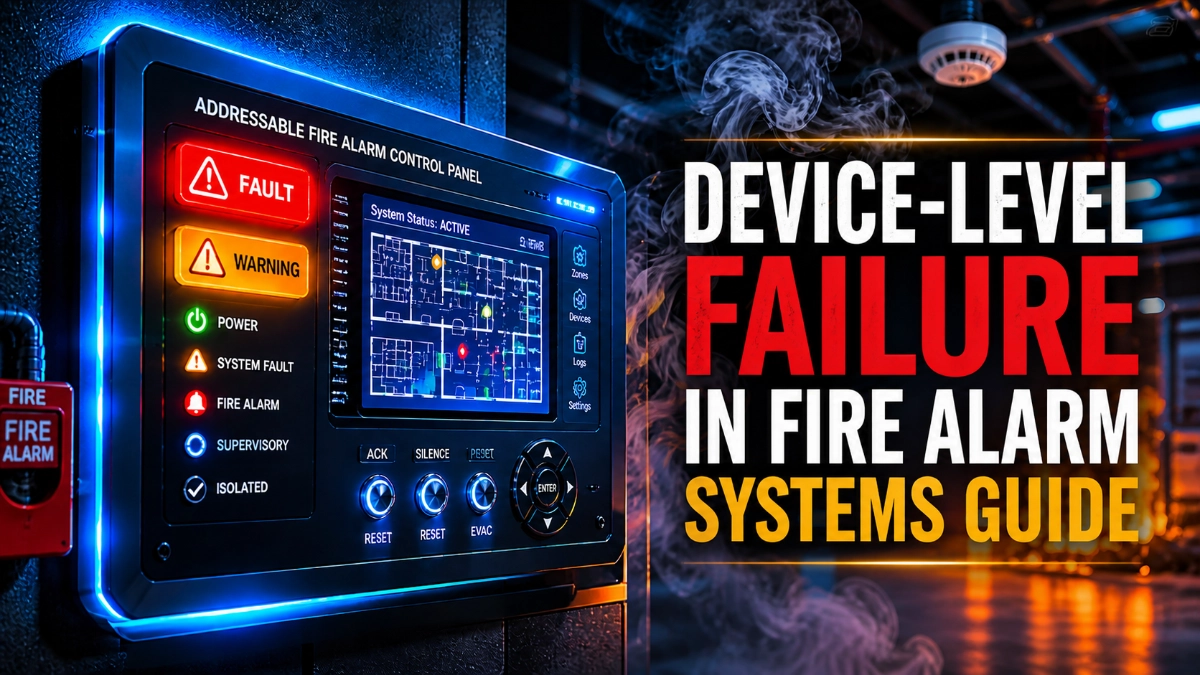
Three months later, a wiring fault ignites insulation in the cable tray above that floor. The detector never triggers. The suppression system never activates. Damage runs into crores.
This isn’t a hypothetical. It’s a pattern that repeats itself across commercial buildings, hospitals, data centres and industrial facilities every year. The culprit isn’t a catastrophic system meltdown; it’s a quiet, gradual device-level failure that went undetected for too long.
Understanding these failures, what causes them, how to spot them early, and how to prevent them, is one of the most important responsibilities a facility manager or fire safety engineer can have.
What Is Device-Level Failure in Fire Alarm Systems?
Device-level failure refers to the malfunction or degraded performance of an individual component within a fire alarm network, such as a smoke detector, heat detector, call point, sounder, or module, rather than a failure of the entire system.
In an addressable fire alarm panel, every device has a unique address on the loop. This allows the panel to pinpoint exactly which device is faulty, in which zone, and what type of fault has occurred. Unlike a conventional fire alarm panel, where a fault anywhere on a zone circuit triggers a broad zone alarm, addressable systems give you surgical precision.
But that precision is only useful if someone is watching, interpreting, and acting on those fault signals. When they’re ignored, device-level failures silently accumulate until the system can no longer perform its core function: saving lives.
Common Device-Level Failure Patterns in Addressable Systems
1. Detector Contamination and Dirty Sensors
Contamination is the leading cause of nuisance alarms and detector failure. Dust, insects, aerosols, cooking vapours and construction debris accumulate inside optical smoke chambers over time. As the chamber becomes dirty, the detector either becomes hypersensitive (false alarms) or desensitised (missed alarms).
| Cause | Poor environmental controls, dusty environments and proximity to HVAC vents |
| Effect | Frequent false alarms, then a gradual drift toward non-detection |
| Solution | Scheduled cleaning cycles, environment-appropriate detector selection, and drift compensation monitoring via the panel |
In industrial settings like cement plants or woodworking facilities, contamination can occur within weeks. Choosing addressable detectors with built-in drift compensation technology is critical in these environments.
2. Loop Communication Errors
Addressable fire alarm systems use a communication loop (typically RS-485 or a proprietary protocol) to poll devices at regular intervals. When a device fails to respond, the panel logs a fault. These communication failures can stem from:
- Damaged or corroded wiring
- Loose terminal connections
- Electromagnetic interference (EMI) from nearby motors or inverters
- Exceeding the maximum loop resistance
| Real-World Example: In a commercial high-rise, an elevator motor room generates strong EMI that intermittently disrupts loop communication on a nearby circuit. The panel logs sporadic “device not responding” faults, which the team dismisses as a panel glitch. Over time, three detectors on that segment become permanently uncommunicative. |
Loop communication errors are among the most misunderstood addressable fire alarm faults because they can look like random noise before revealing a deeper wiring or interference problem.
3. Address Conflicts and Configuration Errors
Every device on an addressable loop must have a unique address. During installation or replacement, a technician might accidentally set two devices to the same address. The panel then receives conflicting data, may log one device as faulty, or worse, silently ignores one entirely.
Address conflicts also occur after system expansions when new devices are added without a proper audit of existing addresses. This is a classic fire alarm troubleshooting scenario where the problem is invisible in normal operation but catastrophic in an emergency.
Prevention: Always use a loop audit tool after any device addition or replacement. Reputable systems like the GST fire alarm system include software tools for visual loop mapping and address verification.
4. Power Instability and Battery Failures
Devices powered through the loop or via auxiliary power supplies are vulnerable to voltage drops. When supply voltage falls below threshold, devices may enter fault mode, provide unreliable readings, or go offline entirely.
Backup battery failures are particularly dangerous. If mains power fails during a fire event and the backup battery is degraded (a common occurrence after 3–4 years), the entire system may lose power precisely when it’s needed most.
Key indicators to monitor:
- Panel reports of “low voltage” or “power fault”
- Battery test results trending downward over quarterly checks
- Frequent device resets or spontaneous reboots
5. Environmental Impact: Temperature, Humidity, and Corrosion
Fire alarm devices are rated for specific environmental conditions. When installed outside those parameters, degradation accelerates dramatically.
| Environment | Risk | Common Failure Mode |
| High humidity (>95% RH) | Corrosion on PCB contacts | Intermittent faults, false alarms |
| Extreme heat (>55°C) | Component degradation | Sensor drift, device lockout |
| Freezing temps (<-10°C) | Battery capacity loss | System shutdown during cold events |
| Chemical exposure | Sensor contamination | Permanent desensitization |
| UV exposure | Enclosure degradation | Ingress of moisture and dust |
Warehouses, cold storage facilities, outdoor car parks and process industries are especially vulnerable to environment-driven device-level failures.
Root Causes Behind These Failures
Most device-level failures don’t happen overnight. They build through a combination of:
Installation Issues: Incorrect cable routing, poor terminations, inadequate cable screening, or devices mounted in incompatible locations set the stage for failure years before it manifests.
Maintenance Gaps: Many facilities run annual or biannual inspections, often the bare minimum required by compliance. But addressable systems generate continuous diagnostic data. Without someone reviewing panel logs regularly, faults accumulate unaddressed. A dirty sensor warning in January that becomes a dead detector by July is a maintenance failure, not a technology failure.
Environmental Factors: Buildings change. A server room that was climate-controlled when the system was installed may now run hotter due to added equipment. A loading dock area may have new dust sources after a facility expansion. The environment your detectors were designed for may no longer exist.
How to Detect Device-Level Failures Early
Panel Diagnostics and Fault Code Monitoring
Modern addressable fire alarm panels log every event, faults, warnings, dirty detector alerts, battery status, loop voltages and more. Reviewing these logs is the single most effective tool for early detection.
Look specifically for:
- Recurring faults on the same device address (signals imminent failure)
- Gradual drift in detector sensitivity readings
- Low voltage warnings on specific loop segments
- “Device not found” errors after maintenance activities
Fire Alarm Troubleshooting Using Fault Patterns
A single fault may be a one-off event. But a pattern of faults on nearby devices, at the same time of day, or correlating with specific building operations, points to a systemic problem. Train your maintenance team to think in patterns, not isolated incidents.
Loop Communication Diagnostics
Most modern addressable systems allow loop interrogation directly from the panel, displaying real-time response times for every device. Devices with slower-than-normal response times are often the first to fail.
Impact on Fire Safety and Compliance
A non-functional detector is not just a technical problem; it’s a legal and moral liability.
Risk to Life and Property: A single dead detector in a critical zone (near electrical rooms, storage areas, cooking facilities) can mean a fire goes undetected for crucial minutes. Every minute of undetected fire growth dramatically increases both human harm and property damage.
Compliance and Regulatory Risk: In India, fire safety systems must comply with NBC (National Building Code), IS 2189, and local fire authority requirements. An addressable fire alarm system with documented unresolved faults may fail an inspection, lead to occupancy permit issues, or expose building owners to liability in the event of an incident.
Insurance Implications: Insurance providers increasingly require documented maintenance records. A system with a history of unresolved fault logs may affect claim validity following a fire event.
Prevention Strategies
Routine Maintenance with a Device-First Mindset
Move beyond annual “whole system” tests. Implement quarterly device-level inspections, focusing on:
- Cleaning the optical chambers of smoke detectors
- Functionally testing call points, sounders, and beam detectors
- Reviewing panel diagnostic logs for fault trends
- Load-testing backup batteries
- Checking and tightening all terminal connections
Smart System Design
Prevention starts at the design stage. When specifying a new system or upgrading an existing one:
- Size loops with headroom (don’t run loops near maximum device count)
- Install cable screening in EMI-prone areas
- Use environmentally appropriate detector grades
- Ensure the addressable fire alarm panel is located where staff will regularly observe it, not locked in a remote plant room
Choosing Reliable, Diagnostics-Rich Systems
The quality of your fire alarm system directly affects how much visibility you have into device health. A system with rich diagnostic capabilities built in, drift monitoring, detailed fault categorisation and remote monitoring capability gives you far more warning before a device-level failure becomes a safety incident.
The Role of Advanced Fire Alarm Technology
Intelligent fire detection technology has fundamentally changed what’s possible in device-level diagnostics. Today’s addressable detectors go far beyond simply detecting smoke or heat; they continuously self-monitor.
Drift Compensation: Detectors track the gradual accumulation of contamination and automatically adjust sensitivity within permitted parameters while alerting the panel when cleaning is needed. This extends detector life and reduces false alarms while maintaining reliable detection.
Predictive Diagnostics: Advanced systems analyse device response patterns over time to predict which devices are approaching failure before they actually fail. Think of it as preventive healthcare for your fire safety network.
Remote Monitoring Integration: Cloud-connected panels allow facilities teams and service providers to monitor system health 24/7 from any location. Fault alerts reach the right person immediately, not days later when someone happens to check the panel.
Systems like the GST fire alarm system integrate these capabilities natively, providing detailed device-level diagnostics, drift alerts and fault history that make proactive maintenance genuinely practical. For facilities managing multiple buildings or large campuses, this kind of visibility is not a luxury; it’s a safety necessity.
The shift from reactive maintenance (fix it when it breaks) to predictive maintenance (fix it before it breaks) is what separates facilities with strong fire safety records from those that experience avoidable incidents.
Don’t Wait for a Fire to Test Your Fire Alarm
Device-level failure in fire alarm systems is rarely dramatic. It’s a slow, quiet degradation, a dirty sensor here, a loose terminal there, a battery that tests at 80% capacity and then 60% and then fails on the one night it matters. The good news is that modern addressable fire alarm systems are designed to tell you exactly what’s wrong, where it is, and often how serious it is if you’re paying attention.
The panel diagnostic log is one of the most underutilised safety tools in any building. Your fire alarm system is only as strong as its weakest device. Invest in systems that work as hard at diagnostics as they do at detection. Because in fire safety, the best alarm is the one that never needs to sound.
Read Also: Engineering Use Cases of GST-IFP8 vs GST100 in Industrial Deployments