When Every Second Counts: A Real-World Scenario
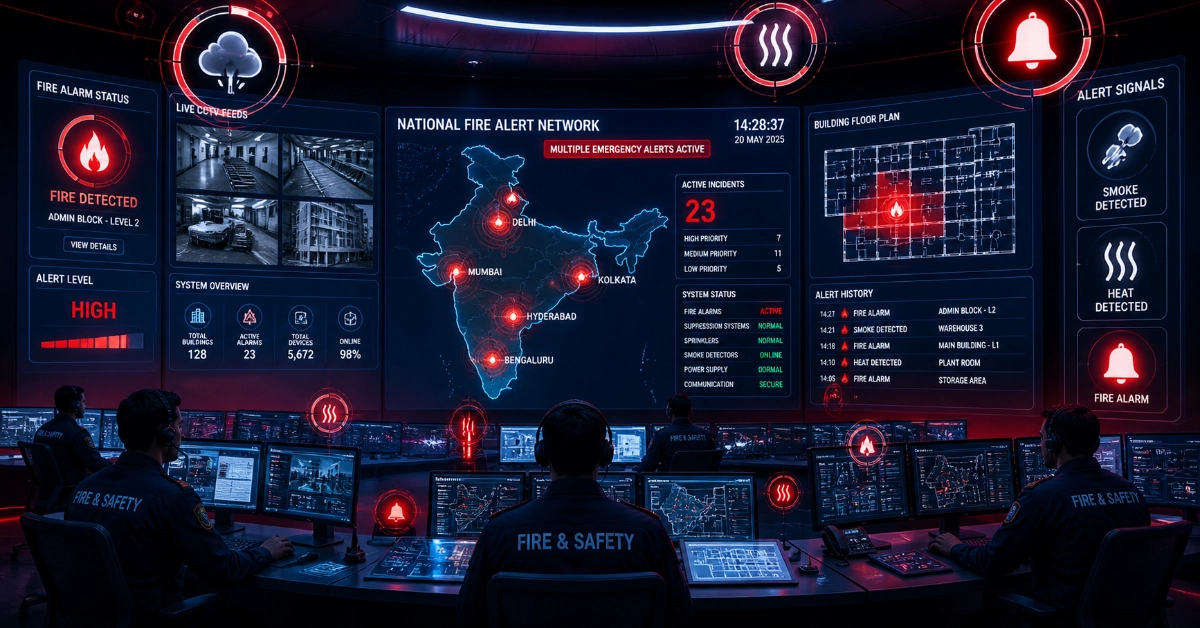
It is 2:47 AM in a 45-storey commercial tower in Mumbai. A faulty HVAC duct overheats and sends smoke drifting through the 18th-floor server room. Within seconds, an addressable smoke detector activates. A signal races through the building network and lands on the operator’s screen at the Integrated Command Centre with a floor map, device ID and real-time CCTV feed of the affected zone.
The operator confirms the threat in under 90 seconds. Evacuation alarms sound on floors 15 to 22. Suppression systems engage. Lifts lock out. The fire brigade is automatically notified. The incident is contained before it spreads.
This is not a coincidence. This is a fire alarm event flow working exactly as it should inside a fully Integrated Command Centre.
Fire emergencies are brutally unforgiving. A delay of just a few minutes can transform a containable incident into a catastrophe. That is why understanding the fire alarm event flow in integrated command centres is no longer optional; it is essential for every building manager, security professional and fire safety engineer.
What Is Fire Alarm Event Flow?
Fire alarm event flow is the complete, sequential journey of a fire signal from the moment a detector senses a threat to the moment the incident is resolved and logged.
Think of it as a chain of actions, each linked to the next. Every link matters. A break in any link, a delayed signal, a misconfigured panel, or an unprepared operator can have serious consequences.
Why Does Event Flow Matter?
- It determines how fast an emergency is detected and communicated.
- It defines the quality of the operator’s response.
- It drives automated safety actions (suppression, evacuation, etc.).
- It creates an auditable record for compliance and post-incident analysis.
- It directly impacts life safety outcomes.
In older, siloed systems, event flow was linear and manual. In modern Integrated Command Centres, it is dynamic, automated and cross-system, making it exponentially more effective.
What Is an Integrated Command Centre (ICC)?
An Integrated Command Centre (ICC) is a centralised hub that monitors, manages and responds to all safety and security systems across a facility from a single interface.
It is the nerve centre of a smart building or smart city. Everything flows into it, and every response flows out of it.
What Does an ICC Typically Integrate?
- Fire Alarm Systems (addressable or conventional panels)
- CCTV and Video Surveillance Systems
- Building Management Systems (BMS) HVAC, lighting, power
- Public Address (PA) Systems
- Access Control and Door Locking Systems
- Emergency Lighting and Evacuation Guidance Systems
- Gas Detection and Suppression Systems
- Lift/Elevator Control Systems
ICCs are now standard in large commercial complexes, airports, hospitals, metro stations, data centres, petrochemical plants and smart city infrastructure across India and globally.
The fire alarm system sits at the heart of ICC operations. When a fire event triggers, it is the fire alarm event flow that sets every other system in motion.
Fire Alarm Event Flow: Step-by-Step
Here is the complete, detailed flow of a fire alarm event inside an Integrated Command Centre. This seven-stage sequence represents best-in-class fire safety practice.
| Step | Stage | What Happens |
| Step 1 | Detection | Smoke, heat, or gas detectors (addressable or conventional) sense the threat and send a signal. |
| Step 2 | Signal Transmission | The signal travels via wired or wireless loops to the fire alarm control panel. |
| Step 3 | Panel Processing | The addressable fire alarm panel identifies the exact zone and device, validates the alert and classifies the event. |
| Step 4 | ICC Visualization | The command centre dashboard displays the alarm with location maps, device ID and severity levels. |
| Step 5 | Operator Response | Trained operators verify the alert via CCTV feeds, initiate protocols and communicate with on-ground teams. |
| Step 6 | Automated Actions | Systems trigger evacuation alarms, fire suppression, door releases and elevator recalls automatically. |
| Step 7 | Resolution & Logging | Once the incident is resolved, operators close the event. All data is logged for compliance and analysis. |
Stage 1 — Detection
Detection is the starting point. Addressable detectors such as optical smoke detectors, heat detectors, multi-sensor detectors, or beam detectors constantly monitor their environment. When conditions exceed pre-set thresholds, they activate.
Unlike conventional detectors that only signal a zone, addressable detectors send their unique device ID along with the alert. This pinpoint accuracy is critical for fast response in large buildings.
Stage 2 — Signal Transmission
The activated detector sends an electronic signal through the building’s fire alarm loop, typically a two-wire SLC (Signalling Line Circuit). This loop connects back to the addressable fire alarm panel.
Modern systems also support wireless transmission and IP-based communication, enabling faster and more resilient signal delivery across complex infrastructures.
Stage 3 — Panel Processing
The addressable fire alarm panel receives the signal and immediately processes it. It identifies the exact device, validates the alert type, cross-checks with neighbouring detectors, and classifies the event as pre-alarm, alarm, or fault.
This processing stage is where intelligent panels reduce false alarms. Advanced panels can cross-reference multiple sensor inputs before triggering a full alarm, eliminating nuisance alerts that waste emergency resources.
Stage 4 — Command Centre Visualisation
Once the panel confirms an alarm, the event is instantly displayed on the ICC dashboard. Operators see a real-time floor map with the exact device location highlighted, the alarm type, severity level, time stamp and live CCTV feeds from nearby cameras.
This visual clarity is what separates an ICC from a standalone panel. Operators do not have to guess where the fire is; they see it.
Stage 5 — Operator Response
Trained operators at the ICC follow pre-defined Standard Operating Procedures (SOPs). They verify the alert using CCTV, contact floor wardens, dispatch security or fire response teams and initiate communication through the PA system.
This human verification layer is essential for avoiding over-reaction to false alarms while ensuring zero under-reaction to real ones.
Stage 6 — Automated Actions
In parallel with operator response, the ICC triggers a cascade of automated actions:
- Evacuation alarms sound in affected zones and adjacent areas.
- Fire suppression systems (sprinklers, gas suppression) activate in the specific zone.
- Magnetic door hold-open release, closing fire doors automatically.
- Lifts recall to the ground floor and lock out.
- HVAC systems shut down or switch to smoke extraction mode.
- Access control restricts non-emergency personnel from affected areas.
- The fire brigade receives an automated notification with location data.
These automated responses happen in seconds, far faster than any manual intervention could achieve.
Stage 7 — Resolution and Logging
Once the fire is extinguished and the area declared safe, the operator resets the alarm. The ICC automatically generates a full incident log including activation time, response time, devices involved, actions taken and personnel notified.
This log is invaluable for fire safety audits, regulatory compliance, insurance claims and continuous improvement of emergency response plans.
5. How Integration Enhances Fire Safety
An isolated fire alarm panel does its job, but an integrated fire alarm system inside an ICC does it exponentially better. Here is why.
Real-Time Alerts Across All Systems
Integration means that a fire alarm event does not just trigger a siren. It simultaneously updates every connected system, CCTV, BMS, PA and access control in real time. Decision-makers get the full picture instantly.
Faster Decision-Making
When an operator can see the fire location on a map, pull up a live CCTV feed, and trigger suppression all from one screen, response time drops dramatically. Studies in smart city deployments consistently show that integrated systems reduce effective response time by 30% to 60% compared to standalone systems.
Reduced Human Error
Manual coordination between different departments and systems introduces delays and mistakes. Integration automates the most critical actions, eliminating the risk of human error at the most crucial moment.
Centralised Monitoring Across Multiple Sites
For facility managers overseeing multiple buildings, retail chains, hospital networks and industrial campuses, a single ICC can monitor all fire alarm systems from one location. This centralised oversight means no site is ever unmonitored.
6. The Role of Advanced Fire Alarm Systems in ICC Performance
The performance of the entire fire alarm event flow depends on the quality of the fire alarm system at its core. A system with slow signal processing, poor integration capability, or limited scalability will undermine even the best-designed ICC.
This is where choosing the right fire alarm system becomes a strategic decision, not just a compliance one.
GST Fire Alarm Systems are engineered specifically for demanding, large-scale environments, including integrated command centres, industrial facilities, smart city infrastructure and high-rise buildings across India.
What Makes GST Suitable for Integrated Command Centres?
- Addressable panel architecture with loop capacities supporting hundreds of devices per panel.
- High-speed signal processing for sub-second event transmission to the ICC.
- Open-protocol integration capability compatible with leading BMS, SCADA and security platforms.
- Scalable design that grows with the facility from a single building to a campus-wide network.
- Robust hardware built for the Indian climate, dust, heat and humidity resistant.
- Compliance with IS 2189 and other relevant fire safety standards.
GST fire alarm systems are not just detectors and panels; they are intelligence nodes in your ICC network. When every millisecond of the fire alarm event flow matters, the reliability of GST systems provides the foundation that operators and building managers can trust.
7. Addressable vs Conventional Fire Alarm Systems in an ICC
One of the most important decisions in designing fire alarm event flow for an ICC is the choice between an addressable fire alarm panel and a conventional fire alarm panel. They are fundamentally different in how they communicate, and that difference has enormous implications for ICC performance.
| Feature | Addressable System | Conventional System |
| Device Identification | Exact device & location | Zone only |
| Response Speed | Faster — precise location | Slower — zone-wide search needed |
| False Alarm Reduction | High — individual device data | Lower — no device-level data |
| ICC Integration | Seamless with full data feed | Limited data output |
| Scalability | Highly scalable | Limited scalability |
| Cost | Higher initial investment | Lower initial cost |
| Best For | Large buildings, smart cities, ICCs | Small buildings, simple setups |
Addressable Fire Alarm Panels — The ICC Standard
An addressable fire alarm panel assigns a unique address to every single detector, call point, sounder and module on the loop. When any device activates, the panel knows exactly which device it is and where it is located, room number, floor, zone and building.
This precision is essential in an ICC. Operators cannot afford to search an entire floor to locate a fire. With an addressable system, they know the exact device within seconds of activation.
For large buildings, airports, hospitals, or multi-site campuses, addressable detectors connected to an addressable panel are the only practical choice for ICC integration.
Conventional Fire Alarm Panels — Limited ICC Integration
A conventional fire alarm panel divides a building into zones. When an alarm triggers, the panel knows which zone is affected, but not which specific device. This zone-only identification is a significant limitation in ICC environments.
Conventional systems are better suited to smaller, simpler buildings where the number of devices per zone is low and precise location data is less critical. They are rarely deployed in modern ICCs due to their limited data output and integration constraints.
Real-World Example: In a 500-bed hospital with 2,000 fire devices across 8 floors, a conventional system would tell the ICC operator that fire is detected on Floor 3 East Wing. An addressable system would tell them it is Smoke Detector SD-3-E-47 in the ICU isolation room, with a photo from the nearest CCTV camera already on screen.
8. Common Challenges in Fire Alarm Event Flow
Even well-designed fire alarm systems face challenges in real-world ICC environments. Understanding these challenges helps teams design better, more resilient systems.
Signal Delays
In large loop networks, signal transmission delays can occur, especially in older wiring or poorly maintained systems. Every second of delay matters. Regular cable testing and panel diagnostics are essential to maintain sub-second event transmission.
False Alarms
False alarms are among the biggest operational challenges for ICCs. They waste response resources, cause evacuation fatigue, and can desensitise operators to real threats. Advanced addressable detectors with multi-criteria sensing (combining smoke, heat and CO data) significantly reduce false alarm rates.
Integration Gaps
Not all fire alarm panels communicate using open protocols. Some proprietary systems refuse to share data with third-party BMS or SCADA platforms, creating gaps in the ICC’s ability to respond holistically. Always specify open-protocol compatibility during system procurement.
Data Overload
In very large facilities with thousands of devices, operators can be overwhelmed by the volume of alerts, status updates, and system messages. Intelligent ICC software must prioritise and filter events so operators focus on what matters, not every routine status ping from a healthy system.
Maintenance and Testing Gaps
Fire alarm event flow is only as reliable as the last maintenance check. Unserviced detectors, corroded connections, or outdated panel firmware can silently degrade system performance. Scheduled preventive maintenance and regular full-scale testing are non-negotiable.
9. Best Practices for Seamless Fire Alarm Event Flow
System Design
- Always choose an addressable fire alarm panel for any ICC-integrated deployment.
- Design detector placement based on detailed risk assessment, not just regulatory minimums.
- Plan cable routes for redundancy, so that a single cable fault should not disable an entire zone.
- Size the panel loop capacity with at least 20% headroom for future expansion.
Integration Planning
- Specify open-protocol communication (BACnet, Modbus, TCP/IP) for all fire alarm panels in ICC environments.
- Map event flow SOPs before system commissioning, and know exactly what happens at each stage.
- Test integrated responses end-to-end, not just individual systems in isolation.
- Ensure the ICC software is configured to prioritise fire events above all other alerts.
Maintenance and Testing
- Conduct quarterly inspection of all detectors, panels and communication pathways.
- Perform full evacuation drills twice per year with real-time ICC monitoring.
- Review incident logs monthly to identify patterns; recurring false alarms may signal a deteriorating detector.
- Keep panel firmware updated to access the latest security patches and performance improvements.
- Engage certified fire alarm engineers for all maintenance activities.
10. Future Trends: The Next Generation of Fire Alarm Event Flow
AI-Based Fire Detection
Artificial intelligence is transforming fire detection. AI-powered detectors use machine learning to distinguish between actual fire signatures and common false alarm triggers (cooking smoke, steam, dust). This dramatically reduces false alarms while improving detection sensitivity for real events.
In ICC environments, AI-based analytics can also predict which areas are at elevated risk based on environmental patterns, enabling preventive intervention before a fire starts.
Smart City Integration
India’s smart city mission is accelerating the integration of building-level fire alarm systems with city-wide command centres. Under this model, fire events at individual buildings are automatically reported to municipal emergency services, triggering coordinated responses that include fire brigades, ambulances and traffic management (to clear routes for emergency vehicles).
This city-level event flow represents the most advanced expression of integrated fire safety, and it is already operational in several Indian cities.
Cloud-Based Monitoring and Analytics
Cloud-connected fire alarm systems enable remote monitoring of panels, detectors, and event logs from anywhere in the world. Facility managers can monitor multiple sites from a mobile device. Predictive analytics flags potential maintenance issues before they cause failures.
GST Fire Alarm Systems are actively developing cloud-ready solutions that position their addressable panels at the centre of next-generation, cloud-connected ICC infrastructures.
IoT-Enabled Devices
The Internet of Things (IoT) is bringing fire safety into the connected device ecosystem. IoT-enabled detectors self-report health status, calibration drift and battery levels, enabling predictive maintenance that eliminates unexpected failures.
Conclusion: Event Flow Excellence Saves Lives
Fire safety is not just about having the right detectors on the ceiling. It is about what happens after they activate and how fast, how accurately and how effectively the entire system responds.
Fire alarm event flow in integrated command centres represents the gold standard of modern fire safety management. It transforms isolated hardware into an intelligent, coordinated safety ecosystem, one that gives operators the information, tools and automation they need to protect lives and property in the moments that matter most.
Whether you are designing a new ICC, upgrading an existing fire alarm system, or planning a smart city safety infrastructure, the choice of fire alarm system is one of the most consequential decisions you will make.
GST Fire Alarm Systems delivers the reliability, integration capability, and scalability that modern Integrated Command Centres demand. From addressable detectors that pinpoint the exact source of danger, to panels that speak fluently with your BMS and SCADA, GST is engineered for the environments where failure is simply not an option.
Choose your fire alarm system the way you choose a safety partner for reliability, expertise and the confidence that when the alarm sounds, everything that follows will work perfectly.
Read Also: Device-Level Failure Patterns in Addressable Fire Alarm Systems: Causes, Detection & Prevention