Imagine spending ₹50 lakh on a CCTV infrastructure rollout only to find that your cameras are outdated within 3 years, maintenance costs are spiralling, and you’re locked into a system that can’t scale with your business.
Or imagine choosing a “pay-per-month” surveillance subscription and realising two years later that the cumulative cost has exceeded what you’d have paid to own the system outright.
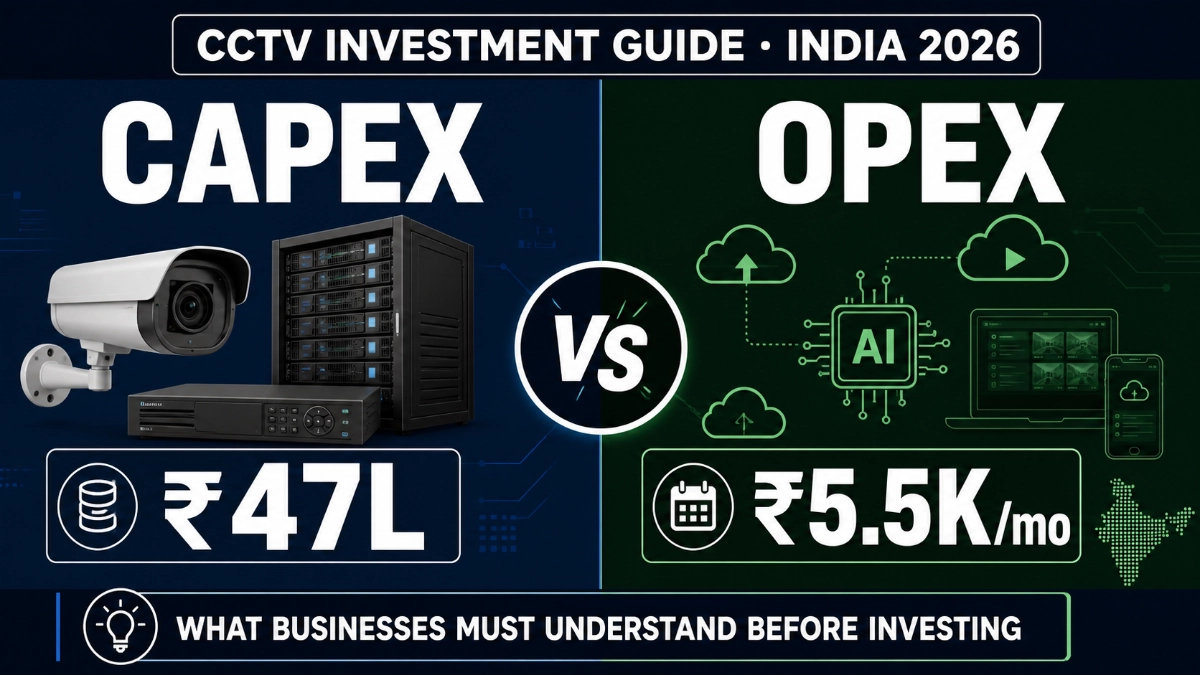
This is the CAPEX vs OPEX dilemma, and it’s one of the most important financial decisions any business makes when investing in security infrastructure.
Whether you’re a factory owner in Pune, a retail chain operator in Delhi, or a smart city project manager in Hyderabad, understanding how you fund your CCTV system can directly impact your total cost of ownership, operational agility and long-term security posture.
This guide breaks it all down clearly, practically and with India-specific insights that matter in 2026 and beyond.
What Are CAPEX and OPEX?
CAPEX (Capital Expenditure) in CCTV refers to a one-time upfront investment in hardware, software and installation that a business owns outright. OPEX (Operational Expenditure) refers to a recurring subscription or service fee model, such as cloud CCTV or VSaaS, where infrastructure costs are spread over time.
CAPEX (Capital Expenditure)
CAPEX refers to funds spent to acquire, upgrade, or maintain physical assets. In CCTV terms, this includes purchasing cameras, DVRs/NVRs, servers, cabling and paying for installation all as a one-time investment.
Example: A manufacturing plant in Gujarat invests ₹80 lakh to deploy 200 IP cameras with an on-premise NVR and a dedicated server room. This is a CAPEX investment owned, depreciated over time and maintained by the plant’s internal IT team.
OPEX (Operational Expenditure)
OPEX refers to ongoing business costs for day-to-day operations. In CCTV terms, this means subscribing to a managed surveillance service, cloud-based video storage, or Video Surveillance as a Service (VSaaS), paying a monthly or annual fee instead of owning hardware outright.
Example: A retail startup in Bengaluru installs 20 cloud-connected cameras through a managed security provider. They pay ₹15,000/month for 24/7 monitoring, cloud storage and maintenance. No upfront capital required.
Quick Comparison: CAPEX vs OPEX at a Glance
| Parameter | CAPEX | OPEX |
| Nature of Expense | One-time capital investment | Recurring operational cost |
| Ownership | Business owns the assets | Service provider owns infrastructure |
| Upfront Cost | High initial outlay | Low or zero upfront cost |
| Maintenance | In-house responsibility | Included in service contract |
| Scalability | Limited (hardware-bound) | Highly flexible and scalable |
| Technology Refresh | Requires new capital spend | Automatic with subscription |
| Accounting Treatment | Depreciated over asset life | Expensed in current period |
| Best For | Large, stable enterprises | SMEs, startups, fast-scaling orgs |
The CAPEX Model in CCTV: Deep Dive
Traditional enterprise-grade CCTV infrastructure has always been built on CAPEX. It’s the conventional approach: buy the hardware, install it, own it and manage it internally.
What Does a CAPEX CCTV Project Look Like?
- Hardware procurement: IP cameras, PTZ cameras, NVRs, DVRs, servers, hard drives, PoE switches.
- Civil and cabling work: Conduit laying, junction boxes, power backup (UPS), server room setup.
- Software licensing: VMS (Video Management Software), analytics platforms, and access control integration.
- Installation and commissioning: Professional setup by certified integrators.
- Ongoing AMC (Annual Maintenance Contract): Separate recurring cost for support and repairs.
Real-World CAPEX Example: Industrial Warehouse
Scenario: A large FMCG warehouse in Bhiwandi (Mumbai Metropolitan Region) requires complete CCTV coverage across 4 lakh sq. ft., including loading docks, storage zones and entry/exit points.
| Cost Component | Estimated Cost (INR) |
| 50 IP Cameras (2MP HD) | ₹24,00,000 |
| NVR + Server Infrastructure | ₹15,00,000 |
| Cabling & Civil Work | ₹10,00,000 |
| VMS Software License | ₹7,00,000 |
| Installation & Commissioning | ₹10,50,000 |
| Total CAPEX Investment | ₹66,50,000 |
| Annual AMC (Ongoing OPEX) | ₹15,00,000/year |
Advantages of CAPEX in CCTV
- Full ownership and control over data and infrastructure.
- No dependency on internet connectivity for local recording.
- Long-term cost savings if the system is well-maintained.
- Greater customisation of hardware and software tailored to specific needs.
- Suitable for compliance-heavy sectors (banking, government, defence).
Challenges of CAPEX in CCTV
- High upfront capital requirement can strain cash flow.
- Technology obsolescence risk: Cameras and NVRs become outdated.
- Internal IT team must manage maintenance, upgrades and failures.
- Difficult to scale without significant additional investment.
- Depreciation can become an accounting burden over 5-7 years.
The OPEX Model in CCTV: Modern Surveillance-as-a-Service
The rise of cloud computing, IoT, and AI has given birth to a new era of surveillance, one where you don’t buy security, you subscribe to it.
What is VSaaS (Video Surveillance as a Service)?
VSaaS is a cloud-based CCTV model where cameras stream footage directly to secure cloud servers. The service provider handles storage, maintenance, software updates and often AI-powered analytics, all included in a monthly/annual fee.
What Does an OPEX CCTV Deployment Include?
- Cloud cameras: Edge-processing cameras with direct cloud connectivity.
- Managed storage: Video retained in the cloud (7 to 90 days, based on plan).
- AI analytics: Motion detection, facial recognition, crowd analysis, intrusion alerts.
- Remote access: View footage anytime, anywhere on mobile or desktop.
- SLA-backed maintenance: Hardware replacement and uptime guarantees by the provider.
Real-World OPEX Example: Retail Chain Expansion
Scenario: A D2C fashion brand is rapidly expanding, opening 30 new stores across Tier 1 and Tier 2 cities in India over 18 months. Installing a traditional CAPEX CCTV system at each store would cost approximately ₹2-3 lakh per outlet upfront.
Instead, they opt for a VSaaS model:
| OPEX Model Component | Monthly Cost per Store |
| 4 Cloud Cameras (HD AI-enabled) | ₹5,200/month |
| Cloud Storage (30-day retention) | ₹1,500/month |
| AI Analytics & Dashboard Access | ₹1500/month |
| Maintenance & SLA Coverage | ₹2000/month |
| Total per Store (Monthly) | ₹10,200/month |
Result: Zero upfront cost. Full scalability. AI-powered monitoring across all 30 outlets from a single dashboard.
Advantages of OPEX in CCTV
- Minimal to zero capital investment upfront.
- Predictable monthly budgeting for finance teams.
- Automatic software and firmware updates.
- Easily scalable, add cameras without additional infrastructure.
- Access to cutting-edge AI analytics without extra licensing.
- Ideal for geographically distributed operations.
Challenges of OPEX in CCTV
- Long-term cumulative costs may exceed CAPEX over 7-10 years.
- Dependency on internet connectivity for live access and cloud storage.
- Data privacy concerns footage stored on third-party servers.
- Vendor lock-in risk if the provider discontinues service.
- May not meet compliance requirements for sensitive data sectors.
CAPEX vs OPEX: The Definitive Comparison
Cost Comparison: Short-Term vs Long-Term
At first glance, OPEX seems cheaper. But the math changes over time.
| Scenario | Year 1 | Year 3 | Year 5 | Year 7 |
| CAPEX (50-cam system) | ₹67L (setup) | ₹36L (incl. AMC) | ₹42L | ₹48L |
| OPEX @ ₹40K/mo | ₹4.8L | ₹14.4L | ₹24L | ₹33.6L |
| OPEX @ ₹75K/mo | ₹9L | ₹27L | ₹45L | ₹63L |
Note: Hypothetical illustrative figures for a 50-camera mid-size commercial deployment.
Full Feature Comparison
| Factor | CAPEX | OPEX |
| Upfront Investment | High (₹10L+) | Low or Zero |
| Monthly Recurring Cost | Low (AMC only) | Fixed subscription fee |
| Ownership | Full ownership | Service right only |
| Technology Lifecycle | 3-7 year hardware life | Always current tech |
| Maintenance | In-house/AMC | Provider-managed |
| Scalability | Difficult, costly | Instant, easy |
| AI/Analytics Access | Additional licensing needed | Often bundled |
| Cloud Storage | Requires local servers | Included/add-on |
| Data Privacy Control | Full control | Shared with provider |
| Internet Dependency | No (local NVR) | Yes (cloud-dependent) |
| Best Deployment Size | Large, stable sites | Multi-site, growing orgs |
| Tax Treatment | Depreciation | Fully deductible expense |
| Ideal Sector | Industrial, Government | Retail, IT, Startups |
When to Choose CAPEX and When to Choose OPEX
Choose CAPEX When…
- You operate a large, permanent facility: Factories, warehouses, hospitals, or government buildings with stable, long-term usage.
- Data sovereignty is a priority: Sectors like banking, defence, and healthcare require on-premise storage.
- You have strong internal IT capability: Your team can manage maintenance and upgrades without external support.
- Long-term ROI is the goal: CAPEX delivers better value over 7+ years in stable environments.
- Connectivity is limited: Sites in remote areas or with unreliable internet need local recording.
Choose OPEX When…
- You are scaling rapidly: Retail expansion, franchise rollout, or new project sites that change frequently.
- Capital conservation is critical: Startups, SMEs, or new businesses that can’t commit large upfront funds.
- You need multi-location management: Centrally monitor 5, 50, or 500 locations through a single cloud dashboard.
- Technology upgrades matter: You want access to the latest AI cameras without reinvesting in hardware.
- Flexible contracts are preferred: Project-based or leased commercial spaces where long-term investment isn’t justified.
Industry-Wise Recommendations
| Industry | Recommended Model | Rationale |
| Heavy Manufacturing & Factories | CAPEX | High camera density, stable sites, and data control needs |
| Warehousing & Logistics | CAPEX or Hybrid | Long-term sites with AMC backup |
| Retail Chains & D2C Brands | OPEX (VSaaS) | Multi-site scalability, no IT overhead |
| IT Parks & Co-working Spaces | OPEX or Hybrid | Tenant flexibility, cloud dashboard access |
| Government & Smart Cities | CAPEX (or Hybrid) | Compliance, local data storage, large scale |
| Hospitals & Healthcare | CAPEX | Patient data privacy, regulatory compliance |
| Startups & Small Businesses | OPEX | Zero capex, predictable opex, easy start |
| Infrastructure Projects (Roads, Ports) | CAPEX + Hybrid | Long lifecycle, phased deployment |
The India Market Perspective: A Shift in Surveillance Investment
India’s security and surveillance market is projected to grow to USD 7.2 billion by 2027, driven by smart city missions, industrial expansion and rising security awareness. But more importantly, the model of investment is changing.
Why Indian Businesses Are Moving Toward OPEX
- Capital constraints: Many Indian SMEs and mid-size businesses prefer predictable monthly costs over large lump-sum investments.
- Rapid urbanisation: New commercial complexes, township developments, and retail corridors need surveillance from Day 1 without waiting for capex approvals.
- GST Input Tax Credit: OPEX-based security expenditure may qualify for ITC claims, improving effective cost efficiency.
- Digital infrastructure push: Affordable 4G/5G and Jio’s broadband expansion make cloud CCTV viable even in smaller towns.
- Smart City Mission: Government initiatives in 100+ cities are integrating cloud-based surveillance platforms, setting a precedent for OPEX-first thinking.
Tier-Wise Market Insights
| City Tier | Dominant Model | Key Driver |
| Tier 1 (Mumbai, Delhi, Bengaluru, Chennai) | Hybrid (CAPEX + OPEX) | Enterprise scale + cloud analytics |
| Tier 2 (Pune, Ahmedabad, Jaipur, Lucknow) | Growing OPEX adoption | Retail expansion, affordable broadband |
| Tier 3 & Industrial Zones (Surat, Coimbatore, Ludhiana) | CAPEX dominant | Factory & MSME ownership preference |
| Smart City Zones (Bhopal, Indore, Visakhapatnam) | OPEX / Hybrid | Government-driven cloud surveillance |
Bottom line: India is not abandoning CAPEX; it is evolving toward a more nuanced, hybrid approach that reflects the diversity of its industries, geographies, and business scales.
Future Trends Reshaping CCTV Investment Models
1. AI-Powered Surveillance
AI is no longer a premium add-on; it’s becoming standard. Object detection, behaviour analytics, licence plate recognition and crowd density analysis are now embedded in cloud cameras, making OPEX models far more attractive.
2. Cloud Adoption & Edge Computing
Hybrid edge-cloud architectures allow cameras to process data locally (reducing bandwidth costs) while syncing critical footage to the cloud. This is driving a new wave of intelligent OPEX deployments.
3. The Rise of Hybrid CAPEX + OPEX Models
The smartest businesses today are adopting hybrid models: investing in camera hardware (CAPEX) while subscribing to cloud storage and AI analytics (OPEX). This balances ownership with flexibility.
Example: An industrial park in Pune installs 500 cameras (CAPEX) but uses a VSaaS platform for cloud storage, remote access, and AI-based perimeter alerts (OPEX subscription of ₹3L/month).
4. Cybersecurity & Compliance Trends
With India’s Digital Personal Data Protection (DPDP) Act 2023 coming into force, businesses must carefully evaluate where surveillance data is stored and who has access. CAPEX deployments with on-premise storage offer stronger compliance clarity, while OPEX providers are increasingly offering sovereign cloud options in India.
5. Subscription Models from OEM Manufacturers
Major CCTV manufacturers like Honeywell are launching subscription-based analytics and cloud services directly. The line between CAPEX and OPEX is blurring at the OEM level itself.
Expert Insights: Practical Tips for Decision-Makers
“The question is not CAPEX or OPEX, it is which model best aligns with your growth trajectory, risk appetite and operational reality. The most expensive mistake is choosing based on upfront cost alone.”
Before You Invest: Ask These Questions
- How long will this facility or site be operational? (5 years vs 20 years changes everything)
- Is your organisation in an expansion phase or a stable maintenance phase?
- What are your data privacy and compliance obligations?
- Do you have internal IT resources to manage on-premise infrastructure?
- Is AI analytics a nice-to-have or a core security requirement?
- What is your total cost tolerance over 5 years, not just Year 1?
- Do you need redundancy and disaster recovery built into your surveillance?
The 3-Step Evaluation Framework
- Step 1 — Map Your Footprint: Identify the number of sites, camera count, storage requirements and growth plans for 3-5 years.
- Step 2 — Calculate TCO: Total Cost of Ownership over 5-7 years for both CAPEX and OPEX scenarios. Include hardware refresh, AMC, cloud fees and personnel costs.
- Step 3 — Validate with a Pilot: Before full deployment, run a 90-day pilot with your preferred model at one site to validate performance, cost assumptions and operational fit.
The Right Model is the One That Works for You
There is no single “correct” answer in the CAPEX vs OPEX debate. The right choice is deeply contextually shaped by your industry, scale, geography, growth plans and financial strategy.
CAPEX builds permanence: It gives you control, ownership and long-term cost efficiency when your operations are stable, and your site is here to stay.
OPEX builds agility: It lets you scale faster, adopt newer technology and conserve capital when you need flexibility more than ownership.
Hybrid builds resilience: And increasingly, the smartest organisations in India and globally are combining both owning the hardware and subscribing to the intelligence.
As AI surveillance, cloud computing and smart city infrastructure continue to evolve at breakneck speed, the organisations that stay ahead will be those that evaluate their CCTV investment not as a one-time procurement decision but as a strategic, evolving security posture.
Read Also: Camera Exposure and WDR Tuning for Industrial Lighting
Read Also: Camera Exposure and WDR Tuning for Industrial Lighting