It was 2:47 AM. A large FMCG warehouse in Pune, India, lost goods worth over ₹18 lakhs in a single shift. The perpetrators walked straight through three unmonitored rack aisles, bypassed the loading-dock entry and vanished before the next guard round.
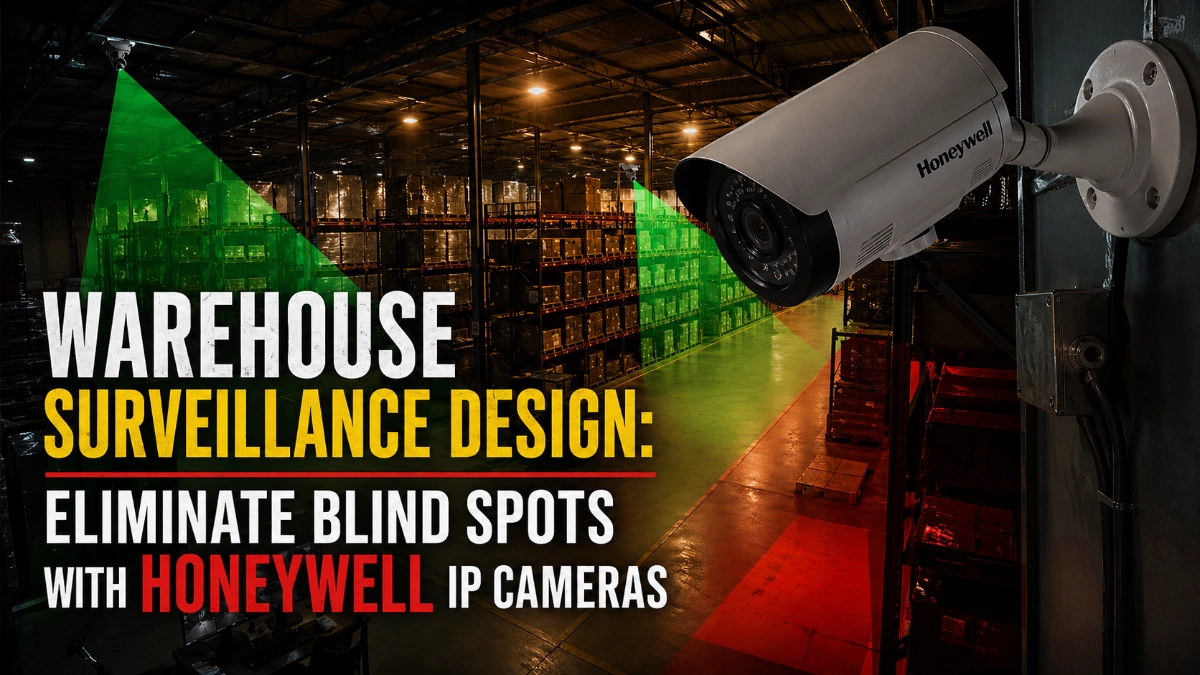
Discover how Honeywell industrial IP cameras transform warehouse security, the right way.
The warehouse had CCTV. But it had the wrong CCTV.
Standard commercial cameras covered only the entry gates and a single manager’s cabin. The rest of the 40,000 sq. ft. floor, every dark aisle, every raised pallet position, every corner behind a storage rack sat completely invisible.
This is the blind spot problem. And it costs Indian warehouses thousands of crores every year.
Today, you will learn exactly how to design a warehouse surveillance system that eliminates blind spots using a proven, step-by-step engineering methodology and Honeywell IP cameras built for industrial environments.
Why Blind Spots Are a Major Risk in Warehouses
Blind spots are not just security gaps. They are operational liabilities. Here is why they matter so much in a warehouse environment:
Theft Zones
Criminals study your CCTV coverage before striking. They move goods through unmonitored rack aisles, exchange high-value items at loading docks, or conceal stock beneath raised pallets, all in your blind spots.
Loading and Unloading Areas
Loading docks are the highest-risk zones in any warehouse. Goods move in and out rapidly. Without precise camera coverage, theft and unauthorised entry happen in plain sight yet remain completely undetected.
Rack Aisles
Standard warehouse racks reach 8 to 12 feet in height. They create natural corridors that block camera sight lines. A single misplaced camera misses entire sections of inventory.
Human Error and Safety Hazards
Poor surveillance visibility also causes safety failures. Forklifts collide with pedestrians. Workers ignore safety zones. Accidents go unrecorded. Without complete visual coverage, you cannot investigate incidents properly or prove regulatory compliance.
Stat: Up to 42% of inventory losses in Indian warehouses occur in areas with poor or zero CCTV coverage. (Industry estimate)
Why Industrial CCTV Is Fundamentally Different from Commercial CCTV
This is the most misunderstood aspect of warehouse security. Many facility managers deploy commercial-grade cameras purchased from a retail store and wonder why their coverage fails within months. The difference is not just price, it is engineering philosophy.
| Feature | Industrial CCTV | Commercial CCTV |
| Operating Environment | Harsh — dust, heat, humidity, vibration, direct sunlight | Controlled — offices, malls, retail stores |
| Camera Build | IP66/IP67 rated, metal housing, tamper-proof | Plastic housing, standard indoor rating |
| Resolution | 4MP to 8MP+ for wide coverage | 1MP to 2MP typical |
| Coverage Strategy | Zero blind spots — engineered placement | General area coverage |
| IR / Low-Light | Advanced IR up to 60–100m, Wide Dynamic Range | Basic IR up to 20–30m |
| Integration | Fire alarms, access control, SCADA, industrial PLCs | Limited — standalone or basic NVR |
| Analytics | AI-based — intrusion, object tracking, heat mapping | Basic motion detection only |
| Lifespan | 7–10 years in field conditions | 2–4 years typical |
| Power Backup | Compatible with industrial UPS and PoE switches | Standard power only |
| Compliance | BIS/STQC compatible, MIL-STD vibration rated | No industrial certification |
The conclusion is clear. Using commercial cameras in a warehouse is like using a car engine in a truck. It might run, but it will not last or perform.
Warehouse Surveillance Design Strategy — Step by Step
Follow this engineering methodology to design a truly blind-spot-free warehouse surveillance system.
Step 1: Site Survey and Risk Mapping
Begin with a full site walk. Document the warehouse floor plan to scale. Mark every zone storage aisles, loading docks, entry/exit gates, manager cabins, high-value storage and perimeter walls.
Identify all existing infrastructure: power points, conduit routes, network switch locations, lighting levels and ceiling heights. This data forms the foundation of your design.
Step 2: Blind Spot Identification
On your floor plan, mark all areas that current cameras miss. Use a camera coverage simulation tool or simply draw camera view angles manually (typically 90° to 110° for fixed cameras). Shade every uncovered zone in red.
Pay special attention to: rack aisle ends, column bases, dock leveller areas, emergency exits and elevated mezzanine storage.
Step 3: Camera Placement Planning
Plan camera positions to achieve overlapping coverage. Every critical zone must be covered by at least two cameras from different angles. This redundancy ensures no single camera failure creates a blind spot.
Use a mix of fixed cameras for specific zones and PTZ (pan-tilt-zoom) cameras for wide open areas. PTZ cameras allow remote operators to track movement across large sections.
Step 4: Wide Dynamic Range and IR Camera Selection
Warehouses face extreme lighting challenges. Loading dock doors open to bright daylight while interiors remain dim. Choose cameras with a Wide Dynamic Range (WDR) of at least 120dB.
Select cameras with built-in infrared (IR) illumination for night-time coverage. Honeywell’s industrial IP cameras offer IR ranges up to 80 metres, sufficient for most warehouse aisle lengths.
Step 5: Height and Angle Optimisation
Mount cameras at 3 to 4.5 metres height for optimal aisle coverage. Tilt cameras 15° to 30° downward to capture face-level images while maintaining wide area coverage.
Avoid mounting cameras too high above 6 metres, as face identification becomes difficult even at 4MP resolution.
Step 6: Overlapping Coverage Technique
Design camera fields of view to overlap by 20 to 30 per cent with adjacent cameras. This overlap ensures continuous visual coverage and provides backup footage if one camera is obstructed.
For rack aisles, mount cameras at every third or fourth rack column end, angled down the aisle. Two cameras facing each other from opposite ends of a long aisle eliminate the aisle blind spot.
Step 7: AI Analytics Integration
Modern warehouse surveillance design is not complete without AI-based video analytics. Configure your system for motion detection, intrusion zone alerts, object left behind detection and crowd density analysis.
These analytics dramatically reduce false alarms and ensure security teams respond only to genuine threats, not every forklift movement.
How Honeywell IP Cameras Solve Warehouse Blind Spot Problems
Honeywell’s industrial IP camera range is specifically engineered for environments like warehouses, manufacturing plants and logistics hubs. Here is why system integrators across India specify Honeywell for industrial projects:
Smart On-Board Analytics
Honeywell IP cameras include built-in edge analytics. They run motion detection, tripwire alerts and object classification directly on the camera, reducing bandwidth consumption and NVR processing load. In large warehouses with 50+ cameras, this matters enormously.
High Resolution — 4MP to 8MP
Honeywell’s Performance and Equip series cameras deliver 4MP and 8MP resolution. This resolution allows a single camera to cover a wider area while still producing clear identification-quality images. Fewer cameras. Better coverage. Lower installation cost.
Exceptional Low-Light Performance
Honeywell’s Starlight and WDR-enabled cameras perform exceptionally in low-light conditions down to 0.002 lux in some models. This makes them ideal for Indian warehouses where ambient lighting is inconsistent and power failures are common.
Remote Monitoring and Mobile Access
Honeywell’s Pro-Watch and MAXPRO VMS platforms allow warehouse managers and security teams to access live and recorded footage from any device, smartphone, tablet, or desktop. Real-time alerts push to mobile devices for immediate response.
Seamless Integration with Industrial Systems
Honeywell IP cameras integrate natively with Honeywell access control systems, fire alarm panels, and building management systems. This integration creates a single unified security platform, reducing the complexity and cost of managing multiple systems separately.
Key fact: Honeywell IP cameras carry IP66 and IK10 ratings protecting against dust ingress, powerful water jets and physical impact. These ratings are mandatory for any camera installed in an active loading dock area.
Camera Placement Guide by Warehouse Zone
Zone 1 — Entry and Exit Gates
- Mount one camera above the gate facing inward (captures faces of people entering)
- Mount one camera above the gate facing outward (captures vehicle plates and departures)
- Use cameras with LPR (license plate recognition) capability at vehicle gates
- Recommended camera type: 4MP bullet camera with WDR 120dB
Zone 2 — Loading Docks
- Mount cameras at dock corners to capture both the dock leveller area and the truck interior
- Add overhead cameras to capture goods movement between the truck and the warehouse floor
- Use cameras with IR illumination for night shift operations
- Ensure no blind spots behind dock equipment or support pillars
Zone 3 — Storage Aisles
- Install cameras at every alternate aisle entry, pointing down the aisle length
- Use fisheye or wide-angle cameras at cross-aisle intersections
- Maintain overlapping coverage between adjacent aisle cameras
- Mount at rack column top height typically 4 to 5 metres
Zone 4 — High-Value Storage Areas
- Apply a two-camera minimum coverage from perpendicular angles
- Add a PTZ camera for operator-controlled zoom capability
- Configure motion-based recording with immediate alert notifications
- Consider access control integration with camera triggers on the door open event
Zone 5 — Perimeter Security
- Install cameras at 15 to 20 metre intervals along perimeter walls or fences
- Use long-range IR cameras with 60 to 100 metre night vision
- Configure AI-based perimeter intrusion detection with zone exclusions for authorised entry
- Add PTZ cameras at corners for wide-area surveillance with operator control
AI and Smart Surveillance in Modern Warehouse Security
Artificial intelligence has transformed warehouse surveillance design. AI-based video analytics move security from passive recording to active protection.
Motion Detection with Zone Filtering
Configure defined zones where motion triggers alerts, for example, after-hours movement in a high-value storage area immediately alerts the control room. Zone filtering eliminates false alarms from authorised forklift movements.
Intrusion and Loitering Alerts
AI analytics detect individuals who enter restricted zones or remain stationary beyond a defined time threshold. This is critical for loading dock areas where unauthorised loitering precedes theft attempts.
Object Tracking Across Cameras
Advanced systems track an individual or vehicle across multiple camera feeds automatically. If a suspect enters at Gate 1 and moves toward Aisle 7, the system follows and records the complete journey without operator intervention.
Heat Mapping for Coverage Verification
Heat maps generated from surveillance data show you exactly which zones receive the most traffic and which remain inactive. This data helps you identify coverage gaps and optimise camera positions over time.
Automated Reporting and Compliance
AI systems generate automated daily activity reports, including the number of people detected, vehicles processed, and alerts triggered. This data supports audit requirements under Indian warehousing regulations and GST compliance frameworks.
India-Specific Considerations for Warehouse CCTV Design
Designing a warehouse surveillance system in India requires attention to specific local challenges that do not appear in standard international design guides.
Compliance and Regulatory Requirements
Indian warehouses operating under WDR (Warehousing Development and Regulatory Authority) guidelines and those handling bonded goods under customs supervision face specific CCTV compliance requirements. Ensure your system supports a minimum 30-day footage retention, tamper-evident recording, and remote access capability for regulatory auditors.
For cameras procured under government or PSU projects, STQC (Standardisation, Testing and Quality Certification) certification may be mandatory. Honeywell’s India-certified product range satisfies these requirements.
Power Backup and Grid Instability
India’s power grid remains unreliable in many industrial zones, particularly in Tier 2 and Tier 3 cities. Design your CCTV system with a minimum 4-hour UPS backup. Use PoE (Power over Ethernet) switches to reduce power distribution complexity.
Edge storage on the cameras’ local SD card recording provides a critical backup when NVR power fails. Honeywell’s cameras support 256GB edge storage, ensuring no footage gap during power interruptions.
Dust and Temperature Extremes
Indian warehouses in Rajasthan, Gujarat, and the Indo-Gangetic plain regularly experience summer temperatures above 45°C and heavy dust conditions during the dry season. Only cameras with IP66 dust and water ingress ratings perform reliably year-round.
Avoid housing cameras in enclosures unless necessary sealed enclosures that trap heat. Choose cameras with built-in thermal management rated for operating temperatures up to 60°C.
Labor-Intensive Environments
Indian warehouses employ large numbers of daily workers, contract staff and seasonal labour. This high personnel density increases both theft risk and the complexity of monitoring. AI-based crowd analytics help security teams manage large shift changes and identify unusual group movements.
Common Mistakes in Warehouse CCTV Design
Avoid these engineering errors that make even expensive systems fail:
- Ignoring blind spots during the design phase. Always complete a formal blind spot analysis before specifying cameras.
- Using commercial cameras in industrial environments, commercial cameras fail within 18 months in dusty, high-temperature warehouse conditions.
- Poor camera mounting angles. Cameras mounted too high lose face identification capability; cameras mounted too low are vulnerable to tampering.
- No overlapping coverage. Single-point coverage of critical zones creates a single point of failure.
- Underestimating storage requirements, 30-day retention at 1080p/4MP across 50+ cameras requires significant NVR and storage capacity planning.
- Ignoring cable and conduit protection. Exposed cables in active warehouses are damaged by forklifts and machinery regularly.
- No redundancy planning. Critical systems require dual NVRs, RAID storage, and redundant network paths.
- Skipping staff training. Even the best system fails if the control room team does not know how to operate analytics and respond to alerts.
Benefits of Proper Warehouse Surveillance Design
Theft Reduction
Warehouses with properly designed surveillance systems report 60 to 80% reductions in internal theft within the first year of deployment. Comprehensive coverage removes the hiding places that opportunistic theft depends on.
Operational Efficiency
Beyond security, surveillance footage provides invaluable operational data. Review footage to optimise forklift routes, identify bottlenecks at loading docks and verify SOP compliance during goods receipt and dispatch processes.
Safety Improvement
Cameras covering forklift operating zones and pedestrian walkways reduce accident rates. Incident footage provides objective evidence for insurance claims, safety audits and regulatory compliance documentation.
Compliance Readiness
A well-documented surveillance system supports ISO 9001, ISO 45001 and WDRA compliance requirements. Automated reporting simplifies audit preparation and reduces the administrative burden on warehouse managers.
Deterrence Value
Visible, professional CCTV systems deter external theft, vandalism and unauthorised entry. The presence of Honeywell cameras recognisable as high-quality, enterprise-grade equipment signals a serious security posture to potential intruders.
Eliminate Every Blind Spot Before the Next Shift Starts
Warehouse surveillance design is not a box-ticking exercise. It is an engineering discipline that directly protects your inventory, your workforce and your business continuity.
The gap between commercial CCTV and industrial-grade surveillance systems is enormous in performance, durability, analytics capability and real-world value. Honeywell IP cameras bridge that gap with proven technology engineered specifically for harsh industrial environments.
Every blind spot you allow to exist is an invitation to loss. Every camera positioned correctly is a line of defence that pays for itself many times over.
If you are a CCTV engineer, system integrator or warehouse decision-maker in India, now is the time to upgrade. Conduct a formal blind spot analysis. Design for zero unmonitored zones. Specify industrial-grade hardware.
Read Also: Top 10 CCTV Trends Every Business Should Know in 2026
Read Also: Cloud NVR vs Traditional NVR – What’s Better in 2026?