Imagine this: It is 2:30 AM in a large warehouse in Greater Noida. A short circuit sparks inside a packaging unit. The fire starts small, as a flicker, then a flame. The fire alarm system is installed and operational. However, due to poor system architecture and unaddressed network latency in fire alarm systems, the signal takes several extra seconds to travel from the smoke detector to the control panel. Those extra seconds turn a containable fire into a ₹2 crore loss.
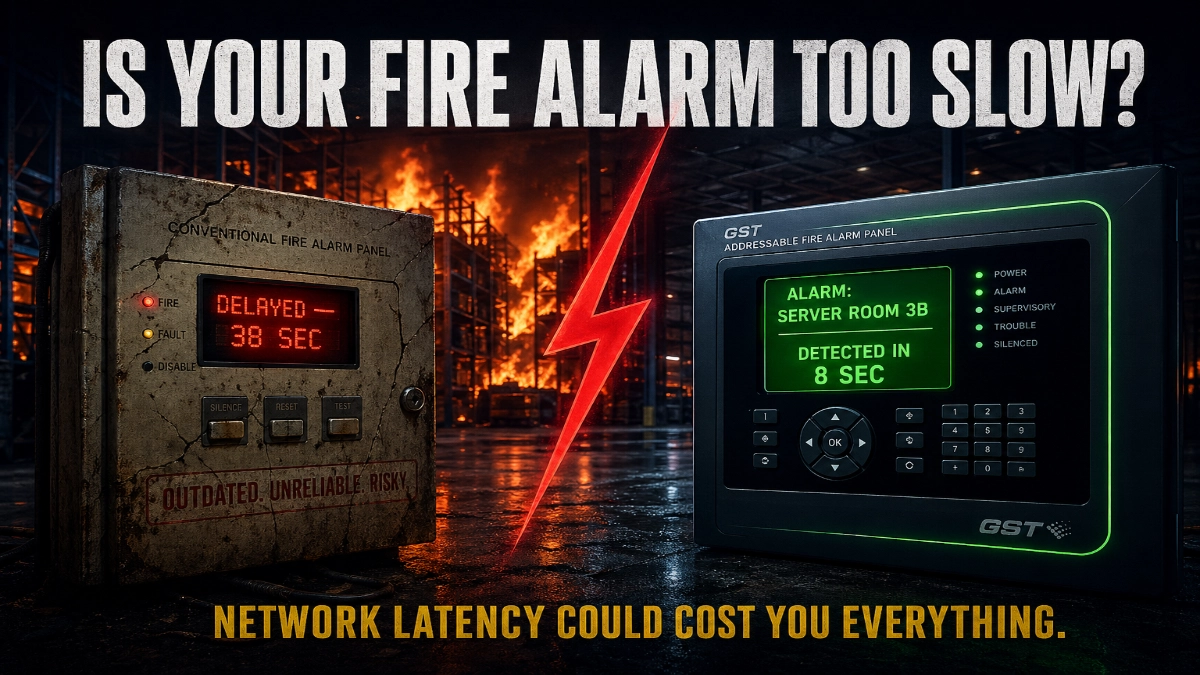
This is not a hypothetical. Across India’s rapidly growing industrial belts, from Noida and Faridabad to Pune and Surat, fire incidents cause enormous damage every year. And a surprising number of them are linked not to a complete absence of fire detection systems, but to systems that responded too slowly.
One of the most overlooked technical risks in modern fire safety is network latency, the delay between when a sensor detects smoke or heat and when the alarm panel actually responds. In older or poorly designed systems, this delay can stretch from milliseconds into full seconds, and in a fire emergency, seconds cost lives and property.
On top of technical delays, Indian factory owners and facility managers face another serious challenge: compliance with fire safety authorities. False alarms, non-standard installations, and outdated panels frequently lead to failed inspections, delayed NOCs and friction with fire departments. This article addresses both problems head-on and explains how modern solutions, such as GST fire alarm systems, are helping Indian businesses solve them together.
What Is Network Latency in Fire Alarm Systems?
Before we dive into impact, it helps to understand what network latency actually means in the context of fire alarm systems.
A Simple Definition
Network latency refers to the time delay between when a device, such as a smoke detector or heat sensor, sends a signal and when the fire alarm control panel (FACP) receives and processes that signal.
Think of it like a phone call with a bad connection. You speak, but there is a half-second gap before the other person hears you. In casual conversation, that is mildly frustrating. In a fire emergency, that gap can be catastrophic.
How Data Travels in a Fire Alarm System
In a fire alarm setup, every detector, manual call point and device is connected to a central panel. When a detector senses smoke or heat above a threshold, it sends an electronic signal through its communication channel, either a wired loop or wireless frequency, back to the panel.
The panel then interprets the signal, verifies it and triggers the appropriate alarm or response protocol. The total time this process takes is influenced by many factors, including the type of system, wiring quality, number of devices and panel processing speed.
Traditional vs. Modern Fire Alarm Systems
| Factor | Conventional System | Modern Addressable System |
| Signal Communication | Zone-based (all devices on a zone signal together) | Device-by-device (each device has a unique address) |
| Latency Risk | Higher — panel must poll the zone, not the specific device | Lower — direct communication per device |
| Location Pinpointing | Only the zone is identified | Exact device and location identified |
| Panel Processing | Simpler, slower logic | Faster, intelligent processing |
| System Load Impact | High device counts slow response | Scales well, minimal latency increase |
In short, the communication architecture of your fire alarm system has a direct bearing on how quickly or slowly it can detect and respond to a fire.
Does Network Latency Impact Fire Detection Time? Yes – Here’s How
| Yes. Network latency in fire alarm systems directly impacts the detection-to-alarm time. In poorly designed systems, it can add meaningful delays that reduce evacuation time and increase damage. |
Milliseconds vs. Real-World Impact
A common misconception is that because latency is measured in milliseconds, it cannot meaningfully affect outcomes. That logic does not hold when you consider how fire behaves.
A fire in a room filled with flammable materials can double in size every 30 to 60 seconds. Even a 3-to-5 second delay in alarm activation caused by cumulative latency in an overloaded system can mean the difference between a contained incident and a full building evacuation emergency.
Now multiply that by a large industrial plant with hundreds of zones, high ambient temperatures and multiple simultaneous sensor triggers and even small latency problems compound quickly.
Wired vs. Wireless Latency
Wired systems generally have lower and more predictable latency. Signal travel is near-instantaneous through copper cables and the main delay comes from panel processing time. However, poor-quality wiring, bad terminations, or cable damage can introduce unexpected delays.
Wireless systems offer installation flexibility but can suffer from RF interference, frequency congestion and signal retries that add latency. In industrial environments with heavy machinery, metal structures and electromagnetic interference, wireless systems must be carefully designed to avoid communication gaps.
System Load and Scalability
The more devices connected to a fire alarm panel, the more processing it must perform. Older or low-grade conventional panels have limited processing capacity. As the device count grows, common in large factories, malls, and IT campuses, the panel can experience slowdowns in polling cycles, increasing the effective detection-to-alarm latency.
Modern addressable systems are designed to handle hundreds or even thousands of devices without degrading response speed. The panel logic is built to process unique device addresses quickly, maintaining consistently low latency regardless of scale.
Panel Response Time: The Final Bottleneck
Even with fast sensors and clean wiring, the control panel itself must process the incoming signal, match it against programmed logic and trigger output devices (sounders, strobes, suppression systems). A slow or outdated panel adds its own delay to the chain.
High-quality panels such as those in the GST product line use fast microprocessors and optimised firmware to minimise processing delays, ensuring the system’s total response time remains within safe parameters.
Addressable vs. Conventional Systems: A Latency Comparison
When it comes to fire alarm detection speed, the choice between an addressable and a conventional system matters enormously.
How Conventional Panels Work
A conventional fire alarm panel divides a building into detection zones. All the detectors and devices within a zone share a single circuit. When any device in a zone triggers, the panel knows which zone is alarming, but not which specific device.
This matters for latency because the panel must wait for the zone circuit condition to change before it recognises an alarm. In a large zone with many devices, the signal can take longer to register clearly, and the panel may require verification time before triggering the alarm output.
Conventional systems are perfectly adequate for smaller buildings with simple layouts. However, in multi-floor commercial buildings, large warehouses or complex industrial facilities, their limitations in speed and location precision become a real safety risk.
4.2 How Addressable Panels Work
An addressable fire alarm panel assigns a unique digital address to every single detector, manual call point and module on the system. The panel communicates with each device individually, polling them in rapid succession through a loop circuit.
When a device triggers, it sends back its unique address along with the alarm signal. The panel instantly knows exactly which device has been activated and where it is located. This process is far faster and more informative than zone-based detection.
The polling cycle in a modern addressable system can cover hundreds of devices in under a second. This means detection-to-alarm time is dramatically reduced compared to conventional systems at scale.
| Attribute | Conventional Panel | Addressable Panel |
| Detection Method | Zone-level (group of devices) | Device-level (individual address) |
| Average Response Speed | Slower at scale | Consistently fast at any scale |
| Location Accuracy | Zone only | Exact device and location |
| False Alarm Discrimination | Limited | Advanced (pre-alarm, confirmation logic) |
| Suitability | Small buildings, simple layouts | Large/complex facilities, industrial sites |
| Scalability | Limited | High (1000s of devices) |
Why This Matters for Indian Facilities
Many factories and commercial properties in India were built with conventional systems because they were cheaper at the time. As these facilities expanded, more devices were added to existing zones, increasing latency and reducing system reliability.
Upgrading to addressable systems is not just about technology; it is about matching the fire alarm infrastructure to the current scale and complexity of the building. It is also increasingly becoming a factor in compliance approvals from fire authorities.
Role of Detectors in Detection Speed
The control panel is only one part of the equation. The detectors themselves play a critical role in how quickly a fire is identified and how much latency is introduced at the sensor level.
Addressable Detectors vs. Conventional Detectors
Addressable detectors are intelligent devices. They do not just send a simple on/off signal; they transmit analogue data about their environment continuously. The panel receives real-time readings: How much smoke is present? Is the level rising or stable? Is it consistent with a real fire or with steam, dust, or cooking fumes?
This intelligence enables the panel to apply sophisticated decision logic before activating an alarm. In practical terms, it means fewer false alarms and faster, more accurate detection when a real fire occurs.
Conventional detectors, by contrast, are binary devices. They have a fixed threshold. When environmental conditions cross that threshold, they trip the circuit, and the panel sees the zone alarm. There is no nuance, no pre-alarm level, and no ability for the panel to distinguish between a false alarm and a genuine emergency based on sensor data alone.
Sensor Intelligence and Latency
Because addressable detectors communicate richer data, the panel can act on early-stage pre-alarm conditions, a rising smoke level that has not yet triggered the threshold and prepare for an alarm before the full trigger. This actually reduces the effective detection time because the system is already tracking and responding before the formal alarm threshold is crossed.
In contrast, conventional detectors wait passively until their threshold is breached, then send a binary signal. There is no pre-alarm intelligence, no early warning, and no dynamic response.
Importance of System Architecture
Detector type and panel type must be matched correctly. Connecting addressable detectors to a panel not designed for addressable communication will not yield the speed and intelligence benefits. Equally, placing conventional detectors on an addressable panel wastes the panel’s capabilities.
Proper system architecture, the right detector type, wired correctly to the right panel, with appropriate loop design and device addressing, is the foundation of a low-latency, high-reliability fire alarm system.
Indian Fire Safety Compliance Challenges
For factory owners, facility managers and safety officers in India, technical performance is only half the challenge. The other half is navigating the regulatory and compliance landscape, and this is where many installations fall short.
Common Authority Issues in India
Fire departments and local authorities across India are becoming increasingly strict about fire safety compliance. Common issues that facilities face include:
- Frequent false alarms due to over-sensitive or poorly placed detectors
- Delayed alarm response noted during authority inspections or mock drills
- Non-standard wiring and installation practices that do not meet prescribed guidelines
- Outdated panels that lack audit trail capabilities or event logging
- Systems that cannot interface with building management systems (BMS) or emergency communication systems
- Inadequate zone coverage or missing devices in high-risk areas
Each of these issues can lead to a failed inspection, a requirement to re-install the system, delays in obtaining the NOC (No Objection Certificate), or, in worst cases, penalties and forced shutdowns.
The National Building Code (NBC) Context
India’s National Building Code provides the framework for fire safety requirements in buildings. It specifies requirements around detection, alarm, suppression and evacuation systems for different occupancy types. While the NBC does not mandate specific brands, it does set performance standards that a fire alarm system must meet.
Key NBC considerations relevant to detection time and latency include requirements for system reliability, response time within acceptable limits, proper zoning and regular testing protocols. Systems with known latency issues or false alarm problems struggle to demonstrate compliance with these standards.
False Alarms: The Compliance Nightmare
False alarms are one of the most damaging issues a facility can face from a compliance perspective. They erode trust in the system, lead to alarm fatigue among occupants and draw negative attention from fire authorities. Repeated false alarms can result in fines and damage the facility’s safety reputation.
The root cause of most false alarms in Indian facilities is the use of conventional detectors with fixed thresholds in environments with dust, steam, cooking fumes, or temperature variations. Addressable, analogue-intelligence detectors are far better at discriminating between real fires and environmental false triggers.
How GST Fire Alarm Systems Solve These Problems
| Note: GST (Gulf Security Technology) fire alarm systems are widely recognised in India for their reliability, compliance-readiness and advanced addressable technology. The following section explains how GST systems address the key challenges discussed above. |
Fast Communication Protocols
The GST fire alarm system uses high-speed, proprietary communication protocols between its addressable detectors and control panels. The polling cycle is optimised to minimise signal travel and processing time, keeping detection-to-alarm latency consistently low even in large installations with hundreds of devices.
This is particularly important for Indian industrial environments, where large floor areas and high device counts are common. GST’s architecture maintains response speed as the system scales, without the latency degradation seen in conventional or lower-grade addressable systems.
Intelligent Loop Architecture
GST systems use a Class A (Style D) loop architecture, which means the communication loop is fully supervised and fault-tolerant. Even if there is a cable break anywhere in the loop, every device remains operational because the loop operates as a ring rather than a simple line.
This design eliminates a major source of latency risk in wired systems, partial circuit failures that cause communication delays or dropped device signals. Facility managers can be confident that every device is communicating at full speed at all times.
High Reliability and Scalability
GST panels are engineered for industrial-grade reliability. They are designed to operate continuously in the temperature ranges and environmental conditions common across Indian factories, warehouses and commercial complexes. The panels use high-quality components with proven field performance.
From small commercial installations with a few dozen devices to large industrial campuses with thousands of points, GST systems scale without compromising on speed or accuracy. This makes them suitable for facilities in growth phases where the fire alarm system needs to expand alongside the building.
Compliance Readiness
GST systems come with comprehensive event logging, audit trail functionality and support for integration with BMS and other emergency systems. These features directly address the compliance requirements that Indian fire authorities look for during inspections.
The event log captures every alarm, fault, test and acknowledgement with timestamps providing a complete history that safety officers and fire marshals can present during authority reviews. This transparency is a significant advantage in getting NOC approvals and passing compliance inspections.
Addressing Authority Compliance Using GST Panels
Meeting Regulatory Standards
GST fire alarm panels are designed and tested to meet international and Indian fire safety standards. This means the technical performance of the system, detection speed, sensitivity, and false alarm rejection align with what authorities expect to see. When an inspector evaluates the system, a GST installation has the technical documentation and certification support to demonstrate compliance.
Improving Inspection Success Rate
One of the most practical benefits of GST panels in the Indian context is the improvement in inspection pass rates. Because the system provides accurate location information for every alarm (not just the zone), fault self-diagnostics and real-time device health monitoring, inspectors can verify the system’s integrity quickly and confidently.
The panel’s user interface also allows safety officers to run test sequences and generate reports, making pre-inspection preparation straightforward. Facilities that have upgraded to GST systems consistently report smoother authority interactions and faster NOC processing.
Reducing False Alarms
GST’s analogue-addressable detectors collect real-time environmental data and apply intelligent algorithms to distinguish genuine fire conditions from false triggers. The panel can be programmed with pre-alarm thresholds, dual-knock confirmation (requiring two devices to alarm before triggering the full alarm) and environmental compensation.
For facilities that have previously struggled with false alarms, particularly those near kitchens, manufacturing processes generating dust or steam, or outdoor areas, this reduction in nuisance alarms has a direct positive impact on compliance standing.
Demonstrating System Integrity
Fire authorities increasingly require evidence that a fire alarm system is not just installed but also maintained and performing correctly. GST panels support regular automated testing cycles, fault identification and remote monitoring capabilities.
This means safety officers do not need to manually verify every device; the panel does it automatically and flags any device that is not communicating correctly. When the authority asks for evidence of system performance, GST provides it automatically.
Best Practices to Reduce Latency in Fire Alarm Systems
Choosing the right technology is important, but proper implementation and maintenance are equally critical to maintaining low latency and reliable performance.
System Design
- Match the system type to the facility use addressable systems for large or complex buildings.
- Plan loop layouts to minimise cable runs and avoid overloading single loops.
- Place detectors according to the specific hazards and room characteristics, not just to meet minimum coverage requirements.
- Design for redundancy: Class A loops, backup power and panel fault monitoring.
Proper Installation
- Use quality, specification-compliant cables and termination hardware.
- Ensure all devices are correctly addressed and programmed at commissioning.
- Validate communication signal strength and loop timing at installation.
- Commission the system with full cause-and-effect testing before handover.
Regular Maintenance
- Schedule quarterly inspections to test devices, check battery backup and review the event log.
- Clean optical smoke detectors regularly. Dust contamination is a leading cause of both false alarms and detector desensitisation.
- Replace aged or degraded devices proactively; do not wait for a device to fail.
- Keep panel firmware updated. Modern panels receive updates that improve processing speed and reliability.
Choosing the Right Panel
Not all panels labelled as ‘addressable’ deliver the same performance. Evaluate panels on their polling cycle speed, maximum device capacity without latency degradation, event logging capabilities and compliance certifications.
Working with reputable system integrators who have experience with Indian compliance requirements and who use proven products like GST panels significantly reduces the risk of performance or compliance issues post-installation.
Real-World Use Cases: Latency vs Optimised System
Industrial Warehouse – Noida, Uttar Pradesh
Scenario A: Conventional System with Latency Issues
A 15,000 sq. ft. packaging warehouse in Noida installed a conventional fire alarm system five years ago. Over time, more machinery and storage racks were added. The original zone layout now has over 40 devices per zone. During an electrical fault in a packaging machine, smoke begins to build up.
- The zone circuit takes 4–6 seconds to register the change in resistance from multiple simultaneous triggers.
- The panel then applies a 30-second verification delay (programmed to reduce false alarms from dust).
- Total detection-to-alarm time: approximately 35–40 seconds.
- By the time the alarm sounds, the fire has spread to adjacent packaging material. Damage: ₹85 lakhs.
Scenario B: GST Addressable System
- The GST addressable detector nearest the ignition point detects rising smoke levels within 3–5 seconds.
- The analogue data shows a steep rise characteristic of a real fire, not a slow drift from dust.
- The panel confirms the alarm without artificial delay and activates within 8–10 seconds total.
- Sprinklers and sounders activate. Staff evacuate. Fire is contained. Damage: ₹6 lakhs (limited to the machine).
IT Office Park – Greater Noida
Scenario A: Mixed Conventional/Addressable System
A 6-floor IT park was installed with a mixed system addressable on floors 1–3, conventional on floors 4–6, due to budget constraints during construction. On floor 5, a server room cable fault triggers a slow-burning fire.
- The conventional zone on floor 5 takes 8 seconds to register the alarm.
- The panel cannot pinpoint which room on the floor the fire response team checks before locating the fire.
- Fire spreads to adjacent server racks. Data loss and hardware damage: ₹1.2 crore.
Scenario B: Full GST Addressable System
- The GST addressable heat detector in the server room sends a pre-alarm notification within 6 seconds of temperature rise.
- Panel displays the exact device address and room location instantly.
- The fire response team goes directly to the correct room. Fire was suppressed within 4 minutes of ignition.
- Hardware damage: one server rack. Total loss: ₹8 lakhs.
Conclusion: The Cost of Latency Is Too High to Ignore
Network latency in fire alarm systems is not a theoretical concern reserved for engineers. It is a real, measurable risk that affects how quickly a building reacts to fire and, therefore, how much damage occurs and how many lives are protected. In India’s fast-growing industrial and commercial landscape, where facilities are scaling rapidly and compliance pressure is increasing, addressing this risk is both a technical and a business priority.
The good news is that the solutions are proven, available and increasingly cost-effective. Addressable fire alarm systems with intelligent, analogue detectors, fast polling protocols and comprehensive compliance features represent the current standard for any serious facility.
GST fire alarm systems stand out in the Indian market because they combine low-latency performance with the compliance readiness that Indian fire authorities expect. Whether you are building a new industrial facility in Noida, upgrading an ageing system in a Greater Noida warehouse, or managing a large IT park, GST addressable panels and intelligent detectors offer a direct path to faster detection, fewer false alarms, and smoother authority approvals.
Do not wait for an incident or a failed inspection to prompt an upgrade. Evaluate your current system’s latency profile, zone design and compliance documentation today and consult with a certified fire safety integrator to understand whether your system is performing at the level your facility requires.
| Ready to Upgrade? Speak with a GST-certified fire safety integrator today to assess your facility’s detection performance and compliance readiness. A faster system is not just a technology upgrade; it is a commitment to the safety of your people, your assets and your business continuity. |
Read Also: Fire Alarm Panels as Critical Infrastructure: Security & Reliability Risks
Read Also: Top 10 CCTV Trends Every Business Should Know in 2026