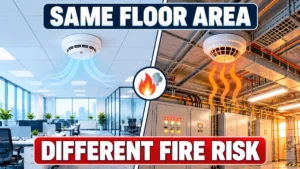
Picture this: it is 2 AM at a busy cement plant. The fire alarm blares. Workers evacuate. Production halts. Emergency responders rush in. After a tense investigation, everyone discovers the culprit: a thin layer of cement dust sitting inside a smoke detector.
False alarms in dust-heavy industrial environments are not just annoying. They are expensive, dangerous and a serious compliance risk.
Industries such as cement plants, textile mills, flour-processing units, warehouses, and large manufacturing facilities face this challenge daily. In these environments, airborne dust, particulate matter and fine debris constantly threaten the integrity of fire detection systems.
The real-world impact of false alarms includes:
- Unplanned production downtime costs thousands of rupees per hour
- Workforce disruption and reduced morale
- Wear and tear on emergency response teams
- Compliance penalties and failed fire safety audits
- Loss of trust in the fire alarm system itself creates genuine safety risks
The solution begins with a clear, systematic Root Cause Analysis (RCA). Understanding why false alarms occur is the first step to stopping them permanently.
What is Root Cause Analysis (RCA) in Fire Alarm Systems?
Root Cause Analysis (RCA) is a structured method for identifying the underlying causes of a recurring problem. In fire alarm systems, RCA helps engineers and safety managers discover exactly why a detector is triggering false alerts.
Instead of simply resetting a tripped alarm, RCA asks: “What caused this? Why did it happen? How do we prevent it from happening again?”
In industrial fire detection, RCA is critical because:
- Industrial environments have complex conditions that standard detectors are not always designed for.
- Repeated false alarms can lead staff to ignore genuine fire warnings, a phenomenon called alarm fatigue.
- Fire safety compliance frameworks in India (NBC, TAC, IS standards) require functioning, reliable systems.
- Insurance providers and factory inspectors can reject claims or flag violations based on system reliability records.
Common Causes of False Alarms in Dust-Heavy Environments
Let us break down the most frequent root causes, one by one.
Dust Accumulation Inside Detectors
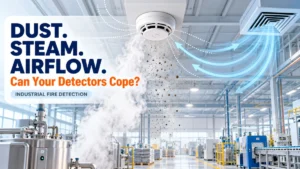
Most smoke detectors use optical or ionisation sensing. When fine dust, flour, cement particles, or textile fibres enter the detection chamber, they scatter or absorb light in a way that mimics actual smoke. The detector cannot tell the difference, so it triggers an alarm.
This is the single most common cause of false alarms in dusty industrial environments. Standard residential detectors offer no protection against this.
Wrong Detector Type Selection
Using a standard ionisation or optical smoke detector in a cement warehouse is the wrong choice. These detectors are designed for clean environments. In dusty conditions, they need to be replaced with heat detectors, beam detectors, or industrially rated dust-resistant models with adjustable sensitivity.
Environmental Interference
High humidity causes moisture condensation inside detectors, which can mimic smoke. Strong airflow from industrial fans or HVAC systems can rapidly carry dust into a detector’s sensing chamber. Vibration from heavy machinery can also cause physical displacement of detector components, triggering fault signals.
Poor Installation Practices
Installing detectors directly above dust-emitting machinery, in airflow paths, or too close to ventilation outlets increases the risk of nuisance alarms. Many false alarm cases trace back to a rushed or uninformed installation process.
Lack of Periodic Maintenance
Industrial fire alarm systems require scheduled cleaning, calibration, and testing. Without regular maintenance, detectors drift from their calibrated sensitivity, becoming either too sensitive (causing false alarms) or too insensitive (missing real fires).
Electrical Noise and Interference
Industrial facilities use heavy motors, welding equipment, and power switching gear. These generate electromagnetic interference (EMI) that can corrupt signals in poorly shielded fire alarm wiring, resulting in ghost alarms or system faults.
Detector Types and Their Performance in Dusty Conditions
Choosing the right detector is perhaps the most important decision in preventing false alarms in industrial fire alarm systems. Here is a comparison of the two primary system architectures:
| Feature | Addressable Fire Alarm Panel | Conventional Fire Alarm Panel |
| Sensitivity Control | Individually programmable per detector | Fixed; zone-wide only |
| Fault Identification | Pinpoints the exact device and location | Identifies zone only |
| False Alarm Risk | Lower — intelligent algorithms reduce nuisance alarms | Higher — no real-time analysis |
| Suitability for Dusty Environments | High — with dust-rated addressable detectors | Moderate — limited flexibility |
| Maintenance Monitoring | Real-time drift and contamination alerts | Manual inspection required |
| Cost | Higher upfront investment | Lower initial cost |
| Compliance Readiness | Strong — preferred by auditors | Acceptable for smaller setups |
For dust-heavy industrial environments, addressable detectors are clearly the superior choice. Their programmable sensitivity, real-time diagnostics and intelligent event processing make them far more reliable than conventional detectors in challenging conditions.
Role of Advanced Technology in Reducing False Alarms
Modern fire alarm technology has evolved significantly. Today’s industrial-grade systems use several advanced features to dramatically reduce false alarms in industrial fire alarm systems.
Intelligent Detection Algorithms
Smart detectors now analyse multiple data points over time before triggering an alarm. Instead of reacting to a single spike in particulate density, they look for patterns consistent with an actual fire sustained rise in temperature, specific rate of smoke increase and gas signatures.
Multi-Criteria Sensing
Multi-sensor detectors combine optical smoke sensing, heat detection, and sometimes CO sensing into a single device. A trigger requires two or more criteria to be met simultaneously, reducing the chance of dust alone setting off an alarm.
Adjustable Sensitivity Levels
With addressable systems, engineers can program individual detectors to operate at lower sensitivity during high-dust production hours and revert to full sensitivity during quieter periods or after-hours, a feature impossible with conventional systems.
Alarm Verification Features
Modern panels include alarm verification delays a short window where the system cross-checks the signal from a second detector or re-evaluates the triggering detector before sounding the full evacuation alarm. This single feature can eliminate a significant percentage of nuisance alarms.
Addressing Authority Compliance Issues Using GST Fire Alarm Panels
False alarms are not just a nuisance; they are a compliance liability. In India and across the Gulf region, fire safety authorities conduct periodic inspections of industrial facilities. Repeated false alarms signal a dysfunctional fire protection system, which can result in failed inspections, legal penalties, insurance complications and mandatory shutdowns until the issue is resolved.
This is where GST (Gulf Security Technology) fire alarm systems become an essential part of the solution.
GST Fire Alarm Systems are engineered specifically for high-demand, challenging environments. Their addressable fire alarm panels are trusted in industrial projects across the Middle East and South Asia, delivering the kind of precision and reliability that compliance authorities demand.
Why GST Fire Alarm Systems Excel in Dusty Industrial Conditions
High-Precision Detection Technology: GST’s addressable detectors use multi-criteria sensing and intelligent algorithms to distinguish between dust and real fire events, dramatically cutting false alarm rates.
Designed for Industrial Environments: GST systems are built to function reliably in environments with elevated dust, humidity, vibration, and electromagnetic interference conditions that overwhelm standard detectors.
Reduced Nuisance Alarms: With programmable sensitivity, alarm verification and real-time contamination monitoring, GST systems ensure that the alarm sounds only when it truly should.
Compliance with Fire Safety Standards: GST fire alarm panels comply with international and regional fire safety standards, making compliance inspections smoother and more predictable.
Advanced Diagnostics: System administrators receive real-time alerts when a detector shows signs of dust contamination or drift, enabling proactive maintenance before a false alarm occurs.
Faster Response Time: Because every device on a GST addressable system is individually identified, the control panel instantly pinpoints the location of an event, reducing response time and investigation effort.
By deploying a GST fire alarm system, industrial facilities not only resolve false alarm problems, but they also build a fire safety infrastructure that stands up to the scrutiny of any compliance audit.
Preventive Measures and Best Practices
Beyond selecting the right system, a comprehensive strategy for false alarm prevention includes the following best practices:
- Select the Correct Detector Type: Use heat detectors in areas with high dust concentration. Use beam detectors for large open spaces like warehouses. Deploy multi-sensor addressable detectors where smoke and heat detection are both needed.
- Conduct Routine Cleaning and Maintenance: Schedule detector cleaning every three to six months in dusty environments. Use compressed air or approved vacuum cleaning methods; never blow dust deeper into the sensing chamber.
- Apply Proper Installation Techniques: Keep detectors away from direct airflow paths, dust-emitting machines, and steam sources. Follow manufacturer-recommended mounting heights and positions.
- Use Dust-Resistant Detectors: For the highest-dust zones, use IP-rated or dust-proof fire-alarm-system-compatible detectors that physically prevent particulate entry into the sensing chamber.
- Regularly Test and Calibrate the System: Conduct formal functional tests quarterly and full system tests annually. Record all test results for compliance documentation.
- Train Your Team: Ensure that maintenance staff and safety officers understand how to read panel diagnostics, identify pre-alarm conditions and respond correctly to different alarm types.
Real-World Industrial Scenario: From Chaos to Compliance
Case Study: Textile Manufacturing Unit, Western India
The Problem: A mid-sized textile manufacturing unit was experiencing 8 to 12 false alarms per month. The facility ran three shifts, and every false alarm triggered a full evacuation, halting production for an average of 45 minutes per incident. Over six months, this resulted in over 90 hours of lost production time and two failed fire safety audits.
The Root Cause: RCA identified that the facility was using standard optical smoke detectors throughout. Airborne cotton fibres and dye dust were constantly entering the detector chambers. Additionally, several detectors were mounted directly above the weaving machines, a major installation error.
The Solution: The facility replaced its entire system with a GST addressable fire alarm system. GST addressable detectors with adjustable sensitivity were installed at optimised locations, away from primary dust-generation zones. Multi-sensor detectors were used near the dyeing section. The GST panel’s contamination monitoring was configured to alert the maintenance team when dust levels inside a detector reached 60% of the alarm threshold.
The Result: In the twelve months following the upgrade, the facility recorded zero false alarms. The next fire safety audit was passed with full marks. Management estimated a recovery of over 90 production-hours and avoided a potentially significant compliance penalty.
Stop the False Alarms Before They Stop You
False alarms in industrial fire alarm systems are never random. They always have a cause, and that cause can always be found and fixed.
A proper Root Cause Analysis gives industrial safety managers the clarity to act decisively: replace the wrong detector, fix the installation, schedule the maintenance, or upgrade to a smarter system altogether.
In today’s compliance-driven industrial landscape, the choice of fire alarm technology matters more than ever. GST fire alarm systems, with their advanced addressable architecture and industrial-grade reliability, provide a proven path from chronic false alarms to full compliance confidence.
The question is not whether you can afford to upgrade your fire detection system. It is whether you can afford not to.
Read Also: Fire Alarm System Integration with CCTV for Incident Verification
Read Also: Best STQC-Compliant CCTV Cameras for Commercial Use in India