A textile factory in Surat installed a 48-camera CCTV system. The project cost over ₹12 lakhs. The cameras were mounted, the DVR was running, and the management felt secure.
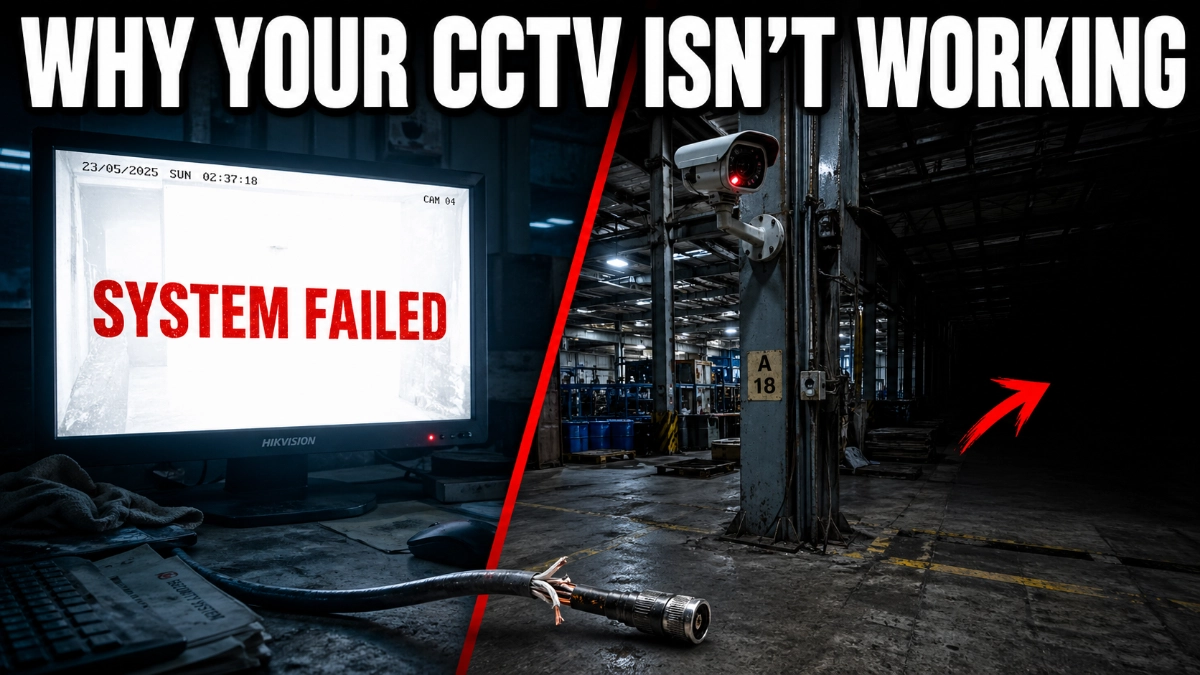
Three months later, raw material worth ₹3 lakhs disappeared from the warehouse storage area. The footage? Completely black. The IR night vision had reflected off a freshly painted white wall and blinded the camera. The cable feeding that section had also degraded, and a poor-quality coaxial cable had picked up interference from nearby motor drives, turning the image into a static blur.
No one had planned for any of this. The cameras were installed, but the system was never truly designed.
This is not a one-off case. Across factories, warehouses and industrial plants in India, CCTV systems fail quietly, not because cameras are bad, but because the installation and design decisions made along the way create invisible gaps that only reveal themselves when something goes wrong.
| Key Insight: A CCTV system is only as strong as its weakest cable run, its most poorly placed camera and its most overlooked blind spot. |
Why Industrial CCTV Fails More Often Than Expected
In a home or small office, a basic CCTV system works reasonably well. Mount a camera, run a cable, plug it in, done. But industrial sites are a completely different environment.
Factories, chemical plants, logistics warehouses and manufacturing units in India deal with a unique set of challenges: high dust levels, wide open spaces, extreme heat, vibration from heavy machinery, irregular power supply and large metallic surfaces everywhere. These conditions turn basic installation errors into major system failures.
The failures typically fall into three broad categories:
- The cabling failures signal never reaches the recorder cleanly
- IR reflection issues, night vision becomes the enemy
- Coverage gaps in critical areas are never in frame
Each of these is preventable. But only if you understand why they happen.
Cabling Issues: The Silent Killer of Industrial CCTV
If you ask most installers what causes CCTV failure, cabling rarely makes the top of the list. Yet in industrial environments, it is the single most common reason systems underperform or fail outright.
Poor Cable Quality
Not all coaxial cables are equal. In an office environment, a low-grade RG59 cable might work fine for years. In an industrial site where cables run near motors, welding machines, conveyors and electrical panels, that same cable becomes a liability.
Low-quality cables have inadequate shielding. They pick up electromagnetic interference (EMI) from nearby electrical equipment, turning a clean video signal into a noisy, degraded image. In some cases, the picture becomes completely unusable.
| Common Mistake: Using domestic-grade coaxial cable (meant for DTH or cable TV) in an industrial CCTV system. Industrial sites need cables with double or triple shielding specifically rated for high-EMI environments. |
For IP-based CCTV systems (which now dominate the market), the cable quality issue shifts to network cabling. Cat5e or Cat6 cables are standard, but the quality of the cable and the connectors make a massive difference. Poor crimping, substandard plugs, or cables without proper sheathing fail quickly in hot, humid, or dusty environments, all of which are common in Indian industrial settings.
Signal Loss Over Distance
Signal loss over cable length is a physics problem. Analogue video signals degrade the longer they travel. For standard coaxial cable, quality starts dropping noticeably beyond 150–200 metres. Beyond 300 metres, the image may be unusable.
In large factories or warehouses common in industrial corridors like Bhiwandi (Maharashtra), Manesar (Haryana), or Krishnapatnam (Andhra Pradesh), camera-to-DVR distances often exceed 200 metres easily.
Solutions exist: video amplifiers, baluns (which convert video to run over twisted pair cable), or switching to IP cameras with network switches deployed closer to the cameras. But these solutions only work if the problem is anticipated during the design phase. Too often, it isn’t.
Improper Cable Routing in Harsh Environments
How a cable is routed matters just as much as what type of cable you use.
In industrial sites, cables that run without conduit near heat sources, machinery, or chemicals deteriorate rapidly. PVC insulation softens and cracks under sustained heat. Cables that run through areas with forklift traffic get crushed. Cables near hydraulic systems in a factory can be damaged by oil exposure.
A common failure in Indian factories is running cables without proper conduit through production floor areas to save cost. The cables last a few months, then faults start appearing, intermittent signal loss, complete feed dropout and tracing the fault in a long cable run takes hours.
- Always use armoured cable or run cables inside rigid conduit in production areas
- Maintain minimum separation from power cables (at least 30 cm for coaxial, more for network cables)
- Use cable trays at height wherever possible, keep cables away from floor traffic
- Label every cable run with the camera ID at both ends
- Use waterproof junction boxes at every connection point, especially in humid environments
| Did You Know? In IP-based CCTV systems, a single bad RJ45 crimp on a 70-metre cable run can cause a camera to drop offline intermittently, a fault that is notoriously difficult to trace without a cable tester. |
IR Reflection Problems: When Night Vision Becomes a Problem
Infrared (IR) illumination is the technology that makes CCTV cameras see in the dark. Built-in IR LEDs emit invisible light that bounces off objects and returns to the camera sensor, creating the black-and-white night vision image we are all familiar with.
In theory, it works brilliantly. In industrial settings, it regularly fails, and the reason is reflection.
What Is IR Reflection and Why Does It Happen?
IR light behaves like visible light; it reflects off surfaces. When a camera is pointed at a highly reflective surface (a white wall, a metallic machine casing, a glass panel, a polished floor), the IR light bounces directly back into the camera lens. The sensor gets overwhelmed by this intense, reflected IR signal.
The result is a completely washed-out, overexposed image, a white blob that shows nothing useful. The camera is technically working. The IR LEDs are technically on. But the footage is worthless.
| Common Mistake: Mounting IR cameras too close to white or metallic walls inside warehouses. Even a camera mounted 30 cm from a painted wall will produce a glowing white overexposed image at night. |
Industrial Environments That Make IR Reflection Worse
Industrial sites have an unusually high density of IR-reflective surfaces:
- Freshly painted walls (white, cream, or light grey standard in clean rooms and food factories)
- Stainless steel machinery and food-grade equipment
- Aluminium structural members and roof sheeting
- Glass partitions in production control rooms
- Polished concrete floors with reflective coatings
- Dust particles suspended in the air (common in flour mills, cement plants, and textile factories in India)
That last point — dust — is particularly important. In environments with heavy airborne dust, IR light scatters off suspended particles and creates a foggy, hazy image. This is called backscatter. It is a significant problem in grain storage facilities, quarries and many manufacturing environments across India.
Wrong Camera Placement Amplifies IR Problems
Many IR failures come not from the environment itself but from camera placement decisions made without thinking about light behaviour.
Cameras mounted in corners where two reflective walls meet get IR bouncing from multiple directions. Cameras installed looking directly into windows create an IR reflection off the glass at night. Cameras positioned above polished surfaces, like a security desk with a glass top, effectively blind themselves after dark.
The fix is a combination of placement strategy and camera selection. Cameras with adjustable or external IR, where the LEDs can be angled separately from the lens, give more control. In some cases, switching to cameras without IR and supplementing with separate, directional IR illuminators is the better solution.
For extreme environments with heavy dust (like coal handling plants or cement factories in Rajasthan or Chhattisgarh), thermal cameras or cameras with laser IR illumination outperform conventional IR cameras significantly.
Coverage Gaps and Blind Spots: The Zones Nobody Watches
A CCTV system can have 60 cameras and still miss the most important areas in a facility. Coverage gaps are not about having too few cameras; they are about having cameras in the wrong places, with the wrong lenses, pointed in the wrong directions.
The Consequence of Poor Planning
Most industrial CCTV layouts in India are still done by placing cameras based on gut feel and walking through the site once. No coverage mapping. No field-of-view calculations. No simulation of blind spots.
The result is predictable: cameras covering wide open corridors where nothing interesting happens, while loading docks, cash rooms, server rooms and raw material storage areas go unwatched.
A proper CCTV design starts with a risk assessment identifying the highest-risk zones in the facility and working backwards to determine what camera placement and lens selection will cover those zones adequately.
Ignoring Critical Zones
In an industrial site, the highest-risk zones are often the least intuitive ones. They include:
- Loading and unloading bays where material enters and leaves the facility
- Weighbridge areas where quantities are verified, and fraud often occurs
- Chemical storage zones where safety incidents can escalate rapidly
- Server rooms and electrical panels targets for sabotage or accidental damage
- Emergency exits are frequently used for the unauthorised removal of goods
- Boundary walls and perimeter fencing are often ignored in internal-focused layouts
A common gap in Indian factories is the perimeter. Cameras cover the inside of the plant well, but the 200-metre outer boundary has nothing. In facilities near industrial estates in cities like Pune, Ahmedabad, or Chennai, perimeter breaches at night are a real threat that a well-designed camera layout would detect early.
Wrong Lens Selection Creates Permanent Blind Spots
Lens selection determines how much of a scene a camera covers and how much detail it captures. A wide-angle lens covers a large area, but at the cost of detail; a face or a number plate at 15 metres will be too small to identify. A narrow-angle (telephoto) lens captures distant detail but covers a small area and misses activity nearby.
In large open spaces like a 50,000 sq ft warehouse or a factory floor, using fixed-lens cameras with the wrong focal length creates guaranteed blind spots. Either the field of view is too narrow and only captures a slice of the space, or it is too wide, and the images have no forensic value.
| Pro Tip: For wide open industrial spaces, consider PTZ (Pan-Tilt-Zoom) cameras at key vantage points combined with fixed wide-angle cameras for continuous overview coverage. This combination provides both situational awareness and the ability to zoom in on incidents. |
Environmental Factors: The Unique Challenge of Indian Industrial Sites
Indian industrial environments add a layer of complexity that European or North American installation guides rarely account for. If you are specifying a CCTV system for a factory in Rajkot, a warehouse in Bhiwadi, or a chemical plant near Dahej, you need to plan for conditions that would damage a standard commercial-grade system within months.
Dust and Particulate Matter
Dust is the enemy of electronics. In textile factories, foundries, stone crushing units, and cement plants, fine particulate matter gets into every unsealed enclosure. It coats camera sensors, clogs cooling vents on DVRs/NVRs and degrades cable connectors.
For these environments, cameras must carry a minimum IP66 rating (dust-tight and protected against water jets). In extreme dust environments, IP67 or IP68-rated cameras are worth the additional investment.
Heat and Humidity
India’s climate is punishing for electronics. Summer temperatures in industrial areas of Gujarat, Rajasthan and Maharashtra regularly exceed 45°C outdoors. Inside poorly ventilated production areas, temperatures near furnaces or boilers can exceed 60°C.
Standard cameras are typically rated to operate up to 50°C. In these environments, that margin disappears quickly. Thermal stress shortens the life of IR LEDs, lens assemblies and image sensors. High humidity, especially in coastal industrial zones like Kandla, Mundra, or Haldia, accelerates corrosion on exposed metal components and connector contacts.
Investing in cameras with built-in thermostat-controlled heaters and blowers, not just IP ratings, makes a measurable difference in longevity in these environments.
Vibration
Heavy machinery creates constant vibration. Cameras mounted on structural columns near presses, compressors, or mills gradually loosen their mounting brackets. Over time, a camera that was correctly aimed at a loading bay slowly rotates down to cover the floor instead.
Use anti-vibration mounting brackets and check camera aim quarterly in high-vibration zones. This simple maintenance step is almost universally ignored.
Power Fluctuations
Power quality in Indian industrial areas, particularly in smaller industrial estates, is inconsistent. Voltage spikes, dips, and outages are common. Standard CCTV power supplies are not always equipped to handle these conditions.
A single major voltage spike can damage multiple cameras simultaneously if the power supply has inadequate surge protection. Using UPS systems for CCTV power supply and adding surge protectors on both the power and video/data lines is essential, not optional.
Installation Mistakes vs Design Mistakes: Understanding the Difference
Most CCTV failures in industrial sites come from one of two sources: poor installation execution or poor system design. They produce similar symptoms but require different solutions.
Side-by-Side Comparison
| Installation Mistakes | Design Mistakes |
| Wrong cable termination at connectors | No site survey done before installation |
| Cameras mounted without angle planning | Incorrect lens focal length specified |
| IR LEDs blocked by nearby walls or poles | No lighting analysis for night vision zones |
| Power supply undersized for camera load | Single-camera coverage for wide open areas |
| No weatherproofing on outdoor junction boxes | CCTV plan ignores dust and heat zones |
| Cables run without conduit near machinery | No redundancy planned for critical zones |
The distinction matters because installation mistakes are often fixable on-site. Design mistakes like specifying the wrong number of cameras for a zone or planning a layout that creates structural blind spots, require going back to the drawing board.
This is why the pre-installation site survey is not a checkbox exercise. It is the foundation on which everything else is built.
How to Fix and Prevent Industrial CCTV Failures
Prevention is always cheaper than correction. Here is a practical checklist that engineers and project managers can use at each stage of a CCTV project.
Pre-Installation Design Checklist
- Conduct a formal site survey walk-through of every zone, document distances, lighting conditions, and surface materials.
- Create a scaled floor plan with camera positions, fields of view and cable routes marked.
- Calculate cable run lengths, identify runs over 100m, and plan signal boosting or IP conversion.
- Identify all IR-reflective surfaces in the coverage area and adjust camera angles accordingly.
- Select camera IP ratings appropriate for dust and moisture levels in each zone.
- Specify cable type with adequate shielding for EMI levels in each installation area.
- Include a perimeter coverage plan, not just internal camera positions.
- Plan for a UPS and surge protection on all CCTV power feeds.
During Installation
- Test each cable run with a cable tester before connecting cameras.
- Verify signal quality at the recorder end before finalising each run.
- Use proper weatherproof connectors on all outdoor connections.
- Confirm camera aim before tightening final mounting, check both day and night images.
- Label all cables and junction boxes clearly with camera IDs.
- Seal all conduit entry points with fire-rated sealant (for compliance with fire safety norms).
Post-Installation Verification
- Review night vision footage from every camera, check for IR reflection or backscatter.
- Walk the entire site and identify any blind spots not covered by the current layout.
- Stress-test the recording system, verify all cameras record simultaneously without frame drops.
- Document the final camera positions, settings and cable routes in an as-built drawing.
- Set up a quarterly maintenance schedule, including camera aim checks and lens cleaning.
Expert Tips for Engineers and Installers
Tip 1: Design for the Worst Case, Not the Average Case
Plan your cabling for the longest possible run, your cameras for the harshest environmental conditions in the facility, and your coverage for the most challenging lighting scenario. A system that works under average conditions will fail when conditions are worse, which is precisely when you most need it to work.
Tip 2: Use Camera Simulation Software Before You Install
Tools like JVSG IP Video System Design Tool allow you to simulate camera fields of view, IR range and blind spots on a digital floor plan before a single cable is pulled. This is standard practice among professional integrators in large projects. It should be standard for industrial sites, too.
Tip 3: Separate Your IR Source from Your Camera Where Possible
In environments with highly reflective surfaces, consider cameras without built-in IR and pair them with external, directional IR illuminators. External illuminators give you control over the angle and intensity of the IR beam, significantly reducing the reflection problem. This is particularly effective in cold storage facilities, pharmaceutical factories, and food processing plants, environments common in India, where hygiene standards require highly reflective surfaces.
Tip 4: Plan for Network Resilience in IP Systems
In large industrial IP CCTV systems, a single failed network switch can take down a large section of cameras. Use industrial-grade managed switches (not commercial-grade office switches) that can handle wider temperature ranges and support features like VLAN segmentation to isolate CCTV traffic from other network traffic.
Tip 5: Train Your Security Team, Not Just Your System
The best camera system in the world is useless if nobody is watching the monitors during critical hours. Equally, if the security team does not know how to retrieve footage, adjust PTZ cameras, or report system faults, the system’s value drops dramatically. Technical installation and operational training must happen together.
The System You Design Is the System You Deserve
A CCTV system for an industrial site is not a product; it is an engineered solution. The difference between a system that works and one that fails quietly comes down to the decisions made before the first camera is ever mounted.
Cabling failures, IR reflection issues and coverage gaps are not random misfortunes. They are the predictable results of skipping site surveys, specifying inadequate cable, ignoring environmental conditions and copying layouts that were designed for different spaces.
For factories, warehouses, and industrial plants across India where the combination of heat, dust, power fluctuations, and large spaces creates uniquely challenging conditions, getting CCTV right requires treating it with the same engineering rigour applied to any other critical system in the facility.
The ₹12 lakh system in Surat that failed? It could have worked. A proper design process, the right cable specification and a night vision test before sign-off would have caught the problems. The cost of doing it right the first time is always less than the cost of doing it wrong.
If you are planning a CCTV upgrade or a new installation for an industrial site, start with a professional site survey and a coverage design, not a quotation for hardware. The hardware is the easy part. The design is where the system either succeeds or fails.
Read Also: NVR vs Edge Recording in Large-Scale Honeywell Surveillance Systems
Read Also: Warehouse Surveillance Design for Blind-Spot Elimination Using Honeywell IP Cameras