It was a routine Wednesday afternoon at a large automotive parts manufacturing plant on the outskirts of Pune. A smouldering electrical fault in one of the sub-panels triggered the fire alarm, but no one knew exactly where. The conventional alarm panel displayed a zone alert covering an entire 3,000 sq. metre production floor. By the time the response team located the source, precious minutes had passed. The damage was contained, but it could have been catastrophic.
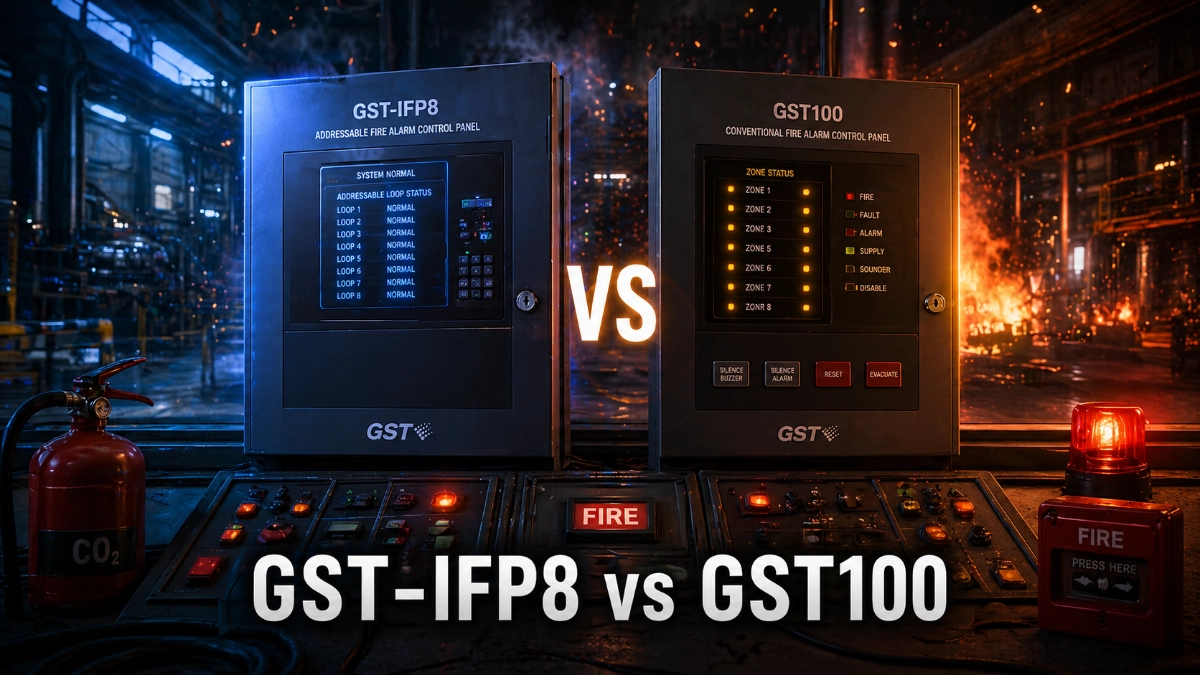
This scenario plays out in industrial facilities across India every year, not because engineers lack expertise, but because the wrong fire alarm panel was chosen for the facility’s complexity.
Choosing between a GST-IFP8 addressable fire alarm panel and a GST100 conventional fire alarm panel is one of the most consequential decisions in industrial fire safety engineering. Both are products of Gulf Security Technology (GST), a globally trusted name in fire detection and alarm systems, but they serve fundamentally different deployment environments.
This article breaks down the engineering use cases, real-world deployment scenarios, cost implications and compliance requirements of both panels so that decision-makers, facility managers, consultants and engineers in India can choose with confidence.
Understanding GST-IFP8 and GST100 — The Basics
What Is the GST-IFP8 Addressable Fire Alarm Panel?
The GST-IFP8 is an intelligent addressable fire alarm panel that communicates with each connected detector and device individually. Every sensor on the system has a unique address, allowing the panel to identify precisely which device is triggering an alarm, reporting a fault, or requiring maintenance.
Key capabilities include:
- Support for up to 8 loops with 254 addressable devices per loop
- Bi-directional communication between panel and field devices
- Real-time diagnostics and remote monitoring capabilities
- Intelligent alarm processing to reduce false alarms
- Seamless integration with building management systems (BMS)
What Is the GST100 Conventional Fire Alarm Panel?
The GST100 is a conventional fire alarm panel that divides a facility into zones. When a detector triggers within a zone, the panel indicates which zone has the event, but not the exact device. It is a reliable, straightforward system that has proven its worth in thousands of installations across India and globally.
Key capabilities include:
- Multiple zone configuration for basic area coverage
- Simple, robust panel design for straightforward installations
- Easy-to-use interface, minimal training required
- Cost-effective for small to medium facility footprints
- Compatible with a wide range of conventional detectors
The Core Difference: The GST-IFP8 tells you exactly which device is alarming. The GST100 tells you which zone is alarming. This distinction drives every engineering decision downstream.
Key Technical Differences — Head-to-Head Comparison
The table below summarises the core technical and operational differences between the two GST fire alarm panels:
| Feature | GST-IFP8 (Addressable) | GST100 (Conventional) |
| System Type | Addressable | Conventional |
| Detection Accuracy | Exact device location identified | Zone-level identification only |
| Scalability | Up to 254+ devices per loop | Limited by zone capacity |
| Wiring Complexity | Single loop wiring (SLC) | Multiple cable runs per zone |
| Installation Cost | Moderate to High | Low to Moderate |
| Long-Term Maintenance | Easier—remote diagnostics available | Manual inspection per zone |
| False Alarm Management | Excellent—sensor intelligence built in | Basic |
| System Expansion | Easy—add devices to existing loop | Requires new cabling & zones |
| Suitable Facility Size | Medium to Very Large | Small to Medium |
| Compliance (India) | Meets NBC/BIS for complex sites | Meets NBC/BIS for basic sites |
| Ideal For | Industries, campuses, data centres | Warehouses, small factories |
| Engineer Insight: In large industrial facilities with multiple buildings, choosing a conventional system to save upfront costs often results in significantly higher lifecycle costs due to complex maintenance and slower fault resolution. Always evaluate the 5-year total cost of ownership, not just the installation budget. |
Engineering Use Cases — Where Each Panel Performs Best
A. Where GST-IFP8 Addressable Panel Performs Best
1. Large-Scale Manufacturing Plants and Industrial Complexes
In a large-scale Indian manufacturing facility, such as an automobile plant in Chennai, a steel rolling mill in Jharkhand, or a pharmaceutical manufacturing unit in Hyderabad, the sheer scale and operational complexity demand precision. These environments often span multiple buildings, contain hundreds of rooms and operate 24/7 with a rotating workforce.
The GST-IFP8 addressable fire alarm system enables instant identification of the exact affected location. Instead of sending responders to sweep an entire production block, the panel directs them to Panel C, Zone 4, Detector 17. Response time drops dramatically. This translates directly to lives saved and production losses minimised.
2. Multi-Building Industrial Campuses
Industrial campuses such as SEZs (Special Economic Zones), integrated refineries, or large logistics hubs often comprise multiple structures spread over tens of acres. In these environments, a conventional system would require either an enormous number of separate panels or a poorly granular zone map.
With the GST-IFP8, a single networked system of addressable panels can cover an entire campus, providing a unified alarm management interface at the control room while still offering pinpoint device-level detection across every building.
3. Data Centres and Server Room Facilities
Data centres in India, particularly those in Mumbai, Bengaluru and Noida, represent some of the highest-value, highest-risk industrial environments in the country. Equipment damage from even a minor fire event can run into the crores in downtime and hardware loss.
The GST-IFP8, paired with addressable smoke detectors and aspirating smoke detection (ASD) systems, provides the earliest possible warning with the highest location precision. Suppression systems can be triggered with confidence, knowing the exact affected area, eliminating accidental suppression in unaffected rooms.
4. Oil, Gas, and Chemical Processing Facilities
High-risk industrial sectors such as petroleum refineries, chemical plants and fertiliser units in India’s industrial corridors (Gujarat, Andhra Pradesh, Odisha) require fail-safe, highly reliable fire detection with precise fault identification. These facilities frequently have hazardous zones (classified areas as per IS/IEC standards) where a delayed or imprecise alarm can trigger a chain of catastrophic events.
The GST-IFP8’s diagnostic capabilities, loop supervision and integration with industrial safety systems make it the engineering-preferred choice for these high-stakes environments.
5. Hospitals, Research Labs and Critical Infrastructure
While not purely industrial, large hospitals and research facilities often combine cleanrooms, server rooms, chemical storage and patient care areas under one roof, each with radically different fire risk profiles. The ability of the GST-IFP8 to apply different alarm thresholds and response logic to different addressable devices or zones makes it the right panel for these complex environments.
B. Where the GST100 Conventional Panel Is More Suitable
1. Small Factories and Light Manufacturing Units
A small metal fabrication unit, a garment manufacturing facility, or a food processing plant with a single open floor plan of up to 1,500–2,000 sq. metres does not require addressable precision. The GST100 conventional fire alarm panel provides reliable zone-based detection at a fraction of the cost, making it the practical choice for budget-conscious small businesses.
When a single zone covers the entire production area, zone-level identification is sufficient, and the simpler wiring and panel operation mean faster installation and easier day-to-day management.
2. Standalone Warehouses and Storage Facilities
A standalone warehouse, particularly one with an open floor plan, consistent storage type and a limited number of rooms, is an ideal deployment for the GST100 conventional system. Detection zones can be mapped to distinct storage bays and a simple alarm response protocol can be implemented without the complexity of an addressable network.
Across India’s tier-2 and tier-3 cities, thousands of logistics and storage businesses rely on conventional fire alarm systems like the GST100, and they work exceptionally well when matched to the right environment.
3. Budget-Constrained Projects with Simple Layouts
Infrastructure development projects, such as small industrial sheds, temporary storage structures, or ancillary utility buildings within a larger complex, often have strict budget envelopes. In these cases, the GST100 delivers robust fire detection compliance without the investment required for addressable technology. It is an honest, dependable tool for what it is designed to do.
4. Retrofit Installations in Legacy Buildings
Many older Indian industrial buildings were not designed with integrated fire alarm infrastructure. Running new cabling in established structures is expensive and disruptive. The GST100’s simpler wiring architecture with conventional cabling to detectors within each zone often makes it the more practical choice for retrofit scenarios where an addressable single loop would be difficult to route.
Real Industrial Deployment Scenarios
Deployment Scenario 1: Automotive Parts Manufacturing Plant — GST-IFP8
| Scenario: A 25,000 sq. metre automotive components manufacturing plant in Pune, comprising 3 production buildings, a raw materials warehouse, a paint shop and an administrative block. |
Challenge: The paint shop contains highly flammable solvents. The production floor has CNC machinery and electrical panels. Multiple risk profiles exist across the campus.
Solution Deployed: GST-IFP8 addressable fire alarm system with two interconnected panels, 6 loops, and 380 addressable devices including smoke detectors, heat detectors, multi-criteria detectors in the paint shop and manual call points at all exits.
Outcome: During a quarterly drill, engineers verified that the panel accurately identified individual detector locations within 2 seconds. The system’s diagnostic reporting also flagged two detectors with dust contamination during a maintenance cycle, preventing potential false alarms during production.
Deployment Scenario 2: Logistics Warehouse — GST100
| Scenario: A 4,500 sq. metre single-floor logistics warehouse in Bhiwandi, Maharashtra, storing FMCG goods in racked storage. The facility has one entry/exit point and a simple rectangular floor plan. |
Challenge: The client needed a cost-effective, NBC-compliant fire alarm system with a fast installation timeline. Budget was a primary constraint.
Solution Deployed: GST100 conventional panel with 4 detection zones corresponding to 4 storage bays, plus a loading dock zone and office zone, 6 zones total. Conventional smoke and heat detectors were used throughout.
Outcome: The system was installed and commissioned within 4 days. Annual maintenance costs are minimal. The GST100 met all NBC and local fire authority compliance requirements. The client saved approximately 35% on installation compared to an addressable solution, a justified saving for this facility type.
Deployment Scenario 3: Multi-Floor Industrial Office + Production Building — GST-IFP8
| Scenario: A 7-storey building in an industrial estate in Bengaluru, with ground and first floors used for production, floors 2-5 as R&D labs and cleanrooms and floors 6-7 as offices. |
Challenge: Each floor had a different occupancy type and fire risk profile. The facility needed a single unified alarm system that could apply different alarm logic to different floors and integrate with the building’s BMS.
Solution Deployed: GST-IFP8 with 1 main panel and 1 repeater panel, 4 loops and 210 addressable devices. Different alarm thresholds and two-stage alarm protocols were programmed for cleanrooms, production floors vs. offices.
Outcome: The GST-IFP8’s flexible programming allowed the facility manager to customise alarm behaviour by floor, providing investigation alerts in the cleanrooms (minimising false evacuations) and immediate general alarms in production areas. The system paid for its higher cost within 18 months through eliminated false alarm disruptions.
Cost vs Performance Analysis
Understanding the full cost picture requires looking beyond the initial purchase price. Here is a realistic cost comparison across the lifecycle of both systems:
| Cost Factor | GST-IFP8 (Addressable) | GST100 (Conventional) |
| Initial Installation Cost | Higher (smart devices + loop wiring) | Lower (basic devices + multi-cable runs) |
| Device Unit Cost | Higher per detector | Lower per detector |
| Wiring & Labour | Moderate (single loop) | Can be high (multi-zone cabling) |
| Annual Maintenance | Lower (remote diagnostics, fewer visits) | Higher (manual zone checks needed) |
| System Expansion Cost | Low (add to existing loop) | Significant (new zones, cabling) |
| Downtime Risk Cost | Low (faster fault isolation) | Higher (zone-level ambiguity) |
| 5-Year Total Cost Estimate | Moderate-High upfront, lower ongoing | Low upfront, higher ongoing |
| Best ROI Scenario | Large or complex facilities | Small, simple, static installations |
| Pro Tip: For facilities planning any expansion in the next 5 years, always factor in the addressable system’s scalability advantage. Adding 50 detectors to a GST-IFP8 loop can cost 60–70% less than rewiring new zones for a conventional system expansion of similar scope. |
Compliance and Safety Benefits in India
Industrial fire safety in India is governed by several key standards and regulations. Both the GST-IFP8 and GST100 are engineered to support compliance, but the level of facility complexity determines which system aligns better with regulatory requirements.
Applicable Indian Standards and Codes
- National Building Code (NBC) 2016 Part 4 covers fire and life safety requirements for buildings in India, including detection, alarm and notification systems.
- BIS Standards (IS 2189:2008) Specification for automatic fire detection and alarm systems.
- TAC (Tariff Advisory Committee) Relevant for insurance compliance in industrial facilities.
- IS/IEC 60529 for ingress protection ratings of detectors in harsh industrial environments.
- Petroleum and Explosives Safety Organisation (PESO) for oil, gas and chemical sites.
How GST-IFP8 Supports Compliance
The GST-IFP8’s comprehensive event logging, fault reporting and zone-level override capabilities make it highly suitable for facilities that undergo regular audits by fire authorities, insurance inspectors, or regulatory bodies. Its ability to produce detailed maintenance and alarm logs supports the documentation requirements of NBC Part 4 and insurance underwriters.
For high-risk industrial environments requiring IS/IEC hazardous area compliance, such as ATEX-rated detectors in explosive atmospheres, the GST-IFP8’s addressable architecture allows certified detectors to be integrated and individually monitored within the same system.
How GST100 Supports Compliance
The GST100 meets NBC and BIS compliance requirements for facilities where zone-level detection is acceptable, which covers the majority of small to medium industrial installations in India. Its simplicity is an advantage in routine compliance inspections: straightforward zone maps are easier to document and easier for local fire authority inspectors to verify.
| Engineer Insight: Always verify your facility’s specific compliance requirements with a qualified fire safety consultant before system selection. High-risk industrial classifications under PESO or NBC may mandate addressable systems even for smaller sites. |
How to Choose the Right System — Decision Checklist
Use this practical engineering checklist to guide your system selection:
Project Size and Facility Footprint
- Under 3,000 sq. metres with simple layout → Consider GST100
- Over 3,000 sq. metres, multi-building, or multi-floor → GST-IFP8 recommended
Risk Level and Hazard Classification
- Low to moderate risk (general storage, light manufacturing) → GST100 acceptable
- High risk (flammable storage, chemical processes, data centres, cleanrooms) → GST-IFP8 required
Budget Constraints
- Tight capital budget with predictable, static facility → GST100 practical choice
- Willingness to invest in lower lifecycle costs and operational efficiency → GST-IFP8 justified
Expansion and Future-Proofing Plans
- Facility footprint unlikely to change → GST100 sufficient
- Planned expansion within 3–5 years → GST-IFP8 strongly recommended
Response Time Requirements
- Zone-level response acceptable (large open floor, single risk type) → GST100 works well
- Pinpoint location required for rapid response or automatic suppression → GST-IFP8 essential
Integration Requirements
- Standalone alarm system with no BMS integration needed → GST100 sufficient
- BMS integration, CCTV linkage, or suppression system integration required → GST-IFP8 required
Maintenance Capability
- In-house team comfortable with manual zone checks → GST100 manageable
- Remote monitoring or contract maintenance preferred → GST-IFP8 preferred
Why Choosing a Trusted GST Fire Alarm Supplier Matters
The performance of any GST fire alarm system, whether it is an addressable GST-IFP8 or a conventional GST100, depends not only on the panel itself but on the quality of the supply chain, the expertise of the installation team and the reliability of after-sales technical support.
When selecting a GST fire alarm supplier for your industrial project, look for:
- Authorised GST distributors supplying genuine, certified products.
- Pan-India supply and logistics capability is particularly important for projects in Tier-2 and Tier-3 industrial locations.
- Technical support teams with certified fire alarm engineers on staff.
- Demonstrated experience in industrial deployments across your sector.
- After-sales support, including commissioning assistance, AMC (Annual Maintenance Contracts) and spare parts availability.
- Documentation support for BIS, NBC and insurance compliance submissions.
India’s industrial fire safety requirements are evolving rapidly. As NBC 2016 enforcement strengthens and insurance underwriters apply stricter technical scrutiny, the quality and authenticity of your fire alarm equipment and the expertise of your supplier directly affect your facility’s regulatory standing and insurance premiums.
| Pro Tip: Always request equipment datasheets, BIS certification documents and genuine product warranty cards from your supplier before project commissioning. Counterfeit or substandard detectors paired with genuine panels can compromise the entire system’s performance and void certifications. |
Make the Right Choice — The First Time
The choice between the GST-IFP8 addressable fire alarm panel and the GST100 conventional fire alarm panel is not a question of one being superior to the other. It is a question of engineering fit.
Large, complex, high-risk, or expanding industrial facilities in India benefit enormously from the precision, scalability and intelligence of the GST-IFP8. The ability to pinpoint an alarm to an individual detector anywhere on a networked campus can be the difference between a contained incident and a catastrophic loss.
Smaller, simpler, budget-constrained industrial sites are excellently served by the proven reliability of the GST100. For thousands of factories, warehouses and industrial sheds across India, the conventional panel delivers dependable, compliance-meeting fire protection without unnecessary complexity or cost.
The key to getting this decision right is working with engineers who understand both systems deeply, sourcing equipment from authorised GST suppliers who stand behind their products and taking a total lifecycle view of costs and performance, not just the initial installation price.
Your fire alarm panel is the sentinel of your facility. Choose the one that fits the environment it protects, and trust genuine GST fire alarm systems to do the job.
Read Also: Root Cause Analysis of False Alarms in Dust-Heavy Industrial Environments
Read Also: Fire Detection in High-Ceiling Warehouses | GST Solutions